

A B2B ecommerce tech stack is the collection of software systems that work together to run a wholesale commerce operation: the storefront, the back-office systems that feed it data, the marketing tools that drive buyers to it, and the operational tools that fulfill orders and manage customer relationships.
For manufacturers, distributors, and wholesalers running on Shopify Plus, the stack question is not which single platform to choose. Shopify Plus is already the commerce layer. The question is which systems to connect to it, at what stage of growth, and in what order.
This guide breaks the B2B ecommerce tech stack into functional layers, explains what Shopify B2B handles natively, identifies where third-party tools are needed, and explains what to look for at each layer, based on 380+ Shopify storefronts since 2013.
What Is a B2B Ecommerce Tech Stack?
A B2B ecommerce tech stack is the set of technology systems that enables a wholesale or B2B operation to sell, manage, and fulfill orders online. It typically spans ten functional layers: the commerce platform, ERP, CRM, PIM, order management, warehouse management, marketing automation, search and discovery, analytics, and tax and compliance. In electrical and electronics distribution, the catalog alone can carry thousands of spec-driven SKUs, which shapes how heavily each of these layers gets used.
The difference between a B2B tech stack and a B2C stack is primarily in the back-office layer. B2B operations require customer-specific pricing, complex payment terms, multi-contact account management, ERP integration for inventory and fulfillment, and quote-to-cash workflows that do not exist in consumer commerce. The tools that serve these needs are different, and the integration requirements are more demanding.
Layer 1: Commerce Platform (Shopify Plus)
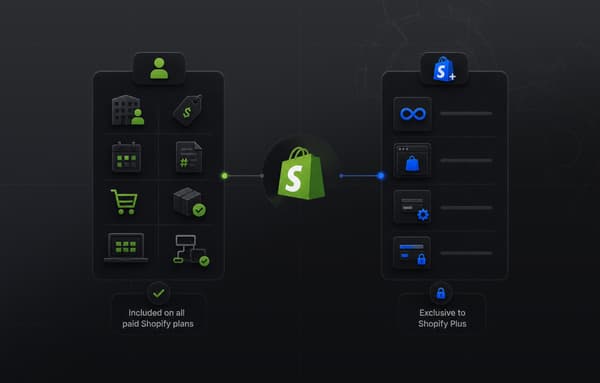
Shopify Plus is the commerce foundation that every other layer connects to. Before evaluating third-party tools, it is worth understanding what Shopify B2B handles natively, because significant capabilities exist before you add a single app. Shopify B2B is available on the Basic, Grow, Advanced, and Shopify Plus plans, and most B2B features are available on all of them. The Plus-only items are unlimited B2B market catalogs, direct company catalogs (catalogs assigned directly to specific companies and company locations), deposit requirements, partial payments, and payment requests per fulfillment. On the Basic, Grow, and Advanced plans, you can assign up to 3 active catalogs across all your B2B markets.
What Shopify B2B Provides Natively
Company accounts and multi-user management. Shopify B2B supports companies with multiple buyer contacts, each with a location-level permission: Ordering only places orders and sees that buyer's own order history, and Location admin also sees every order placed for the location. This is the account management layer that wholesale buyers expect.
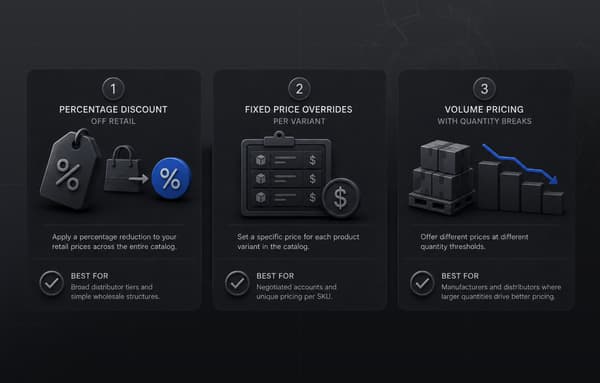
Catalog pricing. Catalogs in Shopify B2B set B2B prices with an overall percentage increase or decrease, fixed prices for specific products, and volume pricing. On Shopify Plus, catalogs can also be assigned directly to a company or company location for customer-level pricing. No app required for standard wholesale pricing logic.
Net payment terms. Shopify B2B supports net payment terms on every B2B plan: net 7, net 15, net 30, net 45, net 60, and net 90, or payment due on fulfillment.
Gated catalogs. Product visibility is set by catalog: you can include or exclude specific products, by B2B market on every B2B plan and by company or company location on Shopify Plus. Distributors see only their approved product range; trade accounts see pricing without retail comparisons.
Purchase order capture. Buyers enter their PO numbers at checkout. PO numbers flow through to order records, ERP sync, and all order notifications.
Shopify Flow. A workflow automation tool built into Shopify, with B2B objects available on the Basic, Grow, Advanced, and Plus plans, that handles rule-based automation: customer tagging, inventory alerts, fraud prevention workflows, order routing, and campaign-triggered pricing rules. Properly implemented, Shopify Flow replaces manual processes across your operations team without requiring developer work.
Shopify Functions. WebAssembly-based framework for customizing checkout logic: custom discount rules, shipping logic, payment method filtering, and order validation. This replaced Shopify Scripts (deprecated on June 30, 2026) and is the correct architecture for all checkout customization going forward. Stores on any plan can use public apps from the Shopify App Store that contain functions; only stores on a Shopify Plus plan can use custom apps that contain Shopify Function APIs.
Shopify Markets. Multi-currency, multi-language, and multi-region commerce management from a single Shopify Plus backend. Relevant for B2B operations with international buyers or distribution partners in multiple markets. For B2B, contextual checkout and storefront customization through Shopify Markets are available on the Advanced and Plus plans.
Start with what Shopify B2B gives you before adding tools. Many B2B operations layer apps on top of capabilities that already exist natively on the platform, paying for complexity they do not need.
One layer worth extra attention is fulfillment, since shipping is an underrated growth driver in B2B commerce.
Layer 2: ERP (Enterprise Resource Planning)
The ERP is the system of record for inventory, financials, order fulfillment, and customer accounts. For most B2B manufacturers and distributors, the ERP is not optional. The question is how it connects to Shopify Plus.
A properly built ERP-Shopify integration runs bidirectionally in real time: orders placed in Shopify appear immediately in the ERP's fulfillment queue; inventory levels, pricing, and customer account data sync from the ERP to Shopify continuously.
ERP Platforms Commonly Integrated with Shopify Plus
NetSuite (Oracle NetSuite). The most common ERP for mid-market B2B operations on Shopify Plus. Oracle provides its own native Shopify connector; custom API integrations are available for operations with non-standard data models or complex pricing logic.
Microsoft Dynamics 365 Business Central / Finance. Widely used across manufacturing and distribution. API-based integration with Shopify Plus handles order sync, inventory, and customer account management.
SAP S/4HANA / SAP Business One. Enterprise-grade for larger operations. Integration complexity is higher and typically requires a custom middleware layer or a purpose-built SAP-Shopify connector.
Epicor Kinetic. Common in manufacturing. Integration covers order management, inventory, and pricing with good support for complex product catalog structures.
Sage Intacct / Sage 300. Mid-market option with strong financial management capabilities and Shopify Plus integration via API connectors.
QuickBooks Online. Appropriate for earlier-stage B2B operations. Integration with Shopify Plus handles order sync, accounting, and basic inventory. Note: QuickBooks Desktop 2023 support ended May 2026. QBO is the current recommended path.
Uncap builds ERP integrations to Shopify Plus as part of every B2B commerce implementation. The Uncap Connect service handles NetSuite, Dynamics, SAP, and Epicor with real-time, bidirectional sync architecture.
Layer 3: CRM (Customer Relationship Management)
B2B commerce runs on relationships. Your CRM is where sales reps manage accounts, track opportunities, log interactions, and coordinate with operations. Integrating your CRM with Shopify Plus gives your sales team visibility into buyer portal activity, order history, and account status without leaving their primary tool.
Salesforce Sales Cloud. The most common enterprise CRM in B2B commerce. Integration with Shopify Plus syncs company accounts, order history, and buyer activity. Sales reps see what accounts have ordered and when.
HubSpot CRM. Widely used at mid-market scale. Native integration with Shopify available; provides order history in the CRM and supports sales pipeline management alongside buyer portal data.
Microsoft Dynamics 365 Sales. Strong fit for operations already running on Microsoft Dynamics for ERP; native integration keeps CRM and ERP in the same vendor ecosystem.
Pipedrive. Simpler CRM for smaller B2B sales teams. Shopify integrations available via middleware platforms.
For B2B operations where wholesale sales are rep-led, the CRM-Shopify integration closes the gap between digital orders and relationship management. Sales reps should never have to ask their operations team what a buyer's last order was.
Layer 4: PIM (Product Information Management)
A PIM system manages the single source of truth for product data: attributes, descriptions, images, technical specifications, certifications, and digital assets. For B2B manufacturers with complex product catalogs (hundreds or thousands of SKUs with variant structures, compliance documentation, and channel-specific content), a PIM is essential for maintaining data quality across Shopify Plus and other sales channels.
When you compare PIM platforms, check how each handles complex attribute structures, multi-channel publishing, channel-specific content, digital assets, and product relationships, and whether the vendor publishes its own Shopify connector. Our guide to choosing a PIM for Shopify covers what to compare.
Not every B2B operation needs a standalone PIM. Shopify Plus's native product management handles most catalog structures at mid-market scale. Evaluate a dedicated PIM when you are managing 5,000 or more active SKUs with complex variant structures, channel-specific content requirements, or compliance documentation workflows.
Layer 5: Search and Discovery
B2B buyers search differently from B2C buyers. They search by SKU, by part number, by specification, by compatibility, and by supplier reference. A B2B buyer managing 50 accounts does not browse; they search for exactly what they need to order.
What to look for. Faceted navigation, typo-tolerant search, synonym handling, part number and specification search, and custom merchandising rules let buyers find the right SKU in a catalog of thousands.
For B2B operations with large catalogs, complex product relationships, or buyers who search by technical specifications, a dedicated search app is worth evaluating. The search experience is often the biggest driver of buyer self-service adoption in wholesale portals.
Layer 6: Marketing Automation and Customer Communication
B2B marketing automation drives buyer engagement, repeat ordering, and account development. The tools in this layer handle email, SMS, and customer journey automation.
Marketing automation. Look for native Shopify integration and customer segmentation based on order behavior, purchase frequency, and account status, across email and SMS. B2B-relevant automations include reorder reminders, account activation sequences, and price list update notifications.
Customer service. Look for live chat, email, social media, and SMS support in a single inbox, with order lookup and customer account visibility inside the support interface and automated responses to common B2B queries (order status, invoice requests, delivery confirmation).
Layer 7: Analytics and Conversion Optimization
Note: Google Optimize was discontinued by Google in September 2023. It should not be part of any recommended tech stack. The current tools for analytics and testing on Shopify Plus are:
Google Analytics 4 (GA4). The current Google Analytics platform, required since Universal Analytics was sunset in July 2023. GA4 provides event-based tracking, conversion funnel analysis, and audience segmentation. The native Shopify-GA4 connection handles standard ecommerce tracking.
Session recording and heatmaps. Session recording, heatmaps, and user behavior analysis provide qualitative insight into how buyers navigate the portal and where friction occurs in the buying journey.
Shopify Analytics. Shopify Plus's native analytics dashboard provides order metrics, customer segmentation, product performance, and conversion reporting directly in the admin. For most B2B operations, Shopify Analytics combined with GA4 covers the reporting needs without additional tools.
Server-side tracking. Server-side tracking for Shopify can improve GA4 data accuracy by capturing events that browser-based tracking misses. Relevant for operations where marketing attribution accuracy is business-critical.
A/B testing. For structured experimentation programs, use a dedicated testing tool that integrates with Shopify Plus.
Layer 8: Shipping, Fulfillment, and Logistics
Shipping management. Look for connections to the carriers you use and automated carrier selection, label generation, and tracking updates based on order and customer rules.
Checkout shipping rates. Look for dimensional packaging, LTL freight rates, zone-based shipping rules, and carrier negotiated rates. These matter most for B2B operations where shipping complexity (heavy freight, hazmat, regulatory restrictions) makes simple rate tables inaccurate.
Outsourced fulfillment. A 3PL fulfillment network with a Shopify integration is relevant for B2B operations outsourcing fulfillment rather than managing warehouse operations directly.
Shipping APIs. API-based carrier integration suits operations building custom fulfillment workflows with bespoke logistics requirements.
Layer 9: Tax and Compliance
Automated tax compliance. Look for nexus determination, tax rate calculation, multi-jurisdiction filing, and exemption certificate management. For B2B operations, exemption certificate management is particularly important: wholesale buyers often have tax-exempt status that must be validated and applied correctly at checkout.
Shopify Plus includes basic sales tax calculation natively. For multi-state or international B2B operations, automated tax compliance tools eliminate manual filing risk and ensure exemption certificates are handled correctly.
Layer 10: B2B-Specific Commerce Tools
This layer covers the tools for the B2B-specific workflows that sit on top of the commerce platform: quote management, configure-price-quote (CPQ) workflows, buyer portals, and rep-assisted selling.
CPQ and Quote Management
Configure-price-quote tools manage the pre-order workflow for B2B operations where buyers request quotes before committing to purchases, where pricing requires custom negotiation, or where complex product configurations must be validated before order submission.
Uncap Quotes. The full configure, price, quote workflow inside the Shopify admin. Negotiated prices, tiers, and volume breaks apply automatically, approvals route to the right approver, quotes carry validity windows and a full revision history, and an approved quote becomes a Shopify cart and order in a single click.
Request-a-quote apps. Shopify App Store apps that add a Request a Quote button and a quote form to the storefront, then let your team reply with a priced quote the buyer can accept and check out. They fit operations where buyers mostly ask for a price and one reply settles it.
Buyer Self-Service Portals
Uncap Portal. A self-serve account home for trade buyers, built on Shopify B2B: company accounts with roles and permissions, account catalogs where each buyer sees their assortment and pricing, reorder lists and order history, and NET terms, invoices, and payments in the portal. Catalogs and pricing are account-specific, driven by Shopify B2B and your ERP.
Rep-Assisted Selling Tools
Shopify draft orders. Shopify's native tool for orders a rep builds on a buyer's behalf. If a draft order has a B2B customer and a company location assigned to it, the prices, payment terms, and checkout options automatically reflect the settings for that company, and the rep can then send an invoice or accept payment for the order.
This layer is where the most meaningful efficiency gains exist for B2B manufacturers and distributors. The standard Shopify Plus tech stack handles the storefront and back-office integration. The B2B-specific layer handles the quote and order workflows that sit between them.
A Practical B2B Tech Stack by Growth Stage
Not every layer is required from day one. Here is how the stack typically builds by operational maturity. Teams replatforming from BigCommerce often find the ceiling was the integration layer, so they prioritize the ERP connection first.
Launching a B2B Portal on Shopify Plus
Essential from day one: Shopify B2B on the Basic, Grow, Advanced, or Plus plan (native features: company accounts, catalogs, net terms), ERP integration (real-time order and inventory sync), marketing automation (buyer communication), a customer service inbox (customer support), shipping management and checkout rates (fulfillment), automated tax compliance, GA4 (analytics).
Add once the portal is stable: dedicated search (if catalog exceeds 1,000 SKUs), an accounting integration, CRM integration (if rep-assisted selling is significant).
Scaling a Mature B2B Operation
Add at scale: PIM (at 5,000+ SKUs or multi-channel content requirements), CPQ tools (when quote volume exceeds what reps manage manually), buyer self-service portal (when inbound support volume is high), advanced analytics (server-side tracking for attribution accuracy).
Enterprise B2B Commerce
Enterprise additions: Full CRM integration (Salesforce or Dynamics), EDI capabilities for large retail or distribution accounts, headless storefront (Hydrogen) if performance is a competitive differentiator, agentic commerce tools (AI agents for upsell, reorder, and account management at scale).
The Uncap B2B Commerce Stack
Uncap builds and maintains B2B commerce operations on Shopify Plus for manufacturers, distributors, and wholesalers. Our ERP integration service connects Shopify Plus to NetSuite, SAP, Dynamics, and Epicor with real-time bidirectional sync. Our Shopify apps cover the quote and account layer: Uncap Quotes for configure, price, quote through to the Shopify order, and Uncap Portal for self-serve buyer accounts.
We have been building wholesale and distribution commerce on Shopify since 2013, and we are a Platinum Shopify Partner. The guidance in this guide reflects what we have seen work across 380+ Shopify storefronts, not theoretical feature comparisons.
Talk to Our Experts about the right stack architecture for your specific operation.
Continue Reading
- Shopify B2B Wholesale for Suppliers: The Complete 2026 Guide
- Shopify B2B Wholesale Setup: Catalogs, Pricing, Permissions, and Net Terms
- B2B Ecommerce Replatforming: A Step-by-Step Guide to Moving to Shopify Plus
Frequently asked questions
What is a B2B ecommerce tech stack?
A B2B ecommerce tech stack is the set of software systems that collectively enable a wholesale or B2B operation to sell, manage, and fulfill orders online. It typically includes a commerce platform (such as Shopify Plus), an ERP for inventory and financials, a CRM for account management, marketing automation, search tools, shipping and fulfillment software, tax compliance tools, and B2B-specific applications for quote management and buyer portals. The specific tools in the stack depend on the operation's size, complexity, and growth stage.
What does Shopify include natively for B2B?
Shopify includes native B2B features on the Basic, Grow, Advanced, and Shopify Plus plans: companies with multiple buyer contacts and location-level permissions, catalogs with custom pricing and volume pricing, net payment terms, PO numbers at checkout, and Shopify Flow automations. Some features are available only on the Shopify Plus plan: unlimited B2B market catalogs (the other plans can assign up to 3 active catalogs across all B2B markets), catalogs assigned directly to specific companies and company locations, deposit requirements, partial payments, and payment requests per fulfillment. Stores on any plan can use public apps that contain Shopify Functions, while custom apps that contain Shopify Function APIs need Shopify Plus.
What ERP systems integrate with Shopify Plus?
Shopify Plus integrates with all major ERP platforms including NetSuite (Oracle), SAP S/4HANA and Business One, Microsoft Dynamics 365 Business Central and Finance, Epicor Kinetic, Sage Intacct, Sage 300, and QuickBooks Online. Integration can be built through official connectors, integration middleware platforms, or custom API development depending on the ERP's data model complexity.
What is the difference between B2B and B2C ecommerce tech stacks?
B2B ecommerce tech stacks require additional layers that B2C stacks do not: ERP integration for inventory and fulfillment routing, customer-specific pricing and payment terms, quote and CPQ tools for pre-order workflows, account hierarchy management for multi-contact companies, and compliance tools for tax exemption certificates. The storefront technology (Shopify Plus) is the same; the back-office and workflow layers are significantly more complex.
What tools should a B2B ecommerce operation use for marketing automation?
Look for a marketing automation platform with native Shopify integration, email and SMS automation, and customer segmentation based on order behavior and account status. For B2B specifically, relevant automations include reorder reminders, price list update notifications, new account activation sequences, and win-back campaigns for dormant wholesale accounts.
How important is a PIM for B2B ecommerce?
A PIM is essential for B2B operations with complex product catalogs: 5,000 or more active SKUs, products with many technical attributes or compliance documentation, or operations publishing product data across multiple sales channels. For operations under this threshold, Shopify Plus's native product management typically handles catalog complexity adequately without a dedicated PIM.