


The pandemic forced digital transformation. But in 2026, the focus has shifted from keeping the lights on to improving margins and quote-to-cash speed. B2B buyers now expect speed, transparency, and self-service capabilities that rival consumer experiences. At the same time, operations teams are under pressure to reduce costs, accelerate quote-to-cash cycles, and eliminate manual workflows.
The shift isn't just about technology. It's about who's buying and how they expect to work. Millennials now hold 73% of B2B purchasing influence, and they've brought expectations shaped by years of consumer digital experiences. They research independently, expect transparent pricing, and prefer platforms that reduce friction across the entire buying process.
For manufacturers, distributors, and wholesale brands, 2026 is less about chasing trends and more about implementing systems that improve margins, reduce operational overhead, and support Unified Commerce strategies.
The Changing Profile of B2B Buyers
Understanding the modern B2B buyer starts with recognizing a demographic shift that's been building for years. In 2012, Baby Boomers and Generation X dominated B2B purchasing decisions. By 2020, well over half of B2B buyers were millennials, and that share has only grown since.
This isn't a trivial change. Each generation approaches purchasing differently:
Baby Boomers relied on sales literature, datasheets, and product trials. Their buying process centered on personal relationships and face-to-face interactions.
Generation X valued trade shows, print advertising, and conferences. They were early adopters of digital tools but still preferred traditional validation methods.
Millennials conduct extensive online research before engaging with sales teams. They grew up with consumer ecommerce and expect similar digital experiences in B2B transactions. They also carry more student debt than previous generations, making them more cautious and demanding greater transparency before committing to purchases.
By 2026, this demographic now leads procurement decisions across mid-market and enterprise organizations. The implication for B2B businesses is clear: if your commerce infrastructure doesn't support self-service research, transparent pricing, and frictionless ordering, you're creating barriers that cost you revenue.
Unified Commerce: Running B2B and B2C Together
One of the most significant operational shifts in 2026 is the move toward Unified Commerce. Historically, B2B and B2C operations ran on separate systems with different workflows, pricing structures, and fulfillment processes. This created redundancy, increased costs, and made it difficult to serve hybrid customers who buy through both channels.
Unified Commerce consolidates these operations onto a single platform. For Shopify-based businesses, this means using Shopify's native B2B capabilities alongside B2C storefronts to manage everything from customer accounts and catalogs to pricing, orders, and fulfillment.
The benefits go beyond convenience:
Reduced operational complexity. Teams no longer maintain parallel systems or manually reconcile data across platforms.
Lower technology costs. Consolidating onto one platform eliminates duplicate licensing fees and integration maintenance.
Faster time to market. Changes to product catalogs, pricing, or promotions can be deployed across both B2B and B2C channels simultaneously.
Better data visibility. Unified Commerce provides a single source of truth for customer behavior, inventory levels, and revenue performance across all channels.
For operations leaders, Unified Commerce directly addresses two of the most persistent pain points: system complexity and the cost of maintaining legacy infrastructure. Brands that adopt this approach in 2026 are seeing measurable improvements in quote-to-cash speed and operational efficiency. Operators leaving a platform like OroCommerce often make Unified Commerce the reason to finally simplify the stack.
AI-Assisted Operations: Moving Beyond Hype to Practical Automation
Artificial intelligence in B2B ecommerce has moved past the experimental phase. In 2026, AI is being used to solve specific operational challenges: converting unstructured data into orders, recommending complementary products based on purchase history, and automating approval workflows that previously required manual intervention.
The most practical applications include:
Email to quote conversion. AI can read customer emails requesting products and automatically generate quotes, reducing manual data entry and response time.
Document processing. Purchase orders submitted as PDFs or images can be extracted and converted into orders without human intervention.
Intelligent product recommendations. AI analyzes past orders to suggest upsells, cross-sells, or replacement products that align with customer needs and improve average order value.
Margin and inventory insights. Real-time analysis helps sales and operations teams make decisions about pricing and fulfillment based on current stock levels and profitability.
These aren't futuristic concepts. They're being deployed today by mid-market B2B businesses looking to accelerate revenue workflows without adding headcount.
The bigger shift in 2026 is that AI has become accessible. Shopify-native tools and third-party apps provide AI capabilities without requiring custom development or data science teams. This means even smaller manufacturers and distributors can benefit from automation that was previously reserved for enterprise organizations.
Composable Architecture: Modular Systems Without a Full Rebuild
For years, "composable commerce" meant ripping out a monolithic platform and assembling a custom stack from a dozen best-of-breed vendors, a project few mid-market teams had the budget or the engineering headcount for. That's changed. The practical version of composability in 2026 is modular by default: a core commerce platform that already handles checkout, payments, and B2B logic natively, with the option to swap out or extend individual pieces, like search, PIM, or a headless front end, only where the business actually needs something different.
On Shopify, that shows up as Shopify Functions for customizing checkout logic, Shopify Headless and Hydrogen for teams that want a fully custom storefront experience while keeping commerce operations on Shopify's backend, and a Shopify App Store deep enough that most specialized functionality is an install away instead of a from-scratch integration project. The result is closer to what composability actually promised: flexibility where it matters, without the multi-year rebuild.
For most manufacturers and distributors, the honest answer is that full architectural composability is overkill. The businesses that benefit most are the ones with one specific, genuinely custom requirement, a unique quoting workflow, an unusual product configuration, a storefront experience that needs to diverge from a standard theme, not the ones trying to reinvent commerce infrastructure from the ground up.
Faster Quote-to-Cash Cycles Through Operational Workflow Automation
Quote-to-cash speed is one of the most critical metrics for B2B operations teams. Delays in quoting, approval, contract execution, or order processing directly impact revenue. Every day a deal sits in limbo is a day the business isn't generating cash flow.
In 2026, the focus is on eliminating manual touchpoints across the entire quote-to-cash cycle. This includes:
Automated quoting. Instead of sales reps manually building quotes in spreadsheets or standalone CPQ tools, quotes are generated directly within the commerce platform using live pricing, inventory data, and customer-specific terms.
Collaborative deal management. Buyers and sellers can negotiate terms, request changes, and approve quotes in a shared workspace rather than through email chains and phone calls.
Integrated contract lifecycle management. Once a quote is accepted, contract generation, signature collection, and order confirmation happen within the same system, reducing handoffs and administrative overhead.
Real-time approvals. Approval workflows route requests to the appropriate internal stakeholders automatically, and approvers can review and authorize from any device.
For operations directors and finance teams, faster quote-to-cash cycles mean improved cash flow, reduced days sales outstanding (DSO), and lower administrative costs. It also reduces the risk of deals falling through due to delays or communication breakdowns.
Self-Service Portals: Reducing Operational Workload While Improving Buyer Experience
Self-service has become a baseline expectation in B2B commerce. Buyers want to check pricing, place orders, track shipments, and access account information without needing to contact a sales rep or customer service team.
In 2026, effective self-service portals do more than display products and accept orders. They provide:
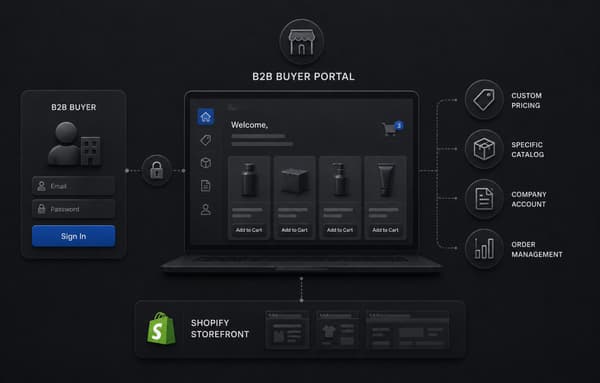
Customer-specific pricing and catalogs. Buyers see only the products they're authorized to purchase, at the negotiated prices that apply to their account.
Reorder functionality. Recurring purchases can be completed in seconds by reordering from past invoices.
Order tracking and history. Buyers can monitor shipment status and access order history for reconciliation or reordering.
Quote requests and approvals. Buyers can build and submit custom quotes, track their status, and approve internally before final submission.
From an operational perspective, self-service portals reduce inbound calls and emails, freeing up sales and customer service teams to focus on higher-value activities like relationship building and upselling. They also improve order accuracy by letting buyers input their own requirements rather than relying on a rep to interpret and enter information correctly.
For brands managing large customer bases or high-volume repeat orders, self-service portals are one of the most effective ways to scale operations without proportionally increasing headcount. For a closer look at what a well-built portal actually includes, see our breakdown of B2B buyer portals on Shopify.
ERP Integration: Reducing Dependency Without Losing Data Integrity
ERP systems remain central to B2B operations, managing inventory, fulfillment, accounting, and reporting. But in 2026, the relationship between ecommerce platforms and ERPs is changing.
Rather than treating the ERP as the master system that controls every aspect of commerce, forward-thinking operations teams are reducing ERP dependency by handling more workflows directly within the commerce platform. This includes:
Order management. Orders are captured, edited, and managed in the commerce system, with only final confirmed orders synced to the ERP for fulfillment and accounting.
Customer relationship management. Customer accounts, permissions, and communication are managed in the commerce platform rather than relying solely on the ERP's customer database.
Quoting and pricing logic. Complex pricing rules, customer-specific pricing, and quoting workflows are handled within the commerce system, reducing the need for real-time ERP lookups that slow down the buyer experience.
This approach doesn't eliminate the ERP. It reduces the number of real-time integrations required, which lowers integration costs and improves platform performance. It also gives ecommerce teams more control over the buyer experience without waiting for IT or ERP administrators to make changes.
For businesses running legacy ERP systems, this shift can significantly reduce the total cost of ownership while still maintaining the data integrity and reporting capabilities the ERP provides.
Mobile Commerce: No Longer Optional for B2B
Mobile commerce in B2B has crossed the threshold from emerging trend to operational necessity. Buyers use mobile devices throughout their purchasing journey, from initial research to placing orders while in the field.
The data is clear. More than half of B2B buyers use mobile devices to research products, and a significant portion completes purchases on mobile. Sales reps also rely on mobile access to check inventory, generate quotes, and process orders while meeting with customers.
Despite this, many B2B websites still treat mobile as secondary. Pages load slowly, product catalogs are difficult to navigate, and checkout processes are cumbersome on smaller screens. This creates friction that directly impacts conversion rates.
In 2026, B2B mobile commerce means:
Mobile-first design. Websites and portals are designed for mobile devices first, then adapted for desktop rather than the other way around.
Fast load times. How quickly pages load is critical. B2B buyers abandon slow sites just as quickly as consumer shoppers.
Simplified navigation. Product search, filtering, and catalog browsing have to work as well on a phone as they do on a desktop.
Mobile-friendly checkout. The entire ordering process, from cart to payment to confirmation, needs to work in as few taps as possible for mobile users.
For operations teams, mobile readiness also means equipping field sales reps with tools that work on phones and tablets, allowing them to serve customers without being tethered to a desktop.
Direct-to-Consumer Channels for B2B Brands
Historically, manufacturers sold through distributors and retailers, maintaining an arm's-length relationship with end customers. In 2026, more B2B brands are adding direct-to-consumer (DTC) channels to complement their existing distribution networks.
This shift is driven by several factors:
Retailer closures and market disruption. Physical retail channels that once carried B2B products have contracted, leaving manufacturers with fewer distribution options.
Access to customer data. DTC channels provide first-party data on buying behavior, preferences, and product performance that isn't available when selling exclusively through intermediaries.
Revenue diversification. DTC channels create new revenue streams and reduce dependency on a small number of large distribution partners.
Brand control. Manufacturers can control pricing, messaging, and customer experience in ways that aren't possible when selling through third parties.
From an operational standpoint, launching a DTC channel requires infrastructure for order fulfillment, customer service, and payment processing. But the payoff is a more resilient business model that captures margin previously lost to intermediaries and provides strategic insights into customer demand.
For manufacturers considering this shift, the key is to implement DTC in a way that complements rather than competes with existing distribution partners. This often means offering exclusive products through the DTC channel or serving customer segments that distributors don't reach.
Vertical Marketplaces: A Second Channel Without a Second Storefront
Alongside DTC, more B2B brands are testing distribution through niche, industry-specific marketplaces rather than general-purpose ones. A manufacturer that would never list on a mass consumer marketplace will often list on a marketplace built specifically for their trade, where the buyers browsing are already other businesses with purchase authority, not consumers comparison-shopping on price alone.
Shopify's own product lineup reflects this shift. Shopify Collective lets Shopify brands source and sell each other's products without a separate integration, and Faire operates as a dedicated wholesale marketplace where independent brands and retail buyers transact directly. Neither requires a business to stand up a second storefront or maintain a second inventory feed manually, since both connect back to the same product catalog a Shopify store already runs.
For a manufacturer or distributor testing a new customer segment or geography, a vertical marketplace is a lower-risk way to find out if the demand is real before investing in dedicated marketing or a standalone storefront for that segment.
What to Prioritize in 2026
Not every trend deserves equal attention. Operations leaders need to evaluate which changes will deliver measurable improvements in efficiency, cost reduction, and revenue acceleration.
The highest-impact priorities for 2026 are:
Unified Commerce infrastructure. Consolidating B2B and B2C operations onto a single platform reduces complexity and lowers costs.
AI-driven workflow automation. Automating manual processes like quote generation, order entry, and approvals directly improves quote-to-cash speed.
Self-service capabilities. Investing in buyer portals reduces operational workload and scales efficiently as customer volume grows.
Mobile-ready buying journeys. Making sure the entire buyer journey works as well on a phone as it does on a desktop is no longer optional.
Strategic ERP integration. Reducing ERP dependency while maintaining data integrity improves platform performance and lowers integration costs. When that ERP is SAP, a dependable integration is what turns these priorities into orders rather than slideware.
For businesses operating on legacy systems or managing growth with outdated processes, the operational ROI from these investments is significant. The goal isn't to chase trends. It's to implement infrastructure that reduces costs, accelerates revenue, and positions the business to scale efficiently.
The Operational Impact of Getting This Right
B2B ecommerce in 2026 is defined by operational efficiency. The brands seeing the greatest success aren't the ones with the flashiest websites or the most features. They're the ones that have cut days out of their quote-to-cash cycles, reduced manual workflows, and built infrastructure that supports Unified Commerce across B2B and B2C channels.
For manufacturers, distributors, and wholesale brands, the operational benefits are tangible: faster order processing, lower administrative costs, reduced dependency on expensive legacy systems, and improved margins through automation and self-service.
The demographic shift toward millennial buyers isn't reversing. The expectation for digital-first, transparent, and efficient buying experiences will only intensify. Operations teams that invest in the right infrastructure today will see measurable improvements in both top-line revenue and bottom-line efficiency.
Frequently asked questions
What are the biggest B2B ecommerce trends in 2026?
The trends with the most operational impact are AI-driven workflow automation, self-service buyer portals, Unified Commerce across B2B and B2C channels, and modular, composable architecture that lets a business extend one specific capability instead of rebuilding its whole stack. Mobile optimization and new channels like DTC and vertical marketplaces round out the list.
Do B2B businesses actually need composable or headless commerce?
Most don't need a full headless rebuild. Shopify's native B2B tools, checkout customization through Shopify Functions, and the Shopify App Store cover the majority of what mid-market manufacturers and distributors need. Headless, through Shopify Headless and Hydrogen, is worth it for the smaller group of businesses with a genuinely custom storefront requirement a standard theme can't support.
Is AI in B2B ecommerce actually practical, or is it still mostly hype?
It's practical now. The applications with real adoption in 2026, email-to-quote conversion, document processing for PDF purchase orders, and product recommendations based on order history, solve specific, narrow operational problems rather than promising to automate the entire business. Shopify-native and third-party AI apps mean mid-market businesses can use these without a data science team.
Should a B2B brand sell on a vertical marketplace in addition to its own storefront?
For businesses testing a new customer segment or geography, yes, it's a lower-risk way to validate demand before investing in a dedicated storefront. Shopify Collective and wholesale marketplaces like Faire both connect back to a store's existing product catalog, so it doesn't require a second inventory feed or a separate integration project to try.