

B2B fashion ecommerce has always been built around the wholesale buyer. Retail accounts that order by collection, by colorway, by full size run. Pre-season booking windows with minimum order quantities. Negotiated pricing that enforces the moment they log in. The complexity is real and the requirements are specific. But the same brands running wholesale programs also sell direct to consumers, and most of them run that channel on a completely separate system. A standalone DTC Shopify store with no connection to wholesale inventory, wholesale pricing, or the ERP that runs the actual business. Two catalogs to maintain. Two inventory counts. Two systems that have never spoken to each other. Uncap builds unified commerce on Shopify Plus for fashion brands and apparel companies. One platform that handles wholesale ordering for retail buyers and a branded DTC storefront for direct consumers, from the same catalog, the same inventory, and the same apparel wholesale software foundation.
Fashion and apparel runs two businesses. Most platforms handle one.
Fashion brands are not a single channel. A contemporary womenswear brand runs a wholesale program selling to 60 boutique and department store accounts on seasonal terms, and a DTC store generating a growing share of revenue from consumers who buy direct. An activewear manufacturer distributes wholesale to gym chains, sporting goods retailers, and corporate uniform buyers, and sells direct to consumers through its own branded store. An accessories brand has a wholesale program, a DTC site, and a private label program for large retail accounts.
The business reality is wholesale and DTC operating in parallel. The technology reality, for most apparel brands, is two separate systems managing them, or one system built for one channel while the other runs on spreadsheets, email orders, and manual workarounds.
Here is what that looks like in practice.
A contemporary brand runs 60 wholesale accounts on seasonal collection ordering. Their Spring collection drops. The wholesale portal has no lookbook-style presentation layer: just a product grid showing 140 SKUs sorted by style number. Retail buyers have been buying collections at trade shows where editorial story, styling photography, and collection groupings are the ordering interface. Twelve accounts place orders in the first week. Sales reps spend the following two weeks calling the other 48. Twenty-two respond before the pre-order cutoff. Fourteen miss it entirely. The production run is short on six styles because the pre-order signal was weak. Season's wholesale revenue comes in at 60% of forecast. Not because buyers did not want the collection, but because the digital channel did not present it in a way they could order from. Meanwhile, the brand's DTC store runs on a separate Shopify instance with its own product listings, its own inventory count, and no visibility into what wholesale accounts have already committed to buying.
A boutique retailer account has a $15,000 net-60 credit limit. They have $11,200 outstanding from the previous season. They log in and place a $7,400 Fall order, bringing their exposure to $18,600 against a $15,000 limit. The wholesale portal has no credit enforcement layer. The order processes. The AR team flags it during weekly review. By then the order has been picked. Partial cancellation is awkward, the relationship gets tense, and two staff hours are spent unwinding the situation. This happens three more times that season with three other accounts. The DTC store, running on a completely separate platform, has no visibility into any of it.
A key wholesale account orders a core denim style in all five colorways. Each colorway needs a full size run across eleven waist sizes and two inseam lengths. That is 110 individual variants across five colors. The wholesale portal has a standard Shopify variant selector, not a size run matrix. The buyer adds each variant individually, miscounts two sizes in the medium-blue colorway, and submits the order. Inside sales catches the error during review. A correction call goes out. The buyer is mildly annoyed. Multiply this across a 40-account wholesale base and there is a full-time inside sales position dedicated to cleaning up what the storefront could not handle. The DTC buyer on the other platform has no such friction. They just cannot see the same products, because the catalogs are managed separately.
These are not edge cases. They are the standard operating cost of running fashion and apparel on infrastructure that was not built to connect wholesale and DTC as one operation.
Why standard platforms cannot solve the fashion and apparel unified commerce problem
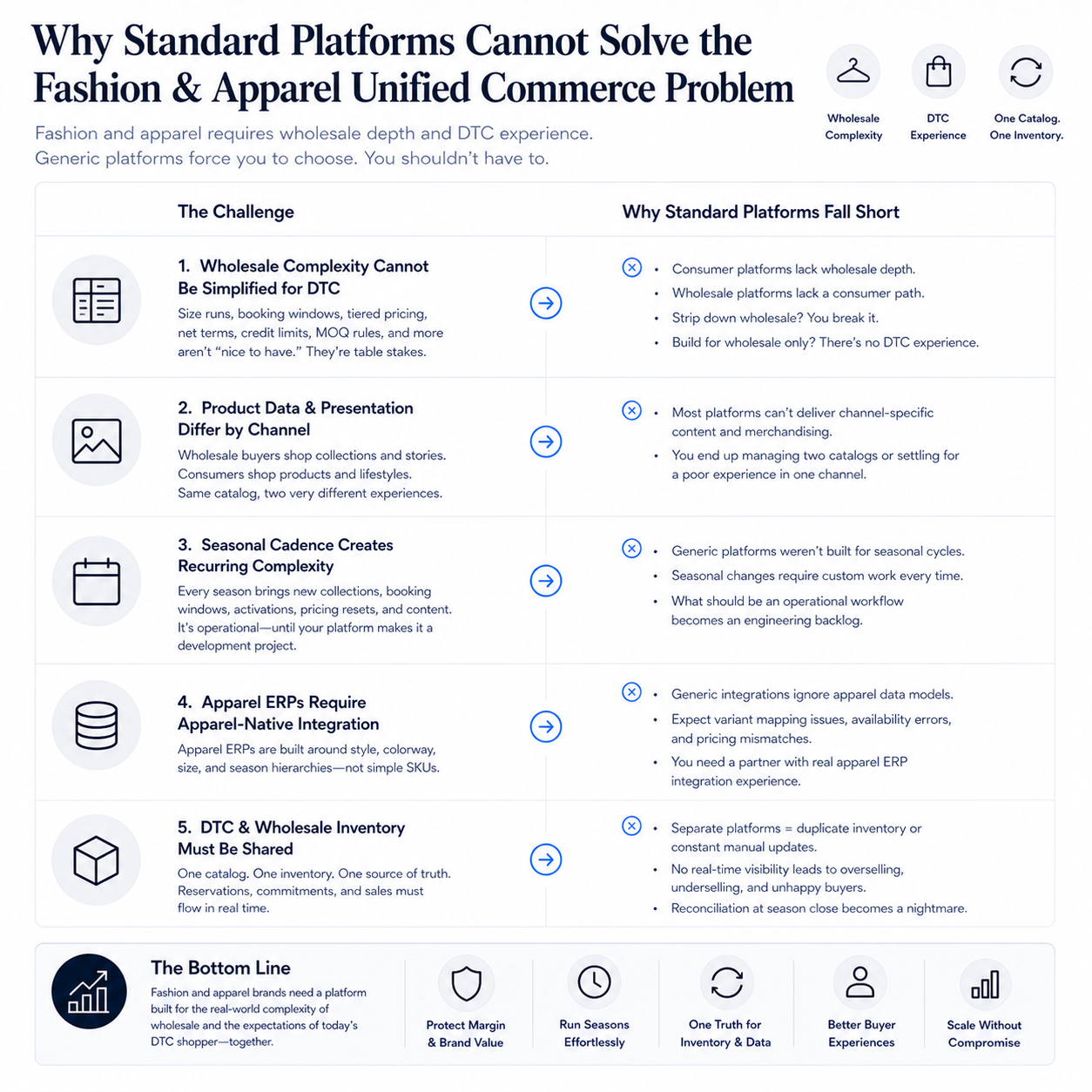
The gap in fashion and apparel runs deeper than most platform vendors acknowledge. Apparel brands face a combination of wholesale complexity and DTC requirements that generic B2B or consumer platforms handle individually but not together.
Wholesale complexity cannot be simplified for DTC without breaking it. Size run matrix ordering, pre-season booking windows, lookbook collection presentation, account-specific pricing tiers, net terms enforcement, credit limit logic, MOQ by style or order: these are not features that a consumer platform approximates. They are either built correctly or they are not there. A platform that strips them down to support consumer checkout loses the wholesale channel. A platform built only for wholesale complexity has no path to a branded consumer storefront. Running both requires architecture designed for both.
Product data and presentation differ sharply by channel. Wholesale buyers order by collection story. They want editorial photography, collection groupings, and a buying interface that mirrors how they experienced the brand at a trade show or in a showroom. Consumer buyers want a clean branded shopping experience with individual product pages, lifestyle imagery, and standard checkout. The same product catalog has to power both without requiring two separate content and catalog management efforts every season.
Seasonal cadence creates recurring complexity that generic platforms cannot absorb. Apparel operates on seasonal cycles. Every cycle means a new collection to set up, a new pre-season booking window to open and close, new style activations and deactivations, new pricing tier resets, and new lookbook content. On a platform not built for apparel, every season is a development project. On a properly configured apparel wholesale software stack, season setup is an operational workflow, not an engineering task.
Apparel ERPs require apparel-native integration. ApparelMagic, Cin7, and NetSuite for apparel all have data models built around the style, colorway, size, and season-code hierarchy. A generic Shopify middleware layer that syncs SKUs without understanding that hierarchy produces predictable errors: variant mapping failures, incorrect size availability displays, pricing tier mismatches at checkout. Getting integration right requires a partner who has built apparel ERP integrations before, not a generic connector that treats a colorway like a product attribute.
DTC and wholesale inventory must be shared, not duplicated. Running DTC and wholesale on separate platforms means two separate inventory pools or two separate catalog maintenance efforts. When a style sells out on the DTC side, the wholesale portal does not know. When a wholesale account commits 200 units of a style in a pre-season booking, the DTC store does not reflect that reservation. Overselling, underselling, and inventory reconciliation at season close are the predictable result.
What unified commerce on Shopify Plus actually looks like for fashion and apparel

Uncap builds unified commerce on Shopify Plus for fashion brands and apparel companies. One platform running wholesale and DTC in parallel, from a single Shopify store, connected to the same inventory and apparel wholesale software foundation. Both channels. One catalog. One ERP connection.
Wholesale buyers log in to an authenticated experience. Their account pricing tier, open net terms, credit balance, and order history are all present from the moment they authenticate. They shop seasonal collections through a lookbook-style presentation with editorial context and ordering integrated directly into the browse flow. They build pre-season commitments through Dealroom's booking workflow. They order by colorway and full size run through a matrix interface. Everything works the way they expect from a sophisticated wholesale buyer experience, without calling a sales rep for anything routine.
DTC buyers access a branded consumer storefront. Clean product presentation, consumer-appropriate editorial photography, standard checkout, and retail pricing. Real-time inventory that reflects what is actually available across both channels, including what wholesale accounts have already committed to in pre-season. The consumer experience reads like the brand, not a wholesale portal with a retail skin on top.
Both channels pull from the same product catalog, the same inventory, and the same ERP connection. When a wholesale account books 200 units of a style in the pre-season window, that inventory is reserved. When a DTC buyer adds that style to cart, they see accurate availability. No dual catalog management, no separate inventory counts, no reconciliation at season close.
Apparel and accessories
In wholesale apparel, the same SKU carries a different price depending on the account. When your ERP and Shopify disagree on which price applies, the error shows up on an invoice your customer disputes rather than in an order they place again. Uncap Connector is a Shopify-embedded app that keeps customer pricing, seasonal inventory, and order data synced between your ERP and Shopify without middleware. $299 a month, flat, no per-record fees.
Here is how the Uncap Revenue Engine works across both channels:
Dealroom manages pre-season booking for wholesale accounts. Accounts open their booking window, browse the seasonal collection in a lookbook presentation, build their buy by style and colorway, and submit it for review before the cutoff. The brand sees full pre-season commitment before production locks. Booking windows open and close by account tier on a defined schedule. DTC buyers do not use this workflow, but the inventory it reserves is reflected in what they see in the consumer store.
Portal gives wholesale accounts 24/7 self-service access to their account pricing, open orders, pre-season commitments, invoices, line sheets, and reorder tools outside showroom hours and trade show season. The same Shopify instance serves DTC buyers through a separate consumer-facing storefront on the same platform.
CPQ handles product configuration for both channels. Wholesale buyers configure full size runs across colorways through a matrix interface, with MOQ enforcement and running totals in real time. DTC buyers navigate the same catalog through a simplified consumer product presentation without the wholesale ordering layer.
CLM captures net terms agreements, retailer contracts, exclusivity arrangements, and territory clauses for wholesale accounts in digital records tied to specific account relationships. DTC buyers pay at checkout through standard methods. Both channels transact on the same platform with appropriate payment architecture for each buyer type.
AI Agents run across both channels as part of Uncap's agentic commerce layer. Agents analyze pre-season order velocity to flag understocked styles before production locks, surface reorder opportunities for top-performing wholesale accounts mid-season, identify DTC reorder behavior, and flag inventory risk when both channels are drawing from shared supply. Your team manages the decisions. The agents handle what used to require a spreadsheet and a sales call.
What Uncap builds for fashion and apparel brands
Capability 1: Unified wholesale and DTC on one Shopify platform
One Shopify Plus instance serves both your wholesale retail buyers and your direct consumers. Wholesale accounts authenticate to their account pricing, net terms, size run ordering, and pre-season booking tools. DTC buyers get a clean branded consumer storefront with standard checkout. Inventory, product catalog, and ERP data are shared across both channels. No dual catalog management, no separate inventory pools, no manual reconciliation at the end of the season.
Capability 2: Seasonal collection launch and lookbook ordering
Each seasonal collection launches as a branded digital experience: editorial layout, collection story, and styling photography with ordering integrated directly into the browse flow. Wholesale buyers shop by collection, by category, or by style. Pre-season booking windows open and close by account tier on a defined schedule, with minimum order quantity enforcement at the style or order level. The collection page reflects your brand, not a generic product grid.
Capability 3: Size run matrix ordering
Wholesale buyers order full size runs across multiple colorways from a single matrix view: sizes across columns, colorways down rows, quantity fields in every cell. Running totals, MOQ alerts, and per-style minimums enforce in real time. Orders submit clean without size or colorway correction calls from inside sales.
Capability 4: DTC storefront and consumer experience
Your consumer-facing storefront runs on the same Shopify Plus platform as your wholesale operation, with its own brand experience, consumer-appropriate product presentation, standard checkout, and retail pricing. Fashion brands and apparel companies building both a trade program and a direct consumer audience can present a polished DTC storefront without managing a separate platform or maintaining a second product catalog.
Capability 5: Net terms, credit limits, and account pricing
Account-specific pricing tiers enforce at login for wholesale buyers. Net terms (30, 60, 90, consignment) apply by account. Credit limits enforce at checkout: an account at their credit ceiling cannot place an order without approval. MAP pricing rules restrict public display where required. Retail buyers see standard pricing. Your AR team stops manually enforcing what the platform should handle.
Capability 6: ERP integration for both channels
Real-time integration with ApparelMagic, Cin7, and NetSuite handles the style, colorway, size, and season-code hierarchy correctly. Inventory by warehouse, cost tiers, customer price levels, and seasonal style activations sync live, not on overnight batch. Both wholesale orders and DTC orders create records in your ERP without manual entry. Your consumer storefront and your wholesale portal reflect what your ERP knows, in real time.
Why fashion and apparel brands choose Uncap for unified commerce

Shopify Platinum Partner, built for apparel's specific complexity. Uncap builds on Shopify Plus B2B infrastructure (company accounts, catalog gating, payment terms, checkout customization) alongside the DTC storefront and brand experience capabilities Shopify is known for. Most Shopify partners build one side well. Running wholesale and DTC from one implementation, with apparel-native product data, seasonal workflow support, and ERP integration that understands the style hierarchy, is not a common capability. It is what Uncap does.
Apparel-specific configuration built in, not approximated. Size run matrix ordering, lookbook collection presentation, pre-season Dealroom booking workflows, net terms and credit limit enforcement, ApparelMagic and Cin7 integration with correct variant mapping: none of this comes out of the box on any platform. Uncap builds it because fashion brands that depend on a clean wholesale ordering experience need it working correctly when a booking window opens, not discovered broken during the first pre-season capture.
One platform. One catalog. Both channels. Your ERP connects once. Your product catalog is maintained once. Your inventory is tracked once. Both your wholesale operation and your DTC storefront pull from the same data layer. The overhead of running two separate systems disappears, along with the seasonal reconciliation work and the inside sales time spent correcting what the portal should have gotten right.
Frequently Asked Questions
What is B2B fashion ecommerce?
B2B fashion ecommerce is the practice of selling apparel and fashion goods wholesale from brand to retailer through a digital ordering channel, replacing or supplementing trade shows, showrooms, and manual order intake with a branded wholesale portal. It encompasses seasonal collection presentation, lookbook-style ordering, size run matrix buying, account-specific pricing tiers, pre-season booking windows with minimum order quantities, net payment terms, credit limit enforcement, and integration with apparel wholesale software and ERP systems. Uncap builds B2B fashion ecommerce on Shopify Plus for brands and apparel distributors that need their own private wholesale portal, not a third-party marketplace.
What is the best apparel wholesale software for fashion brands?
Shopify Plus configured as an apparel wholesale portal is the most capable and cost-efficient apparel wholesale software for fashion brands that want to own their trade channel directly. Out of the box, Shopify Plus handles company accounts, tiered pricing, net payment terms, and catalog gating. The apparel-specific layer (size run matrix ordering, lookbook collection presentation, pre-season booking via Dealroom, ERP integration with ApparelMagic or Cin7 using the correct style hierarchy, and credit limit enforcement at checkout) requires a purpose-built implementation. Uncap builds and delivers that configuration as part of the unified commerce project.
How do fashion brands manage wholesale retailer ordering online?
Fashion brands manage wholesale retailer ordering online through branded account portals where retail buyers log in, see their account-specific pricing, browse the current collection, and place orders directly. Effective implementations include seasonal collection pages with lookbook-style editorial presentation, size run matrix ordering, pre-season booking windows with MOQ enforcement, and real-time inventory visibility. Brands managing more than 30 to 40 wholesale accounts benefit significantly from portal self-service: it reduces the inside sales burden of manually processing orders, correcting configuration errors, and chasing pre-season commitments. Uncap builds this wholesale portal architecture on Shopify Plus, integrated with the brand's ERP and connected to the same catalog and inventory that powers the DTC storefront.
Can a fashion brand run wholesale B2B and direct-to-consumer on the same Shopify store?
Yes. Shopify Plus supports unified commerce for fashion brands, with wholesale retail buyer accounts and DTC consumer storefronts running from the same platform, connected to the same inventory and ERP data. Wholesale buyers authenticate to their account pricing, size run ordering tools, and pre-season booking workflows. DTC consumers access a branded retail storefront with standard checkout. Both channels pull from the same product catalog and inventory, so there is no dual catalog management, no separate inventory count, and no reconciliation gap between the two at season close. Uncap builds this unified commerce architecture specifically for fashion brands running both a wholesale trade program and a direct consumer channel.
How does pre-season ordering work for wholesale fashion brands?
Pre-season ordering for wholesale fashion works through booking windows: a defined period during which retail accounts review the upcoming collection and commit to their buy before production locks. Effective digital pre-season ordering requires a collection presentation layer with lookbook-style editorial context, a size run ordering interface, MOQ enforcement per style or per order, and a booking window that opens and closes by account tier on a defined schedule. Uncap implements pre-season ordering through Dealroom: accounts browse and build their buy digitally within the booking window, the brand sees full pre-season commitment before production decisions are made, and the window closes automatically. No spreadsheet tracking, no email chasing, no missed cutoffs.
Does Shopify Plus support size runs and colorway ordering for fashion wholesale?
Shopify Plus supports the variant data model for apparel (style, colorway, size) but does not natively provide a size run matrix ordering interface. Out of the box, a Shopify store uses a standard variant selector that requires adding each size and colorway combination individually, which is the wrong interface for wholesale buyers ordering full size runs across multiple colorways in a single session. Uncap builds a size run matrix on top of Shopify Plus: a grid view where colorways and sizes intersect with quantity fields in each cell, running totals by style, and MOQ alerts before checkout. This is one of the most consequential product decisions on a wholesale fashion portal and one of the most absent features from generic apparel wholesale software builds.
What is unified commerce for fashion and apparel brands?
Unified commerce for fashion and apparel means running wholesale trade and direct-to-consumer sales from a single platform: one product catalog, one inventory system, one ERP connection, rather than separate systems for each channel. For fashion brands, this means wholesale retail accounts access seasonal collection ordering, size run matrix buying, and pre-season booking on the same Shopify Plus instance that serves consumers through a branded DTC storefront. Uncap builds unified commerce specifically for fashion brands and apparel companies that run both a wholesale trade program and a direct consumer channel, with the apparel-native configuration both sides require.
One platform for your wholesale and DTC operations. Built for how fashion and apparel actually works.
Running wholesale and direct-to-consumer on separate systems compounds every season. Two catalog updates for every collection launch. Two inventory counts that never match. Wholesale pre-season commitments that your DTC store cannot see. A unified commerce platform on Shopify Plus does not just reduce that overhead. It gives your retail buyers and your direct consumers an experience built for them, from the same platform, connected to the same apparel wholesale software and ERP data that runs your business.
Book a free strategy session with Uncap. We will review your current channel setup, map what unified commerce requires for your specific collection cadence, pricing model, ERP environment, and account structure, and walk you through what it looks like to run both channels from one Shopify Plus platform.
Not sure where to start? The Uncap Blueprint is a paid discovery engagement that maps your full channel architecture, ERP integration requirements, pricing configuration, and seasonal workflow before any build begins. You walk away with a complete architecture and build plan, whether you build with us or someone else. Ready to move forward? Uncap's structured Accelerators get fashion and apparel brands to a live unified commerce platform with fixed scope, fixed price, and a defined timeline agreed before the project starts. Already live and looking to grow revenue from both channels? Uncap's Growth services give you a senior Shopify team working your platform every month: conversion optimization, SEO, GEO, and ongoing wholesale and DTC improvements shaped by a roadmap built for your collection cycle and buyer mix.