

Automotive ecommerce has always had a split personality. Platforms built for B2B wholesale handle shop accounts, negotiated pricing, jobber tiers, and core charge management. Platforms built for DTC handle enthusiast audiences, year-make-model filtering, and consumer checkout. Most auto parts and aftermarket businesses need both, and end up running them separately. Uncap builds unified commerce on Shopify Plus for auto parts distributors and aftermarket manufacturers. One platform that handles wholesale ordering for shop accounts and dealers, a DTC storefront for enthusiasts and DIY buyers, and the fitment data, catalog complexity, and ERP integration this industry actually requires.
Auto Parts and Aftermarket Ecommerce for Wholesale and DTC on Shopify Plus
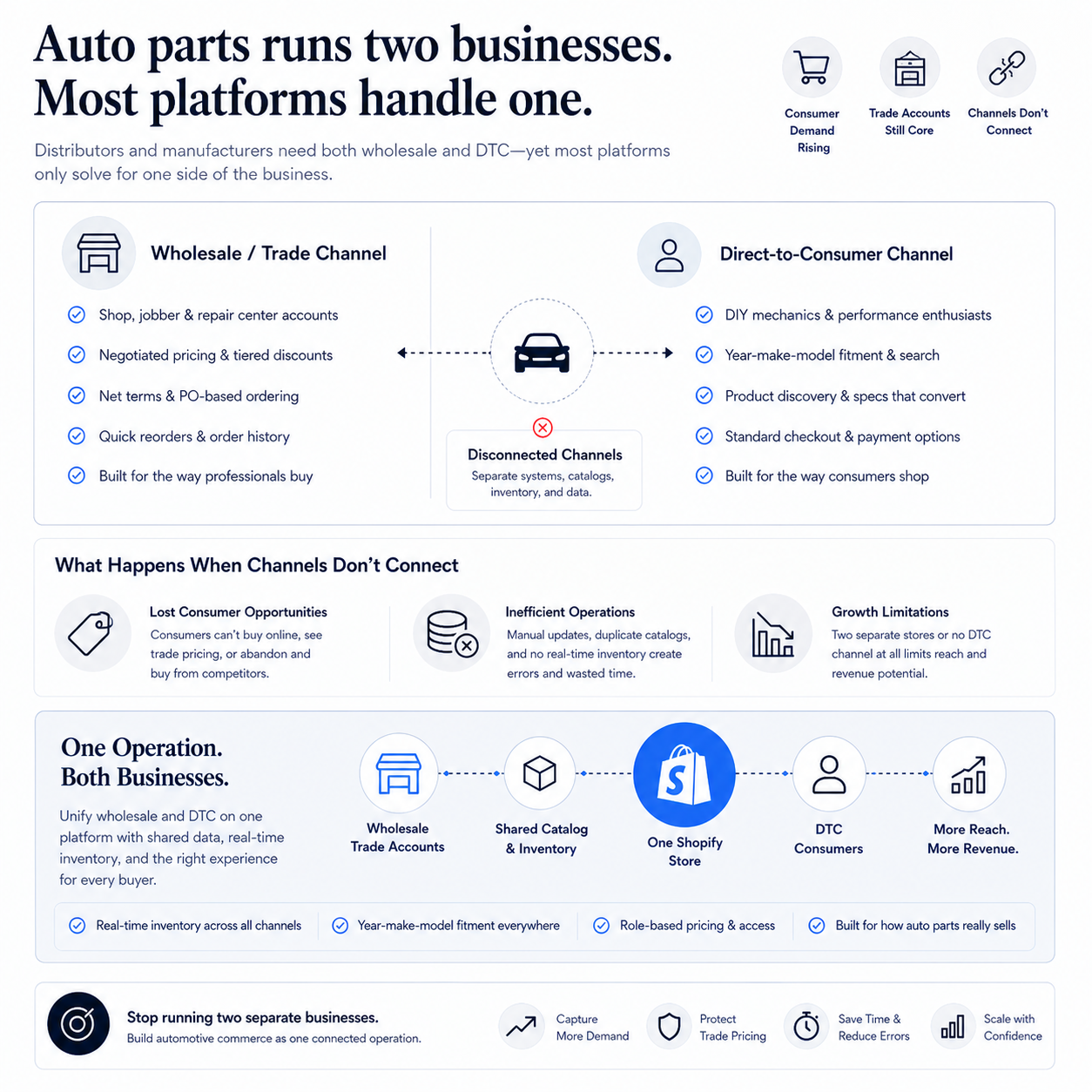
Automotive ecommerce has grown fast on the consumer side. Enthusiasts, DIY mechanics, and performance buyers have made direct-to-consumer auto parts one of the most active DTC categories in the industry. But the wholesale side of most auto parts distributors and aftermarket manufacturers still runs on phone calls, email orders, and shop account portals that were never designed to handle year-make-model fitment filtering, enthusiast product discovery, or standard consumer checkout.
The reverse is just as common. A regional distributor has a functioning B2B ordering portal for their shop accounts and jobbers. But the volume of consumers reaching them through search, social, and brand awareness is growing. Their trade portal shows professional pricing to everyone who finds it, or blocks online ordering entirely and pushes consumers to call. The DTC channel that could be capturing that demand does not exist, or runs on a completely separate platform with no connection to the same inventory.
Both channels exist. They just do not talk to each other.
A regional auto parts distributor serves 250 shop accounts and independent repair centers on negotiated tier pricing. DIY buyers and performance enthusiasts are increasingly finding them through search and want to order direct. The trade portal cannot handle retail checkout, does not have year-make-model filtering for consumer browsing, and shows professional pricing to every visitor. Consumer orders come in by phone or get lost entirely.
An aftermarket performance parts manufacturer sells wholesale to specialty shops, tuning houses, and distributors on volume pricing and net terms. The same brand has a growing direct audience of enthusiasts who follow them on social and want to buy parts direct. Two separate Shopify stores: one for trade, one for consumers. Two product catalogs to keep in sync. No shared inventory. A fitment update on the wholesale side does not automatically propagate to the DTC store.
An import specialist parts distributor serves independent repair shops with professional-only pricing on Japanese and European vehicle platforms. Their wholesale portal works well for shop reorders. But they also attract serious DIY mechanics and vintage car restorers who want access to hard-to-find OEM-spec parts that their local retailer does not stock. No consumer channel exists. That demand goes to competitors.
These are not edge cases. They are what happens when automotive ecommerce grows channel by channel instead of being built as one operation from the start.
The unified commerce gap in auto parts: Shop accounts need account pricing, credit terms, and part number search. DTC buyers need fitment filtering, application notes, and retail checkout. Every platform handles one well. Uncap builds the one that handles both, from the same catalog, the same inventory, the same ERP connection.
Why generic platforms cannot solve the auto parts unified commerce problem
The unified commerce gap in auto parts and aftermarket runs deeper than most platform vendors acknowledge. Auto parts distributors and aftermarket manufacturers face a combination of requirements that generic B2B or DTC platforms handle individually but not together.
Wholesale and retail pricing cannot coexist in most platforms. A shop account sees their negotiated tier pricing, jobber rates, and fleet discounts. A consumer sees retail pricing and standard checkout. Most platforms are built for one model. Running both means either two separate storefronts, which fragments inventory, fitment data, and catalog management, or a series of workarounds that break when order volume picks up or a new vehicle application is added.
Fitment data is the hardest problem in auto parts ecommerce. Year-make-model compatibility needs to work differently for trade and consumer buyers. A shop account ordering brake rotors knows the application. A consumer browsing the DTC store needs YMM filtering to find the right part. ACES/PIES fitment data has to power both experiences from the same underlying catalog. A platform that handles fitment for consumers but not trade, or trade but not consumers, forces two separate catalog management workflows.
Catalog and pricing complexity differs sharply by channel. Shop buyers and jobbers need core charge management, supersession handling when part numbers change, bulk pricing tiers, and fleet account credit terms. Consumer buyers need fitment filtering, application notes, installation guidance, and standard checkout. The same product catalog has to serve both without requiring two parallel maintenance efforts.
Core charges, MAP pricing, and brand restrictions apply selectively. Core charges on parts like alternators and starters have to be handled at checkout for both trade and consumer orders, but the mechanics differ by channel. Minimum Advertised Price policies from brands apply in the consumer channel and need to be enforced without affecting trade pricing visibility. A platform that cannot manage these by channel creates either compliance exposure or friction for the wrong buyer type.
Automotive ERPs were built for one channel. Epicor, NetSuite, and distribution-specific systems are designed for wholesale and trade: shop accounts, jobber networks, parts supersession, inventory across multiple warehouse locations. They were not built to power a DTC storefront with fitment filtering, consumer checkout, or performance product discovery. Connecting both channels to the same ERP without two separate integrations requires architecture most platform vendors have not worked out for automotive specifically.
And DTC demand in auto parts is structural, not cyclical. DIY mechanical work, performance modification, and enthusiast culture are growing. Auto parts and aftermarket businesses that cannot serve this channel digitally are sending that revenue to online marketplaces and direct-to-consumer brands that can.
What unified commerce on Shopify Plus actually looks like for auto parts and aftermarket
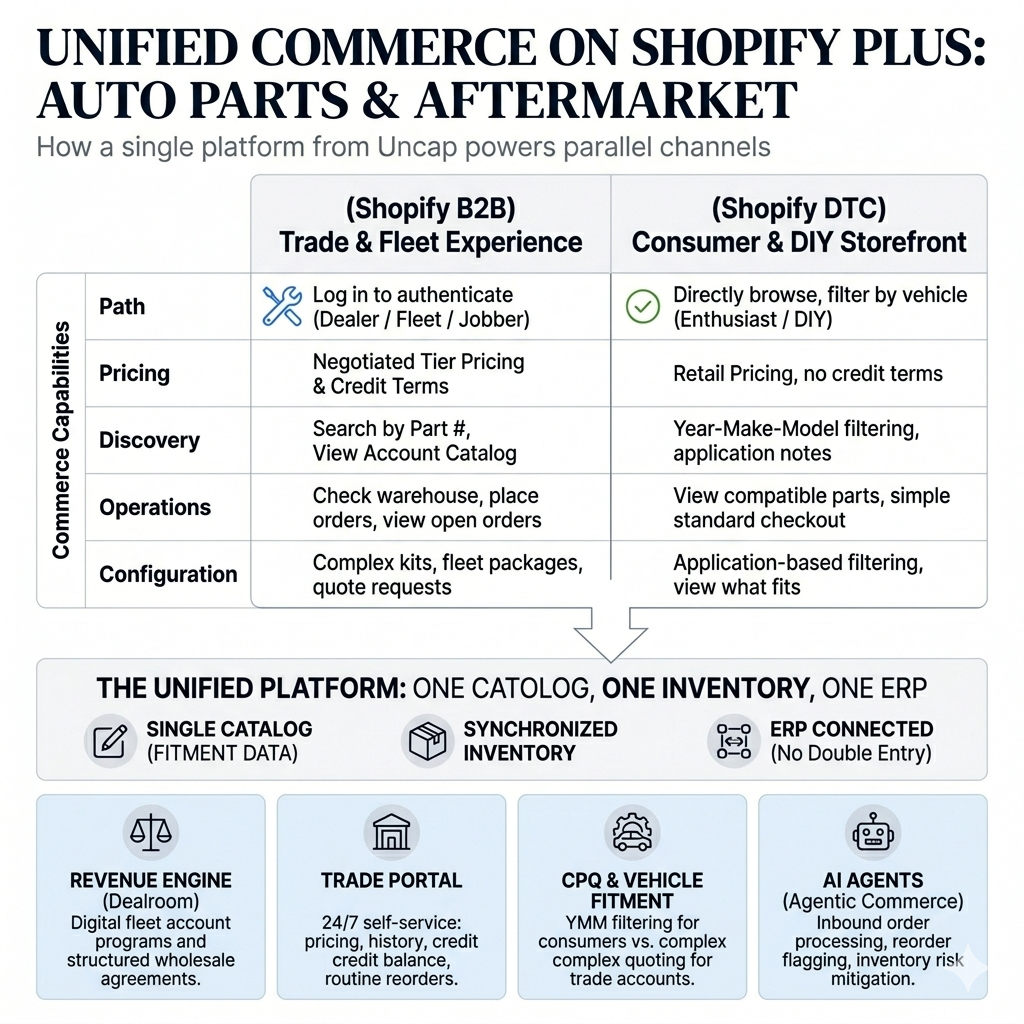
Uncap builds unified commerce on Shopify Plus for auto parts distributors and aftermarket manufacturers. One platform running wholesale and DTC in parallel, from a single Shopify store, connected to the same fitment data, inventory, and ERP. Both channels. One integration. One catalog to maintain.
Shop accounts, dealers, and jobbers log in to an authenticated experience. Their negotiated tier pricing, account credit terms, open orders, and reorder history are all there from the moment they authenticate. They can search by part number, look up applications by vehicle, check warehouse availability, and place orders against their account without calling a rep for routine reorders.
Consumer buyers get a DTC storefront built for the way enthusiasts and DIY buyers actually shop for parts. Year-make-model filtering surfaces the right parts for their vehicle. Product pages carry application notes, compatibility details, and fitment confirmations. Standard checkout with retail pricing, no trade account required. The consumer experience reads like a purpose-built automotive ecommerce destination, not a trade portal with a retail layer on top.
Both channels pull from the same product catalog, the same fitment database, the same inventory, and the same ERP connection. When a shop account orders the last ten units of a brake pad set for a specific application, the DTC store reflects updated availability. When a fitment update is made to the catalog, it propagates to both the trade and consumer experience from a single source. No double-entry, no parallel catalog updates, no reconciliation gap at month end.
Auto parts distribution is catalog-heavy, fitment-dependent, and margin-thin. When your ERP holds account pricing and your Shopify storefront shows something different, the gap costs you either the order or a manual correction after it closes. Uncap Connector is a Shopify-embedded app that syncs your ERP's pricing, inventory, and customer accounts to Shopify without a middleware layer. At $299 a month, the right price is in front of the right account every time.
Here is how the Uncap Commerce platform works across both channels:
Uncap DealRoom manages fleet account programs, distributor volume commitments, and structured wholesale negotiations as digital workflows. The email chain and phone calls that used to run a fleet account's annual parts agreement get replaced by a recorded, traceable process your sales team can see in real time. DTC buyers are not part of this workflow, but the inventory they draw from is reflected in it.
Uncap Portal gives trade buyers (shop owners, fleet managers, jobbers, dealers) 24/7 self-service access to their account pricing, parts availability, order history, credit balance, and reorder tools. The same Shopify instance serves DTC buyers through a separate consumer-facing storefront built on top of the same platform.
Uncap Quotes handles product configuration for both channels differently. Trade buyers configure kits, request quotes on fleet application packages, and manage core return credits within their account. Consumer buyers navigate the same catalog through year-make-model filtering and application-based product discovery that surfaces what fits their vehicle without exposing the trade configuration layer.
Smart Agents run across both channels as part of Uncap's agentic commerce layer. Agents read inbound trade orders, draft quotes against current account pricing and credit terms, flag reorder windows for shop accounts based on service intervals and order history, identify DTC reorder behavior from enthusiasts, and surface inventory risk when both channels are drawing from shared warehouse stock. Your team manages the decisions. The agents handle what used to be done by typing.
What Uncap builds for auto parts distributors and aftermarket manufacturers
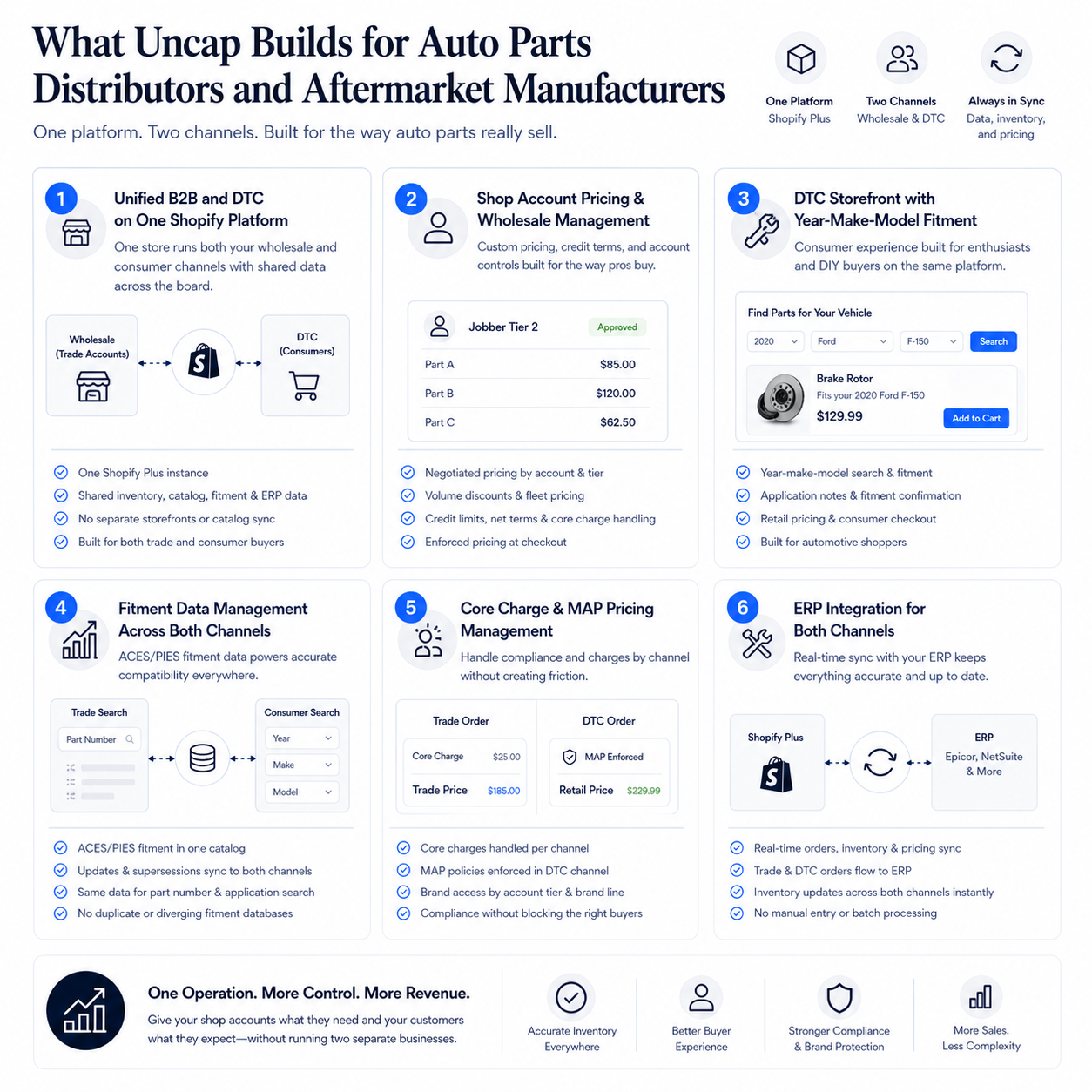
Capability 1: Unified B2B and DTC on one Shopify platform
One Shopify Plus instance serves both your trade accounts and your direct consumers. Shop accounts, dealers, and jobbers authenticate to their negotiated pricing, credit terms, and catalog access. DTC buyers get a consumer storefront with fitment filtering and retail pricing. Inventory, fitment data, product catalog, and ERP data are shared across both channels. No two-storefront workaround, no separate system for each channel, no catalog sync to manage between them.
Capability 2: Shop account pricing and wholesale management
Every trade account sees pricing built for them: negotiated shop rates, jobber tiers, fleet discounts, and volume thresholds. Pricing enforces at checkout. Not displayed as a suggestion, not verified after the order ships. Credit limits, net payment terms, and core charge handling are set at the account level and applied automatically. DTC consumers never see trade pricing.
Capability 3: DTC storefront with year-make-model fitment
Your consumer-facing storefront runs on the same Shopify Plus platform as your wholesale operation, with year-make-model filtering, application notes, fitment confirmations, retail pricing, and standard consumer checkout. Enthusiasts and DIY buyers find the right part for their vehicle without a trade account. The consumer experience is built for automotive buyers, not repurposed from a B2B portal.
Capability 4: Fitment data management across both channels
ACES/PIES fitment data powers both the trade and consumer experience from a single catalog. A fitment update or part number supersession propagates to both channels from one place. Trade buyers searching by application or part number see the same underlying data as consumers filtering by year, make, and model. No parallel fitment databases, no diverging compatibility records between channels.
Capability 5: Core charge and MAP pricing management
Core charges are handled at checkout for both trade and consumer orders with channel-appropriate mechanics. Minimum Advertised Price policies from brand partners are enforced in the consumer channel without affecting trade pricing visibility. Brand access restrictions that apply to specific account types are configured per account tier and per brand line. Compliance rules work by channel without creating friction for the wrong buyer.
Capability 6: ERP integration for both channels
Real-time connection with Epicor, NetSuite, and other automotive distribution systems keeps shop account data, warehouse inventory, pricing, and order records synchronized between your Shopify Plus platform and your back office. Trade and DTC orders both create records in your ERP without manual entry or nightly batch sync. Inventory committed through wholesale orders shows up as updated availability in the DTC channel in real time.
Why auto parts distributors and aftermarket manufacturers choose Uncap for unified commerce
Uncap has been a Shopify Platinum Partner since 2013, with over 380 B2B commerce projects delivered across manufacturing, distribution, and wholesale, including auto parts distributors, aftermarket manufacturers, and specialty parts importers.
Shopify Platinum Partner, built for this specific problem. Uncap builds on Shopify Plus B2B infrastructure (company accounts, catalog gating, payment terms, checkout customization) alongside the DTC storefront and consumer checkout capabilities Shopify is known for. Most Shopify partners build one or the other well. Running both channels from one implementation, connected to fitment data and ERP, is not a common capability. It is what Uncap does.
Automotive-specific configuration built in, not figured out later. Fitment data management across trade and consumer channels, core charge handling, MAP pricing enforcement, part number supersession, jobber tier pricing, and fleet account management: none of it comes out of the box on any platform. Uncap builds it because auto parts businesses that depend on it need it working correctly from day one, not patched after the first fitment mismatch or pricing violation.
One platform. One integration. Both channels. Your ERP connects once. Your product catalog and fitment data are maintained once. Your warehouse inventory is tracked once. Both your wholesale operation and your DTC storefront pull from the same data layer. The overhead of running two separate systems disappears, along with the catalog sync work that came with it.
Frequently Asked Questions
Can an auto parts distributor sell wholesale to shops and direct to consumers on the same platform?
Yes. Shopify Plus supports unified commerce for auto parts distributors and aftermarket manufacturers, with shop account wholesale ordering and DTC consumer storefronts running from the same platform, connected to the same fitment data, inventory, and ERP. Uncap builds this architecture for auto parts distributors, aftermarket manufacturers, and specialty parts importers: trade accounts authenticate to their pricing and account tools, DTC consumers access a branded storefront with year-make-model filtering, and both channels draw from the same product catalog and fitment database without duplication or manual reconciliation.
Is Shopify a B2B or B2C platform for auto parts and aftermarket?
Shopify Plus supports both B2B wholesale and B2C direct-to-consumer automotive ecommerce, making it a unified commerce platform for auto parts businesses that serve both buyer types. Out of the box, Shopify Plus includes B2B features (company accounts, negotiated price lists, net payment terms, and catalog gating) alongside its standard DTC storefront and checkout. For automotive-specific requirements like fitment data management, core charge handling, MAP pricing enforcement, jobber tier pricing, and ERP integration with Epicor or NetSuite, Uncap builds the additional configuration layer that generic Shopify Plus implementations do not include.
How does fitment data and year-make-model filtering work in a Shopify Plus auto parts store?
Fitment data in a Shopify Plus auto parts store is managed through a single product catalog that powers both the trade and consumer experience: trade buyers search by part number or application, while consumer buyers filter by year, make, and model to find compatible parts. Uncap builds the fitment layer on top of Shopify Plus using ACES/PIES data standards, so a fitment update or part number supersession propagates to both channels from one place. Both shop accounts and DTC buyers see accurate compatibility data from the same underlying fitment database without parallel maintenance.
What is unified commerce for auto parts and aftermarket?
Unified commerce for auto parts and aftermarket means running wholesale and direct-to-consumer sales channels from a single platform: one product catalog with fitment data, one inventory system, one ERP connection, rather than separate systems for each channel. For auto parts businesses, this means shop accounts and jobbers access account-specific pricing and ordering on the same Shopify Plus instance that serves enthusiasts and DIY buyers through a branded DTC storefront with year-make-model filtering. Uncap builds unified commerce specifically for auto parts distributors, aftermarket manufacturers, and specialty parts importers that serve both trade and consumer markets.
How do core charges work in a unified auto parts ecommerce platform?
Core charges in a unified Shopify Plus platform are managed at checkout for both trade and consumer orders with channel-appropriate mechanics built into the Uncap implementation. Trade accounts see core charges applied and tracked against their account with return credit managed through the B2B portal. Consumer buyers go through a standard core charge and return process at retail checkout. Both channels handle core charges correctly for their buyer type from the same platform without requiring two separate checkout configurations or manual core tracking.
Can Shopify Plus handle jobber pricing tiers and fleet accounts for auto parts wholesale?
Yes. Shopify Plus supports multiple customer-specific price lists, volume discount tiers, net payment terms, and gated catalog access natively, and Uncap builds the auto parts-specific configuration on top of that infrastructure. Jobber accounts, shop tiers, fleet accounts, and dealer programs each see their correct pricing at login without manual override. Credit limits, payment terms, and account-specific catalog restrictions are set at the account level and enforced at checkout. DTC consumers never see trade pricing.
What ecommerce platform is best for auto parts distributors running both wholesale and DTC?
Shopify Plus is the most capable platform for auto parts distributors and aftermarket manufacturers running wholesale and DTC together, particularly when configured by a development partner with automotive ecommerce experience. Out of the box, Shopify Plus handles B2B company accounts, price lists, and net payment terms alongside DTC storefront and checkout. The automotive-specific layer (fitment data management, core charge handling, MAP pricing enforcement, jobber tier pricing, fleet account management, and ERP integration with Epicor or NetSuite) requires a purpose-built implementation. Uncap scopes and delivers that configuration as part of the unified commerce build.
One platform for your wholesale and DTC operations. Built for how auto parts actually works.
Running shop account wholesale and a DTC consumer channel on separate systems gets more expensive every year. Two catalog updates. Two fitment databases to keep in sync. Two sets of orders with no visibility into each other. A unified commerce platform on Shopify Plus does not just reduce that overhead. It gives your shop accounts and your direct consumers an experience built for them, from the same platform, connected to the same fitment data and ERP.
Book a free strategy session with Uncap. We will review your current channel setup, map what unified commerce requires for your specific catalog, pricing tiers, fitment data, and ERP environment, and walk you through what it looks like to run both channels from one Shopify Plus platform.
Not sure where to start? The Uncap Blueprint is a paid discovery engagement that maps your full channel architecture, ERP integration requirements, fitment data configuration, and pricing model before any build begins. You walk away with a complete architecture and build plan, whether you build with us or someone else. Ready to move forward? Uncap Commerce solutions get auto parts distributors and aftermarket manufacturers to a live unified commerce platform with fixed scope, fixed price, and a defined timeline agreed before the project starts. Already live and looking to grow revenue from both channels? Uncap's Growth services give you a senior Shopify team working your platform every month: conversion optimization, SEO, GEO, and ongoing wholesale and DTC improvements shaped by a roadmap built for your specific catalog and buyer mix.