

B2B ecommerce for manufacturers is selling what you make online to the businesses that buy it: dealers, distributors, contractors, fleets and procurement teams. Some manufacturers add a direct channel to end customers alongside it. Either way, the buyer logs in, sees their own catalog, price and payment terms, and places an order that lands in your ERP.
For example, picture a kitchen equipment manufacturer with 180 dealers across North America. Each dealer has a rep, a custom price list and twenty years of calling in orders by phone. The manufacturer also wants to sell direct to commercial kitchens. Its website cannot show dealer pricing or take an order on net terms, and selling direct too aggressively could damage the dealer network that carries most of its revenue. That is the real shape of ecommerce for manufacturers. It is an operating decision first and a website second.
This guide works through that decision: which channels, what Shopify does natively in 2026, how to keep dealers on side, what connects to the ERP, and what it costs.
What is B2B ecommerce for manufacturers?
B2B ecommerce for manufacturers is the set of digital channels a manufacturer uses to take orders from other businesses, with each buyer's account, pricing and terms applied automatically. It covers three channels that often run side by side.
- EDI: computer-to-computer exchange of formatted documents such as purchase orders and invoices, usually with large trading partners. X12, chartered by the American National Standards Institute, develops and maintains EDI standards.
- A B2B portal: a logged-in ordering site for dealers and distributors, with company accounts, scoped catalogs and net terms. When the buyers are your dealer network, it is usually called a dealer portal.
- A public storefront: a direct-to-consumer (DTC) channel where end customers pay at checkout.
The difference between B2B and B2C in manufacturing is who the buyer is and how they pay. A B2C buyer usually pays the listed price by card. A B2B buyer is a company with locations, several people allowed to order, a negotiated price and an invoice due later. Manufacturer ecommerce has to handle both without letting one channel's rules leak into the other.
How much manufacturing already sells online
Most manufacturing shipments, by value, are already ordered electronically. In the 2022 Economic Census, US manufacturers reported $4,825.9 billion in e-commerce shipments out of $7,048.7 billion in total shipments, and the Census Bureau puts that share at 68.5% (Manufacturing: E-Commerce Statistics for the U.S.: 2022).
The definition matters more than the headline. The E-Stats methodology counts e-shipments as orders where price and terms of sale are negotiated over the Internet, an extranet, an EDI network, email or another online system. It also counts shipments to other domestic establishments of the same company for further manufacture, assembly or fabrication. Payment may or may not be made online.
So the 68.5% is not a count of web storefronts. It says that most manufacturing dollars already move through an electronic channel of some kind, and the table does not split them by EDI, email or website. The share also varies by industry. The same table reports 65.1% for machinery manufacturing, 56.2% for fabricated metal products and 80.3% for transportation equipment.
For an operator, the practical reading is simple. Your largest accounts may already order through EDI or a procurement system. The opportunity in B2B ecommerce is often the long tail: the dealers, smaller distributors and service buyers who still order by phone, email and spreadsheet, plus any direct channel you decide to open.
Three models: dealer portal, direct to consumer, or both
Before choosing a platform, decide which channel you are building. Each model carries different margin, channel risk and complexity.
- B2B dealer and distributor portal: buyers log in, see their own catalog and price, and order on terms. It digitizes relationships you already have, so channel risk is low. It suits manufacturers with a large dealer base and frequent reorders.
- Direct to consumer: a public storefront that sells to end users. It adds margin and gives you the customer data, but it can put you in competition with your own dealers. It suits consumer-facing products or new lines your dealers do not carry.
- Hybrid: both channels on one platform, sharing products, inventory and the ERP connection, with different prices, terms and experiences depending on who is logged in. It is the most demanding of the three to design well.
Hybrid is not theory. Kooks Headers and Exhaust, a 60-year performance automotive manufacturer, replatformed its retail and wholesale business onto a single Shopify B2B and D2C store built by Uncap, with secure portals and custom pricing for wholesale buyers. KBS Golf Shafts, a golf shaft manufacturer, migrated to Shopify Plus with D2C, B2B and POS on one platform.
We cover the one-store setup in detail in selling wholesale and retail on one Shopify store, and the portal choices in build, buy, or configure a dealer and distributor portal.
Does Shopify handle manufacturing? What B2B includes on every plan in 2026
Yes, for the selling side, with your ERP still running production, inventory and finance. Shopify's native B2B features cover company accounts, dealer pricing and terms, and since April 2026 they are not limited to Shopify Plus. The Shopify Help Center now says Shopify B2B is available on all plans.
On April 2, 2026, the Shopify changelog announced that Basic, Grow and Advanced merchants get up to 3 active B2B catalogs (assigned via Markets), company profiles, payment terms, volume pricing, ACH payments (U.S. only) and vaulted credit cards at no additional cost. Our post on Shopify B2B on all plans walks through the change.
What still differs by plan, per Shopify's B2B features page:
- Shopify Plus only: unlimited catalogs, assigned directly to specific company locations; customer-specific deposits; partial payments for B2B orders.
- Advanced and Plus: online store contextualization.
- Basic, Grow and Advanced: up to 3 active catalogs across all B2B markets, and some permission levels might be limited.
The honest downside for a manufacturer is usually the catalog count. If every dealer tier and contract account needs its own price list, three catalogs runs out quickly, and Plus becomes the plan that fits. Shopify's B2B terminology also shapes the build: a company is the parent organization, a company location is the business you sell to, and payment terms define how long a company has to pay.
Who buys from a manufacturer online, and what each buyer needs
A manufacturer's buyers are rarely one audience. Design the storefront around each group's job, not around a single "customer."
- Your own operations team: needs every order, price and stock level to agree with the ERP. Uncap Connect is the real-time data layer between Shopify, your ERP and the warehouse floor.
- Service technicians and parts buyers: know the machine, not the part number. Uncap Diagrams lets buyers click the part straight off an exploded diagram and add it to the cart.
- Automotive aftermarket buyers: need to know the part fits the vehicle. Uncap Garage handles Year-Make-Model fitment, so shoppers see only the parts that fit.
- Dealers and distributors: reorder stocked lines on contract pricing and net terms, often with several people per account. Uncap Portal gives trade accounts a self-serve home for catalogs, pricing, reorders, invoices and users.
- Engineers and procurement teams: buy configured or quantity-sensitive products and need a price before they commit. Uncap Quotes turns your catalog into account-specific quotes inside Shopify.
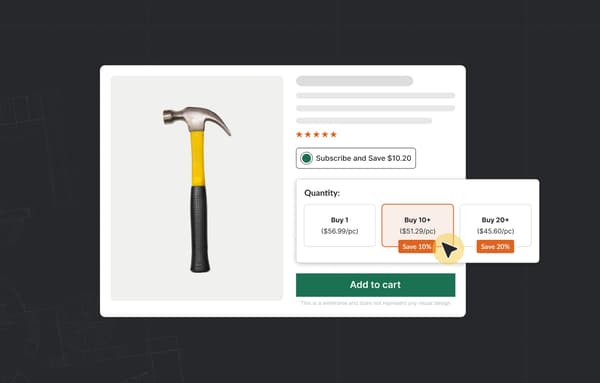
Shopify's native features carry the account, catalog and terms layer for all of them. Quantity rules set minimums, maximums and increments, and volume pricing allows up to 10 price breaks per product. Our industrial and machinery page shows both sides of one equipment business, procurement for supplies and part discovery for machines, running from one Shopify store.
Channel conflict: selling direct without losing your dealers
Channel conflict is the tension that appears when a manufacturer sells direct to the same customers its dealers serve. If a dealer sells your product at $180 and your new storefront lists it at $140, you have not just entered the market. You have undercut the people who built your distribution. Decide your policy before launch, not after the first angry call.
The approaches manufacturers use:
- Price parity: sell direct at the same suggested retail price your dealers use, so dealers compete on service and availability rather than price.
- Exclusive lines: keep some products, bundles or configurations direct only, so the direct channel grows on new ground.
- Geographic protection: sell direct only where you have no dealer coverage, or leave defined territories to dealers.
- Lead routing: pass direct inquiries from a dealer's territory or account back to that dealer, so the storefront generates demand for the network.
- Clear communication: tell dealers what you are launching and why before they hear it from a customer.
A minimum advertised price (MAP) policy is another option, and it needs care. As our MAP pricing entry explains, the FTC discusses MAP as a term of cooperative advertising programs: a reseller that advertises below the minimum advertised price cannot take part. The FTC's guidance on manufacturer-imposed requirements says: "The law allows a manufacturer considerable leeway in setting the terms for advertising that it helps to pay for." It adds that there are limited situations when these programs can have an unreasonable effect on price levels. Minimum resale prices are a separate question. The same guidance says federal standards evaluate manufacturer-imposed vertical price programs using a rule of reason approach, and that some state antitrust laws and international authorities view minimum price rules as illegal, per se. That is FTC guidance, not legal advice, so review any pricing policy with counsel.
On Shopify, the mechanics are separate catalogs: dealers see dealer prices behind login, the public sees retail, and the two numbers never meet.
Connecting the ERP: what syncs and which system owns it
ERP integration is what turns a storefront into an ordering channel. The first rule: decide which system is the system of record for each kind of data before anyone writes code.
- Prices and contract terms: usually the ERP. Shopify displays them.
- Inventory and availability: the ERP, sent per location. For made-to-order items, a promise date often beats a count.
- Orders: captured in Shopify, written to the ERP as sales orders.
- Fulfillment and invoices: created in the ERP, with status sent back to the buyer's account.
- Customer and credit data: the ERP owns credit; Shopify mirrors companies, locations and terms.
Four Uncap builds show the pattern. Shopify was integrated with Kooks' Infor Visual ERP, enabling real-time inventory synchronization. KBS has a direct integration with Oracle ERP. ULE Group has a real-time Epicor ERP integration that syncs inventory and pricing. Sanitaire is a maker of high-performance, energy-efficient commercial cleaning equipment such as carpet extractors and backpack vacuums, sold through a B2B distributor model. Uncap migrated Sanitaire's legacy platform to Shopify Plus and integrated its ERP system.
The design decisions behind a sync, including field ownership, cadence per data class, failure behavior and reconciliation, are in our Shopify ERP sync design spec. ERP connections through Uncap Connect are covered on our integrations page.
Product data: catalogs, specs and the cleanup nobody budgets
Product data is the workstream most easily left out of a manufacturer's plan. An ERP item master was built to make and ship products, not to sell them. It can hold short codes, duplicate SKUs, discontinued items nobody removed and descriptions written for the warehouse.
Three tools help:
- A PIM: a product information management system holds the enriched content, specs and images, while the ERP keeps item numbers, cost and stock.
- GTINs: a Global Trade Item Number is the GS1 identification key for a trade item, a globally unique number for one specific product (GS1 US). If retailers or marketplaces resell your products, plan a GTIN for every sellable unit.
- ACES and PIES: in the automotive aftermarket, the Aftermarket Catalog Exchange Standard (ACES) carries fitment data and the Product Information Exchange Standard (PIES) carries product information. The Auto Care Association manages both.
Scale is where this pays off. ULE Group, a leader in industrial and construction equipment, moved its million-SKU catalog onto a Shopify B2B storefront built by Uncap. A Product Information Management system keeps the large catalog clean and discoverable, and on-site search offers more than 100 filters. Shopify's own article on PIM reports that since migrating to Shopify, ULE Group has achieved 225% growth in site traffic and a 250% increase in sales.
Budget data cleanup as its own workstream, with an owner, before the storefront build starts.
Configured, quoted and engineered-to-order products
Not every manufacturer product can go straight into a cart. Engineered, configured and high-value items need a price conversation first, and the storefront has to support it.
Two terms come up:
- RFQ: a request for quote is a buyer asking for a price on specific products before committing.
- CPQ: configure, price, quote is the workflow for combining components into a valid product and pricing it.
Shopify's native tool for a negotiated price is the draft order. According to Shopify's B2B draft orders documentation, once you pick a company location, prices, payment terms and checkout options follow that company's settings, and you can quote a negotiated price that differs from catalog pricing. Locations can also be set so buyers see a Submit for approval button at checkout, with prices locked by default.
For a full quote workflow, Uncap Quotes runs the configure, price, quote process inside the Shopify admin, keeps the version history when a quote is revised, and turns an approved quote into a Shopify order in one click. ULE Group's store shows the buyer side: a cart-level convert-to-quote feature for high-value purchases, alongside account-based payment terms.
How the quote becomes an order, then an invoice, then cash is covered step by step in quote to cash for B2B on Shopify.
Aftermarket and replacement parts
Replacement parts suit ecommerce well. The buyer already owns your equipment, needs the part now and is happy to order it online if they can find it. The hard part is finding it.
Two patterns solve that:
- Shop by diagram: the buyer opens an exploded diagram, drills from assembly to sub-assembly to part, and adds the exact part to the cart without a part number. Uncap Diagrams works this way.
- Fitment search: the buyer picks a vehicle and sees only the parts that fit. Uncap Garage does this by Year-Make-Model.
Uncap's build for Kooks adds ACES year, make, model and engine fitment search, powered by a PDM Automotive PIM. Uncap built E3 Spark Plugs a blended B2C and B2B Shopify store with a Year-Make-Model tool and a cross-reference application that makes it easier to find replacement parts for competitor SKUs, and Shopify's native B2B features enable group pricing for dealers.
The same idea applies well beyond cars. Our industry pages show it for machinery and equipment, where buyers find the part from the machine, for performance parts, and for tractor and implement parts that must fit the serial, hitch and PTO.
Rep-assisted orders are a channel, not a failure
Some of your best accounts may keep ordering through their rep after the portal launches. That is not a training problem to fix. Those buyers value the relationship, and the system should be designed so their orders land in the same place as everyone else's.
On Shopify, the rep's tool is the draft order. Shopify's draft order documentation covers this case: a company that submits an order with you outside of your Shopify store. The rep picks the company and location in the Shopify admin, builds the order, and the account's prices, payment terms and checkout options apply automatically. A buyer on net 30 terms gets 30 days to pay the invoice instead of paying by card at checkout.
The result is one order history per account. For example, a dealer who self-served three times and ordered twice through the rep shows all five orders in one view, and all five reach the ERP the same way.
What it costs and how long it takes
What you pay depends on your catalog, account structure and how many systems have to stay in sync. On Uncap Commerce, every build is fixed scope and quoted after a scoping call, and the page publishes these figures: "Many projects start with Uncap Blueprint, a $7,500 fixed-price plan delivered in four weeks and credited toward implementation. ERP integration with Uncap Connect starts at $8,000 to set up and runs $390 a month. After launch, Uncap Growth plans start at $2,500 a month."
On timelines, the same page says: "A new build runs about 12 weeks from discovery to launch. A migration from another platform typically takes 10 to 16 weeks, and unifying B2B and B2C on a Shopify store you already run takes 4 to 8 weeks." Our migrations page adds: "Most operator-led replatforms cut over in around 14 weeks, our median."
What moves a manufacturer's number:
- Catalog depth: SKU count, specs, diagrams and fitment data to load.
- Account structure: dealer tiers, contract prices and company locations.
- Systems in sync: ERP, PIM, CRM and any EDI flows that must keep working.
Cost is not only the build. The Kooks case study reports a 22% conversion rate uplift through faster performance and improved product discovery, and a 38% reduction in total cost of ownership by consolidating the tech stack and automating operations.
Where to start: a launch sequence for manufacturers
Order matters. This sequence keeps the decisions ahead of the build.
- Map the account hierarchy: parent companies, ship-to locations, who can order and on what terms, mirrored from the ERP.
- Define price logic: retail, dealer tiers and contract prices, and confirm the ERP owns them.
- Set catalog visibility: which products each channel sees, and any minimum order quantity by channel.
- Map order flows: card checkout for direct buyers, terms and draft orders for dealers, and which warehouse ships each.
- Connect the ERP and clean the data: before launch, not after. A store running on stale stock turns orders into backorders.
- Train reps, operations and finance: on draft orders, new fulfillment triggers and how terms orders move.
Baseline a few numbers before go-live so you can see what changed: the share of orders placed digitally, orders still re-keyed by hand, quote-to-order time and integration exceptions per week.
If you want the architecture planned before you commit, Uncap Blueprint is a fixed-price, four-week plan. Uncap is a Shopify Platinum Partner with 380+ storefronts launched on Shopify, and our Shopify B2B for manufacturers page shows how we work with makers. If you sell through distributors, our ecommerce for distributors guide shows the other side of the channel. Talk to Our Experts and bring your ERP, your dealer price tiers and the one channel decision you have not made yet.
Frequently asked questions
What is B2B ecommerce for manufacturers?
B2B ecommerce for manufacturers is selling your products online to other businesses, such as dealers, distributors and procurement teams, with each account's catalog, price and payment terms applied automatically. It can run alongside EDI with large trading partners and alongside a direct-to-consumer storefront.
Is manufacturing B2B or B2C?
It can be both. Sales to dealers, distributors and other businesses are B2B, on negotiated prices and terms, and a direct channel to end users is B2C. On Shopify, both can run on one store with separate catalogs and checkout rules.
Does Shopify handle manufacturing?
Shopify handles the selling side of manufacturing, not production. Its native B2B features cover companies and locations, catalogs, volume pricing, quantity rules, payment terms and draft orders, and the ERP stays the system of record for production, inventory and finance.
Do manufacturers need Shopify Plus for B2B?
Not always, because Shopify B2B is available on all plans since April 2026. Basic, Grow and Advanced allow up to 3 active catalogs across B2B markets. Unlimited catalogs, direct catalog assignment to company locations, deposits and partial payments are Plus only, so a manufacturer that needs more than three active catalogs needs Plus.
What is the downside of using Shopify for a manufacturer?
The limits Shopify documents are plan based. Basic, Grow and Advanced allow up to 3 active B2B catalogs, and deposits and partial payments are Plus only. The rest of the effort is fit: your catalog data, price tiers, quote workflow and ERP connection have to be designed for Shopify.
How can a manufacturer sell direct without hurting dealers?
Decide a channel conflict policy before launch. The common options are price parity with suggested retail, direct-only product lines, geographic protection, routing leads back to dealers, and telling dealers your plan first. MAP policy is a further option; review it with counsel.
Which ERP systems can connect to Shopify?
The ERP stays the system of record, and Shopify connects to it through an integration. The Uncap builds in this guide connect Shopify to Infor Visual, Epicor and Oracle ERP, and Uncap's integrations page covers ERP connections through Uncap Connect.
How long does a manufacturer ecommerce launch take?
Uncap publishes about 12 weeks for a new build and 10 to 16 weeks for a migration from another platform. Its median replatform cuts over in around 14 weeks. Catalog depth, account structure and the number of systems in sync move the date.
How much does ecommerce for manufacturers cost?
It depends on scope, so Uncap quotes fixed scope after a scoping call. Its published figures are Uncap Blueprint at $7,500 over four weeks, credited toward implementation, Uncap Connect from $8,000 to set up plus $390 a month, and Uncap Growth from $2,500 a month.
Is Shopify still worth it for manufacturers in 2026?
Yes, for manufacturers that want B2B and direct channels on one platform. Since April 2026, native B2B is on every Shopify plan, and manufacturers such as Kooks and KBS Golf Shafts run wholesale and direct on one Shopify store with their ERP connected.