
Quick-Reference: Enterprise Ecommerce Platforms for B2B (2026)
Shopify Plus
B2B Company Accounts: Native
Customer Catalogs: Native
Net Terms: Native
ERP Integration: Uncap Connect / iPaaS
Starting Price: $2,300/mo
Best For: Manufacturers, distributors, wholesalers
Adobe Commerce
B2B Company Accounts: Native
Customer Catalogs: Native
Net Terms: Via extension
ERP Integration: Custom build
Starting Price: $40,000+/yr
Best For: Complex multi-site, heavy customization
BigCommerce B2B Edition
B2B Company Accounts: Native
Customer Catalogs: Native
Net Terms: Via B2B Edition
ERP Integration: Third-party
Starting Price: Custom
Best For: Mid-market B2B, multi-storefront
SAP Commerce Cloud
B2B Company Accounts: Native
Customer Catalogs: Native
Net Terms: Native
ERP Integration: SAP ecosystem
Starting Price: Custom ($100K+)
Best For: Large international enterprises in SAP stack
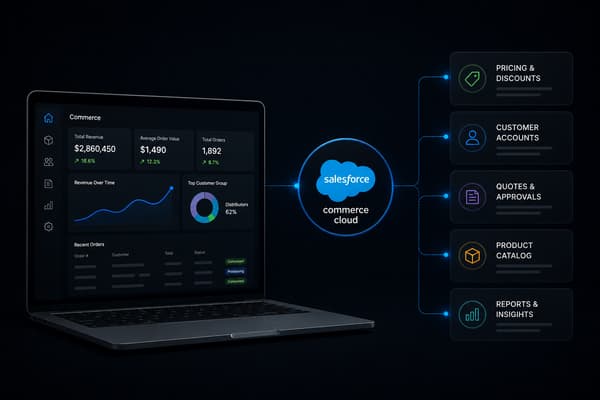
Salesforce Commerce Cloud B2B
B2B Company Accounts: Native
Customer Catalogs: Native
Net Terms: Native
ERP Integration: Salesforce ecosystem
Starting Price: Custom (GMV %)
Best For: Brands already on Salesforce CRM
commercetools
B2B Company Accounts: Via API
Customer Catalogs: Via API
Net Terms: Via API
ERP Integration: Custom build
Starting Price: Custom
Best For: Composable/headless-first enterprises
What "Enterprise" Actually Means for B2B Commerce
Generic ecommerce platforms are built for B2C: one price, one catalog, one checkout flow. Enterprise B2B commerce is different across every dimension.
A true enterprise ecommerce platform for B2B handles: company account hierarchies (parent accounts with multiple buyers), customer-specific pricing (not just discounts off MSRP, but dedicated contract price lists), net payment terms (Net 30, Net 60, partial payments, credit limits), complex order workflows (purchase order numbers, quote-to-order, order approvals), and real-time inventory visibility across warehouses fed from an ERP. Sectors like industrial machinery and equipment stress every one of these, with configured products, contract pricing, and spare-parts reorders sitting in the same catalog.
When manufacturers, distributors, and wholesalers evaluate platforms, they are not asking "can this platform sell products?" They are asking: "Can this platform replicate our existing B2B sales process, integrate with our ERP, and give our buyers the self-service portal they need so our sales reps can focus on growing accounts?"
That is the right question to start with.
8 Criteria for Choosing an Enterprise B2B Ecommerce Platform
1. B2B-Native Feature Depth
The most important differentiator in 2026 is whether B2B features are native to the platform or bolted on via third-party apps. Native B2B features are faster, more reliable, and dramatically cheaper to maintain than app-stacked workarounds.
The core B2B features to evaluate:
Company accounts: Can you model your buyer hierarchy, with a parent account and multiple buyer contacts, each with their own order permissions and purchasing limits?
Customer-specific catalogs: Can you show each buyer only the products they are approved to purchase, at the prices contractually agreed for their account?
Net payment terms: Can the platform natively support Net 30 / Net 60 / Net 90 with a credit limit, partial payments, and a dedicated invoice workflow?
Volume and quantity pricing: Can you configure quantity breaks (e.g., 1-9 units at $50, 10-49 at $44, 50+ at $38) without a third-party app?
Draft orders and quote-to-order: Can your sales reps create orders on behalf of buyers, send quotes for approval, and convert them to orders?
Shopify Plus added native B2B features directly to the Shopify admin in 2022 and has expanded them significantly through 2026, including company accounts, dedicated B2B catalogs with fixed prices and percentage-off rules, volume pricing via quantity rules, net payment terms with partial payments, and vaulted payment methods for frictionless reordering. These are all available without any third-party apps on the Plus plan.
One option in that list, Salesforce Commerce Cloud, prices on a percentage of GMV, and we break down what B2B brands actually pay for Salesforce Commerce Cloud.
2. ERP Integration Architecture
For any manufacturer, distributor, or wholesaler running operations at scale, the ecommerce platform is only as good as its connection to the ERP. Customer pricing lives in the ERP. Inventory levels live in the ERP. Order fulfillment kicks off in the ERP.
The questions to ask:
- Does the platform have a documented, production-tested integration with your specific ERP (NetSuite, SAP, Microsoft Dynamics 365, Epicor, Infor, Sage)?
- Is the integration bidirectional and real-time, or batch-based?
- How are pricing exceptions handled when ERP prices update mid-day?
- What happens to in-flight orders during an ERP maintenance window?
Shopify Plus exposes a clean REST and GraphQL API with documented rate limits and webhooks for all key objects: products, inventory, orders, customers, and pricing. This makes it straightforward to build or implement a purpose-built Shopify-ERP integration.
Uncap's Uncap Connect integration layer was built specifically for B2B Shopify Plus stores: it syncs customer price lists, inventory levels, order exports, and payment terms between Shopify Plus and ERPs like NetSuite, SAP, Dynamics 365, and Epicor in near real-time, with B2B logic like per-customer catalog assignment and contract price inheritance built in.
3. Total Cost of Ownership (TCO)
Platform licensing is only one line item. For a realistic 3-year TCO model, include:
Platform licensing: Shopify Plus starts at $2,300/month ($27,600/year). Adobe Commerce Cloud starts at approximately $40,000/year. SAP Commerce Cloud and Salesforce Commerce Cloud B2B are priced on GMV and are typically $100,000-$500,000/year for mid-market to enterprise brands.
Implementation: A Shopify Plus B2B implementation with ERP integration runs $50,000-$150,000 depending on complexity. An Adobe Commerce implementation for the same use case typically runs $200,000-$600,000 due to the open-source customization burden.
Ongoing development: SaaS platforms like Shopify Plus have near-zero ongoing infrastructure cost. Open-source platforms like Adobe Commerce require dedicated development resources for every platform update, security patch, and module upgrade.
App fees: Every third-party app adds a monthly cost and a maintenance dependency. Native B2B features (company accounts, catalogs, net terms) eliminate the need for several apps that would otherwise cost $200-$1,000/month each.
Migration costs: If you are moving from Magento or a legacy ERP-connected platform, budget for data migration, redirect mapping, SEO preservation, and parallel-run testing.
BigCommerce's own analysis shows a 391% three-year ROI for customers using its B2B Edition, with breakeven at eight months. Independent Forrester research on Shopify Plus customers shows comparable outcomes for merchants who fully leverage native B2B features.
4. Customization Model: SaaS vs. Open Source vs. Composable
SaaS platforms (Shopify Plus, BigCommerce) handle hosting, security, updates, and infrastructure. You customize via themes, apps, and APIs. The constraint is that you cannot modify the core platform, which means some highly specific workflows require workarounds or Shopify Functions (Shopify's serverless execution layer for custom business logic).
Open-source platforms (Adobe Commerce) give you full codebase access. The trade-off is full responsibility: every security patch, every update, every performance optimization is on your team. Projects take longer, cost more, and carry higher technical risk. The Forrester total economic impact study for Shopify Plus found that brands migrating from Adobe Commerce saved an average of 47% on platform operating costs.
Composable platforms (commercetools, VTEX, Fabric) give you maximum flexibility through a microservices and API-first architecture. The cost of entry and ongoing development is the highest of all three models. This approach makes sense for organizations with a dedicated in-house engineering team building a highly differentiated commerce experience.
For most B2B manufacturers, distributors, and wholesalers, SaaS is the right model. The priority is speed to market, operational reliability, and clean ERP integration, not complete codebase ownership.
5. Performance and Scalability
At enterprise scale, performance is commercial. A 100-millisecond delay in page load has been linked to a 7% reduction in conversion (Akamai). A two-second delay increases bounce rate by 100%.
Criteria to evaluate:
Uptime: Shopify Plus has delivered 99.99% uptime annually and 100% uptime every Cyber Week since 2016. SAP Commerce Cloud and Salesforce Commerce Cloud offer enterprise SLAs, though they require more infrastructure management.
API rate limits: Shopify Plus offers 2 requests/second on the REST API (10x the standard rate) and 1,000 points/second on the GraphQL Storefront API. Adobe Commerce has no hard platform-level API limit, but performance depends on your hosting configuration.
Traffic handling: Cloud-native SaaS platforms scale automatically during traffic spikes. Self-hosted or on-premise platforms require pre-provisioned capacity planning.
Core Web Vitals: Shopify's infrastructure delivers fast TTFB (time to first byte) globally via Fastly CDN. Adobe Commerce performance varies significantly based on hosting provider, caching configuration, and module load.
6. Security and Compliance
Enterprise B2B transactions involve large order values, credit terms, and sensitive customer pricing. Security is non-negotiable.
Minimum requirements:
- PCI DSS Level 1 certification: The highest payment security standard. Shopify Plus, BigCommerce, and Salesforce Commerce Cloud are natively PCI Level 1 certified. Adobe Commerce customers are responsible for achieving and maintaining PCI compliance in their own environment.
- SOC 2 Type II: For data security and availability assurance.
- Data residency options: For enterprises with European operations, confirm the platform supports GDPR-compliant data processing agreements and, if required, EU data residency.
7. Implementation Timeline and Partner Ecosystem
A platform is only as fast as your implementation partner's ability to deliver it.
For Shopify Plus, the certified Shopify Plus Partner network includes agencies with verified expertise in B2B implementations, ERP integrations, and migrations. Uncap is a Shopify Platinum Partner, the highest tier in the program, with more than a decade of B2B-focused implementations for manufacturers, distributors, and wholesalers.
For Adobe Commerce, the partner ecosystem is large but quality varies significantly. Expect 6-12 months for a production-ready enterprise B2B implementation. For Shopify Plus B2B with ERP integration, expect 3-6 months.
For SAP Commerce Cloud and Salesforce Commerce Cloud, implementations typically run 9-18 months and require specialized system integrator partners.
8. Vendor Roadmap and Long-Term Stability
You are not just buying software for today. Evaluate:
Platform investment: Shopify has invested heavily in B2B native features since 2022 and launched a dedicated B2B plan in April 2026 with expanded B2B capabilities. Adobe Commerce has slowed new feature development while migrating customers to its cloud edition. SAP and Salesforce continue to invest in their platforms, but primarily for customers already embedded in their ecosystems.
Shopify Functions (2026): Shopify retired Shopify Scripts in June 2026 and replaced them with Shopify Functions, a serverless execution environment that allows merchants to write custom business logic (custom pricing, shipping logic, discount engines) that runs at Shopify's infrastructure layer. This is a significant capability unlock for enterprise B2B use cases previously requiring open-source platforms.
AI and automation: Shopify is building AI capabilities directly into the platform (Shopify Magic, Sidekick) and has positioned AI-assisted commerce as a core roadmap investment. This matters for B2B enterprises looking to automate reordering, personalize buyer portals, and accelerate quote generation.
Platform Deep Dive: Shopify Plus for B2B Manufacturers, Distributors, and Wholesalers
Shopify Plus is the recommended platform for most B2B manufacturers, distributors, and wholesalers considering a new ecommerce platform in 2026. Here is why.
Native B2B Features (No App Required)
Since 2022, Shopify has built the following B2B capabilities directly into Shopify Plus:
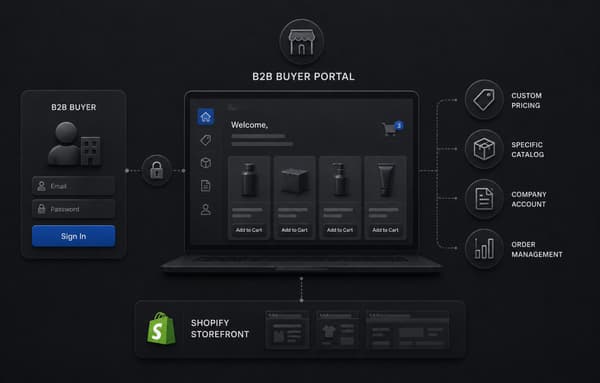
Company accounts: Create companies with multiple locations, assign buyers to companies, set per-buyer purchasing permissions (can they place orders independently, or do orders require manager approval?).
Customer-specific catalogs: Assign dedicated catalogs to companies or company locations. Each catalog can have: a fixed price list (your negotiated contract prices), a percentage-off rule applied to your standard price list, product visibility restrictions (buyers only see what they are authorized to buy), and a dedicated payment term assignment.
Net payment terms: Support for Net 30, Net 60, Net 90, and custom terms. Buyers with net terms can check out without entering payment at time of order. You can set credit limits per company. Partial payment collection at checkout is supported.
Volume pricing (quantity rules): Set quantity breaks at the variant level: minimum order quantities, maximum order quantities, quantity increments, and tiered pricing that automatically applies when the buyer's cart reaches a threshold.
Draft orders: Your sales team can create orders on behalf of buyers, apply custom pricing, attach purchase order numbers, and send the draft to the buyer for confirmation.
Vaulted payment methods: Buyers can store a payment method on file so reorders are one-click.
Shopify Plus B2B Plan (2026)
As of April 2026, Shopify offers a dedicated B2B plan alongside Shopify Plus that includes all native B2B features plus enhanced company account management, expanded catalog capabilities, and additional API access tailored for B2B ERP integrations. Contact Shopify or a certified Shopify Plus Partner for current pricing.
ERP Integration with Uncap Connect
The biggest implementation challenge for B2B manufacturers and distributors is not the storefront. It is the integration between Shopify Plus and the ERP.
Uncap Connect handles the full bidirectional integration:
Data FlowDirectionFrequencyCustomer price lists (contract pricing)ERP to ShopifyReal-time on changeInventory levels (multi-warehouse)ERP to ShopifyReal-time via webhookNew company/customer account creationShopify to ERPOn registration approvalOrder export with PO numberShopify to ERPOn order confirmationNet payment term assignmentERP to ShopifyOn account updateCredit limit enforcementERP to ShopifyDaily sync + real-time flag
Supported ERPs: NetSuite, SAP S/4HANA, Microsoft Dynamics 365 Business Central and Finance, Epicor, and Infor CloudSuite.
Adobe Commerce (Magento) for Enterprise B2B
Adobe Commerce (formerly Magento Commerce) is the incumbent platform for many enterprise B2B organizations. If you are on Adobe Commerce today, you are likely familiar with its flexibility and its cost.
Strengths: Full codebase ownership and customization, a large ecosystem of modules, support for complex multi-site deployments, and deep B2B feature coverage (company accounts, purchase order approvals, RFQ/quote workflow, requisition lists).
Weaknesses: High TCO. Adobe Commerce Cloud (fully managed) starts at approximately $40,000/year in licensing, before development, integration, and ongoing maintenance costs. Security patching and upgrades are your responsibility (on the on-premise edition), or handled by Adobe at a cost (on the cloud edition). Adobe has not dedicated dedicated technical support for Commerce customers separately from its broader Adobe ecosystem support.
When Adobe Commerce makes sense: Organizations with extremely complex business logic that cannot be implemented in a SaaS model, existing heavy investment in custom modules, or multi-region enterprises managing 5+ storefronts in markets with fundamentally different catalog structures.
When to consider migrating away: When you are spending more on platform maintenance than on platform features, when replatforming timelines are 6+ months for routine feature updates, or when your ERP integration is a fragile custom build that breaks on every platform update.
Uncap has executed B2B migrations from Adobe Commerce to Shopify Plus for manufacturers and distributors who found their total annual platform cost (licensing + development + support) exceeding $250,000 with no corresponding increase in buyer experience quality. The B2B Ecommerce Replatforming guide covers the migration process in detail.
SAP Commerce Cloud and Salesforce Commerce Cloud B2B
SAP Commerce Cloud is purpose-built for organizations already deep in the SAP ecosystem (SAP S/4HANA, SAP ERP). If your ERP is SAP and your enterprise architecture team is SAP-native, the integration story is stronger than any other platform. The learning curve is steep, the UI is not buyer-friendly out of the box, and TCO is high (licensing fees plus specialized SAP developers).
Salesforce Commerce Cloud B2B (formerly CloudCraze, acquired by Salesforce in 2018) is built natively on the Salesforce platform. If you run Salesforce CRM for your field sales team, the buyer portal and CRM integration is seamless. The constraint is that you are locked into the Salesforce ecosystem, GMV-based licensing is expensive at scale, and the platform architecture encourages staying within Salesforce's approved toolset.
Neither platform is the right choice for manufacturers, distributors, or wholesalers who are not already heavily invested in the respective vendor's ecosystem.
Headless and Composable Commerce: When Does It Make Sense for B2B?
Headless commerce decouples the frontend (what buyers see) from the backend (commerce engine). Composable commerce takes this further, decomposing the entire commerce stack into microservices (catalog service, pricing service, order management service, etc.) that communicate via APIs.
Platforms like commercetools, VTEX, and Fabric are built on this model.
When composable makes sense for B2B: You are building a highly differentiated buyer portal with deep personalization, the buying experience needs to live within an existing enterprise portal or ERP self-service interface, or you have a dedicated in-house engineering team capable of maintaining a multi-vendor API integration.
When composable does not make sense: Your priority is speed to market, your team does not have the engineering capacity to maintain API integrations across 8-10 vendors, or your total available budget is under $500,000 for year-one implementation.
For the vast majority of B2B manufacturers, distributors, and wholesalers, a SaaS platform with native B2B features and a purpose-built ERP integration is faster, more reliable, and significantly cheaper than a composable build.
The B2B Platform Selection Decision Framework
Use this framework to structure your platform evaluation:
Step 1: Audit your current B2B workflows. Map your existing quote-to-order process, pricing logic, account hierarchy, and ERP data flows. Any platform you evaluate must be able to replicate these workflows, ideally natively.
Step 2: Build your must-have vs. nice-to-have feature list. Separate features that block your B2B go-live (company accounts, ERP pricing sync, net terms) from features that improve the buyer experience (saved order templates, punchout catalog support, guided reordering).
Step 3: Run a TCO model across 3 years. Include licensing, implementation, ongoing development, app fees, and migration costs. Do not compare platform licensing in isolation.
Step 4: Issue a structured RFP. Ask each platform vendor: what is native, what requires a third-party app, and what requires custom development? Get this in writing.
Step 5: Reference check with similar B2B businesses. Ask for references from manufacturers, distributors, or wholesalers with a comparable product catalog complexity and ERP. Generic B2C references are not predictive of B2B implementation success.
Step 6: Evaluate the implementation partner, not just the platform. The platform gets you to the starting line. The implementation partner gets you to launch. For Shopify Plus, work with a certified Shopify Plus Partner with documented B2B and ERP integration experience.
Platform Migration: What to Expect
If you are migrating from a legacy platform (Magento, Volusion, custom-built, or an ERP-hosted catalog), the migration has four phases:
Discovery and architecture (4-6 weeks): Map existing data structures, define ERP integration data flows, finalize B2B feature requirements, design the company account and catalog model in Shopify Plus.
Build and integration (8-14 weeks): Theme development, B2B configuration (company accounts, catalogs, pricing rules, net terms), ERP integration setup and testing, data migration (products, customers, order history).
QA and parallel run (2-4 weeks): Test the ERP integration with live data, validate pricing accuracy across all customer segments, confirm net terms workflow end-to-end, run load testing.
Launch and hypercare (2-4 weeks post-launch): Monitor performance, ERP sync logs, and buyer adoption. Address any edge cases in the order workflow.
For Shopify Plus B2B with ERP integration, expect a total timeline of 16-28 weeks depending on catalog complexity, number of customer segments, and ERP readiness. For context, a comparable Adobe Commerce implementation typically takes 32-52 weeks.
Continue Reading
- B2B Ecommerce Replatforming: A Step-by-Step Guide to Moving to Shopify Plus
- Shopify B2B Wholesale Setup: Catalogs, Pricing, Permissions, and Net Terms
- Ecommerce for Distributors: Going Online with Shopify Plus
- The Best B2B Ecommerce Tech Stack for Shopify Plus
- Uncap Connect: ERP Integration for Shopify Plus
If you are evaluating enterprise ecommerce platforms for a B2B manufacturing, distribution, or wholesale operation, the platform decision is one of the most consequential choices your team will make this year. We have made it with more than 380 B2B organizations over the past decade.
Frequently asked questions
What is the best enterprise ecommerce platform for B2B manufacturers?
For manufacturers selling to wholesale accounts and distributors, Shopify Plus is the recommended platform in 2026. It offers native B2B features (company accounts, dedicated catalogs, net terms, volume pricing), a clean ERP API for connecting to NetSuite, SAP, and Dynamics 365, a 99.99% uptime SLA, and a significantly lower TCO than Adobe Commerce or SAP Commerce Cloud. Uncap has deployed Shopify Plus for more than 380 B2B manufacturers, distributors, and wholesalers.
How much does an enterprise ecommerce platform cost?
Platform licensing ranges from $2,300/month (Shopify Plus) to $40,000+ per year (Adobe Commerce Cloud) to custom GMV-based pricing (Salesforce Commerce Cloud B2B, SAP Commerce Cloud). Full 3-year TCO including implementation, integration, and ongoing development typically runs $150,000-$300,000 for a Shopify Plus B2B build and $400,000-$1,000,000+ for Adobe Commerce or SAP Commerce Cloud.
How long does a B2B ecommerce platform implementation take?
A Shopify Plus B2B implementation with ERP integration takes 16-28 weeks (4-7 months). Adobe Commerce takes 32-52 weeks (8-13 months). SAP Commerce Cloud and Salesforce Commerce Cloud B2B take 9-18 months. Timeline depends primarily on catalog complexity, number of customer pricing segments, and ERP readiness.
Can Shopify Plus handle complex B2B pricing?
Yes. Shopify Plus supports customer-specific catalogs with fixed price lists (contract pricing), percentage-off rules, volume pricing via quantity rules, and draft order pricing overrides for sales rep quotes. For pricing logic that exceeds native capabilities (e.g., CPQ, complex tiered rules driven by ERP conditions), Shopify Functions allows custom pricing logic at the infrastructure layer.
What is the difference between Shopify Plus and Shopify for Enterprise?
Shopify refers to its enterprise offering as "Shopify for Enterprise" in some contexts and "Shopify Plus" in others. As of 2026, Shopify Plus is the flagship plan for high-volume merchants, starting at $2,300/month. There is also a dedicated B2B plan launched in April 2026 with expanded B2B capabilities. Contact a certified Shopify Plus Partner for current plan details.
Do I need headless commerce for an enterprise B2B store?
Most B2B manufacturers, distributors, and wholesalers do not need headless commerce. The buyer portal use case (account-specific catalog, reordering, invoice history) is well served by Shopify Plus's standard Liquid-based storefront or its Hydrogen-based headless framework. Headless adds significant engineering complexity and cost that is rarely justified unless you are building a deeply embedded buyer portal within an existing enterprise portal.
How do I migrate from Magento/Adobe Commerce to Shopify Plus?
The migration involves four phases: discovery and architecture, build and ERP integration, data migration and QA, and launch. Critical steps include mapping your existing B2B pricing logic to Shopify catalogs, migrating product and customer data with relationships intact, rebuilding your ERP integration on Shopify's API, and preserving SEO value via redirect mapping. Uncap's B2B replatforming guide covers this in detail.
What B2B features does Shopify Plus include natively?
Shopify Plus includes: company accounts with multi-buyer support, customer-specific catalogs (fixed prices + percentage-off), net payment terms (Net 30/60/90, partial payments, credit limits), volume pricing via quantity rules, draft order creation by sales reps, vaulted payment methods, B2B-optimized checkout (PO number entry, net terms selection), and a dedicated B2B storefront that hides retail pricing from wholesale buyers.
How does Shopify Plus compare to BigCommerce for B2B?
Both platforms offer native B2B features. Shopify Plus has a larger certified partner network, more B2B implementation references, and a cleaner API for ERP integration. BigCommerce B2B Edition offers competitive native B2B features but has a smaller implementation partner network and historically focuses more on mid-market B2B than complex manufacturer/distributor deployments. For high-complexity B2B with ERP integration requirements, Shopify Plus has a deeper track record.
How do I evaluate implementation partners for an enterprise B2B ecommerce build?
Ask for references from B2B manufacturers, distributors, or wholesalers specifically, not B2C brands. Verify their ERP integration experience with your specific ERP. Confirm their Shopify Plus certification tier (Platinum is the highest). Ask for a detailed scope of work that specifies what is native, what is custom, and what third-party apps are included. Request a fixed-price or capped-price engagement for defined scope.