

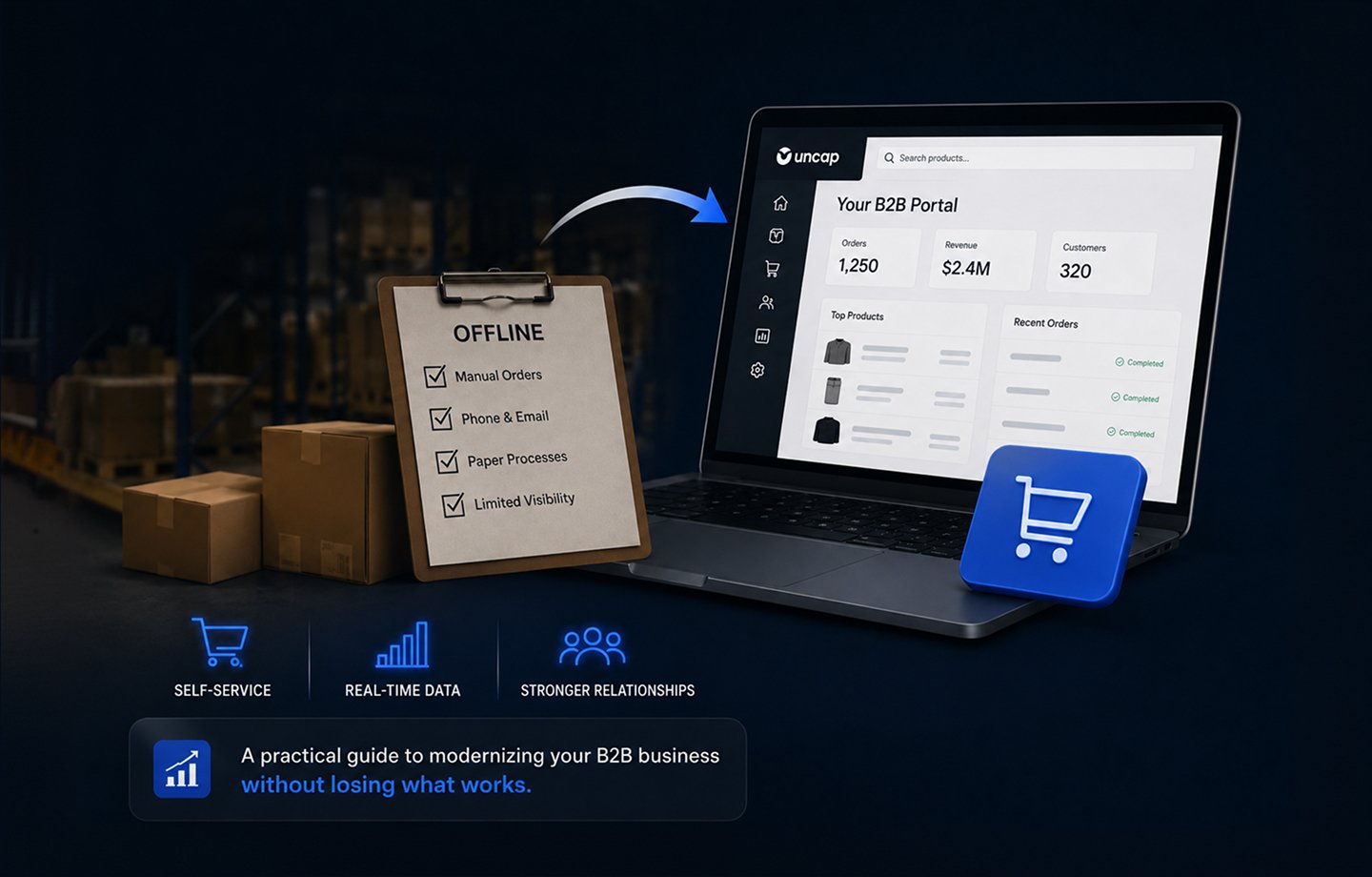
Offline to Online: B2B Commerce Transformation (2026)
Most guides on moving your B2B business online treat the transformation as a technology decision. Pick a platform. Build a portal. Launch it. Done.
That is not how it works for manufacturers, distributors, and wholesalers who have spent years building something worth protecting: account relationships that go back a decade, pricing structures negotiated over many conversations, reps who know their buyers by name and can tell from one email what they actually need.
The technology is not the hard part. The hard part is going online without breaking what already works.
B2B ecommerce sales grew 13% in 2024, which was 26 times faster than the overall market. The direction is clear. But the "rule of thirds" in B2B buying is equally clear: one-third of buyers want in-person interactions, one-third prefer remote conversations with a rep, and one-third expect fully digital self-service. You are not moving to a fully digital model. You are adding a digital channel to a business that will always have multiple ways buyers want to engage. In hospitality and foodservice, where standing orders and rep relationships are the business, that added channel has to fit around how accounts already buy.
That distinction changes everything about how you approach the transformation.
What "Offline to Online" Actually Means
The phrase implies a starting point and an ending point. Offline: orders by phone, fax, email, trade show conversation. Online: orders through a portal, catalog, or self-service checkout.
That framing is too simple for how B2B commerce actually works.
In-person sales generated just 17% of B2B revenue in 2024, according to Deloitte. That number has been declining for years. But the 83% that moved online did not all move to self-service portals. A significant share moved to email, phone, and messaging apps. That is digital, but it is not structured. The conversation happens in an inbox. The order gets manually entered somewhere else. The history lives in a spreadsheet that one person maintains.
Going from offline to online in B2B means three different things depending on where an order currently lives:
Orders on paper or by phone need a digital front end: a catalog your buyers can browse, a way to submit requests without calling, and a record of what was ordered.
Orders by email need structure, not a new channel. The conversation is already digital. What is missing is the connection between that conversation and a clean, confirmed Shopify order.
Orders through a rep need visibility, not replacement. The rep's involvement is often the reason the buyer stays. Taking the rep out of the process is not the goal. Giving the rep better tools and giving management better visibility is.
Each of these requires a different solution. Most platforms are built to solve one of them.
What You Cannot Afford to Lose in the Transition
The fastest way to stall a B2B digital transformation is to launch a portal that your buyers do not use.
It happens more often than the industry admits. A merchant invests in a self-service ordering portal. They send their buyers a login. Six months later, half of those buyers are still emailing their rep. The portal is technically live. The transformation is not.
The reason is almost never the technology. It is that the portal did not account for what the buyer valued about the offline relationship.
Three things your buyers depend on that a standard portal often does not preserve:
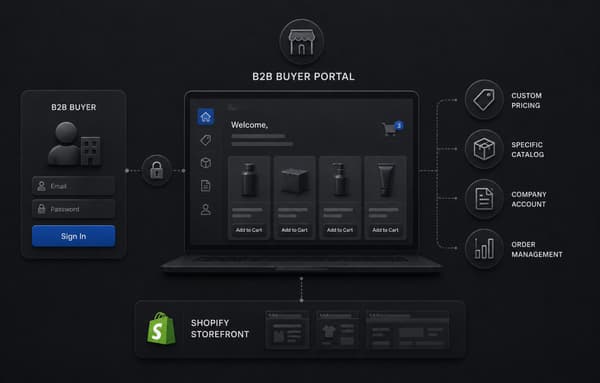
Account-specific pricing. Your buyers know what they pay. If they log into a portal and see list price instead of their negotiated rate, they will call their rep to confirm rather than place the order. That is friction you created by going online.
Order history and reorder simplicity. A buyer who has been ordering the same 12 SKUs every month for three years does not want to browse your catalog. They want to find last month's order and repeat it in two clicks. If the portal does not surface that history cleanly, the portal is harder to use than the email they sent before.
The rep. For many wholesale buyers, the rep is not overhead. They are the relationship. They catch errors before they become problems. They know when a product is backordered before the buyer finds out on delivery. They handle the edge cases that a portal cannot anticipate. Going online does not mean the rep disappears. It means the rep's time gets used on things that matter.
The Three Order Types and Where Each One Belongs
Not all B2B orders are the same. The offline-to-online transformation works best when you match the channel to the order type, not when you try to push everything through a single interface.
Routine reorders are the easiest to move online and should be your first priority. These are orders for the same SKUs, in the same quantities, to the same address, from accounts that know exactly what they need. A self-service portal with clean order history and a one-click reorder flow handles these without rep involvement. Moving routine reorders online frees your reps for everything else.
New product discovery can be self-serve with the right catalog structure. Buyers who are exploring new lines or adding items they have not ordered before benefit from a well-organized digital catalog with account-specific pricing visible. This is where the portal earns attention and drives incremental revenue.
Complex or negotiated orders will always need rep involvement, and they should. These are the orders where specs need to be confirmed, pricing needs to be discussed, quantities are being negotiated, or the buyer is trying something new at scale. Pushing these through a self-service checkout creates errors and erodes trust. The right solution is a structured workflow where the rep is in the loop, the conversation is captured, and the order is confirmed with full visibility on both sides.
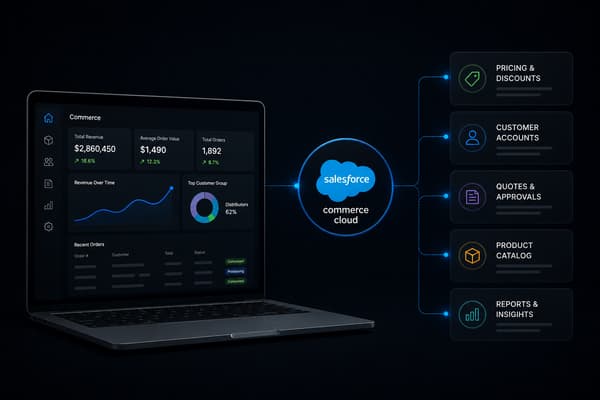
Running wholesale on Shopify requires different configurations depending on which of these order types your account base is weighted toward. Merchants stepping away from a Salesforce Commerce setup often rebuild these order-type workflows from scratch, which is the moment to get that weighting right.
Where Most Merchants Stall
Across 380+ Shopify storefronts since 2013, the most consistent point of failure Uncap has seen in the offline-to-online transition is not technology adoption. It is buyer adoption. Wholesale distributors and manufacturers who launch a portal and then watch their buyers keep emailing their rep are not experiencing a platform failure. They are experiencing a transition failure: the online channel launched, but the buyer's journey did not change.
The buyers are not being difficult. They are doing what works. Email to their rep gets a fast response, accounts for their pricing, and usually produces fewer errors than entering an order themselves. Until the portal is demonstrably easier, buyers will default to what they know.
The fix is not to remove the email option. It is to make the online channel as responsive and context-aware as the rep used to be, and to give the rep visibility into every order regardless of how it came in.
Converting emails to Shopify orders without asking buyers to change their behavior is the bridge between the offline relationship and the online infrastructure. When an email becomes a structured order with the same history and pricing the buyer expects, the resistance drops.
Structuring that online channel also means putting the buyer-side controls in place, which we cover in how reviews, approvals, and permissions form the foundation of B2B.
What Changes When the Transition Works
When the offline-to-online transformation is done correctly for a wholesale or distribution business, three things change measurably.
Order accuracy improves. Manual re-entry is the primary source of B2B order errors. When the order originates digitally, whether through a portal or through a structured email-to-order flow, the transcription step disappears. The buyer's intent is the order.
Rep capacity increases. Reps who are no longer manually entering routine orders have more time for the accounts and conversations that move revenue. The transformation does not reduce the team's role. It changes what the team does.
Management gains visibility. When orders and conversations live in one place, a manager can see what is in flight, where deals are stalling, and which accounts have gone quiet, without asking reps for a status update. That visibility depends on an integration like Odoo mirroring the pricing and order history the reps already rely on.
Uncap's platform is built around this: every conversation, quote, and order in the Portal, accessible to the whole team, with Advanced Quote Management that keeps the rep in the loop for complex deals while routine orders move without friction. Smart Agents surface the context reps need at the right moment: which accounts have gone quiet, what was discussed last, what was promised.
The transformation is not about replacing the offline relationship. It is about giving it infrastructure.
Going Online Without Starting Over
The B2B global ecommerce market is on track to reach $36 trillion in 2026. The movement online is not optional. But the timeline and approach are yours to control.
The merchants who make this transition successfully are not the ones who move fastest. They are the ones who move in the right order: routine reorders first, catalog digitization second, rep-assisted workflow connected third. They preserve what buyers value, they give reps better tools, and they bring the offline relationship online rather than replacing it.
Request a Quote and see how Uncap connects the way your team already sells to a structured commerce workflow on Shopify, without asking your buyers or your reps to start from scratch.
Frequently asked questions
What does offline to online transformation actually mean in B2B?
Adding a digital channel to a business that will always have several. The rule of thirds holds: a third of buyers want in-person interaction, a third prefer remote rep conversations, and a third expect fully digital self-service.
How fast is B2B ecommerce growing?
B2B ecommerce sales grew 13% in 2024, roughly 26 times faster than the overall market, while in-person sales generated just 17% of B2B revenue and have been declining for years.
What is the hard part of taking a B2B business online?
Not the technology. It is going digital without breaking what already works: decade-old account relationships, negotiated pricing structures, and reps who know their buyers by name.
Do all online B2B orders go through self-service portals?
No. A significant share of the revenue that moved online moved to email, phone, and messaging, digital channels that are not portals. A realistic transformation captures those orders in the same system.