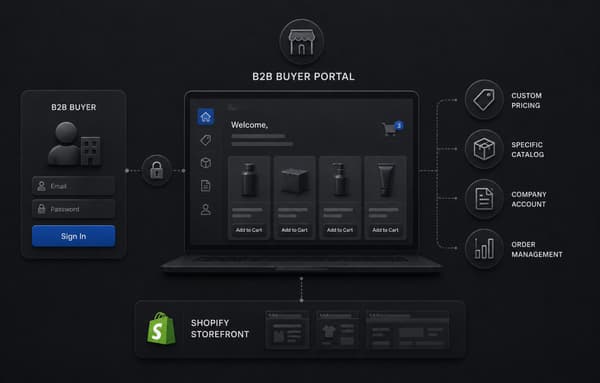


A B2B self-service portal is a logged-in space where business buyers order, reorder, see their own pricing and payment terms, and manage their account without calling a rep. On Shopify, that portal starts with Shopify B2B customer accounts on the Basic, Grow, Advanced and Plus plans. Apps and custom builds extend it for jobs such as buyer-managed budgets and approval steps.
This guide covers what a self-service portal is, the features buyers use, the three ways to run one on Shopify, and how to tell whether it is working.
What a B2B self-service portal is
A self-service portal is the account side of B2B commerce. A public storefront is built for anyone who visits. A portal is built for a known buyer at a known company, so everything it shows is specific to that account: the catalog, the price, the terms, the order history and the people allowed to buy.
That difference shows up in what the buyer can do. On a public site, a buyer browses and checks out. In a portal, the same buyer reorders last month's order, adds a PO number, checks out on Net 30, looks up an old order and starts a return, all without an email to your inside sales team.
On Shopify, the portal and the storefront can be the same store. Shopify B2B buyers log in with customer accounts to reach their wholesale information and assigned catalogs, so a blended store shows retail shoppers one experience and logged-in trade buyers another. A dedicated B2B store can go further: Shopify's Trade theme is designed for B2B-only stores and hides prices from visitors who aren't logged in.
For a broader walkthrough of portal planning, see our guide to the Shopify B2B portal. If your question is which apps to add to a portal, our guide to Shopify B2B apps for a private ordering portal maps them job by job.
What buyers do in a self-service portal
The features that matter are the ones that replace a phone call or an email. These are the jobs a B2B self-service portal should handle, with what Shopify B2B covers natively:
- See their own catalog and pricing. Catalogs assigned to companies and company locations decide which products and prices a buyer sees. Volume pricing and quantity rules apply automatically.
- Order and reorder fast. Easy reorders duplicate a past order into the cart, and quick order lists add multiple variants of a product in one click from the product page.
- Check out on their terms. Net 7 through Net 90 or due on fulfillment, vaulted credit cards, ACH in the United States and PO numbers at checkout.
- Look up orders. Buyers can view their order history from their customer account.
- Start returns. Self-serve returns let buyers and company location admins submit return requests from their customer accounts and track their status.
- Work as a team. Location-level permissions separate a location admin from a buyer who can only order.
Paying fits the same pattern. During the payment term period, Shopify says B2B customers can log in to customer accounts, select an order, and pay for it by clicking Pay now. If your buyers also want company-defined budgets or approval steps for their own users, look at an app or a custom build.
Three ways to run a self-service portal on Shopify
There are three practical paths, and many operations combine them.
Native Shopify B2B
Customer accounts, company accounts, catalogs, payment terms, easy reorders and self-serve returns are part of Shopify B2B. Shopify says B2B features are included at no extra cost on the Basic, Grow, Advanced and Shopify Plus plans. The main plan limit for portals is pricing: below Plus you can assign up to 3 active catalogs across all your B2B markets, and only Plus lets you assign catalogs directly to specific companies and company locations.
A portal app
Shopify lets apps extend the buyer's account through Customer Account UI Extensions, which Shopify says can introduce new features that help B2B customers self-serve. Check every app for B2B compatibility first. Shopify warns that some App Store integrations aren't fully compatible with Shopify B2B, specifically companies and catalogs.
A custom build
Shopify supports custom headless B2B storefronts using Hydrogen or the Storefront and Customer Accounts API, and it supports your own OAuth 2.0 and OpenID Connect identity providers for B2B buyers. A custom build fits when buyers sign in through your own systems or the portal has to reflect rules no app models. It costs the most to build and maintain, so it should solve a problem the other two paths can't.
Connecting the portal to your ERP
A portal is only as trustworthy as the numbers it shows. If the stock level, the price or the invoice balance is a day old, buyers stop trusting the screen and go back to calling. That makes the ERP connection part of the portal, not a separate project.
Shopify says you can integrate Shopify B2B with your ERP, CRM and other systems to sync customer data, orders, inventory, product catalogs and pricing information. It describes three ways to connect: direct integrations from the Shopify App Store, iPaaS providers that work as intermediaries, and custom integrations built on its APIs. It also cautions that some App Store integrations aren't fully compatible with B2B companies and catalogs, which matters most for a portal, since account pricing is the whole point.
Uncap Connect is Uncap's answer to that job. It is the real-time data layer between Shopify, your ERP and the warehouse floor, with native support for Shopify B2B companies, locations, catalogs, price lists and payment terms. Your ERP stays the system of record. Uncap Connect starts at $8,000 for onboarding and then a flat $390 per month.
For scale, ULE Group, an Uncap client, runs a catalog of over 250,000 SKUs on a Shopify B2B storefront where a real-time Epicor ERP integration syncs inventory and pricing and B2B customers get account-based pricing.
Where self-service stops and your reps step in
Not every B2B order should be self-served. A routine reorder is. A first order from a new account, a large order with a special price or an order that needs a credit check may not be. A good portal makes the hand-off clean instead of hiding it.
Shopify gives you two native tools for that hand-off. You can require a company location to submit its orders as drafts for review, which shows that buyer a Submit for approval button at checkout and lets you review and change the order before it is confirmed. And a rep can build a draft order for a company, which takes that company's prices, payment terms and checkout options automatically, with a custom price on any line item when the deal calls for a negotiated number. Our draft orders guide covers both.
When quoting itself is the sales motion, with approvals, versions and expiry dates, that is where Uncap Quotes fits. It turns your catalog into instant, account-specific quotes, routes exceptions to the right approver, and turns approved quotes straight into Shopify orders.
How to tell whether the portal is working
Measure the portal by the calls and emails it removes, using numbers you already have. A few signals worth tracking from the day it launches:
- Share of orders placed in the portal versus by phone, email or rep, per account.
- Reorder use. How many orders start from a past order or a quick order list.
- Account activation. How many invited buyers have logged in and placed an order.
- Support topics. How often buyers still ask for order status, invoice copies or price checks.
- Draft review time. For accounts that submit orders as drafts, how long a draft waits before it is confirmed.
Set a baseline before launch so the comparison is honest. If one account keeps ordering by email, ask why. The answer is usually a missing feature, a price the buyer doesn't trust or a login that never got set up.
Where Uncap Portal fits
Uncap Portal gives trade accounts a self-serve home on Shopify, with catalogs, pricing, reorders, invoices and users, so buyers help themselves and reps stop fielding the same requests. It builds on Shopify B2B and adds what a stock account page doesn't have: real multi-user company accounts with roles and permissions, NET terms, invoices and payments in the portal, and budgets, approvals and limits per user. Reps and admins manage users, limits and approvals from the same place buyers self-serve.
Talk to Our Experts about which of your accounts are ready to self-serve and what your portal needs to get them there.
Frequently asked questions
What is a B2B self-service portal?
A B2B self-service portal is a logged-in space where business buyers order, reorder, see their own pricing and payment terms, look up past orders and manage their account without calling a rep. Everything it shows is specific to the buyer's company, unlike a public storefront built for any visitor.
What features should a B2B self-service portal have?
Account-specific catalogs and pricing, fast reordering, checkout on payment terms with PO numbers, order history, self-serve returns and user roles. Shopify B2B buyers can also pay orders on payment terms from their customer account. For company-defined budgets or approvals, look at an app or a custom build.
Does Shopify include a B2B self-service portal?
Yes. Shopify B2B buyers log in with customer accounts to see their assigned catalogs and pricing, reorder past orders, check out on payment terms and submit returns. It runs on the Basic, Grow, Advanced and Plus plans, and Shopify says B2B features are included at no extra cost on those plans.
Do I need Shopify Plus for a B2B self-service portal?
No. The native portal runs on the Basic, Grow, Advanced and Plus plans. Plus matters if you need more than 3 active catalogs across your B2B markets, catalogs assigned directly to individual companies, or deposits, partial payments and payment requests per fulfillment.
How is a self-service portal different from a public ecommerce site?
A public site shows the same catalog and prices to every visitor. A self-service portal shows each logged-in buyer their own company's catalog, prices, payment terms, order history and users. On Shopify, both can run on the same store, with B2B buyers seeing their account view once they log in.