Shopify Plus costs $2,300 USD a month on a 3-year term or $2,500 USD a month on a 1-year term, which is $27,600 or $30,000 a year. Shopify lists those fees for standard setups and integrations, and says more complex, higher-volume businesses might pay a variable platform fee based on revenue and business model.
Shopify Plus is the Shopify plan for complex, high-volume businesses. On top of the platform fee you pay card rates or third-party transaction fees, apps, themes and any development work.
You are on Shopify Advanced and growing. Orders are stacking up, your team is filling operational gaps by hand, and someone mentioned Shopify Plus. The platform fee comes up. $2,300 a month. You close the tab.
This guide is for before you close the tab. For a lot of operators, that number ends the conversation. But the real question is not what it costs. It's whether what you get back is worth more than what you pay, and whether the timing makes sense for where your operation is right now.
Here is the full breakdown: what Shopify Plus costs and what sits on top of the fee, what it is and what is included, how it compares to Advanced, and who should and should not upgrade.
Shopify Plus pricing in 2026
Platform fee by contract term
Shopify Plus starts at $2,300 per month on a 3-year contract or $2,500 per month on a 1-year contract. On the 3-year term, that is $27,600 per year. On the 1-year term, $30,000 per year. The 3-year commitment saves $2,400 annually.
Those are the USD fees, which Shopify's Help Center lists for the United States and any country without a supported local currency. Canadian merchants are billed in CAD: $3,400 CAD a month on a 3-year term or $3,650 CAD a month on a 1-year term. Shopify's pricing page adds that "If you choose a 1- or 3-year Plus subscription, you can cancel when your term commitment expires," and that "There are no setup fees on any of our plans."
Most merchants who are confident the platform fits their operation lock into the 3-year term. The 1-year term is the right call if you are still evaluating whether Plus matches your requirements or if you are in a period of significant business change.
Variable pricing for high-volume stores
Shopify's Help Center says the fees above are "For standard setups and integrations. For more complex, higher-volume businesses, there might be a variable platform fee based on your revenue and business model, which differs for B2B and D2C companies." For the fee that applies to you, Shopify points you to the Shopify Plus team, so if your volume is high or your business mixes B2B and D2C, get that number from Shopify before you budget.
Expansion stores and extra store fees
The platform fee covers more than one store. Shopify's Help Center says Plus organizations "can have a maximum of ten stores on their contract with no additional cost": one main store and nine expansion stores, and staging stores do not count toward the limit. If you request a store beyond your contract limits, Shopify creates a trial store and asks you to approve an extra fee. Two costs follow every store: apps are billed per store, and each live store needs its own theme license.
Transaction fees
Transaction fees are separate from the platform fee and apply to every sale you process.
With Shopify Payments, Shopify's pricing page lists Plus online standard card rates of 2.25% + 30¢, online premium card rates of 2.95% + 30¢, an extra 1% for international cards, and in-person card rates of 2.3% + 10¢. Shopify notes that pricing and payment options "can differ depending on where your business is based."
If you use a third-party payment processor, Shopify charges 0.20% per transaction on top of your gateway's own fees. At $5M in annual sales, that adds $10,000 per year in Shopify fees. Shopify's Help Center says that with Shopify Payments "you aren't charged third-party transaction fees for orders that are processed through Shopify Payments, Shop Pay, and Shop Pay Installments." You can verify current payment rates directly in Shopify's payment fee documentation.
What is Shopify Plus?
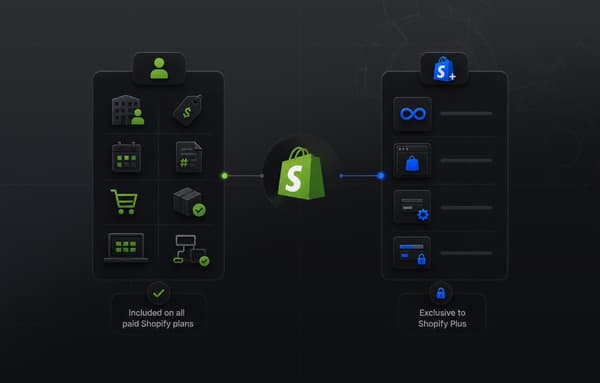
Shopify Plus is Shopify's enterprise commerce plan, designed for high-volume merchants and complex commerce operations that have outgrown the capabilities of standard Shopify plans. It includes custom checkout logic via Shopify Functions, a full native B2B wholesale suite, workflow automation through Shopify Flow, unlimited staff accounts, multi-store management with 10 stores included in the platform fee, and priority 24/7 phone and chat support.
The main difference between Shopify Advanced ($399 USD a month billed monthly, or $299 a month billed yearly) and Shopify Plus ($2,300+ a month) is the set of commerce capabilities that the lower plans do not include: custom checkout logic built in your own custom apps with Shopify Functions, unlimited B2B market catalogs, direct company catalogs, deposits, partial payments and payment requests per fulfillment, and the organizational tooling to run a multi-store, multi-market operation from one admin.
Hosting is part of the fee. Shopify's pricing page says "Shopify includes secure commerce hosting with your Shopify plan, so you don't need to buy separate hosting," and the Plus plan page in Shopify's Help Center lists unlimited bandwidth, a content delivery network backed by Cloudflare, automatic platform updates and DDoS protection among what the plan might include.
What is included in Shopify Plus?
Your monthly Shopify Plus fee includes the following. These are core plan features, not add-ons. The official feature list is maintained on Shopify's Plus plan documentation.
Commerce infrastructure:
Unlimited staff accounts (versus up to 15 on Advanced and up to 5 on Grow).
200 inventory locations (versus 10 on all lower plans).
10 stores included in the platform fee under one Organization Admin: your main store plus 9 expansion stores for international markets, wholesale operations, or region-specific storefronts, with more stores available at extra cost.
Shopify POS Pro included for up to 20 retail locations, or up to 200 locations when Shopify Payments is active.
Automation and checkout customization:
Shopify Flow, a free app on the Basic, Grow, Advanced, and Plus plans, handles rule-based workflow automation for order management, inventory alerts, fraud detection, customer tagging, and fulfillment routing. No coding required for standard flows.
Shopify Functions (checkout extensibility) lets your development team build custom checkout logic: new discount types beyond Shopify's built-in discounts, custom shipping rule logic based on order attributes, payment method filtering, and cart and checkout validation rules built into the checkout itself. Running functions from your own custom app is a Plus-exclusive capability; stores on other plans can use functions only through public apps from the Shopify App Store.
One important note: Shopify Scripts were deprecated on June 30, 2026, and any Scripts still published on a store were deactivated and no longer work. Any store that built checkout customization on Scripts needs to rebuild it with Shopify Functions. If your Plus store relied on Scripts-based checkout logic and has not rebuilt it yet, that is an urgent migration item.
B2B wholesale features:
Company accounts with multi-contact hierarchies and role-based permissions across locations and buyer groups.
Customer-specific price lists enforced at login, so each buyer sees their negotiated pricing before adding anything to cart.
Gated product catalogs per company, restricting which products each account can see and purchase.
Net payment terms (Net 15, Net 30, Net 60, Net 90) enforced at checkout for approved accounts.
Purchase order capture at checkout, so B2B buyers can reference a PO number on every order.
Tax exemptions set per company location for wholesale buyers purchasing for resale.
Self-service B2B buyer portal for reorder without rep involvement.
International commerce:
Shopify Markets for multi-currency, multi-language, and market-specific catalog and pricing management from a single Shopify admin.
Expansion stores for international expansion, product line extensions, B2B and physical retail. Shopify requires each expansion store to "Be extensions of the main brand"; a different brand needs a multi-brand agreement, with its own Shopify Plus plan subscription for each brand.
Analytics and customer acquisition:
Shopify Audiences, which Shopify says helps you "Find high-intent customers" for ad campaigns, retarget potential buyers and exclude existing customers.
Organization Admin for centralized store management, reporting, and user permissions across all stores under one Plus contract.
Support and onboarding:
Priority 24/7 phone and chat support (Shopify's pricing page lists live chat on Basic and Grow and enhanced live chat on Advanced).
How Shopify Plus compares to other Shopify plans
The jump from Shopify Advanced to Shopify Plus is the most significant in the entire plan lineup. Here is what actually changes.
Staff accounts: Basic includes no additional staff accounts, Grow allows up to 5 and Advanced up to 15. Plus is unlimited. For a wholesale operation with a sales team working quotes and orders out of the Shopify admin, this ceiling matters.
Checkout customization: Shopify's pricing page lists checkout customization as Limited on Basic, Grow, and Advanced and Full on Plus. Stores on any plan can use public App Store apps that contain Shopify Functions, but only Plus stores can use custom apps that contain them. If you need your own conditional discount, shipping, payment, or validation logic built into the checkout itself, Plus is the only option available inside Shopify.
B2B features: Since April 2, 2026, Shopify B2B runs on the Basic, Grow, Advanced, and Plus plans, including company accounts, catalogs and payment terms. On the Basic, Grow and Advanced plans you can assign up to 3 active catalogs across all your B2B markets. Plus adds unlimited B2B market catalogs, direct company catalogs, deposits, partial payments and payment requests per fulfillment, which matters once a wholesale program prices many accounts differently.
Transaction fee savings: Shopify Advanced charges 0.6% on sales processed through third-party payment gateways. Shopify Plus charges 0.2%. That 0.4% gap produces $2,000/month in savings at $500,000/month in sales. At that volume, the transaction fee savings nearly cover the entire cost premium of Plus over Advanced ($2,300 vs. $399 = $1,901 difference).
Multi-store management: Shopify's pricing page lists free expansion stores, "Up to 9," only under "Just for Plus." Plus includes 10 stores in the platform fee, your main store plus 9 expansion stores, with more available at extra cost, all manageable from a single Organization Admin. Shopify lists B2B stores and international expansion among the uses for expansion stores, so a wholesale store alongside a DTC store, or regional storefronts for international markets, fit within the ten stores on the contract.
Shopify Markets: All Shopify plans include an unlimited number of country or region markets. Theme customization by market starts on Advanced, and configuring business entities requires Plus.
The real total cost of Shopify Plus
The $2,300/month platform fee is where the cost starts, not where it ends. Most Plus merchants spend significantly more once the complete picture is counted.
App spend: Shopify's Help Center lists "one-time theme purchases and third-party apps" among the other potential costs of Plus. Marketing, loyalty and reviews, subscriptions, upsell and search tools are each billed by their own vendor, usually monthly and often tiered by volume, so price your actual app list from each app's Shopify App Store listing before you budget, and allow for overage charges during peak periods.
Theme and development: A paid theme from the Shopify Theme Store is a one-time purchase, priced on its listing, and every live store in a Plus organization needs its own theme license. A custom theme developed by a Shopify Plus agency typically runs $10,000 to $50,000 depending on complexity. Ongoing development and optimization retainers at mid-market Plus operations commonly land between $5,000 and $20,000 per month.
Migration costs (one-time): Moving to Shopify Plus from another platform is a one-time cost that does not recur, but it affects the first-year total significantly. Data migration typically runs $5,000 to $20,000. SEO and URL redirect mapping adds $3,000 to $10,000. ERP integration setup ranges from a few thousand dollars for a pre-built connector app to $30,000 to $150,000 or more for a real-time B2B integration with ERP pricing, credit limits, and customer hierarchies, depending on the ERP.
Monthly total estimates by store scale:
For a store doing $1M/year in revenue, the realistic monthly total including platform fee, apps, and development support lands around $5,000 to $7,000. At $5M/year, expect $10,000 to $15,000 per month. At $20M/year with variable platform pricing, $20,000 to $30,000 per month is not unusual.
None of these estimates include payment processing fees, which are billed separately and represent a significant line item at scale.
The real cost for a B2B distributor
A distributor's Plus budget looks different from the DTC estimates above, in both directions. The marketing app stack shrinks: a wholesale operation rarely needs the $2,000/month email-and-SMS layer, the loyalty platform, or the upsell tooling that dominate DTC app spend. What replaces it is heavier and more structural: the ERP integration is the peer cost of the platform itself, typically the largest line after the platform fee, because live inventory, account pricing, and order flow into the ERP are what make a B2B storefront trustworthy at all. Add a PIM if the catalog runs deep, and B2B-specific tooling like quoting where the sales motion needs it.
The other difference is what the spend replaces. A DTC brand weighs Plus against its previous platform bill; a distributor weighs it against the cost of taking orders by phone, fax, and rep transcription, which is why the honest evaluation is a cost-to-serve comparison rather than a software comparison. Consolidation is where the number usually lands: Kooks Headers reports a 38% lower total cost of ownership after consolidating its stack onto a unified Shopify B2B and D2C storefront. And for distributors leaving a legacy platform, the full three-year math, licenses, hosting, patching, and developer hours included, is modeled line by line in the Magento vs Shopify Plus 3-year TCO comparison.
Is Shopify Plus worth it for B2B manufacturers and distributors?
This is where the conversation shifts if you are running a wholesale operation rather than a DTC brand.
Before Shopify Plus's native B2B infrastructure, running wholesale on Shopify meant stacking apps: customer-tagged pricing tools that broke during Shopify updates, password-protected collections that created friction for buyers, manual draft order workflows that your sales rep built and sent by hand for every single order. It worked. It also required constant maintenance, created a fragile buyer experience, and made it almost impossible to give a wholesale buyer the self-service reorder capability they expect from a modern commerce platform.
Today, Shopify Plus handles the core wholesale requirements natively. Company accounts let you manage a regional distributor with six buyers, each with different pricing tiers and location-specific catalogs, all under one account hierarchy. Your negotiated price list is enforced at login. Net 30 terms appear at checkout for approved accounts. Purchase orders get captured there too. The buyer portal handles routine reorders without a rep needing to create a draft order every time.
For a mid-market manufacturer evaluating whether to stay on a legacy ERP commerce portal or move to Shopify Plus, the comparison that matters is not Shopify Plus at $27,600 per year versus Shopify Advanced at $4,788 per year. It is Shopify Plus at $27,600 per year versus the $80,000 to $200,000 annual total cost of running wholesale commerce on a legacy developer-dependent platform, including license fees, custom development, hosting infrastructure, and the maintenance overhead that never gets cheaper.
Uncap has been a Shopify Platinum Partner, on Shopify since 2013, with 380+ storefronts launched on Shopify for manufacturers, distributors, and wholesalers. The pattern we see consistently: the legacy ERP portal costs more to maintain than a modern Shopify Plus operation costs to run. The math usually becomes obvious once you add up what the previous platform actually costs, including the developer hours that are invisible in the monthly budget.
For B2B operators who need Shopify to communicate with their ERP in real time, Uncap Connect is a Shopify-to-ERP integration app, built as a Shopify embedded app, that keeps your store and your ERP in real-time, two-way sync. Your ERP stays the system of record.
Shopify Plus B2B builds: what the case studies report
These Uncap builds run B2B on Shopify Plus. Each line is stated the way the published case study states it.
- Farmers Depot: a "Shopify Plus B2B build" integrated with Microsoft Dynamics 365 F&O, serving 14,528 customers across 13,046 companies with about 10 company-specific pricing catalogs and login-required purchasing. Per Shopify's plan table, catalogs assigned to companies are Plus only.
- KBS Golf Shafts: a "Full migration from WooCommerce to Shopify Plus," with D2C, B2B and POS on one platform and a direct integration with Oracle ERP.
- Kodo Kids: a "Full integration of Hubspot CRM, Unleashed ERP and Shopify Plus," with "easy-to-navigate catalogs and flexible payment terms."
- Microfiber Wholesale: a 75-year-old, family-owned business whose case study lists "Migration of legacy platform to Shopify Plus" and "Achievement of all project objectives within the requested timeframe."
When does Shopify Plus pay for itself?
The clearest break-even calculation starts with transaction fees.
Shopify Advanced charges 0.6% on sales processed through third-party payment gateways. Shopify Plus charges 0.2%. The 0.4% difference saves $2,000/month at $500,000/month in sales. The cost premium for Plus over Advanced is $1,901/month. At $500K/month in sales, the transaction fee savings essentially cover the platform premium, before you count the value of any Plus-specific feature.
Most merchants find the financial case becomes clear at $1M or more in annual revenue, roughly $83,000/month in sales. Below that threshold, the fixed cost is difficult to justify unless a specific Plus feature (usually custom checkout logic or unlimited B2B catalogs) is driving a concrete revenue or operational outcome.
Beyond transaction fees, upgrade to Shopify Plus when your operation needs one of these:
Custom checkout logic. Discounts for specific customer segments and buy-X-get-Y offers are built into Shopify on every plan. If your growth requires discount, shipping, payment, or checkout validation logic beyond those built-in settings, a custom app with Shopify Functions on Plus is the only way to build it yourself rather than rely on a third-party app.
Native B2B at scale. Since April 2, 2026, the Basic, Grow, Advanced, and Plus plans can all run wholesale and DTC from one Shopify admin, with company accounts, net terms at checkout, and a self-service buyer portal, but only up to 3 active B2B catalogs. Unlimited B2B market catalogs, direct company catalogs, deposits, partial payments and payment requests per fulfillment require Plus. Complex wholesale programs outgrow the 3-catalog limit quickly.
High-traffic reliability. Shopify's pricing page lists high volume checkout and bot protection under "Just for Plus," and its Help Center says Plus bot mitigation "includes advanced bot protection during flash sales and product launches."
International expansion. Shopify Markets and up to 9 expansion stores give you the infrastructure to run multiple regional storefronts from one admin without duplicating your operations team.
Staff at scale. When your team regularly hits the 15-account ceiling on Advanced, Plus removes the constraint.
Stay on Shopify Advanced if your annual revenue is under $1M, your technical and B2B requirements fit within what Advanced provides, or the fixed cost is material to your margins at your current scale.
How to get started with Shopify Plus
Shopify offers eligible merchants a paid Shopify Plus trial, $399 USD per month for 1 to 2 months depending on your store status, which gives access to most Plus features. If you take no action by the end of the trial, your store is automatically enrolled in a full Plus plan, so decide on the contract term before it ends.
The quality of the architecture and scoping work done before development begins is the single biggest factor in whether a Plus migration delivers on its ROI or turns into a costly rebuild six months later. Merchants who go into Plus implementations without a clear brief on what they need the platform to do, from checkout logic to ERP integration to B2B account structure, spend more and get less.
If you are evaluating Shopify Plus for a B2B wholesale or manufacturing operation, Talk to Our Experts and we will walk you through whether the platform and investment make sense for your specific situation. The conversation is free. The information will be specific to your operation, not a generic sales pitch.
If you have already decided on Plus and need the right migration path, Uncap's Shopify Migration practice is the structured implementation path we use to get B2B brands live on Shopify Plus without the scope drift that sinks most replatforming projects.
Sources
The primary sources this guide cites, each checked on October 25, 2026. Uncap's own prices, timelines and client results come from Uncap's published pages and case studies, linked where they appear above.
- Shopify: Shopify pricing
- Shopify Help Center: Shopify Payments, Shopify Plus plan, Shopify B2B features by plan, Shopify Plus trial, Overview of markets features and concepts, Overview of expansion stores, Shopify Scripts and the Script Editor app, Creating companies
- Shopify developer documentation: About Shopify Functions
- Shopify Changelog: Key B2B features now available on non-Plus plans
Frequently asked questions
What is Shopify Plus?
Shopify Plus is Shopify's enterprise commerce plan, built for high-volume merchants that need custom checkout logic, unlimited B2B catalogs and deposits, multi-store management, and 24/7 priority support. It starts at $2,300 per month on a 3-year contract, and the ROI case typically becomes clear at $1M or more in annual revenue.
How much does Shopify Plus cost per month?
Shopify Plus costs $2,300 USD per month on a 3-year term or $2,500 USD per month on a 1-year term in the United States. Shopify lists those fees for standard setups and integrations and says more complex, higher-volume businesses might pay a variable platform fee based on revenue and business model, which differs for B2B and D2C companies. Transaction fees and app costs are billed separately on top of the platform fee.
How much is Shopify Plus per year?
On a 3-year commitment, Shopify Plus costs $27,600 per year ($2,300/month). On a 1-year commitment, $30,000 per year ($2,500/month). The 3-year term saves $2,400 annually.
What is the difference between Shopify and Shopify Plus?
Shopify Plus adds capabilities that standard plans do not include: custom apps with Shopify Functions for your own checkout logic, unlimited B2B market catalogs, direct company catalogs, deposits, partial payments and payment requests per fulfillment, unlimited staff accounts, 10 stores included under one admin for international commerce, and priority 24/7 phone and chat support. Shopify B2B itself runs on the Basic, Grow, Advanced, and Plus plans, with up to 3 active catalogs below Plus.
Is Shopify Plus worth it?
Shopify Plus is worth the investment when you are generating $1M or more annually and need custom checkout logic, unlimited B2B catalogs or deposits, or reliable performance under high traffic. The break-even point where transaction fee savings from Plus offset the premium over Advanced is approximately $500,000 per month in sales. Below that threshold, the financial case depends on whether a specific Plus feature is solving a problem with a clear revenue or cost impact.
What is the downside of Shopify Plus?
The main downsides are cost and contract length. The platform fee alone runs $2,300 to $2,500 per month, and total monthly costs including apps and development commonly reach $5,000 to $20,000 for a mid-size operation. The 3-year contract locks you in for three years. Shopify Plus also does not replace ERP, financial management, or warehouse management systems, which most mid-market B2B operators need alongside it.
What is the difference between Shopify B2B and Shopify Plus B2B?
Since April 2, 2026, Shopify B2B runs on the Basic, Grow, Advanced, and Plus plans, including company accounts, catalogs and payment terms. On the Basic, Grow and Advanced plans you can assign up to 3 active catalogs across all your B2B markets. Shopify Plus adds unlimited B2B market catalogs, direct company catalogs, deposits, partial payments and payment requests per fulfillment. For a wholesale program with many differently priced accounts, or one that needs deposits on net-terms orders, Plus is the right level.
What is Shopify Functions?
Shopify Functions lets developers customize Shopify's backend logic for discounts, delivery and payment options, cart transforms, and cart and checkout validation. Stores on any plan can use public App Store apps that contain functions, but only Shopify Plus stores can use custom apps that contain Shopify Function APIs. Shopify Functions replaced Shopify Scripts, which were deprecated on June 30, 2026, when any Scripts still published were deactivated. Any store that relied on Scripts-based checkout logic needs to rebuild it with Functions.
How much does Shopify Plus really cost for a B2B distributor?
Start from the same platform fee ($2,300 to $2,500 per month), then budget structurally rather than by DTC averages: the ERP integration is typically the largest line after the platform itself, a PIM joins the stack when the catalog runs deep, and the marketing app layer shrinks compared to a DTC brand. The honest comparison is not against the old platform bill but against the cost of phone, fax, and rep-transcribed ordering, and against the legacy stack being retired: consolidation is where distributors usually find the savings.
Does Shopify Plus have a free trial?
Not a free one. Shopify offers eligible merchants a paid Shopify Plus trial at $399 USD per month for 1 to 2 months, depending on store status, with access to most Plus features. If you take no action by the end of the trial, the store is automatically enrolled in a full Plus plan.
Why is Shopify Plus so expensive?
The fee pays for what the lower plans leave out. Plus covers up to ten stores on one contract, unlimited staff accounts, 200 inventory locations, priority 24/7 phone support, custom apps with Shopify Functions, and the B2B features Shopify reserves for Plus: unlimited B2B market catalogs, direct company catalogs, deposits, partial payments and payment requests per fulfillment. If you run a third-party payment gateway, Shopify's fee on those sales drops from 0.6% on Advanced to 0.2% on Plus, which offsets part of the platform fee as volume grows.
Are there extra fees on Shopify Plus?
Shopify's pricing page says "There are no setup fees on any of our plans." The costs on top of the platform fee are card rates if you use Shopify Payments (US online standard cards are 2.25% + 30¢ on Plus), or a 0.2% third-party transaction fee plus your provider's own fees if you use another gateway, an extra fee for any store beyond the ten on your contract, a separate license for each live store that runs a paid theme, since Shopify says a theme license "can't be shared across stores," and apps, which are billed per store.
Can you cancel Shopify Plus before the term ends?
Shopify's pricing page says: "If you choose a 1- or 3-year Plus subscription, you can cancel when your term commitment expires." That makes the term a budget decision: the 3-year term is $2,300 USD a month, and the 1-year term costs $200 more a month but commits you for less time. If you start with a Plus trial and take no action by the end of it, Shopify automatically enrolls your store in a full Plus plan.