

The Ultimate Product Configurator on Shopify (2026)
Your buyer knows what they need. They just cannot find it in your catalog as a single, selectable SKU.
A distributor ordering custom cable assemblies in specific lengths, gauges, and connector types. A manufacturer sourcing packaging with their own dimensions, print specs, and material grades. A wholesale buyer building a product bundle that does not exist in your standard range but represents exactly the kind of order you want more of.
This is where a product configurator on Shopify earns its place. It gives buyers a structured way to build what they need, without a back-and-forth email chain to define the spec.
But here is what most guides do not cover: in B2B, configuration is the beginning of the workflow, not the end. Understanding that distinction is the difference between adding a configurator that creates clarity and adding one that creates a different kind of mess.
What Is a Product Configurator on Shopify?
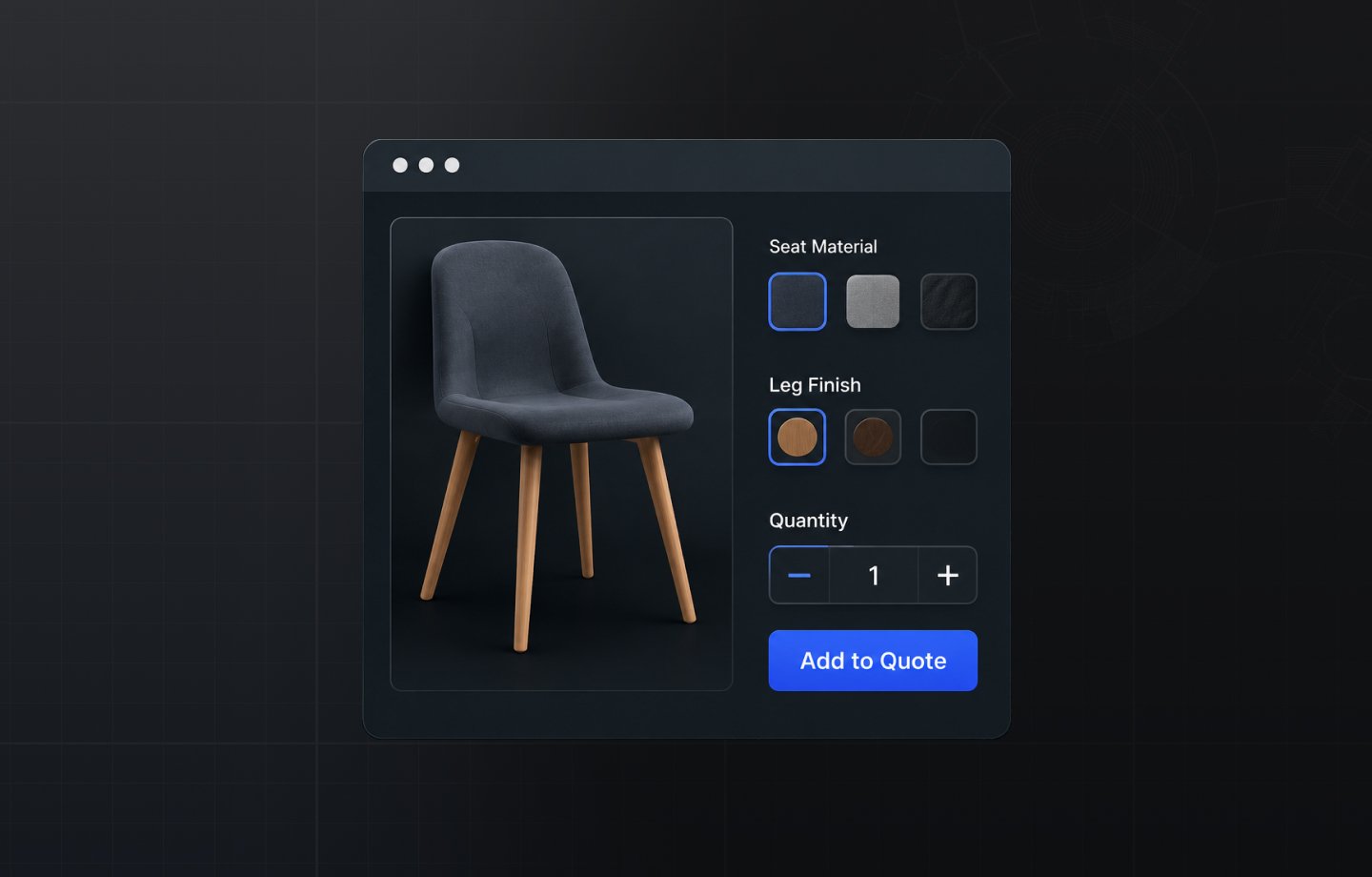
A product configurator is a tool that lets buyers assemble a product from selectable attributes, components, or specifications, rather than choosing from a fixed set of pre-built variants.
Shopify's native product model supports up to 2,048 variants per product. For many merchants, that is enough. For others, it is not close. A product with five independently variable attributes, each with ten options, generates 100,000 possible combinations. That cannot be managed as pre-built variants. A configurator is how you handle it.
At its core, a configurator does three things. It presents the available options in a structured, logical order. It applies conditional logic so that selecting one option updates or restricts what appears next. And it calculates the price in real time based on whatever combination the buyer has built.
Configurator vs. Customizer: What Is the Difference?
These terms are used interchangeably in most app listings, but they describe meaningfully different capabilities.
Customizer: Adds personalization to a fixed product (text, images, colors). Typical use case: Print-on-demand, branded merchandise, engraving. Quote workflow needed: Rarely.
Option-Based Configurator: Extends Shopify variants with conditional logic and dynamic pricing. Typical use case: B2B products with multiple spec variables. Quote workflow needed: Sometimes.
CPQ-Connected Configurator: Full configure, price, quote workflow with rep review and approval. Typical use case: Complex B2B orders, custom manufacturing, engineered products. Quote workflow needed: Yes.
A customizer is a B2C tool. It adds a name to a water bottle or a logo to a hat. It enhances an existing product without changing what the product fundamentally is.
A configurator builds a product from its components. The buyer is not decorating something. They are specifying something. That difference matters enormously in B2B, where the configured output often needs to be reviewed, priced, and confirmed before it becomes an order.
All of this lands on the product page itself, which is why it helps to know how to optimize a B2B product page before you bolt a configurator onto it.
Why B2B Sellers Need a Configurator More Than Anyone
In B2C, a buyer who cannot find the exact product they want will leave. In B2B, a buyer who cannot configure what they need will call your rep.
That call is not a sign of a good relationship. It is a sign that your ordering process could not handle the request. The rep takes the spec over the phone, writes it down somewhere, and manually builds the order. That is time spent on data entry rather than selling.
B2B product complexity creates this problem at scale. Manufacturers and industrial distributors routinely deal with products that have dozens of configurable attributes: material grades, tolerances, finish types, connection specs, labeling requirements. Nowhere is that truer than in industrial machinery, where a single line item can carry a dozen interdependent specs. Getting those specs into Shopify as a clean, confirmed order, without a manual transcription step in the middle, is the operational problem a configurator solves.
The CPQ market reflects how significant this problem is. From $3.5 billion in 2025, the configure, price, quote software segment is projected to reach $10.84 billion by 2035, growing at 16.5% annually. That growth is driven almost entirely by B2B buyers who want to specify and purchase complex products without a rep in the loop for every transaction.
Where Shopify's Native Product Model Stops
Shopify handles simple configuration well. If your product has a handful of variants and pricing can be set at the variant level, you may not need a configurator at all. Manufacturers leaving a platform like Shopware often assume they must rebuild that configuration logic from scratch, when Shopify can carry most of it.
The native model runs into limits when:
Variant count exceeds what is manageable. 2,048 variants sounds like a lot until you are building a catalog for a product with interdependent specs. Shopify stores the data, but the merchant has to create and manage every combination manually.
Conditional logic is required. Shopify's variant selectors do not hide or restrict options based on upstream choices. If a buyer selects aluminum as the material, the finish options for steel should disappear from view. Native Shopify cannot do this without a third-party layer.
Pricing depends on the configuration. Shopify supports variant-level pricing, but it cannot calculate a price based on a formula involving multiple selected attributes. An option-based configurator handles this through dynamic pricing rules.
The configured output needs to become a structured quote. This is where most configurator apps stop, and where the real gap in B2B workflows lives.
The Part Most Guides Miss: Configuration Is Not the Order
Every guide on product configurators treats the configured output as the end of the process. The buyer selects their options, the price updates, they add to cart, and they check out.
That works in B2C. In B2B, it often does not.
A purchasing manager at a manufacturing facility who has just configured a $28,000 order of custom-spec components cannot click Add to Cart and expect that to process. The order needs to be reviewed by an approver. The pricing needs to be confirmed against the account's negotiated rate. In some cases, engineering or operations needs to sign off that the specification is producible before the order is accepted. An Epicor integration is often what turns that configured spec into an order the plant can actually schedule and make.
What the configurator generates in B2B is not a cart item. It is a specification document. The next step is not checkout. It is a quote.
Across 380+ Shopify commerce storefronts since 2013, Uncap has seen this gap consistently in industrial, building materials, and auto parts verticals: merchants add a product configurator, buyers use it to build accurate specs, and then everything stalls because the platform has no structured way to turn that configured spec into a reviewable, quotable, approvable document.
Understanding how draft orders work in Shopify is foundational here. Draft orders are the native mechanism for holding a configured order in a reviewable state before it is confirmed, and they are the bridge between the configurator and the quote workflow.
What to Look For in a B2B Product Configurator on Shopify
Not all configurators are built for B2B workflows. Here is what separates the ones that hold up from the ones that create problems downstream.
What a B2B-ready product configurator needs: Conditional logic that restricts options based on upstream selections, so buyers cannot configure combinations that are not producible. Dynamic pricing that applies account-specific rates, tiered pricing, and volume discounts to the configured output. A structured output format that captures the full specification and can feed into a quote workflow, not just a standard cart. Integration with Shopify's B2B features: company accounts, contact-level permissions, and negotiated pricing. And a clear path from configured product to rep-reviewed order, not a direct-to-checkout assumption that bypasses the approval chain.
The Quote Request App handles the connection between configuration and quotation, letting buyers submit their configured spec for rep review rather than sending it straight to checkout. That is the piece that makes a configurator viable for high-value or custom-spec B2B orders.
The Configurator Is the Front End. The Workflow Is the Rest.
Adding a product configurator to your Shopify store solves the specification problem. Buyers can define what they need in structured terms, without a phone call.
But in B2B, the specification is only half the job. The other half is what happens next: rep review, custom pricing, quote approval, and order confirmation. Shopify's B2B product configurator capabilities have matured significantly, but the native platform still assumes a direct path to checkout that does not fit most complex B2B scenarios.
That gap is where Uncap Quotes comes in. Buyers configure and price themselves against their own negotiated terms, approvals route to the right approver, and every quote carries a validity window and a full revision history. An approved quote becomes a Shopify cart and order in a single click, without anyone rebuilding it from scratch.
The configurator gives buyers control over the specification. The quote workflow gives your team control over the deal. Both halves need to work together.
Talk to Our Experts and see how Uncap connects product configuration to the full B2B quote and order workflow on Shopify.
Frequently asked questions
What is a product configurator on Shopify?
A tool that lets buyers assemble a product from selectable attributes and specifications instead of picking from pre-built variants, presenting options in order, applying conditional logic, and pricing the combination in real time.
When do you need a configurator instead of variants?
Shopify supports up to 2,048 variants per product. A product with five independent attributes of ten options each has 100,000 combinations, which cannot be managed as variants. That is configurator territory.
What is the difference between a configurator and a customizer?
A configurator builds a product from structured technical attributes, lengths, gauges, materials, while a customizer handles visual personalization like monograms and colors. B2B buying is overwhelmingly the former.
Why is configuration only the beginning of the B2B workflow?
In B2B, a configured product usually flows into a quote, an approval, and an ERP-visible order rather than straight to checkout. A configurator that ignores that downstream workflow creates a different kind of mess.