

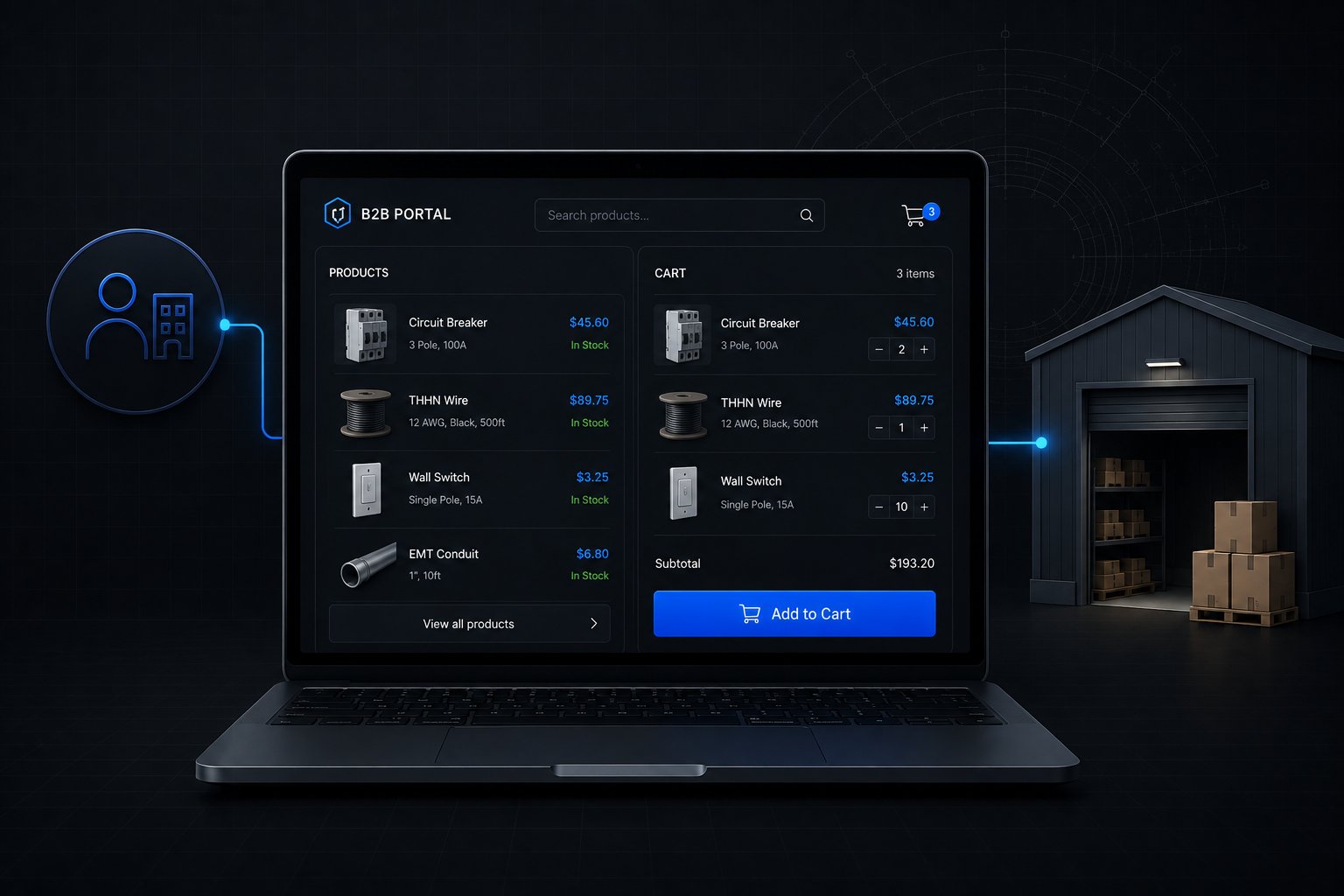
Electrical distributors are building B2B online ordering portals by deploying Shopify B2B with company accounts, account-specific price lists mapped to contractor multipliers, real-time Eclipse ERP inventory, and cut-to-length wire ordering. The portal replicates the branch counter experience digitally: contractors log in, see their negotiated multipliers applied to manufacturer list prices, and submit project and MRO orders 24/7 without calling a sales rep.
What a B2B Portal Must Handle for Electrical Distribution
Pricing Model
What Electrical Distributors Need: Multiplier off manufacturer list price, by account and product category
Wire and Cable
What Electrical Distributors Need: Cut-to-length ordering (per foot), spool sizes (250 ft, 500 ft), continuous UOM
ERP Integration
What Electrical Distributors Need: Eclipse (Epicor), SAP Business One, NetSuite with real-time ATP and branch inventory
Account Tiers
What Electrical Distributors Need: Residential contractor, C&I contractor, MRO buyer, utility contractor
Order Types
What Electrical Distributors Need: MRO (small, frequent) and project orders (large, quote-driven take-off lists)
Product Data
What Electrical Distributors Need: IDEA-standard content: part number, UNSPSC code, specifications, images
Terms
What Electrical Distributors Need: Net 30/60/90 per account, vaulted payment methods
Portal Access
What Electrical Distributors Need: 24/7 self-serve with account history, invoice access, reorder from saved lists
The Electrical Distribution Market Is Largely Still Offline
The US electrical distribution industry generates over $130 billion in annual revenue through a network of more than 3,600 NAED-member distributors, regional independents, and specialty wholesalers. Yet according to data published by the National Association of Electrical Distributors, the average distributor generates just 4.3% of revenue through their website. Even the top performers reach only 7.7%.
That offline concentration is not a technology failure. It reflects the genuine complexity of how electrical distribution pricing and ordering works. A general contractor calling a branch knows their rep, knows their negotiated multiplier on each product category, and trusts that the price on the counter ticket is right. Building that same confidence into a digital portal requires solving problems that most B2B ecommerce platforms were not designed for.
The market is shifting anyway. ADP Research data shows that 45% of electricians and electrical contractors are now under 40. These buyers expect to place orders from a job site tablet at 10 PM. They do not want to wait until 7 AM when the branch opens. National players including Wesco International, Graybar Electric, Sonepar USA, and Border States Electric have all invested heavily in digital channels. Sonepar alone has committed over €2.5 billion to supply chain and digital platform modernization. Independent regional distributors who delay portal adoption are already losing project orders to these better-capitalized competitors.
Statista projects global B2B ecommerce revenue will reach $25.65 trillion by 2028, accelerated by exactly the kind of trade buyer digitization happening in electrical supply. The distributors building portals now are capturing that shift before it becomes a survival issue.
Three Forces Accelerating Digital Adoption
1. The Generational Handoff in Electrical Contracting
The electrical contractor buying base is turning over. The master electricians who built relationships with branch counter staff over decades are retiring. The project managers and purchasing coordinators replacing them grew up ordering online. They do not view a phone call to confirm a price as a relationship touchpoint. They view it as friction.
This cohort makes purchasing decisions from tablets and phones at the job site. When they search for a 200-amp main breaker panel or THHN 12-gauge wire by the foot, they want to find it on a portal where their account multipliers are already applied. If they cannot, they find a distributor whose portal works.
2. National Competitors Have Set the Digital Baseline
Wesco, Graybar, and Sonepar now generate meaningful percentages of their revenue through digital channels. Their portals support punchout integration with contractor procurement systems, barcode scanning for reorders, and real-time branch inventory. When an electrical contractor compares a regional distributor's portal against a national account's digital experience, the gap is visible.
Regional independents have advantages that nationals cannot replicate: local inventory depth, project expertise, and account relationships. A portal does not replace those advantages. It amplifies them by making the distributor's inventory and pricing accessible at 2 AM when a contractor is building a take-off list.
3. Project Complexity Is Increasing, Not Decreasing
Commercial and industrial electrical projects are getting more complex. Data center buildouts, EV charging infrastructure, and solar interconnects involve large material lists with time-sensitive delivery windows. Contractors managing these projects need a portal where they can upload a take-off list, verify branch-level stock on each line item, and request a quote on anything not in stock, all in a single session.
Distributors still routing these requests through phone calls and email are creating a competitive opening for any rival who has solved the workflow digitally.
What Makes Electrical Distribution Harder Than Other Trades
Most B2B ecommerce platforms, including many built for distribution, are designed around a simple model: a buyer has a customer-specific price for each SKU, and the portal shows that price. Electrical distribution does not work that way. Understanding the actual pricing and product structure is the prerequisite for building a portal that contractors will use.
Multiplier-Based Pricing Off Manufacturer List
Electrical distribution pricing is built on the multiplier model. Every major manufacturer (Eaton, Schneider Electric, Leviton, Southwire, Hubbell, ABB) publishes a book price, called the list price, for every product. Distributors negotiate a "multiplier" or "discount factor" that applies to that list price to derive the customer's net cost.
A residential electrical contractor might carry a multiplier of 0.45 on breakers and 0.62 on conduit from a specific branch. A large C&I contractor doing a hospital project might negotiate different multipliers by product category because of volume commitments. A utility contractor working under a framework agreement carries yet another rate structure.
This multiplier architecture means the portal cannot simply store a flat net price per SKU per account. The underlying logic must:
- Map each account to its multiplier schedule by product category
- Apply the correct multiplier when a customer views a product
- Update net prices when the manufacturer changes list pricing, without requiring manual re-entry for thousands of accounts
- Support exceptions where specific projects have negotiated project pricing that overrides the standing account multiplier
Shopify B2B handles this through its catalog and price list architecture. Each contractor company account is assigned a catalog. Each catalog carries a price list. The price list stores the pre-calculated net price for that account tier. When manufacturer list prices change, the ERP integration recalculates and pushes updated net prices to the correct price lists automatically. The portal always displays the right number.
Wire and Cable: Cut-to-Length Ordering
Wire and cable represent a significant revenue category for most electrical distributors, and they break nearly every standard ecommerce UOM assumption. THHN building wire, XHHW-2 wet-rated wire, MC cable, and armored cable are all sold by the foot. A contractor ordering 375 feet of 12-gauge THHN red does not want to choose between a 250-foot spool and a 500-foot spool. They want to enter "375" and receive 375 feet.
The portal must support:
- Continuous quantity input in feet, with price-per-foot calculated from the account multiplier
- Minimum order quantity rules (typically 1 foot, with some products requiring a minimum spool)
- Cut charge logic where applicable
- Inventory display showing available footage at each branch, not just spool counts
This requires custom UOM handling that connects the portal's line item quantity to the ERP's inventory unit. Eclipse (Epicor), which tracks wire in feet at the branch level, exposes this data through its API. The integration must translate the portal's "375 feet" request into the correct Eclipse transaction, confirm available footage, and reserve the correct quantity without breaking the spool inventory logic.
Eclipse ERP Integration Specifics
Epicor Eclipse is the dominant ERP among US electrical distributors. Wesco's legacy branches, Graybar, Border States, and hundreds of regional independents run Eclipse. The platform was purpose-built for electrical and datacom distribution, which is why it handles branch inventory, multiplier pricing, and wire footage natively, but also why integrating it with modern ecommerce requires specific API work.
Eclipse exposes data through its REST API (introduced in more recent versions) and through legacy ODBC/direct database connections in older installations. Key data flows for a portal integration include:
- Item master and list pricing: Product records with manufacturer part numbers, IDEA-standard descriptions, and current list prices, pulled to populate the portal catalog
- Account-specific net pricing: Customer pricing records including multiplier schedules by product group, pushed to Shopify Plus price lists
- Branch-level available-to-promise (ATP): Real-time inventory by branch location, including will-call availability and transfer lead times from the distribution center
- Order entry and confirmation: Portal orders submitted as Eclipse sales orders with the correct ship-from branch, customer PO reference, and line-item detail
- Order status and invoice: Open order status, shipment confirmations, and invoice records surfaced in the portal account dashboard
Distributors running Epicor Prophet 21 (more common in industrial distribution) or NetSuite follow a similar integration pattern with different API endpoints. The core requirement is the same: the portal must be a real-time window into the ERP, not a separate catalog with nightly sync delays.
Distributors in adjacent trades are working through the same shift from phone and counter orders to self-serve portals, and the parallels are clear in how farm supply distributors are moving wholesale ordering online.
MRO Orders vs. Project Orders: Two Distinct Workflows
An electrical distributor's customer base places two fundamentally different order types, and a portal that handles one well but ignores the other will underperform.
MRO (maintenance, repair, and operations) orders are small, frequent, and predictable. A facilities manager at a manufacturing plant ordering replacement breakers, outlets, and conduit fittings knows exactly what they need. They want to find it fast, see their price, and submit. Saved order lists and barcode/part-number search are the key portal features for this buyer.
Project orders are large, quote-driven, and tied to a specific job. A C&I electrical contractor building a commercial tenant improvement project has a take-off list: 47 line items across wire, conduit, panels, devices, and fittings. They need to upload that list, verify branch stock on each item, flag unavailable items for a quote, and get a project-specific price on the full order before committing.
The portal must support both workflows without conflating them. MRO buyers need a fast reorder path. Project buyers need a quote-to-order workflow where the sales rep can review the take-off, apply project pricing, and release it back to the portal for the contractor's approval and submission. For the fast reorder path, Uncap Portal gives trade accounts a self-serve home on Shopify, with reorder lists and order history a click away.
IDEA Product Data Standards
The Industry Data Exchange Association (IDEA) administers the electrical industry's standard for product content. IDEA-compliant product records carry standardized attributes: UNSPSC commodity codes, manufacturer part numbers, descriptions to a defined character limit, technical specifications (voltage rating, amperage, wire gauge range), and compliance documentation (UL listing, RoHS status).
A portal catalog that does not conform to IDEA standards will have inconsistent product descriptions, missing specs, and search results that fail to match how electricians actually search (by part number, by spec, or by application). Integrating a PIM or data feed from IDEA Connector ensures catalog quality that matches what contractors expect after using national distributor portals that have invested in product content.
Mapping Contractor Account Tiers to Shopify Plus
Shopify's native B2B infrastructure was built for exactly this type of tiered account structure. The mapping from electrical distribution account types to Shopify B2B entities is direct.
Residential electrical contractors represent the highest volume, lowest margin tier. These accounts typically carry the highest multiplier (meaning the smallest discount from list). They order frequently, in moderate quantities, and are the most likely to respond to 24/7 self-service. Shopify B2B company accounts for this tier carry a catalog with residential contractor price lists and default Net 30 payment terms.
Commercial and industrial (C&I) contractors manage larger projects with larger orders and have negotiated better multipliers because of volume commitments. These accounts often need purchase order approval workflows, project-based pricing overrides, and quote submission capabilities. Shopify supports multiple buyers per company location with Ordering only and Location admin permissions, and you can set a location to submit every order as a draft for your team's review. An approval chain inside the contractor's own company is not native and needs an app or custom build. Our Shopify B2B portal guide covers what the native layer handles and where it stops.
MRO buyers at facilities, plants, and property management firms order on replenishment cycles rather than project schedules. They benefit most from saved order templates and recurring order functionality. Shopify's B2B customer accounts support order history and reorders that duplicate a past order into the cart, which enables this workflow.
Utility contractors and framework agreement accounts carry the most complex pricing, often with contract-specific multipliers negotiated at the project level. These accounts typically remain partially managed by the sales team, with the portal handling reorders and order status while project quotes stay in the ERP.
Multiple buyers within a single contractor company account, each with their own login and permission, are handled natively through Shopify B2B's company location structure and its two permissions, Ordering only and Location admin. A general contractor with three project superintendents can each have portal access while the account's billing and credit remain centralized.
Net payment terms (Net 30, Net 60, Net 90) are configured per company location in Shopify B2B, matching the terms already established in Eclipse. Vaulted credit cards let frequent MRO buyers check out without re-entering card details every time.
For a deeper look at how these B2B portal capabilities fit into a broader Shopify Plus implementation, the enterprise ecommerce replatforming checklist covers the evaluation and migration stages that electrical distributors typically work through. Many arrive carrying this logic on a strained Optimizely build that was never designed for multiplier pricing or wire footage.
Uncap Connect: Five Data Flows for Electrical Distributors
Uncap Connect is the real-time data layer between Shopify, your ERP, and the warehouse floor. It is embedded natively inside Shopify, with no separate middleware platform to maintain, and it is ERP-agnostic: for Eclipse, Prophet 21, NetSuite, or another ERP, the Uncap team confirms fit and the depth of sync directly.
Data Flow 1: Product Catalog and IDEA-Standard ContentEclipse item master records are synchronized to Shopify Plus product listings with IDEA-compliant descriptions, manufacturer part numbers, UNSPSC codes, and technical specifications. Wire and cable products carry footage-based UOM configuration. New products added in Eclipse appear on the portal within the sync window. Discontinued items are depublished automatically.
Data Flow 2: Account-Specific Multiplier PricingCustomer pricing records in Eclipse, including multiplier schedules by product category and any account-level exceptions, are translated into Shopify Plus price lists and assigned to the corresponding company catalog. When manufacturer list prices change in Eclipse, the recalculated net prices push to Shopify Plus price lists automatically, keeping every account's portal pricing current without manual intervention.
Data Flow 3: Real-Time Branch Inventory (ATP)Available-to-promise quantities at each branch location are surfaced on the product page: "In stock at [branch name]" with quantity available and will-call cutoff times. For products available on transfer from the distribution center, transfer lead times display alongside local stock. Wire and cable products show available footage per branch. This branch-level inventory visibility is the single most-requested feature by contractors who have used generic portals showing only aggregate stock.
Data Flow 4: Order Entry and ConfirmationSubmitted portal orders are written into Eclipse as sales orders with the correct ship-from branch, customer PO number, requested delivery date, and line-item detail including wire footage specifications. Order confirmation numbers return to the portal in real time. The customer sees their order acknowledged and assigned an order number before they close the browser.
Data Flow 5: Order Status, Invoices, and Account HistoryOpen orders, shipment notifications, and invoice records from Eclipse are surfaced in the Shopify Plus account dashboard. A contractor can check order status, download a PDF invoice, and view 12 months of purchase history without calling the branch. For the B2B distributor solutions pattern, this self-service account visibility is what reduces inbound branch calls most significantly.
Implementation: Four Phases, 16 Weeks
Electrical distributor portal implementations follow a predictable sequence. The Eclipse integration requires the most lead time because of the pricing complexity and wire UOM configuration, but the overall timeline is shorter than many distributors expect.
Phase 1: Discovery and Data Architecture (Weeks 1 to 3)
The integration team maps Eclipse customer account records to Shopify Plus company structures. This is where multiplier schedule complexity surfaces: how many distinct pricing tiers exist, whether project overrides are managed in Eclipse or outside it, and which product categories carry category-specific multipliers versus flat account multipliers. Wire and cable UOM configurations are scoped and tested against real Eclipse inventory records. IDEA content gaps in the Eclipse item master are identified for remediation before catalog import.
Phase 2: ERP Integration and Catalog Build (Weeks 4 to 9)
Uncap Connect is set up inside Shopify and the Eclipse API connections are established. Product catalog synchronization runs against the full item master. Price list builds are validated account-by-account against Eclipse pricing records to confirm multipliers are applying correctly. Branch inventory ATP feeds are tested against live Eclipse data. This phase typically surfaces edge cases in the multiplier logic, particularly accounts with category exceptions, that require configuration adjustments before proceeding.
Phase 3: Storefront Build and Account Configuration (Weeks 10 to 13)
The Shopify Plus storefront is configured with the contractor account structure: company accounts, catalogs, price lists, buyer roles, and net terms per tier. Wire and cable product pages are built with cut-to-length quantity inputs and per-foot pricing display. MRO saved list functionality is configured. The quote-to-order workflow for project accounts is tested with the sales team. A representative set of contractor accounts are onboarded to the portal for user acceptance testing.
Phase 4: Pilot Launch and Full Rollout (Weeks 14 to 16)
A controlled pilot with 20 to 50 active contractor accounts runs for two weeks. The sales team monitors portal orders against branch call volume for the pilot group to confirm that the portal is handling order types correctly and that pricing accuracy is confirmed across accounts. Edge cases identified in the pilot (unusual multiplier configurations, wire footage orders at minimums) are resolved before branch-wide rollout. Full account onboarding follows with branch staff trained to direct customers to the portal for MRO orders while maintaining sales rep engagement on project quotes.
Ready to Build Your B2B Ordering Portal?
Uncap has built B2B portals for electrical distributors, HVAC wholesalers, and industrial supply companies since 2013, with 380+ storefronts launched on Shopify. If you are running Eclipse, Prophet 21, or another distribution ERP and want to see how the multiplier pricing and wire/cable UOM configuration works in practice, the next step is a conversation with a Shopify Platinum Partner who has done this before.
Book a Strategy Session and we will map your specific account tiers, ERP, and product catalog to a portal architecture that your contractors will actually use.
Frequently asked questions
What is a B2B online ordering portal for electrical distributors?
A B2B online ordering portal is a password-protected ecommerce site where electrical contractors and MRO buyers log in with their account credentials, see their negotiated pricing, view real-time branch inventory, and place orders without calling the branch. It replicates the branch counter experience digitally, available 24/7 from a job site device.
How does contractor multiplier pricing work on a portal?
Each contractor account carries a multiplier schedule applied against manufacturer list prices to derive the net price by product category. On the portal, this is implemented through Shopify Plus price lists: the ERP calculates the net price for each account and product, pushes it to the portal's price list, and the contractor sees their correct price every time they log in.
Which ERP systems do electrical distributor portals integrate with?
The most common ERP for US electrical distributors is Epicor Eclipse. Prophet 21 (also Epicor) is common in broader industrial distribution. NetSuite, SAP Business One, and Microsoft Dynamics 365 appear in mid-market and larger distributors. The portal integration connects to whichever ERP runs the distributor's pricing and inventory.
How do portals handle wire and cable sold by the foot?
Wire and cable products require continuous UOM configuration. The portal accepts a footage quantity, prices it at the account's per-foot rate (derived from the multiplier), and submits the order to the ERP in footage units. The ERP confirms available footage at the branch and reserves the quantity without breaking spool inventory records.
What is the NAED, and why does it matter for portal adoption?
The National Association of Electrical Distributors is the US trade association for electrical wholesale distributors. NAED tracks digital adoption data across the industry. As of 2022, NAED data showed average distributor website revenue at 4.3% of total sales, with top performers at 7.7%. This benchmark illustrates both how far behind the industry is digitally and the upside available to distributors who build effective portals.
How are MRO and project orders handled differently on a portal?
MRO orders benefit from saved order lists, part-number search, and fast reorder from account history. Project orders require a take-off list upload workflow, line-item stock verification, and a quote request path for items not in stock or requiring project pricing. A well-designed portal supports both workflows without requiring the buyer to use different systems.
Can multiple buyers from the same contractor company have portal access?
Yes. Shopify B2B company accounts support multiple buyer logins per company location, each with Ordering only or Location admin permission. A general contractor with three project superintendents can give each a portal login while billing and payment terms stay set on the company location.
What is IDEA and how does it affect electrical portal catalog quality?
IDEA (Industry Data Exchange Association) administers the electrical industry's product content standard. IDEA-compliant product records carry standardized descriptions, manufacturer part numbers, UNSPSC codes, and technical specifications. Portals built on IDEA-standard content have accurate search results and complete spec data that match what contractors expect from national distributor portals.
How long does it take to build an electrical distributor portal?
A full implementation, covering Eclipse integration, catalog build, contractor account configuration, and pilot launch, typically runs 16 weeks. The timeline is driven primarily by the multiplier pricing configuration complexity and wire/cable UOM setup. Distributors with cleaner Eclipse customer pricing data in well-defined tiers move faster.
What results do electrical distributors see after launching a portal?
Results vary by distributor size and the starting point for digital sales. Electrical distributors who have invested in digital channels and ERP-integrated portals report significant shifts in how revenue is captured: orders placed outside business hours, reduced inbound calls for routine reorders, and increased average order values as contractors use the portal to build complete project material lists. The how to choose an enterprise ecommerce platform guide covers the platform evaluation criteria distributors use when making this investment.