

What Changed for B2B in Shopify's Summer 2026 Editions
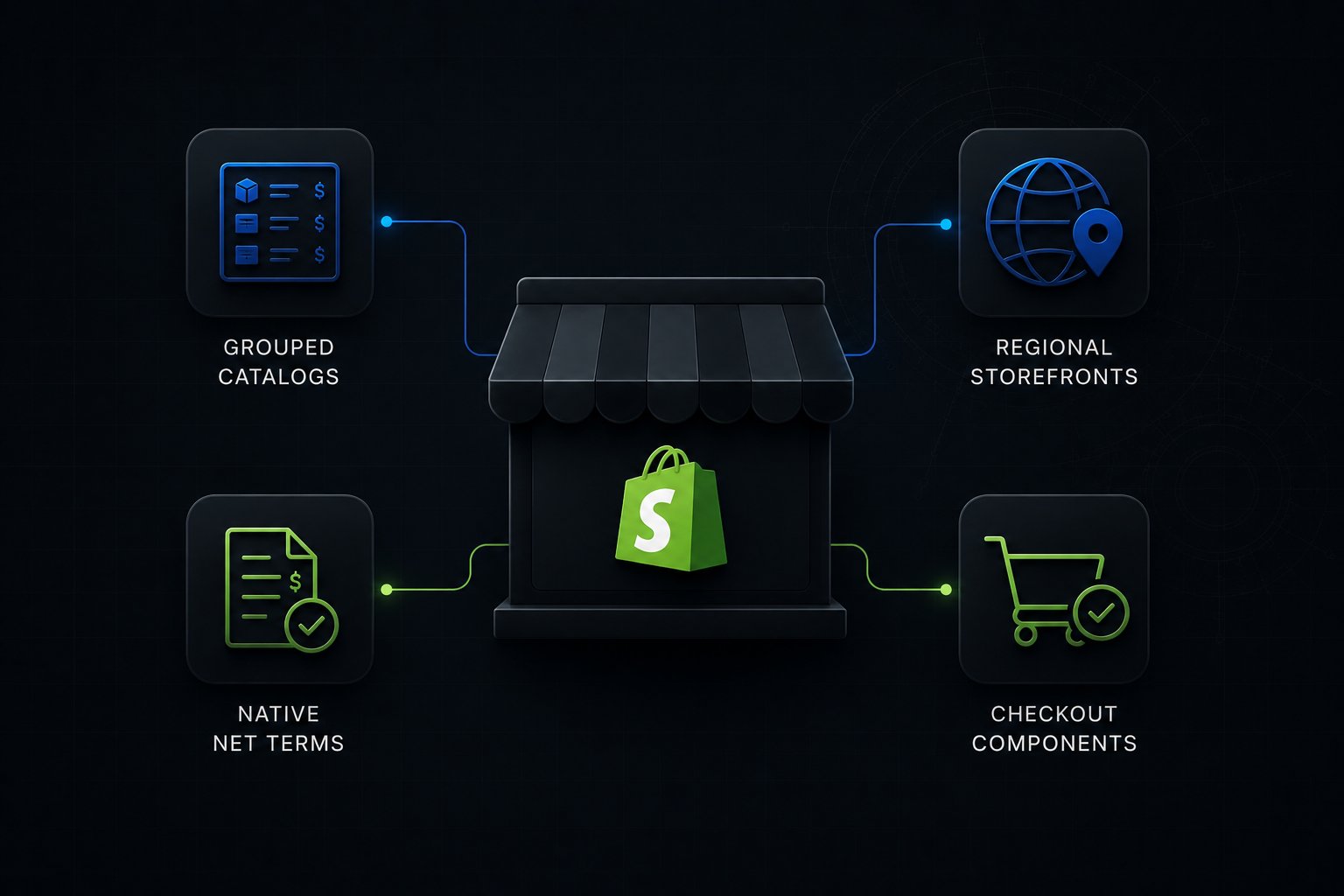
Shopify's Summer 2026 Editions (officially named "Spring '26" on Shopify's site, released June 17, 2026) shipped 150+ updates under the "Horizons" theme. For B2B and wholesale merchants, the most significant changes are: grouped catalog publishing with atomic save-and-discard, native Net Terms with automated invoicing, region-specific B2B storefronts with market-level catalogs and themes, VAT number validation, B2B gift cards, and Checkout Components reaching general availability on Shopify Plus. These Summer '26 features arrive after a full year of B2B investment that included 12 dedicated B2B updates in Winter '26 (January 2026) and the April 2026 expansion of foundational B2B to merchants on every Shopify plan.
One deadline runs parallel to all of this. Shopify Scripts stop executing entirely on June 30, 2026. Any B2B-specific payment logic, volume discount rule, or wholesale shipping customization still running on Scripts will fail silently from July 1 onward unless it has been ported to Shopify Functions.
For manufacturers and distributors managing ERP-connected Shopify stores, 2026 represents the most operationally dense year in Shopify's B2B history. This guide covers every change, what each one means for your operation, and what to act on first.
Why 2026 Is the Year B2B Merchants Cannot Look Away
Shopify has been building its B2B layer since it launched natively on Plus in late 2022. For the first three years, those features were Plus-only and each Editions cycle added incrementally. 2026 changed the cadence. Three separate waves of B2B investment landed in a six-month window, each one structural rather than incremental.
The global B2B ecommerce market is valued at $36 trillion and Shopify has been explicit about its intent to own more of that number. The pace of the 2026 releases reflects that priority. If you have been watching Shopify's B2B roadmap at arm's length and waiting for the platform to mature before committing your wholesale operations to it, the 2026 release sequence answers that question clearly. In medical and dental distribution, that commitment only pays off once contract pricing and account structure are set up correctly first.
The Full 2026 B2B Release Timeline
Understanding Summer '26 in isolation misses the architecture. Each release builds on the last.
January 20, 2026
Release: Winter '26 Editions ("Renaissance")
B2B Scope: 12 dedicated B2B features including ACH, EDI, ERP integrations, Payment Functions, and Sidekick company creation
April 2, 2026
Release: B2B for All
B2B Scope: Foundational B2B extended to Basic, Grow, and Advanced plans for the first time
June 17, 2026
Release: Summer '26 Editions ("Horizons")
B2B Scope: Grouped catalog publishing, native Net Terms, region-specific B2B storefronts, VAT validation, B2B gift cards, and Checkout Components GA
June 30, 2026
Release: Scripts Sunset
B2B Scope: Hard deadline: all Shopify Scripts cease executing
What follows covers each wave in sequence, with detail on what each feature does and what it replaces.
Wave One: Winter '26 Editions B2B Features (January 2026)
The Winter '26 Editions, released January 20, 2026, is where Shopify's 2026 B2B push began. Twelve features shipped specifically for wholesale and B2B operations.
ACH payments at B2B checkout. US-based B2B buyers can now pay directly from a bank account at checkout, without a credit card or invoice workflow. For manufacturers processing large wholesale orders, this eliminates the friction of chasing card authorizations on high-value purchases.
Payment requests per fulfillment. Merchants can now send separate payment requests tied to individual shipments within a single order. For distributors shipping partial orders across multiple warehouse locations, this resolves the long-standing problem of invoicing against a complete order when only part of it has left the warehouse.
Three new ERP integrations in the Shopify ecosystem. Shopify added Fulfil, Patchworks, and OmnifiCX by Kensium to its integration partner ecosystem in Winter '26. These additions expand the ERP connectivity options available natively within Shopify's partner program, complementing middleware solutions like the Uncap Connect that handle deeper, bidirectional ERP data flows.
EDI purchase order syncing. Two EDI partners, SPS Commerce and Crstl, now convert inbound EDI purchase orders directly into draft orders inside Shopify. For manufacturers and distributors serving major retail buyers who still send POs over EDI, this eliminates the manual re-keying step that historically required a separate integration layer.
Dynamic payment terms and deposits via Shopify Functions. Payment Customization Functions now let merchants set conditional payment terms and required deposits programmatically. A B2B store can require a 30% deposit on orders above a threshold, offer net-30 only to verified company accounts, or show invoice payment only to specific customer segments, all without a third-party app.
Order review rules. Payment Customization Functions also power a new order review mechanism that flags orders for manual approval before they process. Distributors selling regulated products or manufacturers managing large-volume dealer accounts can set rules that route certain orders for review automatically.
Sidekick creates B2B companies via natural language. Instead of manually building out company records in Shopify admin, merchants can prompt Sidekick to create a new company, set its payment terms, and assign a catalog, all in a conversational interface. The B2B company importer app, also released in Winter '26, handles bulk imports from spreadsheets for merchants migrating wholesale account lists from another platform or ERP.
Store credit for B2B company locations. Store credit can now be assigned at the company location level, not just the company level. For distributors with buyers across multiple branches or shipping addresses, this enables location-specific credit management without custom development.
Pickup in store for B2B. B2B buyers can now select in-store pickup at checkout, bringing the same omnichannel fulfillment options that DTC buyers have had to wholesale accounts.
Eleven new B2B-compatible apps. Shopify's app ecosystem added eleven apps in Winter '26 specifically built for B2B compatibility, covering quoting workflows, buyer role management, approval flows, and shopping lists. Features that previously required custom development or workarounds with DTC apps designed for a different use case now have native app-store equivalents.
Horizon theme for B2B. Shopify's new Horizon starter theme launched in Winter '26 with built-in support for B2B-specific display elements: volume pricing tables, quantity rules, and quick order lists that let wholesale buyers add multiple SKUs in a single action.
The brands that made this jump early offer a useful reference point, and we profile ten B2B businesses that migrated to Shopify Plus and what changed for each.
Wave Two: B2B for All (April 2, 2026)
On April 2, 2026, Shopify announced a structural change to how B2B is distributed across its plan tiers. For the first time, merchants on Basic, Grow, and Advanced plans received access to foundational B2B features at no additional cost.
The features now available on every Shopify plan include: company profiles for wholesale buyers, up to three custom catalogs with tailored pricing per customer segment, volume discounts and quantity rules, vaulted credit cards, and payment terms.
For merchants who had been running wholesale through a combination of lock-screen workarounds, separate storefronts, or third-party apps on non-Plus plans, this removes the primary reason to maintain that infrastructure. For merchants considering whether to move their wholesale operations to Shopify at all, the minimum viable plan cost dropped significantly.
The data behind this decision is compelling. According to Shopify's own research cited in the announcement, merchants using Shopify B2B see up to a 4.1x increase in reorder frequency compared to DTC orders, a 33% increase in self-serve orders within six months of adoption, and a 20% increase in reorder frequency overall. Snyder Performance Engineering, one of the case studies featured, reported a 25% reduction in time spent on back-office tasks and a 40% increase in average customer spend after consolidating wholesale onto Shopify B2B.
The distinction between plans remains meaningful. Plus merchants keep unlimited catalogs, direct catalog assignment to companies and locations, partial payments, and deposits. Non-Plus merchants are limited to three catalogs. For merchants with complex multi-tier pricing across many customer segments, that catalog limit is a real constraint, and Plus remains the appropriate tier. For merchants just starting their wholesale channel or running a single-tier wholesale operation, the non-Plus plan is now a viable starting point.
Wave Three: Summer '26 Editions B2B Features (June 17, 2026)
The Summer '26 Editions, released June 17, 2026 under the "Horizons" theme, delivered the most significant structural B2B additions of the year. These features extend what Winter '26 built and address specific workflow gaps that have required third-party apps.
Grouped Catalog Publishing
Before Summer '26, editing a Shopify B2B catalog was a piecemeal operation. Changes to individual items within a catalog published immediately, which meant a partial price update visible to buyers during the editing window. The grouped catalog publishing feature introduced in Summer '26 lets merchants save a complete set of catalog edits as a pending batch and publish or discard them all at once.
For distributors managing seasonal pricing updates or manufacturers running promotional pricing windows, this eliminates the risk of a half-published price list visible to buyers during the editing session. It also makes catalog management safe to delegate to a team member without requiring a maintenance window.
Native Net Terms with Automated Invoicing
Native Net Terms arrives as a direct replacement for third-party net terms and invoicing apps on Shopify. The feature lets merchants set payment terms at the company level, generates invoices automatically when orders are placed, and tracks outstanding balances against those terms.
For wholesale operations that have been running net terms through a separate invoicing app, the most immediate question is whether the native implementation covers their approval and credit workflow. For straightforward net-30 or net-60 setups with standard invoice generation, the native feature is likely sufficient to cancel a paid app. For operations with complex credit limit management, multi-currency net terms, or dispute workflows, a period of parallel testing before app removal is advisable.
The combination of Native Net Terms with the ACH payment feature from Winter '26 creates a complete buy-now-pay-later workflow for B2B buyers in the US that is entirely native to Shopify.
Region-Specific B2B Storefronts
Summer '26 introduces the ability to create distinct B2B storefronts per market, with market-specific pricing, catalogs, and themes. A manufacturer selling to wholesale accounts in both North America and Europe can now serve each market a localized B2B experience from a single Shopify store, rather than maintaining separate stores or using catalog rules to approximate regional pricing.
This feature connects directly to Shopify Markets, which handles the underlying market-level configuration. Merchants already using Markets for DTC regional pricing will find the B2B extension of that infrastructure familiar.
For B2B operations managing currency and taxation across multiple geographies, region-specific storefronts reduce the configuration complexity that previously required either a multi-store architecture or significant custom development.
VAT Number Validation
B2B buyers in regions where VAT exemption applies to wholesale transactions can now enter and validate their VAT number at checkout. Shopify verifies the number against applicable registries and applies the correct VAT treatment to the order automatically. For merchants selling to business buyers in the EU and UK, this removes a manual verification step that previously required either a trust-based process or a third-party tax app.
B2B Gift Cards
Summer '26 adds B2B gift card acceptance, meaning gift cards issued by a Shopify store can now be redeemed at the B2B storefront. For manufacturers and distributors that offer promotional credits or loyalty programs through gift card mechanisms, this closes a gap that prevented gift card redemption on wholesale orders.
Checkout Components: General Availability on Plus
Checkout Components reached general availability on Shopify Plus with Summer '26. This feature gives Plus merchants drag-and-drop customization of the full post-cart checkout flow, including the information, shipping, and payment steps. Previously, Plus checkout customization was limited to branding and certain extension points. Composable checkout at the component level has been available on headless builds but not on native Shopify Plus.
For B2B merchants on Plus with complex checkout requirements, including multi-step order approval, conditional payment method visibility, or custom company verification at checkout, this represents a significant expansion of what is possible without a headless architecture. The feature also means that some merchants who were considering a headless migration specifically to gain checkout flexibility may find that native Plus now covers their requirements. That calculus changes fastest for teams coming off commercetools, where a headless build had outrun the team maintaining it.
AI Merchandising for B2B Catalogs
Summer '26 ships native AI merchandising in two forms: AI-driven collection sorting that orders products by real-time conversion probability, and predictive cross-sell product blocks. Both features work on B2B storefronts.
For wholesale buyers ordering through a self-serve portal, AI-sorted collections surface the products most likely to convert based on that buyer's behavior and similar buyers' patterns. For manufacturers with large SKU catalogs, this reduces the merchandising overhead of keeping collections manually sorted by sales priority.
The cross-sell blocks enable recommendations at the product and cart level that are computed from Shopify's order data, without the need for a separate recommendation app. Merchants currently paying for a recommendation engine should audit whether the native feature covers their use case before the next billing cycle.
Horizon Themes: All Ten Are B2B-Ready
Summer '26 released ten new free Horizon themes, and every one of them ships with B2B feature support built in: volume pricing display, quantity rules, quick order lists, and company account login flows. This matters for B2B merchants because theme compatibility with Shopify's native B2B features has historically been inconsistent, requiring theme modifications to expose the right elements for wholesale buyers.
A review of the B2B-specific theme display options is appropriate for any merchant running an older theme that was adapted for B2B rather than built for it.
The Scripts Sunset: What B2B Merchants Need to Act On Before June 30
Shopify Scripts stop executing entirely on June 30, 2026. Editing and publishing Scripts was locked on April 15, 2026. This deadline has a specific and serious implication for B2B merchants: the most common Scripts in wholesale operations are exactly the ones Shopify is retiring.
The three B2B Script types most at risk:
Payment Scripts that hide non-B2B payment methods. Many Plus stores use a Script to hide credit card payments or show "pay by invoice" only to verified B2B buyers. After June 30, that logic stops running and every payment method becomes visible to all buyers unless it has been rebuilt as a Payment Customization Function.
Volume discount Scripts. Tiered discount logic built on Scripts, such as "buy 10 units get 10% off, buy 25 get 15% off," stops applying silently on July 1. The correct migration target is a Discount Function, which compiles to WebAssembly and runs inside Shopify's infrastructure rather than as a Ruby script at checkout.
B2B-specific shipping Scripts. Free shipping thresholds, shipping method restrictions by customer tag, or B2B-only carrier options built on Scripts need to be ported to Delivery Customization Functions.
The migration is not a direct translation. Functions are compiled WebAssembly modules, not Ruby scripts, and they behave differently around discount stacking and ordering. Testing on a development store before June 30 is essential, and any store with complex stacking logic should allow at least a week of buffer for multiple test passes.
For B2B merchants who have been using Shopify Flow to automate wholesale operations, the news is straightforward: Shopify Flow automations are unaffected by the Scripts sunset. Flow is a separate system that is not being deprecated.
For merchants who need assistance migrating B2B-specific Scripts to Functions, this is a time-sensitive project, not a task to defer to the second half of July.
What Changes for Manufacturers and Distributors Specifically
The 2026 B2B wave has different implications depending on the complexity of the wholesale operation.
For manufacturers running dealer or distributor portals, the most impactful Summer '26 features are region-specific storefronts and grouped catalog publishing. Dealers in different geographies can now be served market-specific pricing from a single store, and seasonal price sheet updates can be staged and published in a single operation rather than incrementally.
The EDI integration from Winter '26 is equally significant for manufacturers whose retail customers send purchase orders via EDI. SPS Commerce and Crstl both convert inbound EDI POs into Shopify draft orders without a custom integration, which removes a step that has historically required either middleware or manual re-entry.
For distributors managing large SKU catalogs, grouped catalog publishing and AI merchandising address two recurring operational problems. Price updates that previously required careful sequencing to avoid a partially published state are now atomic. And AI collection sorting keeps high-converting SKUs visible to buyers without manual merchandising work.
For wholesale operations expanding internationally, the combination of region-specific B2B storefronts, VAT validation, and multi-currency payouts (expanded in June 2026 for US, Hong Kong, and Singapore merchants) removes three separate technical blockers that previously required custom development or multi-store architecture.
For merchants on non-Plus plans exploring wholesale, the B2B for All expansion means the starting point has changed materially. A merchant on an Advanced plan can now run a three-catalog B2B operation with payment terms natively, where previously this required Plus or a collection of third-party apps. The practical question is whether three catalogs are sufficient for the pricing complexity of the business. For most small-to-mid-sized wholesale operations, they are.
New ERP Integrations in the Shopify Ecosystem
The Shopify partner ecosystem added three ERP integration partners in Winter '26: Fulfil (an operations management platform for high-volume DTC and B2B brands), Patchworks (an integration platform for mid-market retailers and distributors), and OmnifiCX by Kensium (a Shopify-Acumatica integration specialist).
These additions expand the native ERP connection options available within Shopify's partner program. They complement, rather than replace, the dedicated ERP integration work that Shopify Platinum Partners like Uncap handle for manufacturers and distributors with complex bidirectional data requirements.
The distinction matters in practice. Marketplace-listed integrations handle standard data flows out of the box. Operations with custom pricing logic, BOM data flowing from ERP to Shopify, or production order triggers tied to Shopify sales events require the kind of integration architecture that Uncap builds for manufacturers and distributors, built specifically for Shopify B2B with the ERP's data model in mind.
For manufacturers and distributors evaluating their ERP connection options in light of the 2026 B2B feature releases, the question is not whether to integrate but how deeply. A catalog-price-inventory sync covers many operations. A manufacturer syncing BOM data, production order status, and multi-warehouse inventory across an Acumatica or Infor instance to a Shopify Plus B2B portal needs a different level of integration than a standard connector provides.
How Summer '26 Fits Into Your B2B Roadmap
The 2026 Shopify B2B releases, taken together, move the platform's native capability forward on four dimensions that matter for manufacturers and distributors.
Catalog management now supports atomic updates, regional pricing, and AI-assisted merchandising. For operations that manage price lists seasonally or by geography, the manual overhead decreases significantly.
Payment and terms now support ACH, per-fulfillment payment requests, native Net Terms with automated invoicing, and conditional payment terms via Functions. For a mid-market wholesale operation, this is close to a complete native payment workflow without a third-party app layer.
Checkout extensibility on Plus has moved from extension-point customization to composable components. The gap between native Plus checkout and headless checkout flexibility is now substantially narrower.
AI and agentic commerce introduces a new B2B discovery dimension. Shopify is syndicating eligible merchant catalogs into ChatGPT, Google AI Mode, Microsoft Copilot, and Perplexity through its Agentic Storefronts initiative. B2B buyers are increasingly starting procurement research in AI assistants. Merchants with clean, structured product data are the ones whose catalogs get cited.
For manufacturers and distributors who have been building on Shopify Plus and who want to make sure the 2026 feature releases are properly configured for their operation, a structured review of both the new native features and the Scripts migration requirement is the right place to start. Our team at Uncap has implemented over 380 B2B commerce builds on Shopify since 2013, and we work with manufacturers and distributors specifically to close the gap between what Shopify ships and what a complex wholesale operation actually needs. If you are mapping Shopify Editions Summer 2026: what's new for B2B and wholesale onto your own operation, our wholesale solution page shows how these capabilities come together in a production build.
If you want to understand which Summer '26 features apply directly to your B2B setup and what the Scripts migration means for your current checkout logic, book a strategy session with our team.
Frequently asked questions
What is Shopify's Summer 2026 Editions officially called?
Shopify officially calls the June 17, 2026 release "Spring '26 Editions," available at shopify.com/editions/spring2026. The release is widely referred to as Summer 2026 in partner and industry coverage. Both names refer to the same release, which ships 150+ updates under the "Horizons" theme.
What B2B features shipped in Shopify Summer 2026?
The primary B2B features in the Summer '26 release are: grouped catalog publishing with atomic save-and-discard, native Net Terms with automated invoicing, region-specific B2B storefronts with market-level pricing and themes, VAT number validation, B2B gift card acceptance, expanded variant limits, and Checkout Components reaching general availability on Shopify Plus. All ten new Horizon themes also ship with full B2B feature support.
Does Shopify Summer 2026 affect merchants not on Shopify Plus?
Yes. Several Summer '26 features, including grouped catalog publishing and native Net Terms, are available on Plus. But the April 2026 B2B for All expansion already brought foundational B2B features (company profiles, up to three catalogs, volume discounts, payment terms) to merchants on Basic, Grow, and Advanced plans. Checkout Components is Plus-only.
What is grouped catalog publishing in Shopify B2B?
Grouped catalog publishing lets merchants save all edits to a B2B catalog as a batch and publish or discard them atomically. Before this feature, catalog edits published immediately on save, which could expose buyers to a partially updated price list during an editing session. The feature is especially valuable for seasonal price updates and promotional pricing windows.
What are native Net Terms on Shopify and when did they launch?
Shopify's native Net Terms feature launched as part of the Summer '26 Editions on June 17, 2026. It allows merchants to set payment terms at the company level, automatically generate invoices when B2B orders are placed, and track outstanding balances against those terms, without a third-party app. It works in combination with the ACH payment feature from Winter '26 to create a complete native B2B payment workflow for US merchants.
What happens to Shopify Scripts on June 30, 2026?
Shopify Scripts cease executing entirely on June 30, 2026. Editing and publishing Scripts was disabled on April 15, 2026. Any active Script, including volume discount logic, payment method visibility rules, or shipping customizations, stops running silently from July 1. Merchants must migrate to the corresponding Shopify Functions type: Discount Functions, Payment Customization Functions, or Delivery Customization Functions.
What does the Scripts sunset mean specifically for B2B merchants?
B2B merchants are disproportionately affected by the Scripts sunset because the most common wholesale-specific Scripts are exactly the ones being removed. These include Scripts that hide consumer payment methods and show pay-by-invoice only to B2B buyers, volume tier discount Scripts, and B2B-specific shipping rules. All must be rebuilt as Functions before June 30.
What did Shopify Winter 2026 Editions add for B2B?
Winter '26 Editions (January 20, 2026) added twelve B2B-specific features: ACH payments at B2B checkout, payment requests per fulfillment, three new ERP integration partners (Fulfil, Patchworks, OmnifiCX by Kensium), EDI purchase order syncing via SPS Commerce and Crstl, dynamic payment terms and deposits via Payment Customization Functions, order review rules, Sidekick company creation, store credit for B2B company locations, pickup in store for B2B, eleven new B2B-compatible apps, Horizon theme B2B support, and a B2B company importer app.
What is B2B for All and when did it launch?
B2B for All launched April 2, 2026. Shopify extended its foundational B2B features to merchants on Basic, Grow, and Advanced plans for the first time, at no additional cost. The features now available on all plans include company profiles, up to three custom catalogs with tailored pricing, volume discounts, quantity rules, vaulted credit cards, and payment terms. Shopify Plus retains unlimited catalogs and additional B2B capabilities.
Should manufacturers and distributors review their Shopify B2B setup after Summer '26?
Yes. The combination of Summer '26 features, the April B2B for All expansion, Winter '26 additions, and the June 30 Scripts deadline means that any Shopify B2B implementation built before 2026 may have manual workflows or paid apps that native features now handle, and checkout customizations built on Scripts that will stop working after June 30. A structured review of the full stack against current native capabilities is advisable before the Scripts deadline passes.