

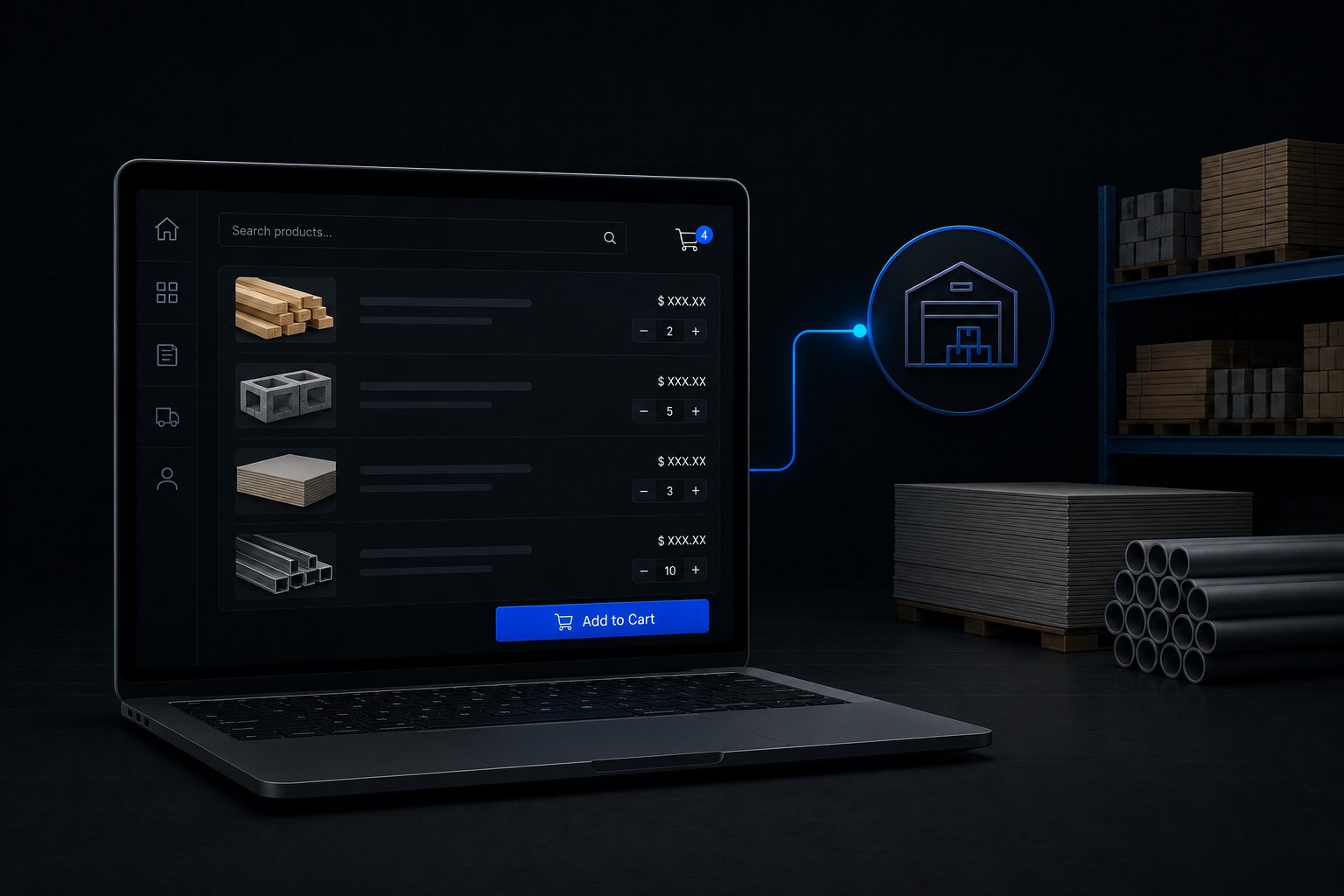
Building materials distributors are moving B2B ordering online by deploying contractor portals built on Shopify Plus that give each professional account its own login, negotiated pricing, branch-level inventory visibility, and self-service reordering. The shift is driven by data: contractor online purchasing grew from 4.3 percent of order volume in 2018 to 30 percent by 2025, according to BigCommerce's 2025 Industrial Buyer Report, yet 45 percent of B2B buyers remain dissatisfied with their current online experience and only 33 percent can reorder with one click. For lumber, roofing, drywall, and specialty building supply distributors, the portal is not a replacement for the branch relationship. It is the digital extension of it, giving contractors the ability to check stock near the job site, reorder recurring materials without calling the counter, and submit quote requests outside business hours, while the distributor's inside sales team focuses on high-value conversations.
Traditional B2B Ordering vs. a Contractor Portal on Shopify Plus
Order Placement
Traditional Ordering: Phone, fax, counter, or sales rep
Shopify Plus Contractor Portal: Self-serve online 24/7
Contractor Pricing
Traditional Ordering: Negotiated price sheets, manually maintained
Shopify Plus Contractor Portal: Account-level catalogs synced from ERP
Branch Inventory Visibility
Traditional Ordering: Call the counter
Shopify Plus Contractor Portal: Real-time stock by branch on the product page
Quote-to-Order Workflow
Traditional Ordering: Sales rep phone or email quote request with reply follow-up, converts to order
Shopify Plus Contractor Portal: Online quote request with reorder support
Repeat Orders
Traditional Ordering: Call back, wait for confirmation
Shopify Plus Contractor Portal: One-click reorder from order history
Credit and Payment Terms
Traditional Ordering: Net 30/60/90 by verbal agreement
Shopify Plus Contractor Portal: Net terms assigned to company account at checkout
Multiple Buyer Contacts
Traditional Ordering: Single account contact manages all orders
Shopify Plus Contractor Portal: Multiple buyers per company with role-based permissions
Order Status Visibility
Traditional Ordering: Call the branch
Shopify Plus Contractor Portal: Live order and delivery tracking in account
Commodity Price Changes
Traditional Ordering: Updated price sheet emailed each week
Shopify Plus Contractor Portal: Catalog refreshed automatically from ERP on schedule
Why the LBM Industry Is Digitizing Now
The North American lumber and building materials (LBM) market is approximately $800 billion across North America and Europe, with an estimated 10,000 distributors operating across the US alone. According to Webb Analytics' 2025 Construction Supply 150 report, the top 150 construction supply companies generated $412 billion in US revenue in 2024, capturing more than two-thirds of the domestic market. This is a massive, fragmented industry where the majority of ordering still happens by phone, at the counter, or through a sales rep's notebook.
That is changing fast for three structural reasons.
Contractor buying behavior has shifted irreversibly. MDM's 2025 B2B buyer research found that 67 percent of buyers now make at least half their purchases online, and 83 percent expect that share to grow. The contractors driving this shift are not just younger buyers on mobile phones. They are project managers and procurement coordinators at mid-size general contractors and specialty trades who need to verify stock at a specific branch before dispatching a driver. A phone call to a busy counter can mean a 10-minute hold and an inaccurate answer. An online portal with real-time branch inventory gives them a reliable answer in 30 seconds.
Market consolidation is raising the digital bar. Home Depot's acquisition of SRS Distribution for $18.25 billion, announced in 2024 and completed later that year, signals that the largest players in building materials distribution are making significant investments in digital ordering infrastructure. SRS alone serves over 130,000 contractor customers across more than 750 branch locations. When a distributor of that scale deploys a self-service ordering portal, independent regional distributors face a new standard for what contractors consider baseline digital capability. Distributors who still take 80 percent of orders by phone are competing against networks that let contractors order any time, track delivery to the job site, and pay invoices online.
Material cost volatility is making pricing transparency a competitive differentiator. Lumber prices rose more than 40 percent above pre-pandemic levels, peaked in 2022, partially declined, and began rising again in 2025. Tariffs on construction goods reached a roughly 40-year high. When a contractor places an order and the price changes without notice, trust erodes. Distributors who maintain accurate, up-to-date pricing on a digital portal, with pricing synced directly from their ERP, give contractors confidence that what they see is what they pay. That transparency is increasingly a reason contractors choose one distributor over another. Our distribution solution page frames how building materials distributors move B2B ordering online as part of the same playbook we apply across wholesale distribution. Distributors leaving a dated Magento store tend to hit this wall first, where every pricing rule had hardened into a custom extension that broke on the next upgrade.
What Makes Building Materials Distribution Uniquely Complex for B2B Ecommerce
Most B2B ecommerce guidance is written for industrial manufacturers or consumer goods wholesalers. Building materials distribution has structural characteristics that require specific platform capabilities.
Multi-branch networks with location-specific inventory. A regional distributor might operate 8 to 25 branches across a territory. A framing contractor in Dallas is not interested in whether the Houston branch has 2x6 studs in stock. They need to know what the Irving branch can have on the truck by 7 AM Thursday. A contractor portal that shows aggregated national inventory is worse than useless; it creates false confidence that leads to unfulfilled orders and angry job-site calls. The portal must surface real-time inventory by branch so contractors can check availability at the location nearest to their current job.
Dimensional and variable-measure products. Lumber is sold by board feet and linear feet, not by "unit." Roofing material is sold by squares. Concrete products are sold by cubic yards. A Shopify Plus catalog for a building materials distributor must handle dimensional products, calculate quantities correctly at checkout, and enforce the minimum order quantities that reflect how these products are actually shipped: a minimum of a full unit, pallet, or truckload depending on the product and distance.
SKU complexity at scale. LBM distributors routinely carry 15,000 to 50,000 active SKUs across product families including dimensional lumber, engineered wood products, roofing materials, insulation, drywall, fasteners, doors and windows, decking, fencing, and specialty building products. Products with length, width, and thickness variants require attribute-based catalog structures that go beyond standard ecommerce product-variant limits.
Commodity price volatility requiring frequent catalog updates. Lumber prices change weekly. Copper, concrete, and specialty materials fluctuate with commodity markets, tariffs, and supply chain conditions. A distributor whose portal shows stale pricing becomes a liability, not an asset. The integration between the distributor's ERP and Shopify Plus catalogs must refresh pricing on a configurable schedule, with the ability to push emergency price updates immediately when market conditions change.
Project-based quotes alongside stock orders. Contractors buying for a large framing project do not place a simple stock order. They submit a take-off list: a detailed materials list derived from the project blueprint, requesting a quote for the full package before committing. A B2B portal for building materials distributors needs both a standard reorder path (for recurring stock items like fasteners and insulation) and a quote request path (for project-sized lumber, engineered wood, or specialty orders that require a sales rep to price the job before the order is confirmed).
Contractor credit and payment complexity. LBM distributors extend significant credit to their accounts. A framing contractor may carry $200,000 to $500,000 in open receivables with a single distributor during an active building season. Payment terms, credit limits, and lien rights intersect in a way that requires the distributor's portal to reflect the contractor's actual approved credit limit, flag accounts approaching their limit, and route payment appropriately for each transaction type.
Contractor Account Tiers and How to Structure Them Digitally
Building materials distributors serve multiple contractor segments with fundamentally different purchasing needs and economics. A digital portal that treats all contractors the same will fail to serve any of them well. Shopify Plus's company account and catalog architecture supports the tier structure that LBM distributors already manage in their ERP.
General contractors and large commercial builders. These accounts buy in large volume across multiple product categories. They typically have negotiated pricing across the full catalog, extended net payment terms, and project-specific pricing for large jobs. In Shopify Plus, they are company accounts with a dedicated catalog, a custom price list synced from ERP contract records, and net payment terms assigned at the company level. Multiple buyer contacts within the company can be assigned roles: project managers who place orders, and accounting contacts who pay invoices and view statements.
Specialty trade contractors. Roofing subcontractors, framing crews, and insulation installers buy deeply within specific product categories but rarely across the full catalog. Their portal experience should surface the product families they use and hide the categories they never buy. In Shopify Plus, this is achieved through category-restricted catalogs assigned to each trade type, ensuring the portal is not overwhelming for a roofer who only needs shingles, underlayment, and ridge caps.
Independent dealers and lumber yards. Some building materials distributors sell wholesale to smaller independent dealers who then retail to contractors and end consumers. These accounts need wholesale pricing, larger minimum order quantities, and potentially a different product mix than direct contractor accounts. In Shopify Plus, independent dealer accounts are assigned to a separate company tier with catalog and pricing rules reflecting the wholesale relationship.
Small and occasional contractors. Not every contractor account warrants a fully negotiated contract price list. Small contractors who buy infrequently may see a standard contractor price list rather than a negotiated account-specific price, with the portal making it easy for them to request account status upgrades as their volume grows.
Multi-Branch Inventory: The Feature That Determines Portal Adoption
For building materials distributors, branch-level inventory visibility is not a nice-to-have feature. It is the feature that determines whether contractors actually use the portal or return to calling the counter.
A contractor placing a lumber order for delivery to a job site in a specific city needs to know which branch has the right species, grade, and quantities available for the delivery date they need. If the portal shows "in stock" without specifying where that stock sits, the contractor cannot trust it for job-site planning. The first time an order shows "in stock" online and the branch calls to say they are out, that contractor never uses the portal again.
Shopify Plus's multi-location inventory feature supports this requirement natively. Each distributor branch maps to a Shopify location. Inventory levels per location are synced from the ERP on a configurable schedule, typically every 15 to 60 minutes during business hours, with more frequent updates during busy periods. The product page displays branch-level availability alongside the branch's city and address, so a contractor can immediately see which nearby location has what they need.
For distributors with complex fulfillment routing, such as one branch drawing stock from another to fulfill large orders, the integration layer applies the distributor's transfer and fulfillment rules before pushing available-to-promise quantities to Shopify. This prevents the portal from showing stock that the branch cannot realistically fulfill by the contractor's required delivery date.
Project-Based Pricing and Commodity Volatility
The quote-to-order workflow is where building materials distribution diverges most sharply from standard B2B ecommerce. A contractor framing 40 houses in a new subdivision does not place a stock reorder. They submit a take-off list with exact material quantities by species, grade, and dimension, requesting the distributor's best project pricing before they commit the purchase order.
Most B2B ecommerce platforms handle stock reorders well and project-based quoting poorly. Shopify Plus addresses this through the quote functionality in the B2B suite: a contractor can build a cart, submit it as a quote request rather than an immediate order, and receive a modified quote from the distributor's inside sales team before confirming. When the sales rep finalizes the pricing, the quote converts directly to an order with one click from the contractor's account, capturing the project-based workflow without requiring manual reentry.
For commodity-priced products, the integration between the distributor's ERP and Shopify Plus catalogs must support rapid price updates. When lumber futures move significantly overnight, the distributor needs the portal to reflect updated prices by morning, not next week's scheduled sync. Uncap Connect supports event-triggered price updates that push ERP price changes to Shopify catalogs within minutes of the update being made, ensuring the portal always reflects the current business price rather than a stale snapshot.
How Uncap Builds B2B Portals for Building Materials Distributors
Uncap's approach to building materials distribution portals starts from two principles that distinguish our work from generic B2B ecommerce implementations.
First, Shopify Plus is configured around the distributor's existing contractor tier structure and ERP data model, not the other way around. We do not ask distributors to simplify their pricing, flatten their branch hierarchy, or reduce their SKU count to fit a platform's limitations.
Second, the integration between the ERP and Shopify Plus is built for the operational pace of building materials distribution, including frequent price updates, high-volume seasonal ordering, and multi-branch inventory routing.
Uncap Connect handles the integration layer between the distributor's ERP (NetSuite, Epicor, SAP Business One, Microsoft Dynamics 365, and Acumatica are the most common in LBM distribution) and the Shopify Plus portal. The integration manages five core data flows specific to building materials:
Product and pricing sync. Product master data, dimensional variants, and pricing records (contractor tier pricing, project pricing, dealer wholesale pricing) flow from the ERP to Shopify Plus on a configurable schedule with event-triggered updates for commodity price changes.
Branch inventory sync. Available-to-promise quantities per branch location push to Shopify Plus on a 15-to-60-minute cycle. Transfer inventory in transit between branches is excluded from available quantities until it arrives at the destination branch.
Contractor account provisioning. Approved contractor accounts in the ERP automatically create Shopify Plus company accounts with the correct tier catalog, pricing, and payment terms. New accounts approved by the credit team in the ERP provision in Shopify Plus without manual intervention.
Order-to-ERP creation. Shopify Plus orders create ERP sales orders under the correct customer number, account terms, branch fulfillment location, and job-site delivery address. Project-based quotes converted to orders carry the sales rep's approved pricing rather than the catalog price list.
Delivery and invoice back-sync. Delivery confirmations, tracking information, and invoice documents from the ERP push back to Shopify Plus orders so contractors can track deliveries and view invoices without calling the branch.
The full scope of distribution-specific solutions Uncap provides is documented on the distributors solution page.
For a deeper build-level walkthrough, we cover exactly how to build a contractor portal for wholesale building materials.
What a Portal Implementation Looks Like for a Multi-Branch LBM Distributor
A building materials distributor with 10 to 25 branches, 20,000 to 50,000 SKUs, and 500 to 2,000 active contractor accounts can expect an implementation structured around four phases. Distributors preparing for this project benefit from working through the enterprise ecommerce replatforming checklist before kickoff, as it surfaces data readiness and integration scoping questions that determine whether a project stays on timeline.
Phase 1: Data audit and ERP integration build (Weeks 1 to 5)
Audit product master data quality: dimensional variants, UOM configurations, weight and packaging data needed for freight calculation. Map branch hierarchy to Shopify Plus locations. Configure Uncap Connect for the distributor's ERP. Build initial product import and validate that dimensional products, variants, and inventory quantities render accurately across branch locations. No contractor access yet.
Phase 2: Pricing tiers and contractor accounts (Weeks 6 to 9)
Configure Shopify Plus catalogs for each contractor tier (GC accounts, specialty trades, dealers, standard contractors). Import pricing records from ERP and validate that each tier sees the correct price. Create Shopify Plus company accounts for pilot accounts. Assign catalogs, payment terms, and credit settings. Test quote-to-order workflow with pilot accounts from the sales team.
Phase 3: Branch inventory launch and order integration (Weeks 10 to 13)
Activate branch-level inventory visibility across all locations. Connect order creation to ERP. Test fulfillment routing: orders from contractor accounts route to the correct fulfillment branch based on job-site address and branch stock availability. Configure delivery and invoice back-sync. Test with a cohort of 20 to 50 contractor accounts across different tiers and branches.
Phase 4: Full rollout and counter-to-online integration (Weeks 14 to 18)
Expand to the full contractor account base by tier. Integrate counter and inside-sales workflows: orders placed by the sales team on behalf of contractors use the same Shopify Plus account infrastructure, so order history is unified regardless of the ordering channel. Train branch counter staff on the portal so they can guide contractors to self-service reordering. Monitor portal adoption rate, quote-to-order conversion, and contractor satisfaction over the first 60 days post-launch.
10 Questions Building Materials Distributors Ask About B2B Online Ordering
10. How do we evaluate whether Shopify Plus is the right platform for our distribution business?
The how to choose an enterprise ecommerce platform guide walks through the evaluation criteria that matter for B2B distributors: contractor account management, multi-location inventory, ERP integration depth, quote-to-order workflows, and the total cost of ownership compared to industry-specific distribution software. Shopify Plus's B2B native features, combined with Uncap's distribution-specific implementation experience, make it a strong fit for mid-to-large LBM distributors that have outgrown their current digital ordering approach.
Ready to Build Your Contractor Ordering Portal?
Uncap has built Shopify Plus B2B portals for distributors across lumber and building materials, roofing and insulation supply, specialty building products, and industrial distribution. As a Shopify Plus B2B Platinum Partner since 2013, we bring 380+ Shopify storefronts' worth of distribution knowledge to every project.
Book a Strategy Session and we will walk through your branch network, contractor tier structure, ERP environment, and pricing complexity to scope a portal your contractors will actually use.
Frequently asked questions
1. Can our contractors see their negotiated pricing when they log into the portal?
Yes. Each contractor company account in Shopify Plus is linked to a catalog containing their account-specific pricing. When a contractor logs in, they see only their pricing, not a generic list price. Pricing is synced from the distributor's ERP account records and refreshes on a configurable schedule.
2. How does the portal handle branch-level inventory for our multi-branch network?
Each branch maps to a Shopify Plus inventory location. Inventory levels per branch sync from the ERP on a 15-to-60-minute cycle. Contractors see stock availability at individual branch locations on the product page, giving them accurate sourcing information before they commit to an order.
3. Can contractors submit project take-off lists as quote requests rather than placing immediate orders?
Yes. Shopify Plus B2B supports quote-to-order workflows where contractors build a cart and submit it for pricing review. The distributor's inside sales rep applies project pricing and returns the quote to the contractor for approval. The approved quote converts to a confirmed order with one click.
4. How do commodity price changes sync from our ERP to the portal pricing?
Uncap Connect supports both scheduled price list syncs and event-triggered updates. For volatile commodities like lumber, price changes in the ERP push to Shopify Plus catalogs within minutes through event triggers. This ensures the portal reflects current pricing even during periods of rapid commodity market movement.
5. How does the portal manage net payment terms and contractor credit limits?
Payment terms are assigned to each Shopify Plus company account based on the contractor's approved terms in the ERP (Net 30, Net 60, Net 90). Credit limit data can be surfaced in the portal to restrict ordering for accounts that have exceeded their approved credit, routing them to a credit review workflow before the order processes.
6. Can multiple buyers from the same general contractor company place orders under one account?
Yes. Shopify Plus B2B company accounts support multiple buyer contacts per company, each with their own login. Role-based permissions allow project managers to place orders while accounting contacts can view invoices and statements. This mirrors how large contractor procurement teams actually work.
7. How do we handle dimensional lumber and variable-measure products in the catalog?
Shopify Plus supports attribute-based product configuration. Dimensional lumber is structured with length, width, and species/grade as product attributes. Quantity is entered in the appropriate unit of measure (board feet, pieces, bundles) with minimum order quantities enforced at the product level. Custom-cut and configured products use quote workflows rather than direct cart ordering.
8. Does the portal work alongside our existing counter and inside-sales operations?
Yes. The portal is designed to extend the branch relationship, not replace it. Orders placed at the counter or by inside sales are recorded under the contractor's Shopify Plus account, keeping order history unified regardless of the channel. Contractors who start with counter ordering can see their full history online, making the transition to self-service reordering natural.
9. What ERPs do you integrate with for building materials distribution?
Uncap Connect integrates with Epicor, NetSuite, SAP Business One, SAP S/4HANA, Microsoft Dynamics 365, and Acumatica. These cover the most common ERP environments in LBM distribution. The integration handles product and pricing sync, branch inventory, contractor account provisioning, order creation, and delivery and invoice back-sync.