

Most Magento to Shopify Plus migration guides are written for a DTC brand moving a product catalog, a theme, and a checkout. A manufacturer migrating a B2B operation has all of that plus a layer none of those guides touch: customer accounts tied to negotiated pricing, shared catalogs mapped to specific buyers, an ERP that has to keep working through the cutover, and a QA pass that has to confirm wholesale pricing is correct, not just that the homepage loads. This playbook covers the execution: migration order, customer account and pricing-tier mapping, ERP re-integration, the redirect plan, and B2B-specific QA, specifically for a manufacturer replatforming, not a general storefront move.
What Makes a B2B Magento Migration Different From a DTC One?
A DTC Magento migration is largely a data and design problem: move the catalog, rebuild the theme, redirect the URLs, launch. A B2B migration adds structural complexity that a generic migration checklist doesn't account for. Magento B2B (through Adobe Commerce's B2B features or a third-party extension) typically handles shared catalogs, customer-specific price lists, company structures, and quote workflows. All of that has to map onto Shopify B2B's company accounts, price lists, and net terms, not get flattened into a single retail price during the move. In a vertical like auto parts and aftermarket distribution, that structural value sits in account hierarchies, custom pricing tiers, and fitment logic that accreted as Magento extensions over years.
The ERP adds another layer most DTC guides skip entirely. A manufacturer's Magento store is usually already connected to an ERP for inventory, pricing, and order sync. That connection has to keep working, or get rebuilt in parallel, through the entire migration, not get treated as a post-launch cleanup task.
Manufacturers coming off a composable stack hit a comparable set of B2B mapping challenges, which we walk through in our guide to migrating from Commercetools to Shopify Plus.
The Right Migration Order for a B2B Manufacturer
Sequencing matters more for a B2B migration than a DTC one, because getting the order wrong means rebuilding B2B configuration work after the fact instead of getting it right the first time. A generic migration checklist built for a retail storefront moves through catalog, design, and launch in a straight line. A B2B migration has two extra dependencies (customer account structure and ERP sync) that need to be resolved before the later steps can be trusted, not layered on at the end.
Audit the full B2B configuration, not just the catalog. Document every customer group, shared catalog, price list, and quote workflow in Magento before touching Shopify. This is the step most migration timelines underestimate.
Scope the ERP integration alongside the storefront, not after it. Decide early whether the ERP integration gets rebuilt for Shopify or runs in parallel during a transition period.
Migrate the product catalog and base pricing first. Get the core catalog structure correct in Shopify before layering B2B-specific pricing and access rules on top of it.
Map customer accounts and pricing tiers next. This is B2B-specific work that has no DTC equivalent and needs its own dedicated phase, not a bullet point inside a general "import customers" step.
Rebuild or reconnect the ERP integration. Confirm real-time or scheduled sync is working correctly before any B2B customer is asked to place a real order.
Build the redirect plan and run B2B-specific QA together. SEO redirects and B2B account testing need to happen in the same pre-launch phase, not sequentially, since both block a safe launch.
Run a parallel or staged cutover for high-volume accounts. Your largest wholesale or dealer accounts should not be the first ones to discover a mapping error.
Mapping Customer Accounts and Pricing Tiers from Magento B2B to Shopify B2B
This is the step that has no DTC equivalent, and it's where most generic migration guides go quiet. Magento B2B's shared catalogs (a defined product and price list assigned to a company or customer group) need to map onto Shopify B2B company accounts and price lists, which use a different underlying structure. A one-to-one field mapping rarely exists; the logic has to be rebuilt, not just exported and imported.
Specific things to verify during this phase: every customer group's pricing tier maps to the correct Shopify B2B price list, company account hierarchies (a buyer with multiple locations or sub-accounts) are preserved rather than flattened into a single account, and payment terms (net 30, net 60) attached to each customer group carry over correctly. A missed mapping here doesn't show up as a broken page. It shows up as a wholesale buyer seeing retail pricing after launch, which is a much harder problem to catch in QA and a much worse one to discover in production.
Re-Integrating Your ERP During the Migration
A manufacturer's ERP (NetSuite, SAP, Epicor, or another system) is almost always already connected to the Magento store for inventory, pricing, and order sync. That connection needs a clear plan before migration starts, not a decision made mid-project. Real ERP integration work takes real time to scope and build correctly, and treating it as a fast follow after the Shopify launch is one of the most common ways a B2B migration timeline blows past its estimate.
Two approaches work, depending on risk tolerance and timeline: rebuild the ERP integration in Shopify before cutover, tested against the same B2B pricing and inventory logic the Magento integration ran, or run both systems in parallel briefly, with the ERP as the single source of truth while Shopify is validated against real order volume before Magento is decommissioned. Whichever approach is chosen, the ERP integration should never be the last thing scoped in a B2B migration; it's usually the piece with the most hidden complexity. Reconnecting a system like Microsoft Dynamics to Shopify's native B2B model is often what decides whether the migration launches clean or needs a rebuild after go-live.
The Redirect Plan: Protecting SEO Through the Migration
URL structure changes between Magento and Shopify, and a B2B store has an added wrinkle: some URLs may be gated behind customer group login (shared catalog pages that only certain buyers could see), which complicates a straightforward redirect map. Every public product, category, and content URL needs a mapped 301 redirect to its Shopify equivalent, and gated B2B URLs need a defined plan for where a returning logged-in buyer lands, not just a generic homepage redirect.
Test redirects before launch, not after. A B2B buyer who bookmarked a shared catalog URL and hits a broken link after cutover is a support ticket and a trust problem, on top of the SEO impact a broader redirect gap creates.
B2B-Specific QA Before Launch
Generic pre-launch QA checks that the site loads, checkout works, and payment processes correctly. None of that confirms a B2B migration actually worked, because all of it can pass cleanly while a wholesale buyer still sees the wrong price. Before launch, verify:
Every customer group logs in and sees correct pricing. Not just that login works, that the specific negotiated price for that account is correct.
Company accounts with multiple locations or sub-accounts function correctly. A buyer managing several locations needs each one to see its own pricing and place its own orders without a rep manually correcting something after the fact.
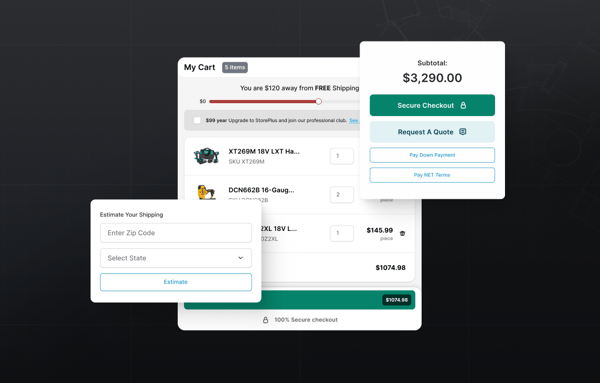
Net terms and credit limits enforce correctly at checkout. A buyer with net 30 terms should not be charged at checkout, and a buyer over their credit limit should be blocked or flagged as expected.
ERP sync reflects real inventory and pricing, not stale test data. Confirm the integration is pulling live numbers before any real customer places an order against it.
At least one full order cycle completes end to end for a B2B account. Place a test order as a company account, confirm it lands correctly in the ERP, and confirm fulfillment status flows back to Shopify.
How Uncap Runs a B2B Magento Migration
Commerce Build implements the migration itself, fixed scope, sequenced around the B2B complexity most generic playbooks treat as an afterthought: customer account and pricing-tier mapping, ERP integration built alongside the storefront rather than after it, and a QA process built specifically to confirm wholesale pricing and company accounts work correctly, not just that pages load. For the platform comparison itself, Uncap's Magento vs. Shopify breakdown covers the case for making the move; Uncap's Magento migration page covers what the engagement includes. This playbook is the execution detail underneath both.
Uncap is a Shopify Platinum Partner and Shopify Expert since 2013, with 380+ storefronts launched on Shopify for manufacturers and distributors, many of them migrations off Magento specifically. See how that work comes together in Uncap's case studies.
A Real-World Scenario: What Gets Missed Without a B2B-Specific Plan
Picture an industrial equipment manufacturer running Magento with roughly 40 customer groups, each with its own shared catalog and negotiated pricing, connected to NetSuite for inventory and order sync. An initial migration plan, built around a generic checklist, budgeted two weeks for "customer data migration" as a single line item, treating it the same as a DTC customer list export.
Once the actual work started, mapping 40 customer groups to Shopify B2B company accounts and price lists took closer to five weeks, not two, because each group's pricing logic had to be rebuilt and verified individually, and the NetSuite integration needed to be re-scoped to handle real-time sync rather than the batch process Magento had been running on. The timeline moved. The alternative, launching on the original two-week estimate, would have meant 40 wholesale accounts discovering pricing errors in production instead of QA.
Where to Start
A B2B Magento to Shopify Plus migration is not a bigger version of a DTC migration. It has structural work (customer account and pricing-tier mapping, ERP re-integration, B2B-specific QA) that a generic checklist built for a general storefront move will miss entirely. Getting the sequence right, with the B2B complexity scoped from the start, is what separates a migration that launches clean from one that needs a costly rebuild after go-live.
Talk to our experts about migrating your B2B operation from Magento to Shopify Plus.
Frequently asked questions
How long does a B2B Magento to Shopify Plus migration take?
Longer than a comparable DTC migration, typically, because customer account and pricing-tier mapping and ERP re-integration add real scope that a general storefront move doesn't have. The timeline depends heavily on how many customer groups and shared catalogs exist in Magento and how complex the ERP integration is, more than on catalog size alone.
Can Magento B2B shared catalogs be migrated automatically to Shopify B2B?
Not as a direct, automated export-import. Magento B2B's shared catalog and customer group structure needs to be mapped deliberately onto Shopify B2B's company accounts and price lists, since the two systems don't use the same underlying model. Treating this as an automated data transfer is one of the most common sources of pricing errors after launch.
Should the ERP integration be rebuilt before or after the Shopify launch?
Before, ideally, or run in parallel during a transition period. Building the Shopify storefront first and treating ERP integration as a fast follow is one of the most common reasons B2B migration timelines run over, since the ERP work usually has more hidden complexity than the storefront build itself.
What's the biggest B2B-specific risk in a Magento to Shopify migration?
Wholesale buyers seeing incorrect pricing after launch because a customer group or shared catalog mapping was missed. This doesn't show up as an obvious broken page, which makes it easy to miss in generic QA and expensive to discover after real orders start coming in at the wrong price.