


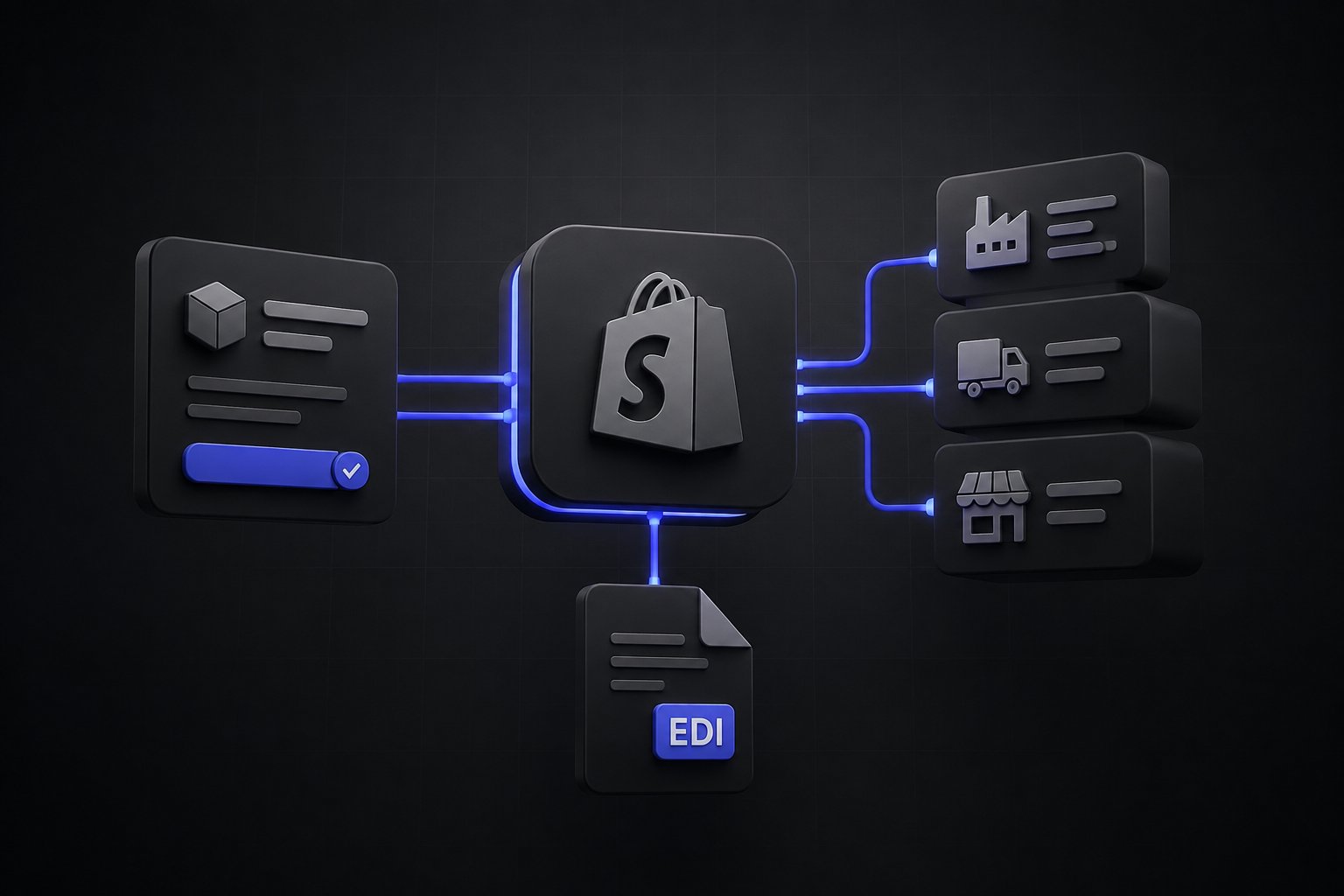
The purchase order that wins you the big-box account never touches your Shopify admin. It arrives as an X12 850 through a network your ecommerce team has never logged into, governed by a vendor compliance manual that runs longer than your reseller agreement, with certification testing before the first real order and deductions waiting behind every document you send late or wrong. Search for how Shopify handles this and you get a wall of connector vendors, each explaining that Shopify has no native EDI and each selling the fix. Both halves of that are true, and neither answers the question a distributor actually has: where should EDI live in a stack that already includes an ERP and a Shopify storefront?
Quick answer: EDI is not an ecommerce feature; it is a trading-partner requirement, and the partner with the buying power decides. Big retail sends purchase orders as 850 documents and expects a functional acknowledgment (997), a commitment (855), an advance ship notice (856) before the freight arrives, and an invoice (810) that matches both the PO and the ASN, with inventory advice (846) on top for drop-ship programs. The architecture decision the connector ads skip: EDI should terminate wherever inventory allocation and invoicing live. For a distributor running an ERP, that is the ERP, not the storefront, and Shopify's job is the channel EDI was never meant for: the long tail of accounts too small to trade documents. The two order streams meet in the ERP, and that meeting point is the whole design.
What EDI Is, and Why the Retailer Gets to Decide
Electronic data interchange is the exchange of standardized, machine-readable business documents between trading partners: purchase orders, acknowledgments, ship notices, invoices, moving system to system with no human rekeying. In North American retail the standard is ANSI X12, with EDIFACT playing the same role internationally, and the documents travel over value-added networks or direct AS2 connections that predate the web and outlasted every prediction of their death.
What keeps EDI alive is not affection but purchasing power. The largest retailers require EDI as part of vendor onboarding, and even Shopify's own enterprise guidance is plain about the market reality: many of the world's biggest retailers mandate it in their vendor management process, and a supplier who cannot meet the requirement often is not considered at all. The retailer publishes a vendor manual, scores your document compliance, and deducts from your invoices when you miss. Trading with big retail means speaking EDI on the retailer's terms, and the only real choices are architectural: where the documents land, and what keeps them accurate.
The Documents One Purchase Order Generates
Follow a single PO through and the alphabet gets concrete. The 850 arrives with the retailer's line items, prices, ship-to locations, and routing requirements. Your system answers twice: a 997 functional acknowledgment confirming the file was received and readable, then an 855 purchase order acknowledgment committing to quantities, prices, and dates, which is where discrepancies get surfaced before they become disputes. If the retailer changes the order, an 860 arrives and the cycle repeats.
Then comes the document with the highest stakes. The 856 advance ship notice describes the physical shipment, cartons, contents, and the GS1-128 labels on the boxes, and it must arrive before the truck does. Late or inaccurate ASNs are the classic source of compliance deductions, because the retailer's warehouse plans its receiving around them. The 810 invoice follows the shipment and must reconcile against both the PO and the ASN, since a three-way mismatch is another deduction. Drop-ship programs add the 846, a recurring inventory advice that tells the retailer what they can sell against, which makes your inventory accuracy a contractual matter rather than an internal one.
None of this is exotic. It is bookkeeping at document speed, and every document is a place where a wrong number costs real margin. That is why the question of which system generates these documents matters more than which vendor transmits them.
Where EDI Should Terminate: The Decision the Connector Ads Skip
There are two legitimate architectures and one common mess. The first pattern lands EDI in Shopify: a connector translates the 850 into a Shopify order, fulfillment updates flow back out as the 856 and 810, and Shopify acts as the operational hub. Shopify's enterprise guidance describes exactly this, EDI documents becoming updates on the Shopify order record, and is candid about who it serves: DTC-first and digitally native brands, where Shopify already is the order management system and there is no ERP behind it. For that business, the pattern is right.
A distribution business is not that business. A distributor's inventory allocation, customer credit, warehouse operations, and invoicing already live in the ERP, which means the second pattern applies: EDI terminates at the ERP or its integration layer, and the retail PO becomes a wholesale order in the system that already knows how to allocate stock, schedule the warehouse, and cut the invoice. The document flow never needs to become an ecommerce order, because nothing about it is ecommerce. Routing big-box POs through the storefront adds a hop, a failure point, and a second order stream to reconcile, and buys nothing the ERP did not already do.
The mess is running both: a connector creating Shopify orders for retail POs while the ERP runs actual operations, which produces duplicate order records, inventory that two systems believe they own, and month-end reconciliation as a permanent job. The rule that sorts all three patterns is one sentence: EDI terminates where inventory allocation and invoicing live, and for an ERP-run distributor that is never the storefront.
Where Shopify Fits Beside the EDI Pipe
Getting EDI out of Shopify's job description is what makes Shopify's actual job clear. Big-box partners trade documents; everyone else logs in. The hundreds of independent retailers, dealers, and smaller accounts that will never run an EDI program order through the B2B storefront, with their pricing, terms, and reorder workflows, which is the channel the distributors Uncap builds for typically underserve while their EDI program absorbs all the integration attention.
The two channels stay honest by meeting in the same place. Both order streams land in the ERP, and the same inventory pool answers both: the 846 you send the retailer and the availability your portal shows a dealer should be drawn from identical numbers, which happens only when the storefront sync is real. That is the job Uncap Connect does between Shopify and the ERP, both directions in real time, inside the broader ERP integration practice that treats the ERP as the system of record for every channel, EDI included. One caveat on scope: if your large partners are procurement platforms rather than retailers, purchase orders arriving from Coupa or Ariba are a different protocol family, and the punchout and procurement network guide covers that side.
Choosing the EDI Layer Without a Vendor's Thumb on the Scale
The EDI provider market splits into managed networks that run the trading-partner relationships for you, API-first platforms that hand your developers a modern surface over the document formats, and the in-house translator, which at distributor scale is usually a legacy liability someone inherited. This post does not rank them, partly because every ranking you will find is published by a contestant, and partly because the deciding questions are about your stack, not their features.
Ask where the provider terminates, because a connector built to create Shopify orders is the wrong shape for an ERP-run operation no matter how good its reviews are. Ask who maintains the document maps when your ERP item master changes, since maps rot at the speed of your catalog. Ask how a chargeback traces back to root cause, whether they support the specific networks your retail partners require, and what partner certification actually took for their last three customers your size. The provider that answers those five concretely is a candidate; the one that answers with a logo wall is an ad.
Uncap has been a Shopify Platinum Partner since 2013, with 380+ storefronts launched on Shopify, including for manufacturers, distributors, and wholesalers. Talk to Our Experts if you are mapping where EDI should land in your stack, the terminate-at-the-ERP conversation with your integration architecture on the table usually settles it quickly.
Frequently asked questions
Does Shopify support EDI natively?
No. Shopify has no built-in EDI capability, and every path to trading with EDI-mandating retailers runs through a third-party layer: a managed EDI network, an API-first EDI platform, or ERP-side middleware. The more consequential decision is where that layer terminates, in Shopify for businesses where Shopify is the operational hub, or in the ERP for distributors whose allocation and invoicing already live there.
Which EDI documents do big-box retailers require?
The core cycle is the 850 purchase order in, then the 997 functional acknowledgment, the 855 commitment, the 856 advance ship notice before freight arrives, and the 810 invoice reconciling against both PO and ASN. Change orders arrive as 860s, and drop-ship programs add recurring 846 inventory advice. The ASN carries the highest chargeback risk because retailer receiving is planned around it.
Should EDI purchase orders become Shopify orders?
Only when Shopify is the order management hub, which is typically a DTC-first brand without an ERP. For a distributor, the retail PO should become a wholesale order in the ERP, where inventory allocation, credit, and invoicing already live, and the storefront should stay out of the compliance path entirely. Running both patterns at once creates duplicate order streams and permanent reconciliation work.
What are EDI chargebacks and how do you avoid them?
Deductions retailers take from your invoices for compliance failures: late or inaccurate ASNs, label errors, invoice mismatches, missed routing requirements. Prevention is data accuracy at the source system, which is the architectural argument for terminating EDI where inventory and invoicing truth lives, so the documents describe what the warehouse actually did.


