
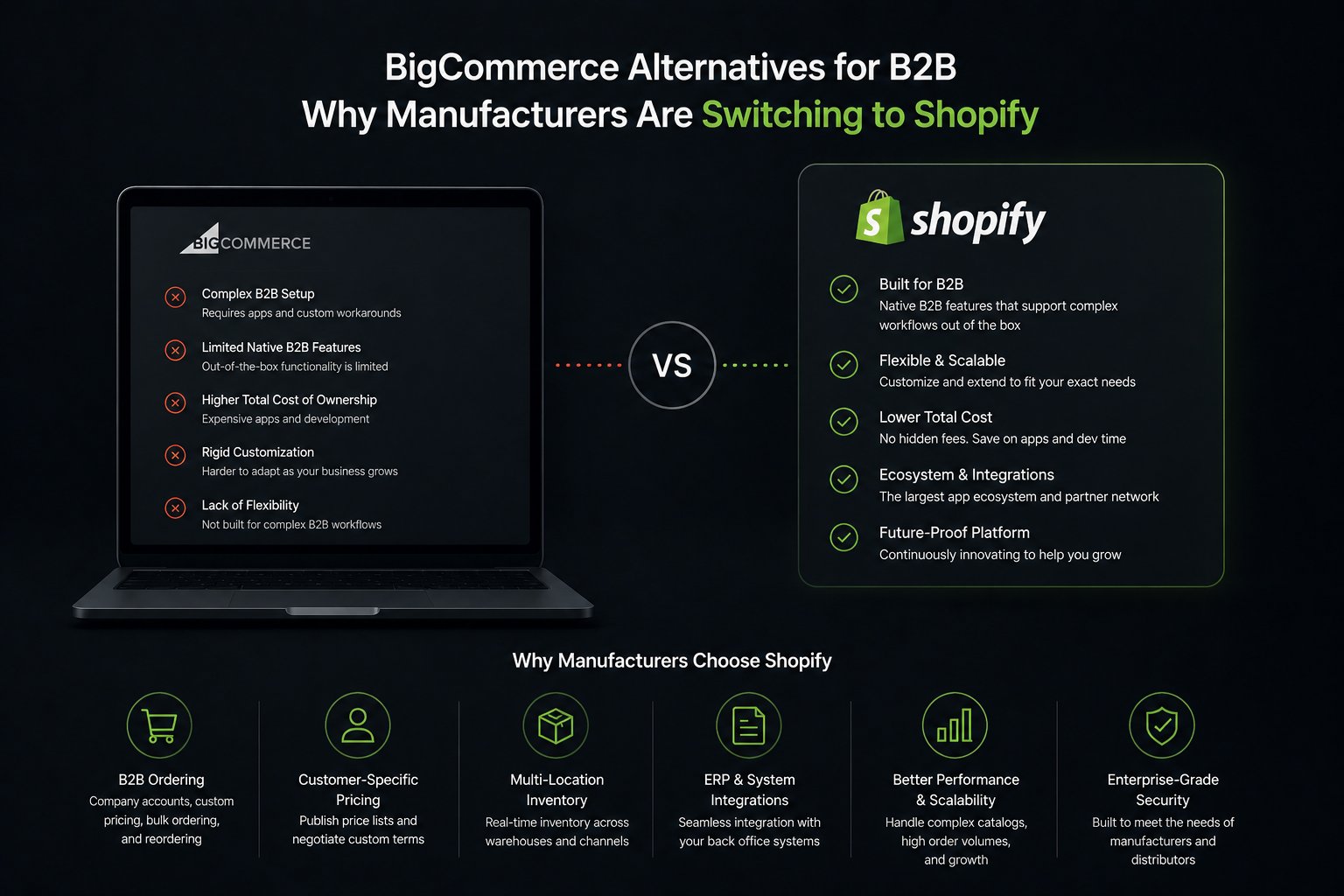
Manufacturers searching for BigCommerce alternatives for B2B in 2026 are not looking for a generic platform list. They are asking a specific question: has Shopify Plus B2B matured enough to replace what they built on BigCommerce, and what does the switch actually involve?
The answer changed in 2023 when Shopify shipped native B2B features: company accounts with buyer roles and location-level permissions, customer-specific catalogs and price lists, and net payment terms built directly into the platform rather than patched in through third-party apps. By June 2026, Shopify had sunset Shopify Scripts and replaced them with Shopify Functions, a significantly more capable checkout customization layer. The capability gap that once made BigCommerce the default choice for mid-market manufacturers has closed.
This guide covers what BigCommerce B2B Edition specifically lacks for manufacturers, what Shopify Plus delivers natively, how ERP integration works post-migration, and what a realistic migration timeline looks like.
BigCommerce B2B Edition vs Shopify Plus B2B: Quick Comparison
Company Accounts
BigCommerce B2B Edition: Via B2B Edition add-on
Shopify Plus B2B: Native, with locations and buyer roles
Customer-Specific Price Lists
BigCommerce B2B Edition: Limited to customer groups
Shopify Plus B2B: Per-company catalogs with fixed and percentage pricing
Net Payment Terms (Net 30/60/90)
BigCommerce B2B Edition: Third-party app required
Shopify Plus B2B: Native
Vaulted Payment Methods per Company
BigCommerce B2B Edition: Third-party app required
Shopify Plus B2B: Native
Checkout Customization Logic
BigCommerce B2B Edition: Limited, no upgrade path
Shopify Plus B2B: Shopify Functions (unlimited custom logic, active June 2026)
MOQ Enforcement at Checkout
BigCommerce B2B Edition: Requires custom development
Shopify Plus B2B: Shopify Functions
B2B + DTC on One Storefront
BigCommerce B2B Edition: Separate storefronts required
Shopify Plus B2B: Unified admin, separate buyer experiences
ERP Integration
BigCommerce B2B Edition: Custom middleware typically required
Shopify Plus B2B: Pre-built connectors available
App Ecosystem
BigCommerce B2B Edition: ~1,000 apps
Shopify Plus B2B: 8,000+ apps
Pricing Model
BigCommerce B2B Edition: Revenue-based tier upgrades
Shopify Plus B2B: Fixed monthly ($2,300 to $2,500/month)
7 Reasons Manufacturers Are Leaving BigCommerce
1. Revenue-based plan upgrades punish manufacturing growth
BigCommerce ties plan tiers to annual online sales volume. As a manufacturer scales digital order volume through a dealer portal or direct B2B channel, the platform forces upgrades to higher pricing tiers regardless of whether the additional features in those tiers are actually needed. Shopify Plus uses a fixed monthly rate starting at $2,300 per month on a three-year term, with no GMV penalties baked into the base structure. For manufacturers processing significant order volume, the total cost of ownership over a three-year period often favors Shopify Plus.
2. B2B Edition is an add-on, not native architecture
BigCommerce's B2B capabilities live in its B2B Edition add-on, layered on top of a platform designed for direct-to-consumer retail. This means the core data model treats buyers as individual consumers first and company accounts second. Features like multi-location company accounts, location-level payment terms, and granular buyer role permissions require additional configuration or third-party tooling that would be native on a purpose-built B2B architecture.
Shopify took a similar approach initially but rebuilt its B2B layer as native infrastructure in 2023. Native features share the same data model as the rest of the platform, which means ERP sync, order reporting, and checkout logic all operate from a consistent foundation without data mapping between separate systems.
3. Shopify Scripts sunset (June 2026) reveals a structural limitation
Shopify sunset Shopify Scripts in June 2026, replacing them with Shopify Functions, a far more capable checkout customization framework. Manufacturers migrating to Shopify Plus after June 2026 build checkout customizations with Shopify Functions from day one, which is an advantage rather than a migration burden.
BigCommerce merchants relying on equivalent checkout workarounds face no comparable upgrade path. Custom checkout logic built on BigCommerce remains their responsibility to maintain indefinitely as the platform evolves.
4. Company account depth falls short for dealer and distributor networks
A mid-market manufacturer typically operates through a combination of direct buyers, regional distributors, and individual dealer accounts. Each account needs a separate pricing tier or catalog, location-specific billing and shipping addresses, contacts with differentiated buying permissions, and net payment terms assigned at the account level rather than per individual contact. This depth matters most in industrial machinery, where dealer tiers and configured products push past what a mid-market platform was built to hold.
BigCommerce B2B Edition supports company accounts but limits the depth of account hierarchy and location-level configuration. Shopify Plus B2B supports companies with multiple locations, each with their own payment terms, price lists, and active contacts assigned to specific buyer roles: admin access, ordering-only access, or location-specific restrictions.
5. The app ecosystem gap is real for manufacturer workflows
Manufacturers need functionality that general-purpose B2B platforms rarely build natively: warranty registration, rebate and store credit management, parts fitment lookup for equipment lines, quote request workflows, saved and shared carts for procurement teams, and printed invoice generation. BigCommerce's app ecosystem covers roughly 1,000 integrations. Shopify's has over 8,000, with a deep library of manufacturer and distributor-specific tools built by developers who know the platform's APIs at depth.
6. ERP integration costs more than it should
Connecting BigCommerce to NetSuite, Epicor, SAP, or Microsoft Dynamics typically requires point-to-point middleware built and maintained by an agency. Every platform update risks breaking the integration. Shopify Plus has attracted a significant ecosystem of native ERP connector partners who build against a stable API, reducing both implementation cost and ongoing maintenance overhead.
7. B2B and DTC require separate storefronts on BigCommerce
Manufacturers selling wholesale to dealers and direct to end consumers must manage two separate BigCommerce storefronts: separate catalogs, separate checkouts, separate theme deployments, and separate analytics. Shopify Plus allows a single storefront to serve both audiences, with B2B login gating the dealer experience and a public DTC storefront available to consumers, both managed from one admin.
What Shopify Plus B2B Delivers Natively for Manufacturers
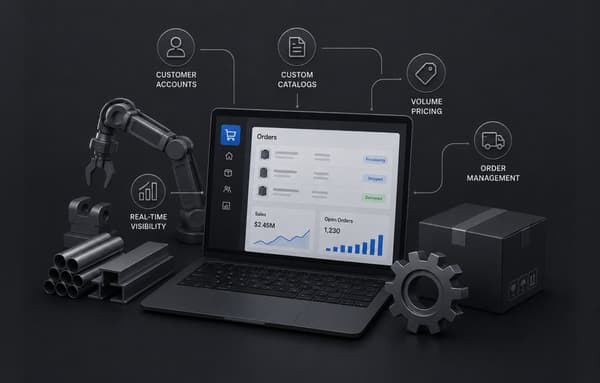
Company accounts, locations, and buyer roles
Every dealer, distributor, or wholesale buyer in Shopify Plus B2B operates as a company account. Within that account, manufacturers can create multiple locations (each location gets its own billing address, shipping addresses, payment methods, and price list) and assign individual contacts to roles that control what they can see and do. A purchasing manager can place orders and manage contacts. A field buyer might be restricted to order placement only. A regional coordinator can access only their assigned location.
This structure maps directly to how manufacturers run dealer networks, which is why adoption tends to be driven at the operations level, not just IT.
Customer-specific catalogs and price lists
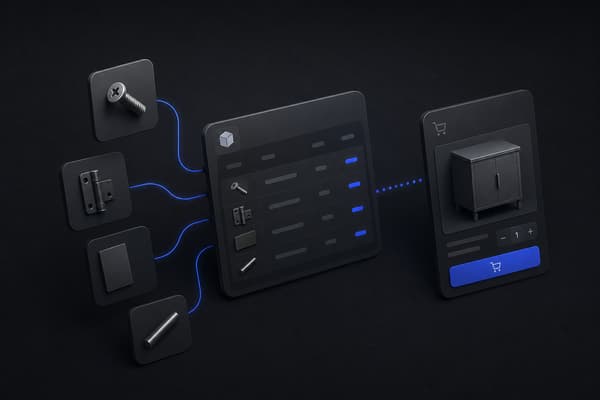
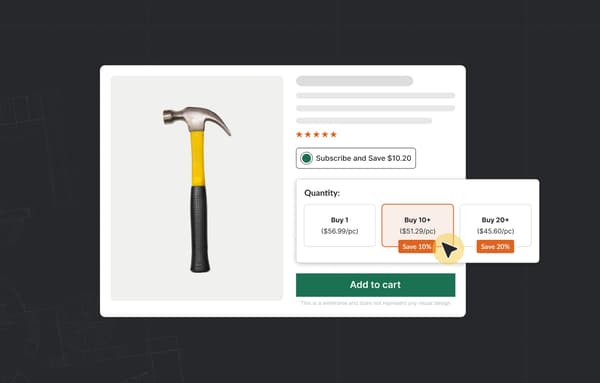
Shopify Plus B2B lets manufacturers assign a specific catalog to each company or location. Each catalog includes a price list that applies fixed prices, percentage adjustments, or volume-based quantity breaks. A tier-one dealer gets one price list. A regional distributor gets another. A new account without a negotiated rate stays on list pricing until a contract is agreed.
All of this lives in the Shopify admin without a third-party pricing engine. The Shopify B2B page covers the full breakdown of catalog and price list capabilities by plan tier.
Net payment terms and vaulted payment methods
Net 30, Net 60, and Net 90 are configured at the company level in Shopify Plus B2B. When a buyer with net terms checks out, they receive an invoice for the approved term rather than a card prompt. Vaulted payment methods let buyers store approved cards against their company account so repeat ordering does not require re-entering payment details.
Both features were previously available only through third-party apps on both platforms. Native implementation means they integrate cleanly with Shopify's order management, reporting, and ERP sync workflows without additional data mapping.
Shopify Functions: the checkout logic manufacturers actually need
Shopify Functions are the replacement for Shopify Scripts as of June 2026. Where Scripts were limited to pre-defined extension points, Functions allow developers to write custom logic that runs server-side at checkout:
- Enforce a minimum order value per company account before checkout can proceed
- Hide specific products from buyers who do not belong to an authorized dealer tier
- Apply custom shipping rules for oversized or hazardous equipment categories
- Trigger an approval workflow that holds an order in draft until a rep confirms it
- Apply automatic volume discounts based on a buyer's contract tier without exposing the logic to the buyer
Shopify Plus is the only major SaaS commerce platform that ships this level of checkout customization natively through a supported, upgradeable framework rather than custom code. More on what this enables for B2B operations is covered in the Shopify Plus B2B updates release history, which Shopify has accelerated significantly since 2023.
For a feature-by-feature look at how these native capabilities stack up against BigCommerce B2B Edition, see our full Shopify Plus versus BigCommerce comparison for B2B.
Draft orders and quote workflows
Sales rep-assisted ordering is standard in manufacturing. A rep builds an order on behalf of a dealer, applies a negotiated price, and submits it for buyer confirmation. Shopify Plus B2B includes draft order functionality natively: reps create orders in the admin, share them with buyers for review, and convert them to paid orders on confirmation. No third-party quoting app is required for standard quote-to-order workflows.
One storefront, two buyer experiences
Manufacturers on Shopify Plus B2B do not need separate storefronts for wholesale and DTC. A single store serves public consumers through the standard checkout while B2B buyers log in to see their company-specific catalog, pricing, and payment terms. Inventory management, order reporting, and ERP sync happen in one place, with one admin, one analytics setup, and one theme deployment to maintain.
ERP Integration for Manufacturers: The Architecture That Makes It Work
The most common reason manufacturers delay a platform switch is ERP integration. They have invested in connecting their existing platform to NetSuite, Epicor, SAP S/4HANA, or Microsoft Dynamics, and they do not want to rebuild that integration from scratch.
The Uncap Connect ERP integration suite is built specifically for this transition, with pre-built connectors for the ERPs manufacturers use most.
NetSuite + Shopify Plus: Real-time inventory sync, customer account creation and price list population from NetSuite customer records, order write-back on placement, and invoice status updates in both directions. Customer-specific pricing from NetSuite price levels maps to Shopify Plus price lists automatically.
Epicor + Shopify Plus: Product catalog and pricing sync from Epicor's item master, order write-back with full line-item detail, and warehouse-level inventory feeds for multi-location manufacturers. Epicor part numbers become Shopify SKUs with direct lookup.
SAP S/4HANA + Shopify Plus: Material master sync, customer-specific pricing from SAP condition records, and automated order-to-cash workflow triggering SAP delivery creation on order placement. The connector handles the SAP BAPI and RFC layer without requiring SAP middleware licensing.
Microsoft Dynamics 365 + Shopify Plus: Customer and contact sync, price list population from Dynamics trade agreements, and order integration supporting both standard and drop-ship workflows. B2B company accounts in Shopify map to Dynamics customer accounts with full contact hierarchy.
Acumatica + Shopify Plus: Bidirectional sync covering inventory, pricing, customers, and orders with native support for Acumatica's warehouse management module and lot/serial number tracking for manufacturers with traceability requirements.
The connector architecture is middleware-free on the Shopify side, meaning Shopify Plus updates do not break the integration. The Uncap Connect layer handles transformation and error handling with a monitoring dashboard that surfaces sync failures before they affect orders.
Migrating from BigCommerce to Shopify Plus: What to Expect
A BigCommerce to Shopify Plus migration follows five phases regardless of catalog size or ERP complexity.
Phase 1: Audit and mapping (weeks 1 to 3)
Catalog structure (products, variants, options), customer accounts, order history, and current customizations are audited against the Shopify Plus data model. BigCommerce uses "options" and "modifiers" for product variants. Shopify uses "options" and "variants" with a 100-variant-per-product limit that requires planning for manufacturers with large configuration matrices. This phase identifies any catalog restructuring needed before migration begins.
Phase 2: ERP reconnection (weeks 2 to 5, overlapping)
The ERP integration is planned in parallel with the catalog audit. New Shopify-side endpoints are configured in the connector layer. Historical ERP data does not need to move, since the ERP remains the source of truth. What gets mapped is which data flows (inventory, pricing, orders, customers) run in which direction and at what frequency.
Phase 3: Company account and price list migration (weeks 4 to 6)
B2B customer accounts, purchase history, and pricing assignments are migrated to Shopify's company account structure. Because passwords cannot be migrated from BigCommerce (they are stored as one-way hashes), B2B buyers receive account activation emails when they access the new platform for the first time. This is standard across platform migrations and is communicated to dealer networks in advance with clear instructions.
Phase 4: URL redirect strategy (weeks 5 to 7)
BigCommerce URL structures differ from Shopify's. A complete URL mapping is built for all product, collection, and content pages to carry Google's existing ranking signals into the new platform. Canonical tags are set correctly before go-live to prevent duplicate content issues during the transition window.
Phase 5: Staged go-live (week 8)
A phased rollout by dealer tier or account segment reduces migration risk. High-value accounts go live first, with a parallel period where any orders that reach the legacy BigCommerce store are processed manually until full cutover is confirmed. Full cutover typically happens within one to two weeks of the staged go-live.
Total timeline: A mid-market manufacturer with 10,000 to 50,000 SKUs and a single ERP integration typically completes migration in 8 to 12 weeks. Larger catalogs or multi-ERP environments extend this to 16 to 20 weeks. Catalog restructuring and ERP connector configuration are the longest variables, not data migration itself.
Who Should Evaluate Other Options
Shopify Plus B2B is the right choice for manufacturers who run mixed B2B and DTC operations, need fast time-to-market, and want access to a large app ecosystem without a large internal development team. It handles the majority of manufacturer use cases natively as of 2026.
Manufacturers with extremely complex multi-organization requirements, such as separate legal entities needing fully isolated backends, catalogs, and workflows with no shared infrastructure, or operations requiring multi-round RFQ negotiation where buyers and sellers exchange multiple quote revisions before an order is placed, should also evaluate dedicated enterprise B2B platforms. These are typically enterprises with $100M or more in annual digital revenue and a dedicated commerce operations function.
For mid-market manufacturers building or rebuilding a dealer portal, wholesale channel, or direct B2B ordering experience, the combination of Shopify Plus native B2B capabilities and Shopify solutions for manufacturing covers the use case without the implementation complexity and ongoing development overhead of enterprise alternatives.
Book a Strategy Session
Uncap has launched 380+ storefronts on Shopify as a Shopify Platinum Partner since 2013. If your manufacturing business is evaluating a move from BigCommerce to Shopify Plus, we can assess your current architecture, ERP integration requirements, and dealer account structure and provide a migration scope in a single working session.
Frequently asked questions
What is the main difference between BigCommerce B2B Edition and Shopify Plus B2B?
BigCommerce B2B Edition is a paid add-on layered on top of a DTC platform architecture. Shopify Plus B2B includes company accounts, customer-specific catalogs, price lists, net payment terms, and vaulted payment methods as native features within the platform, not through an add-on layer. The practical effect is that B2B data (company records, price lists, payment terms) integrates cleanly with Shopify's order management and analytics without additional data mapping.
How much does Shopify Plus cost compared to BigCommerce for manufacturers?
Shopify Plus starts at $2,300 per month on a three-year commitment or $2,500 per month on an annual plan. BigCommerce uses revenue-based pricing that starts lower but forces plan upgrades as annual online sales volume grows. For manufacturers processing significant digital order volume, the total cost of ownership over a three-year period typically favors Shopify Plus's fixed structure.
Can Shopify Plus handle dealer networks and tiered pricing for manufacturers?
Yes. Shopify Plus B2B supports company accounts with multiple locations, each assigned its own catalog, price list, and payment terms. Shopify Functions allow developers to add custom logic at checkout for minimum order quantities, approval workflows, and dealer-tier product access controls. Combined with the manufacturer-specific apps available in Shopify's ecosystem, the platform covers the majority of dealer network workflows without custom development.
What is Shopify Functions and why does it matter for manufacturers?
Shopify Functions replaced Shopify Scripts in June 2026 and allow developers to write custom server-side logic that runs at checkout. For manufacturers, this means enforcing minimum order quantities per account tier, hiding products from unauthorized buyer roles, routing orders through an approval workflow, and applying contract pricing automatically. Functions are a supported, upgradeable framework rather than custom code, which means they do not break when Shopify releases platform updates.
How long does a BigCommerce to Shopify Plus migration take?
A manufacturer with 10,000 to 50,000 SKUs and a single ERP integration typically completes migration in 8 to 12 weeks. Larger catalogs or multiple ERP systems extend this to 16 to 20 weeks. The longest variables are catalog restructuring (for manufacturers whose products exceed Shopify's 100-variant-per-product limit) and ERP connector configuration.
Does Shopify Plus support net payment terms natively?
Yes. Net 30, Net 60, and Net 90 are configured at the company account level in Shopify Plus B2B. Buyers with net terms receive an invoice at checkout rather than a payment prompt. This was previously available only through third-party apps on both Shopify and BigCommerce.
Can a manufacturer run both a wholesale dealer portal and a DTC store on Shopify Plus?
Yes. Shopify Plus allows a single storefront to serve B2B dealers through a gated company account experience and DTC consumers through the standard public storefront. Both audiences share one catalog (with B2B-specific price lists visible only to authenticated company accounts) and one admin. There is no need for two separate storefronts, two theme deployments, or two sets of analytics.
What ERP systems integrate with Shopify Plus for manufacturers?
Shopify Plus integrates with NetSuite, SAP S/4HANA, Microsoft Dynamics 365, Epicor, Acumatica, and Infor through pre-built connectors. Integration covers bidirectional sync for inventory, product data, customer accounts, pricing, and orders, with order write-back triggering ERP fulfillment workflows automatically on placement.
Is Shopify Plus ready for manufacturers with large product catalogs?
Yes, with planning. Shopify Plus supports unlimited products. The constraint manufacturers encounter is the 100-variant-per-product limit: products available in large configuration matrices may need to be restructured into parent-child product relationships or handled through a product configurator app. This is addressed during the catalog audit phase of migration before any data is moved.
What is the main advantage of Shopify Plus over enterprise B2B platforms for manufacturers?
Time to market, ecosystem depth, and total cost of ownership. Enterprise B2B platforms offer deeper native RFQ workflows and multi-organization isolation, but typical implementations run 6 to 12 months and require dedicated developer resources for ongoing operation. Shopify Plus reaches feature parity for the majority of manufacturer use cases with faster implementation, a larger app ecosystem (8,000+ apps), and lower ongoing overhead. For manufacturers who also sell direct to consumers, Shopify's unified B2B and DTC capability on a single store is a structural advantage that dedicated enterprise B2B platforms do not offer natively.