


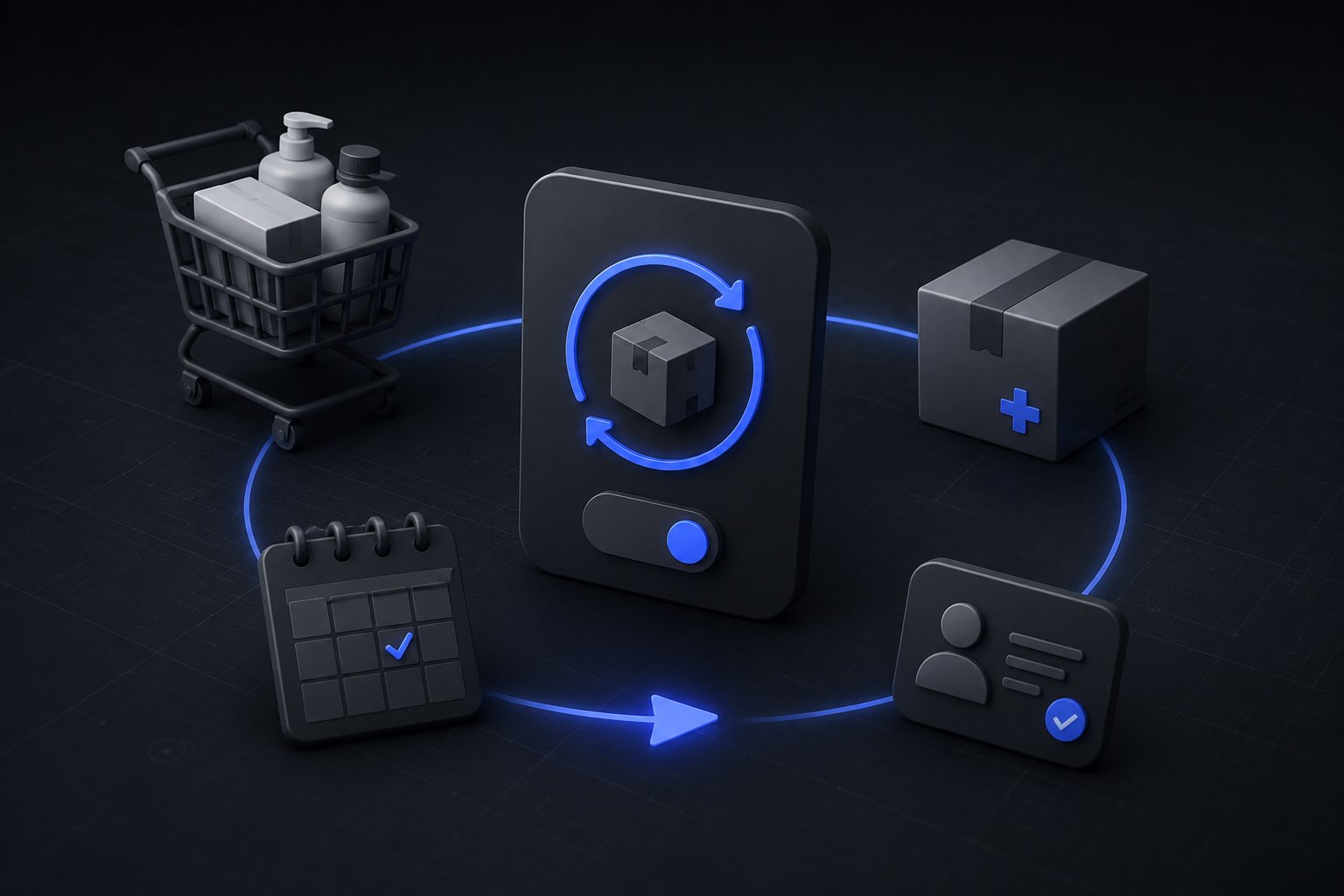
Single-use supplies are bought on a rhythm. A clinic goes through gloves, gauze, and sterilization pouches at a rate that barely changes month to month, which means the distributor already knows, with decent accuracy, what next month's order looks like before the customer places it. The question is what the storefront does with that knowledge. Most do nothing: every order starts from a blank cart, and the predictability that should be the distributor's biggest retention asset stays locked in the order history where nobody acts on it.
Quick answer: Recurring supply programs come in three patterns, and a medical distributor usually needs all three. One-tap reorder puts a past order back in the cart for buyers who want control. Standing orders generate automatically on a schedule for items whose cadence is fixed. Par-level replenishment orders against a target stock level for accounts that manage inventory rather than orders. On Shopify B2B there is a real platform wrinkle worth knowing before you build any of them: consumer subscription apps do not work on B2B checkouts, and the architecture that works instead is better suited to supplies anyway.
Three Patterns, Not One
"Subscriptions" flattens three different buyer behaviors into one word, and the flattening causes bad builds.
One-tap reorder is the floor. The buyer opens their history or a saved list, adjusts a quantity or two, and submits. The buyer stays in control of timing, which matters for practices whose usage shifts with their schedule. This is the workflow layer covered in wholesale medical supplies ordering, and if a distributor builds nothing else, it builds this.
Standing orders remove the decision entirely for items where the decision never changes. The same four cases of gloves, the first Monday of the month, at the account's contract price, on the account's terms. The buyer sets it once and touches it only to change it.
Par-level replenishment inverts the logic for larger accounts: instead of a fixed quantity on a fixed date, the account maintains a target level, say, twelve boxes of a given suture on the shelf, and each cycle's order is whatever brings stock back to par. Surgery centers and multi-site groups tend to think this way because their consumption varies while their storage does not.
The three patterns share everything below the surface: the account's price list, terms, and order history. They differ only in who pulls the trigger, which is exactly the dimension buyers care about.
The Platform Wrinkle Nobody Leads With
Here is the thing a distributor evaluating Shopify B2B should hear before installing anything: Shopify's selling plans, the mechanism every consumer subscription app is built on, are not supported on B2B checkouts, and draft orders cannot carry them either. This is documented platform behavior, discussed openly in Shopify's own community, and it is why stacking a subscription app on top of a B2B store fails at payment no matter how promising the configuration looks.
The temptation is to treat this as a blocker. It is closer to a redirect. Consumer subscription machinery was built for a shopper paying by card at a fixed price, and none of that describes a supply account with negotiated pricing, net terms, and quantities that flex. The pattern that works on Shopify B2B, recurring orders generated against the company account on a schedule, with payment collected through vaulted cards or invoiced against terms, happens to model supply replenishment more honestly than a selling plan ever did.
The Architecture That Actually Fits Supplies
A working standing-order program has four properties, and each one earns its place.
Orders generate against the account, not against a frozen snapshot. Each cycle's order is created fresh from the company's current catalog and price list. When the account's contract rate changes at renewal, the next generated order carries the new price automatically. A subscription that freezes price at signup is wrong for B2B within one contract cycle.
Payment follows the account's real terms. Accounts on net terms get invoiced like any other order. Accounts paying by card can vault one at checkout, and the charge runs automatically when the payment schedule falls due, first-party Shopify capability, no manual collection. The billing model bends to the account instead of the other way around.
The contents are editable without ceremony. A practice adds a new composite to the monthly order, drops a discontinued item, doubles gloves for a busy season. If changing the program requires a support ticket, the program will quietly die and the buyer will go back to ordering manually, or worse, elsewhere.
Generation checks reality before promising anything. More on this below, because it is where recurring programs actually fail.
What the native stack does not provide is the buyer-facing layer: a place where the account sees its programs, pauses one, skips a cycle, or swaps an item without calling anyone. That program-management surface is precisely the kind of account experience Uncap Portal exists to provide, the standing orders live alongside the account's saved lists, history, and pricing, managed by the buyer rather than administered on their behalf.
Stock Truth at 2 AM
A standing order generates on schedule whether or not anyone is watching, which makes it the sternest test of a distributor's data plumbing. If the order that generates overnight includes an item that went out of stock on Thursday, the program just promised something the warehouse cannot ship, and the buyer finds out via a backorder notice on supplies they assumed were handled. Do that twice and the account stops trusting automation entirely, which is expensive, because trust in automation was the whole point.
So the generation step has to check live inventory, and the program needs a policy for the miss: hold the line and notify, substitute an approved equivalent, or ship partial and backorder the rest, per item, per account preference. All of it depends on the storefront and the ERP agreeing about stock in real time, which is the job Uncap Connect does in both directions: current stock and pricing flowing down so generated orders are honest, completed orders flowing up so the ERP remains the system of record for every recurring cycle.
Price sync matters just as much. Contract rates renegotiate, commodity-adjacent items reprice, and each generated order should reflect the account's rate on the day it generates, which is only possible when the price list updates from the ERP rather than by hand.
Where This Fits
Recurring programs are the retention layer of the medical distribution stack this cluster covers: the distributor's guide to B2B ecommerce maps the whole build, and the private portal architecture by account type shows where standing orders sit inside each account shell, since a clinic's monthly program and a health system's par-level replenishment are different rooms in the same house.
Uncap has been a Shopify Platinum Partner since 2013, with 380+ storefronts launched on Shopify, including for distributors, manufacturers, and wholesalers, including operators in medical and dental supply. Book a Demo to see standing orders and par-level programs running against a live ERP connection.
Frequently asked questions
Can you sell subscriptions on Shopify B2B?
Not with consumer subscription apps: selling plans, which those apps are built on, are not supported on B2B checkouts, and draft orders cannot carry them. Recurring B2B supply programs are built instead as scheduled order generation against the company account, with payment through vaulted cards or invoicing on terms, which fits negotiated pricing and flexible quantities better than selling plans do.
What is the difference between reorder, standing order, and par-level replenishment?
Reorder is buyer-triggered: a past order back in the cart in one tap. A standing order is schedule-triggered: fixed items and quantities generated automatically each cycle. Par-level replenishment is inventory-triggered: each cycle orders whatever restores the account's target stock level. They serve different accounts and usually coexist.
What should happen when a recurring order hits an out-of-stock item?
The generation step should check live inventory first, then apply the account's chosen policy: notify and hold, substitute an approved equivalent, or ship partial with a backorder. What should never happen is the order generating against stale stock data and promising inventory the warehouse does not have.
Do prices stay fixed in a B2B supply subscription?
No, and they should not. Each generated order prices against the account's current price list, so contract renewals and rate changes flow into the program automatically. Freezing prices at signup misrepresents how B2B contract pricing works and creates invoice disputes at the first renegotiation.

