


Most of a wholesale medical supply distributor's revenue is not exciting. It is the same boxes of nitrile gloves, gauze, syringes, and exam table paper going to the same clinics, practices, and facilities on a predictable cycle. That is exactly why the ordering experience matters more here than almost anywhere else in B2B: when the products are interchangeable commodities, the distributor that makes reordering effortless is the one that keeps the account.
Quick answer: Buyers of wholesale medical supplies stay with the distributor whose ordering workflow handles three things without a phone call: their tiered price visible while they browse, their net terms applied at checkout, and a reorder path that takes seconds instead of rebuilding a cart. Get those three right and the recurring disposables volume stays in the digital channel. Miss any one of them and the buyer calls, emails, or quietly trials a competitor.
What Wholesale Medical Supply Buying Actually Looks Like
The buyer is rarely a purchasing department. At a dental practice it is the office manager. At a clinic it is a medical assistant with fifteen minutes between patients. At a home health agency it is a coordinator restocking against a checklist. They are ordering consumables, gloves by the case, wound care by the box, incontinence products by the pallet, on a weekly or monthly rhythm that barely changes.
That rhythm defines the requirements. These buyers do not browse. They replenish. A distributor's ordering experience should be built around the 40 SKUs an account actually buys, not the 40,000 the catalog carries. Everything that follows, pricing display, terms, reorder speed, works back from that fact.
Pricing Tiers Buyers Can See Before the Cart
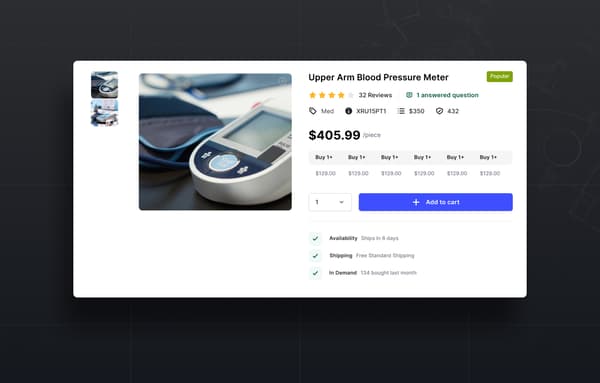
Wholesale medical pricing is volume pricing. A solo practice buying two cases of gloves a month pays a different rate than a multi-location group buying forty, and both expect their rate to be the one on the screen. When the portal shows list price and applies the discount later, or worse, shows a price the invoice then contradicts, the buyer stops trusting the catalog and calls to confirm every order. That phone call is the failure state the whole system exists to prevent.
The mechanics that make tiered pricing work are the same ones that work across B2B: price lists attached to the account, quantity breaks visible on the product page, and tiers that update from the system of record instead of a spreadsheet. How to structure tiered and customer-specific pricing on Shopify B2B covers the build side. For accounts that belong to health system networks or buying groups, tier logic gets harder, volume has to aggregate across facilities, and GPO pricing tiers deserve their own explanation.
The point for the buyer workflow is simpler: the number on the product page has to be their number. Every case where it is not becomes a support ticket, a delayed order, or a small leak in the account's trust.
Net Terms at Checkout, Not After a Phone Call
Established medical accounts buy on terms. Net 30 is the default, larger accounts negotiate longer, and nobody running a clinic wants to put recurring supply orders on a credit card. A checkout that only takes cards tells your best accounts the portal is not for them.
Terms belong in the checkout itself: the account's approved terms displayed as the payment option, the invoice generated against the order, and the credit limit enforced before the order submits rather than caught by accounting two days later. An account over its limit should see that clearly, with a path to resolve it, instead of a generic error. Shopify's native B2B tooling supports payment terms and account-specific catalogs directly, which is what makes this workable without a custom billing layer.
One detail that separates good implementations: multiple buyers on one account. The office manager places orders, the practice owner sees invoices, and both draw against the same terms and the same order history. Medical accounts are small teams, but they are still teams.
Reordering Is Where the Account Is Won or Lost
For disposables and consumables, reordering is not a feature of the buying experience. It is the buying experience. The first order an account places might involve browsing and comparison. The next two hundred are repetition, and every second of friction in that repetition compounds across the life of the account.
The workflow that wins looks like this: the buyer opens their account, sees their recent orders and saved lists, adjusts quantities on the handful of items that changed, and submits. Under a minute, on whatever device they have in hand. Saved lists per location matter for multi-site accounts, a group's downtown clinic and suburban clinic do not stock identically. Order history that shows what was bought, at what price, on what date, replaces the "can you send me what we ordered last time" email entirely.
There is also a quiet compliance benefit: a clean digital order trail per account, per location, per date, is far easier to audit than a stack of faxed POs and phone notes. Nobody buys the portal for that reason, but operations teams learn to love it.
What This Looks Like Built on Shopify
The foundation is native Shopify B2B: company accounts with locations and multiple buyers, price lists per account, catalogs that control which products each account sees, and payment terms at checkout. That covers the structure.
The buyer-facing layer is where Uncap Portal comes in: a private ordering experience per account, built around reorder speed, their catalog, their tiers, their saved lists, their history, rather than a storefront a wholesale buyer has to fight through. Behind it, pricing and inventory stay accurate because Uncap Connect syncs both from the ERP in real time, so the tier a rep negotiated last week is the tier the portal shows today.
This piece is part of a larger picture. The full guide to B2B ecommerce for medical supply distributors covers the rest, license-gated catalogs, ERP architecture, and where to start, and the wholesale solutions page shows how the same workflow patterns apply beyond medical.
Uncap has been a Shopify Platinum Partner since 2013, with 380+ storefronts launched on Shopify, including for distributors, manufacturers, and wholesalers, including operators in medical and dental supply. Book a Demo to see what the reorder workflow looks like against your own catalog and account structure.
Related reading: Selling DME online with configurable, spec-driven orders.
Frequently asked questions
How should a wholesale medical supply distributor show tiered pricing online?
Attach a price list to each account so the buyer's negotiated rate appears on the product page, before the cart, with quantity breaks visible. The tiers should sync from the ERP or pricing system of record so a rate change reaches the portal without a manual update.
Can buyers use net terms when ordering wholesale medical supplies online?
Yes, and established accounts expect it. The checkout should present the account's approved terms as the payment method, generate an invoice against the order, and enforce the credit limit at submission. A card-only checkout effectively excludes the accounts that matter most.
What makes reordering fast for medical disposables and consumables?
Order history and saved lists per account and per location. The buyer adjusts quantities on a short list of familiar items and submits in under a minute, instead of searching a 40,000-SKU catalog for the same 40 products every month.
Do multi-location practices need anything different from a supply ordering portal?
Two things: location-level saved lists and ship-to addresses, since sites rarely stock identically, and shared account infrastructure, so every location draws against the same negotiated pricing and terms while keeping its own order history.