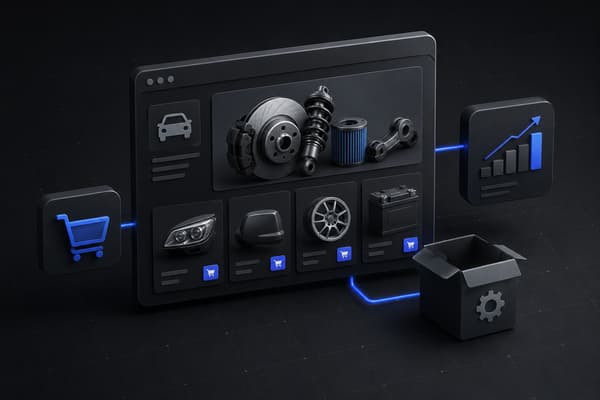


A customer orders brake pads for their 2019 Ram 1500. The pads ship. They don't fit, because the listing covered the 2019 to 2021 Ram 1500 generally, not the specific trim with the larger rotor package. Now you're paying for return shipping, refunding the order, and hoping the review doesn't say "wrong parts." This is exactly what ACES and PIES were built to prevent. ACES defines what a part fits. PIES defines what the part actually is. Together, they're the data backbone behind every serious automotive parts catalog, whether it lives on a dealer's shelf or inside your Shopify store.
What Are ACES and PIES?
ACES (Aftermarket Catalog Exchange Standard) and PIES (Product Information Exchange Standard) are the two data formats the automotive aftermarket uses to describe parts and the vehicles they fit. ACES handles fitment: the year, make, model, and configuration a part works with. PIES handles the product itself: dimensions, pricing, descriptions, and images. Both are maintained by the Auto Care Association.
Before these standards became the default, every supplier built a catalog its own way. One distributor called a part a "control arm." Another called the same part a "suspension arm." A third left out the engine size that determined whether it fit at all. Retailers spent hours reconciling files that should have matched in seconds, and a typo in a model year could send the wrong part to a buyer with no way to catch the error before checkout. Catalogs still stranded on an older Volusion store hit this hardest, since the product model was never built to carry ACES attributes cleanly.
ACES and PIES fixed that by giving the entire supply chain, manufacturers, distributors, retailers, and marketplaces, a shared format. A distributor managing 12,000 SKUs across import and domestic vehicle platforms can hand a retailer one clean file instead of a spreadsheet full of guesswork. The retailer can trust the fitment data before a single part ships, and a buyer searching by vehicle gets a parts list that actually matches what's in their driveway.
How ACES Data Defines What a Part Fits
ACES is built around full vehicle configuration, not just the basic Year-Make-Model most shoppers think in. The Vehicle Configuration Database, or VCdb, breaks every vehicle down into the attributes that actually change which part fits: submodel, engine size, drive type, transmission, and body style. A 2019 Ram 1500 Tradesman with the standard brake package and a 2019 Ram 1500 Laramie with the upgraded rotor package are the same model year, but they need different brake pads.
That's where qualifiers come in. The Qualifier Database, or Qdb, adds the conditions that narrow fitment further: with 17 inch wheels, 4WD only, without tow package. A part listing without qualifier data looks like it fits a vehicle. A part listing with qualifier data tells a buyer exactly when it doesn't, before they add it to the cart.
Say you manufacture exhaust systems for half-ton pickups. The same cab and bed length can ship from the factory with three different engine options, and each one needs a different pipe diameter and hanger position. Without VCdb-level fitment data attached to your catalog, your storefront has no way to know which exhaust system belongs in front of a given shopper. With it, the vehicle they search for determines the parts they see.
How PIES Data Describes the Part Itself
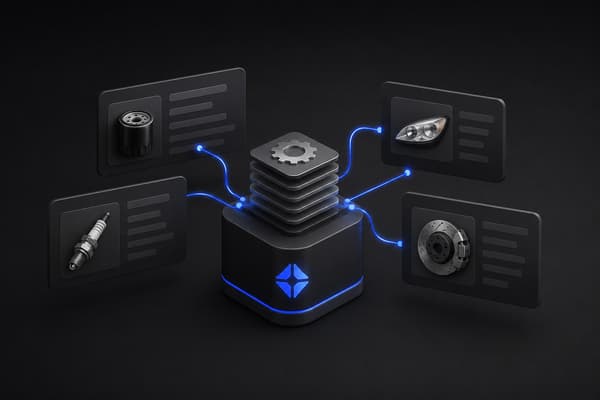
ACES answers what a part fits. PIES answers what the part is. The Part Configuration Database, or PCdb, standardizes part terminology and categories so "brake pad set" means the same thing in every supplier's catalog. The Product Attribute Database, or PAdb, carries the details that fill out a listing: material, weight, dimensions, certifications, and warranty terms. A shared brand table keeps brand names and identifiers consistent, so a buyer searching for a specific manufacturer gets the same results no matter whose feed they're browsing.
Together, PCdb, PAdb, and the brand data turn a bare part number into a complete listing. Accurate dimensions support shipping quotes that don't surprise the buyer at checkout. The right category powers search and filtering, and descriptions read like they were written for this decade, not the last one. It also means your freight costs stop being a guess: accurate weight and dimension data from PAdb is what a shipping rate calculator actually needs, instead of falling back on a flat estimate that eats your margin on anything oversized. And because cost and availability live in the ERP, an Epicor integration is what keeps those numbers aligned with the fitment layer, so a matched part is also one you can price and ship.
From ACES and PIES Files to a Working Fitment Search on Your Storefront
Having clean ACES and PIES files solves half the problem. The other half is what happens when that data lands on your actual storefront, where a buyer is trying to find the right part for their vehicle in under a minute, not parse an XML file.
Ingest the feed. ACES and PIES files typically arrive as XML, either through a subscription to the Auto Care Association's data portal or directly from your suppliers. That data needs a structured home before it can power anything customer-facing.
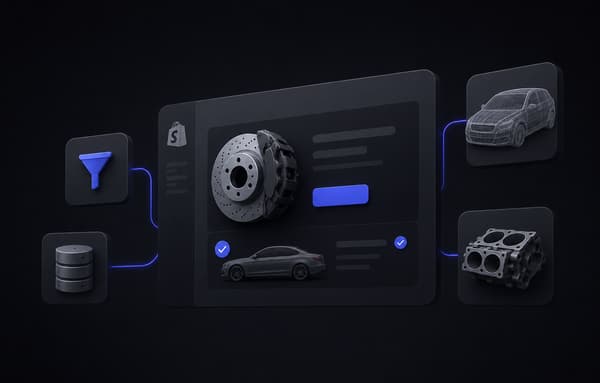
Map VCdb and PCdb to your catalog. Vehicle configurations and part categories from the standard files need to connect to the actual products in your Shopify catalog, not sit in a spreadsheet nobody opens after launch.
Build the Year-Make-Model selector. This is the part shoppers actually see: pick a vehicle, browse only the parts that fit it. Uncap Garage handles this natively on Shopify, pulling from the mapped fitment data instead of a hand-maintained list.
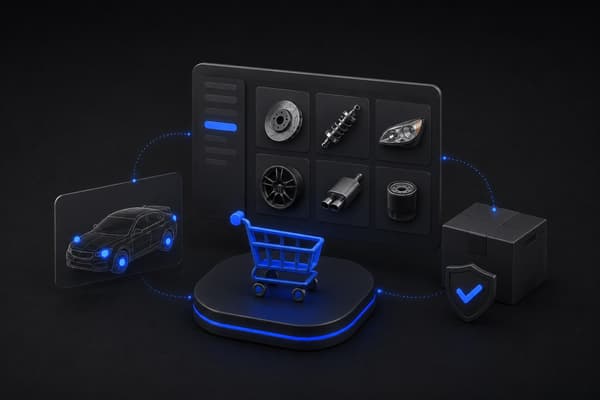
Enforce fitment at the cart, not just the search bar. A buyer can still add a part manually, arrive from a direct link, or change vehicles mid-session. Fitment checks at checkout catch the mismatch before it becomes a return.
Shopify's B2B tooling handles company accounts and custom pricing well, but Year-Make-Model fitment search isn't native to the platform. That's the gap a dedicated automotive parts ecommerce solution, like Uncap Garage for vehicle selection or Uncap PartsDiagram for diagram-based parts discovery, is built to close.
Why Accurate ACES and PIES Data Protects Your Margin
For an auto parts distributor, bad fitment data doesn't just cost one order. It creates a return, a restocking charge, a refund, and a buyer who second-guesses the next listing too. Marketplaces compound the problem. Amazon's automotive category requires ACES and PIES-formatted data to list parts at all, so a supplier with messy fitment data isn't just losing sales on their own site, they're locked out of an entire sales channel. Our related guide on how ACES and PIES fitment data standards shape returns in auto parts ecommerce digs deeper into that cost chain.
The standards themselves keep moving. PIES is currently on version 8.0, up from 7.2, which means a feed that was fully compliant two years ago may already be out of date. Vehicle data changes every model year too, as new trims, engines, and submodels reach the market.
It's not only retail shoppers who depend on this. A regional repair shop or fleet account ordering through your private wholesale portal needs the same Year-Make-Model accuracy a one-time retail buyer does, just without re-entering it on every order. If fitment data only lives on the public storefront, and not inside the account-based ordering experience your B2B buyers use, you've solved half the problem. Your highest-volume accounts are still working off the same guesswork as before.
Uncap has been a Shopify Platinum Partner since 2013, building B2B commerce projects for manufacturers and distributors who live with exactly this problem. A catalog built for the counter, now expected to work as well online as it does in person. For an auto parts and aftermarket operator running thousands of SKUs across multiple vehicle platforms, the fitment layer isn't a nice-to-have feature buried in settings. It's what decides whether a buyer trusts the rest of the catalog.
Getting Fitment Right Starts With the Data
ACES and PIES aren't paperwork to file away after a supplier audit. They're the reason a buyer can search for their exact truck and trust that every part on the page actually fits it. Get the data right, and everything downstream, search, filtering, shipping quotes, marketplace listings, returns, gets easier by default.
Request a Quote to see how Uncap Garage turns your ACES and PIES fitment data into a real Year-Make-Model search on your Shopify store.
Frequently asked questions
Do I need both ACES and PIES data, or just one?
You need both. ACES tells a buyer or a search engine what a part fits, while PIES tells them what the part actually is, including price, dimensions, and description. A catalog with only ACES data has accurate fitment but incomplete listings. A catalog with only PIES data has full product details but no way to confirm a part works with a specific vehicle.
How often does ACES and PIES data change?
ACES and PIES data changes on a regular cycle set by the Auto Care Association, and vehicle configuration data updates at least once a year as new trims, engines, and submodels reach the market. A fitment feed that isn't refreshed at least annually drifts out of sync with current vehicles fast, especially for late-model trucks and SUVs with frequent mid-cycle changes.
Can Shopify handle ACES and PIES data without custom development?
Not on its own. Shopify doesn't natively parse ACES or PIES files or generate a Year-Make-Model selector out of the box. Getting from a raw data feed to a working fitment search means mapping that data into your catalog and building the selector and search logic on top of it. That's exactly what a dedicated fitment app is built to do.