

The return authorization is in. The buyer says the part doesn't fit. You pull the order and check the product listing. The Year-Make-Model lookup said it was compatible. The customer entered the right vehicle. The part shipped to the right address. And it still came back.
This is the most expensive and most preventable problem in automotive parts ecommerce. Industry data consistently identifies incorrect fitment information as the leading cause of parts returns, with some estimates placing fitment errors behind the majority of return volume [verify source: Auto Care Association / AASA before publishing]. The problem is not that buyers order wrong. The problem is that the fitment data on the product page was wrong before they arrived.
For automotive distributors, wholesalers, and parts suppliers running ecommerce operations, this is not a customer service problem. It is a product data problem. And it has a specific, fixable root cause.
What Fitment Data Is and Why It Breaks
Fitment data is the vehicle application information that links a part to the vehicles it fits. At its most basic, it is the Year-Make-Model matrix: this brake pad fits a 2019 Ford F-150 with a 5.0L engine, a 2018 model with the same engine, and a 2019 model with a 3.5L engine, but not a 2019 with a 2.7L because the caliper specs differ.
In practice, fitment data is significantly more complex than a simple YMM lookup. A single SKU might have dozens of application rows, each with sub-model qualifiers, engine notes, transmission qualifiers, body style restrictions, and regional availability flags. A brake pad application that looks like a straightforward match on Year-Make-Model may still be wrong if the qualifier note specifies a specific trim level the buyer's vehicle does not have.
The automotive aftermarket industry manages fitment data through two standards published by the Auto Care Association: ACES (Aftermarket Catalog Exchange Standard) for vehicle application data, and PIES (Product Information Exchange Standard) for product attributes. These standards define the schema that suppliers use to deliver fitment and product data to distributors and retailers.
The problem is that raw ACES data from suppliers is often incomplete, inconsistent, or simply wrong. Application rows are missing engine qualifiers. Trim level notes conflict with each other across supplier data files. Model year ranges are published without sub-model specificity. When a distributor ingests this data into their automotive parts ecommerce catalog without validation, the errors transfer directly to the buyer-facing product page. Distributors fixing this are often mid-migration off a strained BigCommerce catalog that could not model ACES and VCdb data cleanly.
The buyer does a YMM search. They find a part that shows as compatible. They order it. It arrives. It does not fit. They return it.
What Fitment Returns Actually Cost an Automotive Parts Distributor
The visible cost of a fitment return is the reverse logistics: return shipping, inspection, restocking, and processing time. For a $60 replacement part, that visible cost alone often exceeds the margin on the original sale.
The less visible costs are larger.
A wholesale auto parts buyer — a repair shop, dealership, fleet operator, or installer — places orders at frequency. They do not order one part at a time. They order in batches, often referencing your catalog for multiple vehicles they are servicing simultaneously. When a fitment error generates a return, it creates a delay in their workflow. Their technician is waiting for the part. Their bay is occupied. Their customer is waiting for the vehicle.
That delay is not forgotten. The repair shop that experiences two or three fitment-related returns from your catalog in a month does not call to complain. They quietly shift their routine wholesale auto parts orders to a supplier whose catalog they trust.
There is also the hidden inventory cost. A returned part that cannot be immediately restocked sits in your returns queue. If the fitment error is systemic — the same application row is wrong across dozens of SKUs from the same supplier data file — the returns accumulate before anyone identifies the pattern.
Across 380+ Shopify storefronts launched by Uncap as a Shopify Platinum Partner since 2013, fitment data quality is the most common operational gap we see in automotive distributors launching ecommerce for the first time. The catalog looks complete. The YMM search appears to work. But the underlying application data has never been validated against a live vehicle database.
Three Root Causes of Fitment Errors in Automotive Parts Ecommerce
Fitment errors in automotive parts ecommerce almost always trace back to one of three sources. Understanding which applies to your operation determines where the fix needs to happen.
Supplier ACES data quality. The fitment data your parts catalog contains is only as accurate as the data your suppliers delivered. If a supplier published an ACES file with incomplete engine qualifiers, missing sub-model notes, or incorrect year range endpoints, those errors are now in your catalog and on your product pages. Downstream, a buyer selects a part that shows as compatible, and it is not. This is the most common root cause for distributors who import supplier data without a validation step.
No fitment validation layer at import. Even when supplier ACES data is technically correct, it may not be validated against a live vehicle database at the point of import. A fitment record that references a vehicle that does not exist in the VIN database, or an engine configuration that was discontinued mid-model-year, will appear to be valid in your catalog until a buyer finds the mismatch. Distributors who import ACES data directly into their ecommerce platform without running it against a validated vehicle dataset carry this risk in every catalog update.
Storefront search that does not enforce fitment at selection. Some automotive parts ecommerce storefronts allow buyers to search by part number, category, or keyword without requiring a vehicle selection first. This means a buyer can add a part to their cart without ever having their vehicle verified against the application data. They believe the part is correct because they searched for it. The fitment mismatch is discovered at installation, not at checkout.
How the Wholesale Auto Parts Buyer Experience Differs from Retail
The return problem compounds at the B2B level in ways that are not visible in consumer ecommerce metrics.
A retail buyer orders one part, discovers it does not fit, returns it. That is a single transaction error. The cost is contained to that order.
A wholesale auto parts buyer operates differently. A repair shop buyer pulling parts for a week's work may place orders for fifteen vehicles in a single session, cross-referencing your catalog for each application. If a fitment error exists in a common application, it may generate returns across multiple vehicles from that single buyer session. The buyer processes five returns in the same week and does not attribute them to five separate mistakes. They attribute them to one: your catalog is not reliable.
For fleet accounts, the problem is worse. A fleet operator managing a hundred vehicles of the same make and model will place large orders for common maintenance parts using your fitment data as their reference. A single fitment error in that application row can generate a batch return.
The dealer network buyer has a similar pattern. A dealer purchasing wholesale auto parts for their service department relies on parts arriving correct the first time. Their technician does not have time to hold a repair order while a correct replacement part ships. A fitment return in a dealer relationship is not just a return. It is a billable hour lost, a customer wait extended, and a service department reputation affected.
None of this appears in your return rate metric by itself. The metric shows the return. It does not show you the downstream account behavior that follows. Getting ahead of that pattern is a distribution problem as much as a data problem, and our distribution solution treats fitment data and returns in auto parts ecommerce as part of one connected buyer experience.
What Your Automotive Parts Ecommerce Platform Needs to Get Fitment Right
The fitment problem is a data problem, but it manifests at the storefront level. Fixing it requires capability at both layers: the data infrastructure and the buyer-facing search experience.
Year-Make-Model search enforced at catalog entry. The buyer should not be able to add a part to their cart without first selecting their vehicle. A forced YMM selection, or VIN entry for precision lookup, validates the application at the moment the buyer is making their decision. It also prevents the "searched by keyword, ordered wrong part" pattern that generates avoidable returns.
VIN decoder for precision vehicle identification. Year-Make-Model lookup covers the broad application match. VIN decoding covers the edge cases: the mid-year production change, the market-specific variant, the dealer-installed option that changes the applicable part. A buyer who enters their VIN instead of their year and model gets application results that account for their specific vehicle configuration.
Application data validated against a live vehicle database. At the catalog management level, fitment data imported from ACES files should be run against a validated vehicle dataset before it goes live on the storefront. Application rows that reference vehicles not in the dataset, or configurations that conflict with known vehicle specs, should be flagged for review rather than published automatically.
Shop-by-diagram for complex assemblies. For parts with complex installation contexts, where a buyer needs to see the assembly to identify the correct component, a diagram-based selection experience reduces fitment errors at the point of choice. The buyer sees the exploded diagram of the assembly, identifies their part visually, and selects from the correct application. This is particularly valuable for engine components, suspension assemblies, and HVAC systems where part number selection from a list is error-prone.
Product data enrichment upstream from the catalog. Fitment accuracy at the storefront starts with product data quality before any of the buyer-facing tools matter. Well-structured product information management for automotive catalog data gives distributors a validation layer between supplier ACES files and the live storefront, reducing the error rate before buyers ever see the catalog. Fitment accuracy also has to line up with stock; for distributors on Fishbowl, the inventory integration is what ensures the part a buyer selects by vehicle is one the warehouse can actually ship.
How Uncap Builds Fitment-Accurate Automotive Parts Ecommerce on Shopify
Uncap builds automotive parts ecommerce operations on Shopify Plus for distributors, wholesalers, and parts suppliers who need fitment accuracy as a core requirement, not an afterthought.
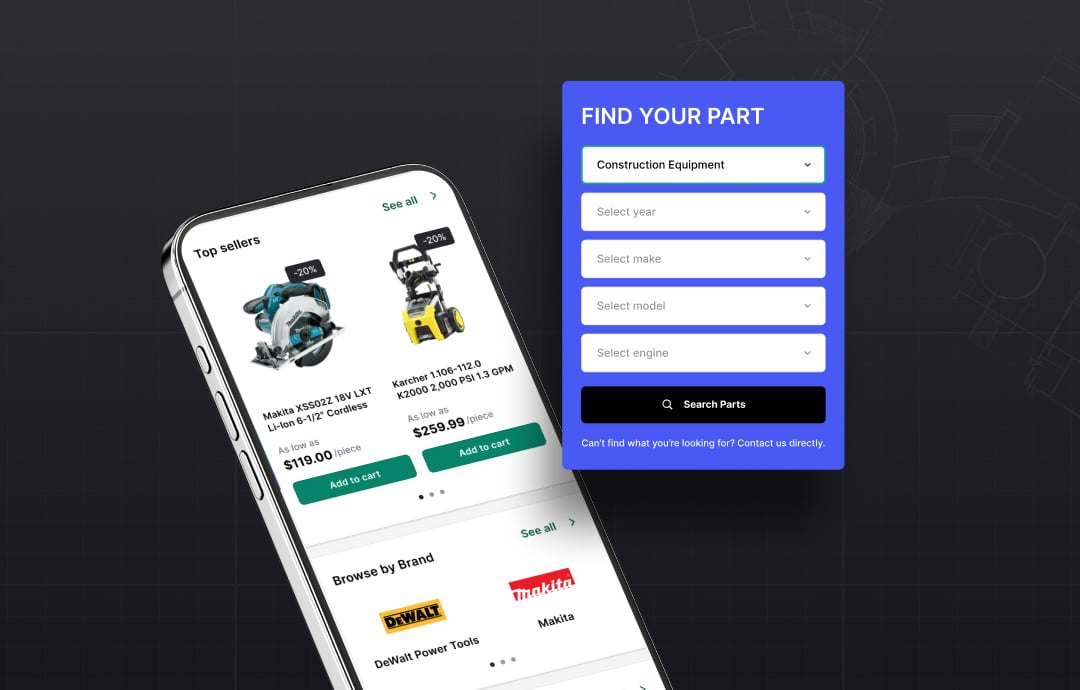
The Uncap Product Fitment app handles Year-Make-Model fitment search on Shopify, connecting your parts catalog to a validated vehicle database so buyers can search by their vehicle and get application results that match their actual configuration. The YMM filter is enforced at the catalog level, so a buyer cannot add a part without their vehicle being verified against the application data.
For assemblies and complex part families where visual identification is essential, Uncap PartsDiagram delivers shop-by-diagram functionality on Shopify. Buyers navigate to their part by viewing the assembly, not by guessing from a part number list. The result is fewer wrong selections, fewer returns, and faster ordering for buyers who know what they need but not what it is called.
Both tools are built for the auto parts and aftermarket industry at a B2B scale, with support for wholesale buyer accounts, customer-specific pricing, and purchase order capture alongside the fitment search layer.
For automotive distributors bringing a large catalog online, the fitment layer is built in combination with a product data enrichment phase: validating supplier ACES data against the vehicle database before import, flagging incomplete application rows, and establishing a workflow for catalog maintenance when supplier data updates arrive. The storefront fitment tools are only as accurate as the data feeding them.
If your team is still getting a handle on the underlying standards, our explainer on the ACES and PIES fitment data standards covers why every automotive portal depends on them.
When the two work together, the return rate drops. Not because returns become harder to process, but because fewer parts go out the door with the wrong application in the first place.
Request a Quote to discuss how fitment accuracy is built into Shopify for your parts catalog.
Fixing Fitment Data Quality Before It Reaches the Storefront
The fastest wins in fitment accuracy come from changes made before the buyer sees the catalog.
The starting point is an audit of your current fitment data. For each supplier data file you are using, the audit asks: how complete is the ACES coverage? What percentage of application rows include engine qualifiers? How many application rows reference vehicles that exist in a validated vehicle database? Where are the gaps most concentrated?
Most automotive distributors find that a small number of supplier data files are responsible for a disproportionate share of fitment errors. Correcting those files, or establishing a validation workflow before import, addresses the majority of return-generating errors without touching the storefront.
The second step is the storefront search enforcement. If buyers can currently order parts without a vehicle selection, enabling mandatory YMM lookup at catalog entry is the single highest-impact change for reducing fitment returns. Some returns disappear immediately because buyers who would have guessed wrong are now guided to correct applications.
The third step is data maintenance. Supplier ACES files update. New model years are added. Production changes mid-year require qualifier updates. A fitment accuracy standard that is set at launch and never maintained degrades over time. Building a process for validating and importing supplier data updates is the operational change that keeps the return rate low after the initial fix.
Frequently asked questions
What causes the majority of automotive parts returns in ecommerce?
Incorrect fitment data is consistently identified as the leading cause of automotive parts returns in ecommerce. This means the vehicle application information on the product page showed the part as compatible with a buyer's vehicle when it was not, due to errors or gaps in the underlying ACES fitment data. The buyer ordered the correct part for what the catalog said their vehicle needed. The catalog was wrong.
What is ACES data and why does it matter for automotive parts ecommerce?
ACES (Aftermarket Catalog Exchange Standard) is the data standard published by the Auto Care Association for vehicle application data in the automotive aftermarket. It defines how suppliers communicate which parts fit which vehicles, including year, make, model, engine, transmission, and sub-model qualifiers. Automotive parts ecommerce distributors receive ACES data files from suppliers and use them to populate the fitment information on their product pages. When ACES data is incomplete or inaccurate, the fitment information buyers see on the storefront is wrong.
How does Year-Make-Model search reduce automotive parts returns?
Year-Make-Model (YMM) search enforces a vehicle selection before a buyer adds a part to their cart. Instead of searching by keyword or part number and hoping the part fits their vehicle, the buyer selects their year, make, and model first, and the catalog filters to show only parts confirmed as compatible with that application. This prevents the most common source of wrong-part orders: a buyer selecting a part that looks right without verifying it against their vehicle.
What is the difference between OEM and aftermarket fitment data quality?
OEM (original equipment manufacturer) parts are designed and validated by the vehicle manufacturer for specific vehicles, so fitment data for OEM parts is generally highly accurate. Aftermarket parts, produced by third-party manufacturers, rely on ACES data published by the supplier, which varies significantly in quality and completeness across the supplier base. Aftermarket distributors carry higher fitment error risk because they are importing fitment data from a larger and more varied supplier pool, often without a validation step before publishing.
How should wholesale auto parts distributors handle fitment data management?
Wholesale auto parts distributors should treat fitment data as a product data discipline with its own workflow, separate from order management or inventory tracking. This includes: validating supplier ACES files against a live vehicle database before import, flagging incomplete application rows for review rather than auto-publishing, establishing a process for handling supplier data updates when new model years or production changes arrive, and enforcing vehicle selection on the storefront so buyers cannot place orders without a fitment check at selection.
Can Shopify handle automotive parts ecommerce with YMM fitment search?
Yes. Shopify handles automotive parts ecommerce effectively when fitment search capability is added through a purpose-built app. Native Shopify product variants and metafields provide the data structure for parts attributes, while a YMM fitment app connects the buyer's vehicle selection to the application data in your catalog and filters results accordingly. For distributors also needing wholesale buyer accounts, customer pricing, and PO capture, Shopify B2B handles those requirements alongside the fitment search layer.