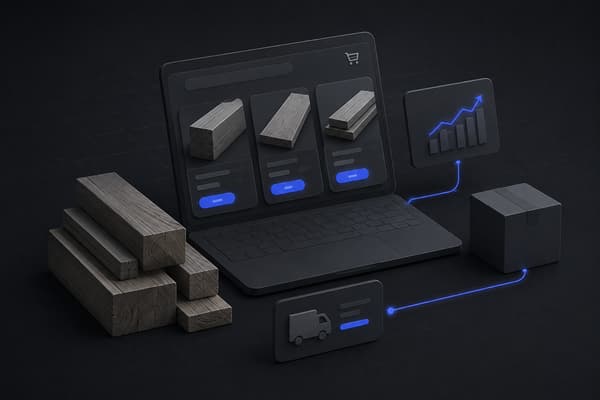


Walk into most building materials distributors and the order desk still runs on a fax machine, a shared inbox, and a phone that does not stop ringing. That is not a knock on the industry. It is a real description of how a lot of building materials ecommerce still works in practice, even as buyers increasingly expect to check pricing, place an order, and confirm a delivery window online, the same way they do in every other part of their day.
This is specifically about building materials, lumber, concrete, drywall, roofing, siding, insulation, windows and doors, the raw and manufactured products that go into a structure. If your business carries tools, fasteners, safety equipment, or jobsite consumables rather than structural materials, Uncap's companion guide to construction supplies ecommerce covers that side of the industry, since the two are genuinely different catalogs and different buying patterns even though they often get lumped together.
The gap between fax-and-phone ordering and real digital ordering is where the opportunity sits, for manufacturers and distributors across lumber, roofing, concrete and masonry, and every other materials category in the building and construction trade.
As a Shopify Platinum Partner since 2013, with 380+ storefronts launched on Shopify, Uncap has worked with manufacturers and distributors across this exact catalog profile, heavy, technical, freight-dependent, and knows where a building materials ecommerce project actually runs into trouble versus where it just looks risky on paper.
Why Building Materials Ecommerce Is Still Behind
Three things make this category harder to move online than most retail, and none of them are good reasons to stay offline forever.
Catalogs are genuinely complex. A single SKU might have a dozen technical variants, gauge, finish, fire rating, code compliance, that a buyer has to get exactly right, because getting it wrong means a failed inspection or a return trip to the jobsite. Pricing is relationship-based, not published, contractors and dealers negotiate volume tiers and account terms that a public price list cannot show. And a meaningful share of orders still need a human: will-call pickup timing, freight coordination on heavy or oversized loads, and project-based buying where the same account orders differently for every job.
None of that rules out ecommerce. It rules out treating building materials ecommerce like a consumer storefront with a bigger catalog.
What Makes Building Materials Ecommerce Different From Retail
A Gartner survey found that 83 percent of B2B buyers now prefer ordering and paying online rather than through a rep, a preference that holds just as true for a contractor reordering lumber as it does for any other B2B buyer. But the storefront that earns that preference in building materials has to do a few things a general retail site does not.
It has to show each account its own negotiated pricing the moment they log in, not a public list price. It has to support will-call and branch pickup alongside shipping, since a lot of building materials orders get picked up at a local yard rather than delivered. It has to surface technical specs, compliance documents, and safety data sheets on the product page itself, so a buyer does not have to call to confirm a fire rating or a code compliance detail. And it has to handle freight-heavy and oversized items, lumber packs, pallets of concrete mix, rolled roofing, without breaking a standard checkout built for small parcels.
What a Modern Building Materials Storefront Needs
Based on where these projects actually run into trouble, a handful of capabilities matter more than the rest.
Account-specific pricing that loads instantly. Shopify's B2B catalogs and price lists handle this at the platform level, so a contractor or dealer sees their real rate the moment they log in, not a generic list price.
Fast reorder from order history. Most building materials revenue is repeat business, the same jobs, the same materials, again and again. Reordering should be one click, not a rebuilt cart every time.
Real-time inventory across every branch or warehouse. A buyer choosing pickup needs to know what is actually on the shelf at their local branch, not a number from a central system that is a day out of date.
A quote path for project-based and volume orders. Not every order fits a fixed price. A buyer pricing out a full job needs a way to request a quote without leaving the site and waiting two days for an email back.
ERP and warehouse data that agrees with the storefront. When pricing, inventory, and account terms live in an ERP, the storefront has to read from that same source in real time, or the two disagree and someone downstream pays for the mismatch.
Freight and LTL shipping calculated correctly. Lumber, drywall, and concrete products often ship LTL (less-than-truckload) rather than standard parcel. A checkout that quotes flat-rate shipping on a pallet of concrete mix the same way it would a small parcel order will quote it wrong, and that mismatch either eats margin or creates a billing dispute after the fact.
What Generic Ecommerce Platforms Miss in Building Materials
Most off-the-shelf ecommerce platforms are built around a retail catalog: a fixed number of SKUs, standard parcel shipping, and one price per product. Building materials break all three assumptions at once.
A single lumber SKU might carry different pricing by grade, length, and treatment, plus a separate freight calculation depending on order volume and delivery zone. A generic platform's product model was not built to represent that without heavy customization, and a generic connector between the storefront and the ERP tends to flatten pricing logic into something less accurate than what the ERP actually calculates.
This is where Uncap Connect fits for building materials manufacturers and distributors: an integration layer built around the ERP data that actually drives a materials business, item master with grade and treatment variants, freight-zone pricing, multi-branch inventory, and account-specific contract terms, rather than a generic sync retrofitted to handle a catalog it wasn't designed for.
The Fax-to-Online Transition, and Why It's Happening Now
The push toward digital ordering in this industry is not coming from a single trend. It is buyer expectations shifting everywhere else and building materials catching up, combined with real operational pressure: order desks that cannot hire fast enough to keep up with phone and fax volume, and younger buyers on the purchasing side who simply expect to self-serve online the way they do for everything else in their job.
That transition, from fax and phone orders to a real digital storefront, is the exact subject of Uncap's Operators Roundtable on building materials and construction supplies, a working session built around one operator's firsthand account of making that move, a live breakdown of what a modern B2B storefront looks like, and a scorecard attendees walk away with. It is built for owners, operators, and executives across distribution, manufacturing, and building-products brands, roofing, lumber, cabinetry, concrete and masonry, doors and windows, flooring, and more.
How One Building Materials Business Made the Fax-to-Online Move
Proof this transition works is already public, not as a case study, but as the reason the Roundtable exists in the first place. Kurt Jones, president of Jones & Sons, is featured on the event page as the peer example: the operator who took a materials business from fax and phone orders to a real online storefront, start to finish. Someone who ran an order desk through the exact reality described above, and came out the other side with a working digital channel, is worth more than another vendor's feature list. It is why the Roundtable is built around a live conversation with him rather than a slide deck.
What Happens After the Storefront Goes Live
Building the storefront is the first step. What a contractor finds after logging in decides whether they keep using it or go back to the phone. Contract pricing that matches the account's real rate, units of measure that match how the trade actually orders (bundles, cubes, pallets, not individual pieces), a job cost code field that ties the order back to a project, real-time inventory by branch, and net terms at checkout instead of a card prompt all matter more than almost anything else once the storefront is live. A closer look at why contractors abandon a portal that gets these wrong and what a contractor portal has to include to keep the order digital cover both sides of that in more depth.
Can You Actually Sell Building Materials Through B2B Ecommerce?
Yes. Building materials are sold through B2B ecommerce today by distributors and manufacturers of every size, provided the storefront supports account-specific pricing, will-call pickup, technical specs on the product page, and a quote path for project-based orders. The materials that resist ecommerce are rarely the products themselves. It is a generic storefront that was never built to handle how this industry actually buys.
Building the Storefront Building Materials Buyers Actually Use
Building materials do not need a generic ecommerce template. They need a storefront that gets pricing, inventory, and technical specs right for how contractors, dealers, and project buyers actually order.
If you want to hear how one operator made this exact move from fax and phone to online, apply for a seat at the Operators Roundtable on building materials and construction supplies. Limited to around 12 operators, free to attend.
If you'd rather talk through your specific catalog and ERP setup first, talk to Uncap's team.
Related reading: Taking a building supply counter business online.
Frequently asked questions
Do contractors actually buy building materials online?
Yes, increasingly for repeat and known-quantity orders. A contractor reordering the same lumber, roofing, or fixtures they used last month is a strong fit for self-service ecommerce, while first-time or highly custom orders are more likely to still involve a rep or a quote.
What is the biggest technical challenge in building materials ecommerce?
Keeping pricing and inventory accurate across every branch or warehouse in real time. When a storefront shows stock or a price that is not actually current, buyers stop trusting it and go back to calling, which defeats the purpose of moving online in the first place.
Does building materials ecommerce replace the branch or the sales desk?
No. It takes the routine, repeat-order volume off the phone and fax so the desk can spend more time on the complex, project-based orders that actually need a person. Will-call pickup and in-branch relationships stay part of how this industry operates.
Is building materials ecommerce different from construction supplies ecommerce?
The two overlap in buyer base but differ in catalog. Building materials, lumber, concrete, drywall, roofing, are structural products with heavy freight and technical spec requirements. Construction supplies, tools, fasteners, PPE, jobsite consumables, are a different SKU profile with different fulfillment needs. See Uncap's guide to construction supplies ecommerce for that side.