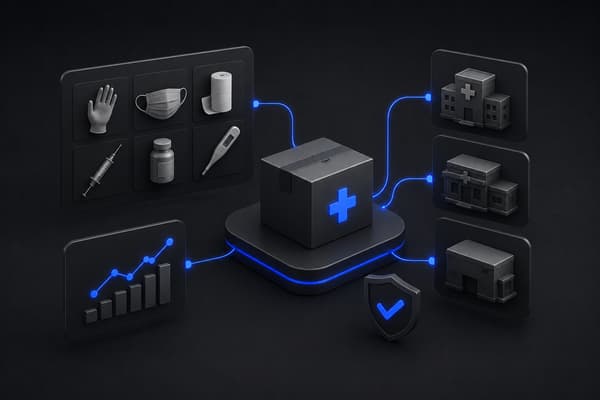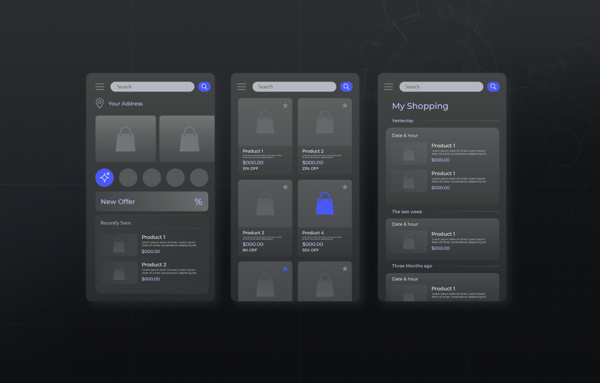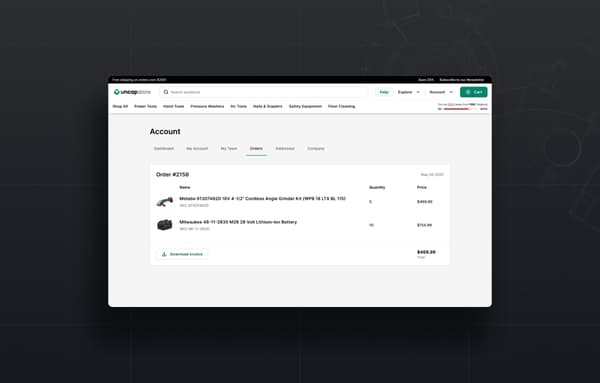



Ask a construction supply house what they sell and the answer is rarely "building materials." It's fasteners, PPE and safety gear, hand and power tools, concrete accessories, jobsite consumables, temporary power, and the hundreds of smaller items a crew burns through on every job. That is a different catalog than lumber and concrete, and it behaves differently online too.
This is specifically about construction supplies, the tools, fasteners, safety equipment, and consumables a contractor needs to actually run a job, not the structural materials that go into the building itself. If your business is closer to lumber, concrete, roofing, or drywall, Uncap's companion guide to building materials ecommerce covers that side, since the buying pattern and the catalog are different enough to treat separately.
The opportunity here sits with the distributors and supply houses serving contractors across every trade in the building and construction industry, PPE and safety, fasteners and hardware, tools, and general jobsite consumables.
As a Shopify Platinum Partner since 2013, with 380+ storefronts launched on Shopify, Uncap has worked across a wide range of B2B catalog profiles, including high-SKU-count distributors where findability and reorder speed matter more than negotiated pricing complexity, which is exactly the shape of a construction supplies business.
Why Construction Supplies Are a Different Ecommerce Problem Than Materials
A materials distributor sells a relatively contained set of SKUs at high volume and high freight weight. A construction supply house sells the opposite: thousands of small, low-cost SKUs, fasteners, blades, PPE, adhesives, that a contractor buys constantly and in unpredictable combinations. That difference changes what the storefront actually has to do well.
Catalog breadth matters more than catalog depth. A crew reordering safety glasses, respirators, and a box of screws needs to find all three fast, not navigate a catalog structured around a handful of major product lines. Order frequency is higher and order size is smaller, which means reorder speed matters more here than almost anywhere else in B2B ecommerce. And because a lot of these purchases are urgent, a crew is out of a consumable on-site, right now, same-day fulfillment and local branch pickup carry more weight than they do for a planned materials order.
What a Construction Supplies Storefront Needs That a Materials Storefront Doesn't
Fast, forgiving search across a huge SKU count. A contractor searching for "3/8 impact driver bits" or "N95 respirator" needs to find the right item in seconds, not browse a category tree built for a few hundred SKUs. Search and filtering matter more here than in almost any other B2B vertical.
Account-based reorder lists, not just order history. Crews reorder the same consumables constantly, gloves, fasteners, blades, tape. A saved reorder list or favorites structure that a foreman can hit in one click matters more than a general order-history page.
Job-site delivery and will-call, both handled well. Some orders need to land on a job site by a specific time. Others are a quick will-call pickup from the branch. A construction supplies storefront has to handle both without treating either as an afterthought.
Multi-buyer company accounts. On a construction supplies account, several people from the same company, the foreman, the site super, the office admin, often place orders under one account. The storefront needs company-account structures that reflect that, not a single login shared awkwardly across a crew.
Bulk and case-quantity pricing. Fasteners, PPE, and consumables are frequently bought by the box or case, not the unit. Pricing and catalog display need to reflect that naturally, not force a buyer to do the math themselves.
Shopify's B2B catalogs and price lists support account-specific pricing and company account structures at the platform level, which is the foundation this kind of storefront is built on.
Compliance and Documentation Buyers Expect to See
Construction supplies carry a documentation requirement that materials sales usually don't. Safety data sheets for chemicals and adhesives, certifications for PPE and fall-protection equipment, and compliance ratings for fasteners used in structural applications all need to be attached and easy to find on the relevant product page, not buried in a separate resources section a buyer has to go hunting for.
A safety manager sourcing PPE for a crew, or a foreman confirming a fastener is rated for a specific structural application, needs that documentation at the point of purchase. A storefront that treats compliance documents as an afterthought creates the same trust problem as inaccurate inventory: buyers who can't verify what they're buying go back to calling someone who can tell them directly.
What Generic Ecommerce Platforms Miss in Construction Supplies
A generic ecommerce platform's search and catalog structure is usually built around a few hundred to a few thousand SKUs organized into clean categories. Construction supply houses often carry tens of thousands of SKUs across dozens of overlapping categories, fasteners alone can run into the thousands of individual part numbers, and a buyer needs to find the right one by size, material, and application, not just a category browse.
This is where Uncap Connect fits for construction supply distributors: an integration layer built to keep a high-SKU-count catalog, real-time multi-branch inventory, and account-specific pricing in sync with the ERP that actually runs the business, rather than a generic sync that starts to break down once the SKU count gets into the thousands.
The Case for Moving Construction Supplies Online
The order desk problem here looks a lot like the one in building materials, phone calls, texted photos of a part number, an order desk that can't scale headcount as fast as order volume grows, but the fix looks a little different because the order profile is different. A materials distributor moving online is mostly solving for a smaller number of larger, more complex orders. A construction supplies distributor moving online is mostly solving for a much larger number of small, fast, repeat orders, where the win is speed and findability, not complexity handling.
That's the same underlying shift driving Uncap's Operators Roundtable on building materials and construction supplies, a working session for owners, operators, and executives across distribution and building-products brands moving order volume from fax and phone to a real digital channel, with a live operator account of making that move and a scorecard attendees walk away with.
What Happens After the Storefront Goes Live
For a construction supplies storefront specifically, adoption lives or dies on speed. If a foreman can find and reorder the fasteners or PPE they need faster online than by calling, the channel sticks. If the search is slow or the catalog is hard to navigate, they go back to the phone immediately, since urgency is baked into a lot of these purchases.
Account-specific pricing, saved reorder lists, real-time branch inventory, and a checkout that supports both job-site delivery and will-call pickup all matter more here than a broad feature list. For contractors specifically evaluating a supplier's digital ordering, why contractors abandon a portal that doesn't fit how they actually order covers the buyer side of this same problem in more depth.
Can You Sell Construction Supplies Through B2B Ecommerce?
Yes. Tools, fasteners, PPE, and jobsite consumables are well suited to B2B ecommerce, arguably more so than heavier materials, provided the storefront is built for fast search across a large SKU count, account-based reorder lists, and both delivery and will-call fulfillment. The barrier is rarely the products. It's a storefront built around a handful of big-ticket SKUs applied to a catalog that actually has thousands of small ones.
Building the Storefront Construction Supply Buyers Actually Use
Construction supplies do not fit the same ecommerce playbook as building materials. They need a storefront built for speed, search, and fast reorder across a catalog that can run into the thousands of SKUs.
If you want to hear how one operator made this exact move from fax and phone to online, apply for a seat at the Operators Roundtable on building materials and construction supplies. Limited to around 12 operators, free to attend.
If you'd rather talk through your specific catalog and ERP setup first, talk to Uncap's team.
Frequently asked questions
Do contractors buy tools and safety supplies online?
Yes, and often more readily than they buy structural materials online, since these purchases are typically lower-risk, well-specified items (a particular blade, a case of gloves) that don't require the same negotiation or technical verification as a materials order.
What's the biggest technical challenge in construction supplies ecommerce?
Search and findability across a large SKU count. With thousands of small, similar items, filtering and search quality determine whether a contractor finds what they need in seconds or gives up and calls the branch instead.
Is construction supplies ecommerce the same as building materials ecommerce?
The two are often grouped together but involve different catalogs and different buying patterns. Construction supplies, tools, fasteners, PPE, consumables, are smaller, more frequent, more urgent purchases. Building materials, lumber, concrete, roofing, are larger, freight-heavy, more technical purchases. See Uncap's guide to building materials ecommerce for that side.
Does moving construction supplies online replace the branch?
No. It takes routine, fast-turnaround reorders off the phone so the branch can focus on urgent will-call requests and larger account relationships. Local branch pickup stays central to how this industry operates.