


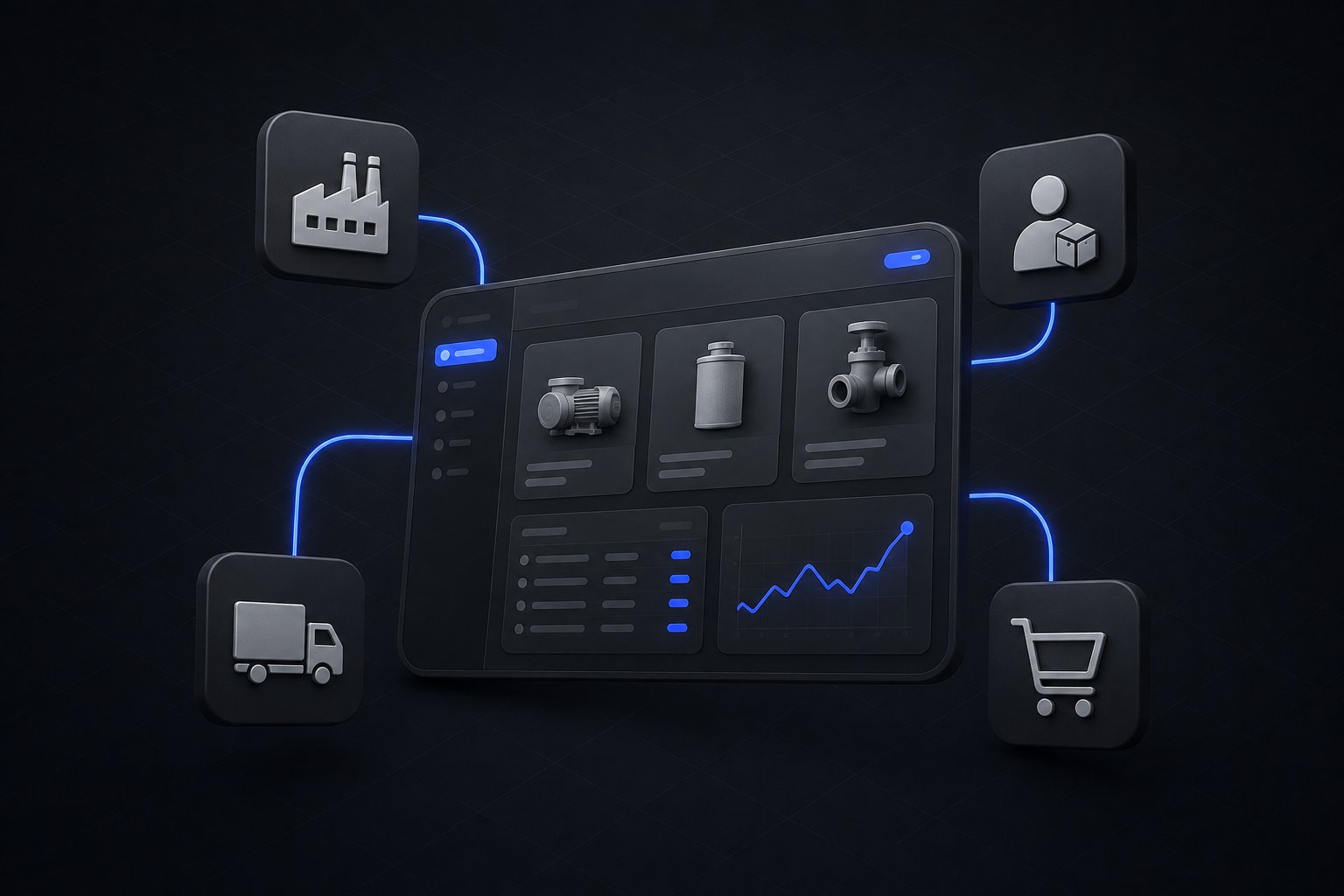
A manufacturer's dealer network runs on relationships, and the ordering runs on whatever those relationships left behind: email threads, price sheets attached to price sheets, and a rep who knows which dealer gets which program. It works until it becomes the bottleneck, and then someone says the word portal, and the real question surfaces: do you build one, buy one, or configure one on a commerce platform you may already run? The three paths produce very different portals at very different costs, and the manufacturers who choose well are the ones who understand what each path actually purchases.
Quick answer: Build means a custom application, justified only when your dealer workflow is genuinely unlike anyone else's, and priced accordingly, a standalone custom portal typically means six to twelve months of development plus the team to maintain it. Buy means a dedicated portal product, fast to stand up and prone to becoming an island: its own catalog, its own logins, one more sync to keep honest. Configure means assembling the portal from Shopify B2B's native primitives, company accounts, price lists, scoped catalogs, terms, with a product layer supplying the dealer-facing experience. For most mid-market manufacturers, configure is the default, build is reserved for the workflow that truly differentiates, and the honest answer is often both: configure the 80 percent, build the one thing that makes your dealer program yours.
What a Dealer Portal Actually Has to Do
Before comparing paths, fix the destination, because a dealer portal is a specific machine, not a login page with a logo. Dealers need their program pricing visible at browse time, the negotiated rates and volume programs their agreement defines, not a list price with a discount promised later. They need a catalog scoped to what they are authorized to sell, by line, by program, sometimes by territory. They need ordering that respects how dealer purchasing works: quick order by SKU for the stocking order, reorder from history for the repeat, purchase orders and terms at checkout because that is how the account pays.
And they need the things that currently generate rep phone calls: live order status, shipment visibility, invoice access, and, for manufacturers who support it, drop-ship ordering where the dealer sells and the manufacturer ships to the dealer's customer. Every item on that list the portal handles is rep time returned to selling, which is the actual business case hiding under the software question.
Option 1: Build a Custom Portal
The build path buys total control and bills for it twice. The first bill is the project: a standalone portal means designing and building account management, catalog, pricing, ordering, and every integration from scratch, which is why these builds run six to twelve months before a dealer logs in. The second bill never stops: the portal is now software your company operates, with hosting, security, upgrades, and a backlog competing for the same developers who built it.
There are manufacturers for whom this is right, genuinely unusual dealer economics, workflows no platform models, scale that amortizes a dedicated team. The test is uncomfortable but clarifying: name the requirements a configured platform cannot meet, and price only those. If the list is short, you are about to rebuild company accounts and price lists at custom rates, and the project deserves the challenge before it deserves a budget.
Option 2: Buy a Portal Product
Dedicated portal products exist precisely because the build path is heavy, and they deliver their headline honestly: a dealer-facing ordering experience, live quickly. The cost shows up structurally rather than on the invoice. A standalone portal product carries its own catalog to maintain beside your commerce catalog, its own accounts and logins beside your customer records, and its own integration to your ERP beside whatever sync your other channels use. Each of those is a second copy of something your business already keeps somewhere else, and second copies drift.
The evaluation questions that matter: where does the portal's catalog come from, and who maintains it? Does pricing mirror your ERP's dealer records or live in the portal's own tables? When the dealer's order lands, does it flow to your ERP under the right account and terms, or into another queue? A portal product that answers those well is a legitimate choice; one that answers them vaguely is a future reconciliation project with a login page.
Option 3: Configure on Shopify
The third path starts from a different premise: most of a dealer portal is not custom. Company accounts with locations and buyer roles, price lists carrying program pricing per dealer, catalogs scoping who sees which lines, net terms and purchase orders at checkout, all of that is native Shopify B2B, configured rather than built. What sits on top is the dealer-facing experience, and that is Uncap Portal's job: each dealer logs into their program, their pricing, their history, and their reorder workflows, while the manufacturer operates one commerce platform rather than a portal island beside it. Our Shopify B2B portal guide covers what those native primitives include on each plan.
The stack completes with the connection that makes the portal trustworthy: Uncap Connect keeping dealer pricing, inventory, and order flow synced with the ERP in both directions, so the portal's promises are the warehouse's facts. And the platform is proven ground for manufacturers well beyond the portal itself, appliance brands like Kalorik run their commerce on Shopify Plus with Uncap, which matters for the configure path's quiet advantage: the dealer portal shares its platform with the rest of the manufacturer's channels instead of becoming another system.
This is the same decision logic that governs the broader question of what to install versus build custom on Shopify B2B: exhaust the primitives first, then build exactly the gap, because paying custom rates to recreate platform features is the most expensive way to feel bespoke.
The Decision, Honestly
Four questions sort most manufacturers onto the right path faster than a feature comparison. How unusual is your dealer workflow really, when described to someone outside the company? What does your catalog and program structure demand, scale and complexity favor platforms with mature primitives? What can your team operate, because build and buy both add operational surface while configure mostly does not? And when does the network need this, since dealer patience is part of the budget?
Then the reframe that dissolves most of the debate: build-versus-configure is rarely either-or. The configured platform covers the dealer portal's common machinery, and the build budget, if one exists, goes to the one workflow that genuinely differentiates your program, implemented as an app on the platform rather than a monument beside it. Manufacturers who frame it that way spend build money on advantage instead of on plumbing.
The Question Under the Software Question
One more thing decides whether any portal succeeds, and no vendor can sell it: channel trust. Dealers watch a manufacturer's digital moves for signs of bypass, and a portal rolled out as "order from us directly" can read as the first step toward competing with the network it serves. The portals that dealer networks adopt are framed and built as sell-through support: the dealer's pricing protected, the dealer's customer relationships untouched, drop-ship executed on the dealer's behalf rather than around them. For the manufacturers Uncap builds for, that channel design conversation belongs at the start of the portal project, because software ships in months and trust ships in years.
Uncap has been a Shopify Platinum Partner since 2013, with 380+ storefronts launched on Shopify, including for manufacturers, distributors, and wholesalers. Book a Demo to see a configured dealer portal, program pricing, scoped catalogs, ERP-synced orders, running against a real catalog.
Frequently asked questions
Should a manufacturer build a custom dealer portal or use a platform?
Configure first, build second: most portal machinery, company accounts, program pricing, scoped catalogs, terms, is native to Shopify B2B, and custom development belongs only on workflows a platform genuinely cannot model. A fully custom standalone portal typically means six to twelve months of development plus permanent maintenance, which is worth paying only for true differentiation.
What is the risk with standalone dealer portal products?
The island problem: a separate catalog, separate logins, and a separate ERP sync beside the systems your business already runs. Every duplicated copy drifts, so the evaluation questions are where the portal's catalog and pricing truth come from, and how its orders reach your ERP under the right account and terms.
What does a dealer portal need beyond ordering?
The things that currently generate rep phone calls: live order status and shipment visibility, invoice access, reorder from history, and drop-ship ordering executed on the dealer's behalf. Each one the portal absorbs converts rep time from order administration back into selling.
How does a manufacturer roll out a portal without alarming the dealer network?
Frame and build it as sell-through support: dealer program pricing protected, dealer customer relationships untouched, and drop-ship serving the dealer rather than bypassing them. Channel trust is the portal's real adoption requirement, and it belongs in the project's first conversation, not its launch memo.


