

Real-time ecommerce ERP integration keeps inventory accurate and compliance data traceable. Here's what medical equipment distributors need to sync correctly.
A recall notice comes in on a lot of infusion sets. The manufacturer flagged a defect and needs to know exactly which facilities received product from that lot, fast. The distributor's ERP has the answer: the lot number is tied to the receiving record and the sales orders it shipped against. The problem is the storefront where eleven hospital accounts placed those orders never captured lot number at the order line, only SKU and quantity. Tracing which facilities got the affected product means pulling pick tickets and invoices by hand for two days while the health system's risk management office is asking for a firm answer.
That gap, between what the ERP knows and what the storefront actually captured and synced, is what breaks first when a medical equipment distributor's ecommerce platform and ERP were never really connected. Fix that gap and a recall trace takes minutes instead of days. Leave it, and every audit, every recall, and every compliance review becomes a manual research project.
What Ecommerce ERP Integration Actually Means for a Medical Equipment Distributor
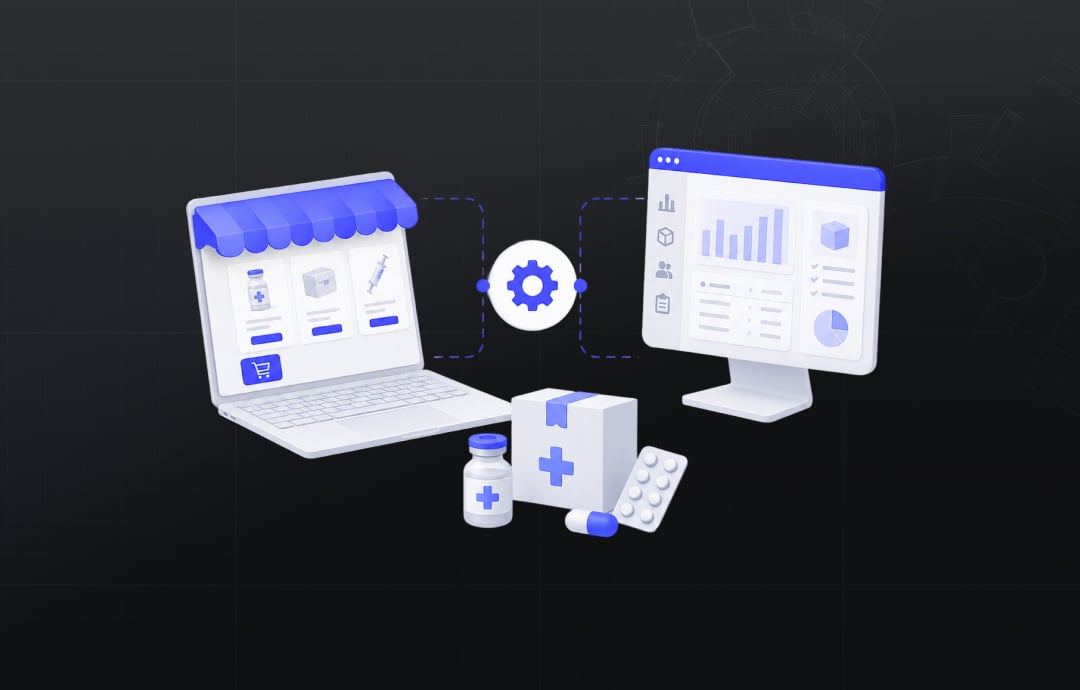
Ecommerce ERP integration is a bidirectional, ongoing data connection between a distributor's Shopify storefront or B2B portal and the ERP that runs pricing, inventory, and order management in the background. When a warehouse transaction changes stock in the ERP, the storefront reflects it within seconds. When a buyer places an order online, a sales order appears in the ERP automatically, carrying the same compliance data that shipped with the product.
For general retail, a nightly sync between ecommerce and ERP is often good enough. A consumer ordering a t-shirt does not need second-by-second inventory accuracy. A hospital ordering surgical supplies for tomorrow's procedures, or a distributor trying to answer a recall inquiry this afternoon, cannot work off data that is a day old. Medical equipment distribution runs on the assumption that what the storefront shows matches what the ERP actually knows right now, not what it knew at midnight.
The Compliance Data That Has to Travel With Every Order
The FDA requires a Unique Device Identifier on nearly every medical device sold domestically, and most regulated products carry a lot or serial number and expiration date alongside it. That tracking system is built around one goal: when something gets recalled or expires, whoever is investigating can trace it back to the specific shipment, buyer, and department that received it.
For that tracing to work, UDI, lot number, and expiration date cannot live only in the ERP or only on a packing slip. They need to be captured at the order line when a buyer checks out on the storefront, and they need to sync back to the ERP as part of the sales order record. An integration that only passes SKU and quantity between systems will get the sale right and leave the compliance trail broken. The fix has to be built into the order data model from the start, not added after the first recall request exposes the gap.
Real-Time Inventory Accuracy Across Facilities
Hospital and health system buyers order for specific departments and specific procedures, often on short notice. A storefront that shows stock as available because the ERP had it in inventory at the start of the day, when a warehouse pick already committed that stock to another order an hour ago, creates a backorder the buyer did not expect and cannot plan around.
The fix is the same event-driven approach that works for any distributor: inventory changes in the ERP push to the storefront as they happen, not on a batch schedule. For a medical equipment distributor running multiple stocking locations, that also means inventory needs to be visible by location, so a buyer sees what is actually available to ship to them, not a combined number that includes stock at a facility with no fast path to their delivery address.
Entitlements: Not Every Buyer Can Order Every Product
Medical equipment distribution has a requirement most B2B ecommerce ERP integrations were never built to handle: some products can only be ordered by buyers who are credentialed to receive them. A facility without the right certification on file for a controlled item, a specialized surgical instrument requiring documented training, or a product restricted to a specific care setting should not be able to add it to cart, regardless of what their account otherwise allows.
That entitlement data usually lives in the ERP or a connected compliance system, tied to the account or facility record. The integration needs to pass those restrictions to the storefront and enforce them at checkout, not just flag them after the order lands in the ERP for someone to catch manually. A distributor relying on a rep to notice a mismatched credential before the order ships is one missed check away from a compliance problem that a synced entitlement flag would have prevented automatically.
Order-to-ERP: Purchase Orders and Records That Hold Up to an Audit
When a buyer places an order on the storefront, a sales order needs to appear in the ERP within seconds, carrying the buyer's PO number, the account or facility reference, and the compliance data attached to each line. Health system finance teams reconcile invoices against their own PO records, and a distributor whose storefront and ERP create separate, unmatched order records is the one fielding reconciliation calls every week.
Contract and GPO pricing usually rides along on that same order record. Getting the tier right at the point of order, not after a hospital's finance team flags an invoice, is its own discipline. How GPO pricing tiers actually work across a health system network covers that mechanic in depth. This guide is about making sure the order record the tier lives on is accurate and synced in the first place.
Multi-Facility Accounts Need to Map Cleanly Between Systems
A health system is rarely one buyer. It is a network of facilities that should share pricing and reporting under one parent account, each placing its own orders. The ERP typically holds that account hierarchy already, tied to contract terms and credit status. The integration's job is to map that structure into Shopify B2B's company accounts and locations correctly, so a facility-level buyer sees their own terms and catalog, not a sibling facility's.
What hospital procurement teams actually expect from a distributor's ordering experience goes deeper on the buyer side of that account structure. Here, the point is narrower: if the ERP's account hierarchy and the Shopify account hierarchy are not kept in sync, every new facility becomes a manual setup task instead of an automatic one.
Integration Methods for Medical Equipment Distributors
Custom API integration. A development team connects Shopify's API directly to the ERP's API or web services layer, with full control over what data flows and how it is mapped. It also means every API update on either side is a maintenance event, and every new compliance field has to be added by a developer.
Native or vendor-built connectors. Most major ERPs, including NetSuite, Microsoft Dynamics 365, and SAP, offer a standard Shopify connector that handles order and inventory sync well. Compliance fields like UDI and lot number, entitlement enforcement, and GPO-aware pricing usually sit outside a standard connector's default scope and require configuration or custom work layered on top.
Purpose-built B2B connector. A connector built for regulated distributors includes compliance data, entitlement logic, and account hierarchy in its core data model from the start, rather than as an add-on to a retail baseline. For a mid-market medical equipment distributor without a large internal development team, this is usually the path that avoids building and maintaining custom code indefinitely.
Why Medical Equipment ERP Integration Carries More Weight Than Standard B2B
Standard B2B ecommerce ERP integration is already more demanding than retail. Medical equipment distribution adds requirements on top of that: compliance data that has to be accurate down to the lot and expiration date, entitlement rules that have to be enforced automatically, and account hierarchies tied to contract and credentialing status rather than just billing convenience.
Demand can also spike in ways that expose a weak integration fast. A product recall, a seasonal illness surge, or a supply shortage on a critical item can produce a burst of order volume and inventory movement in a short window. An integration running on scheduled batch sync that works fine on a normal week can fall behind exactly when accuracy matters most.
What to Look for in a Medical Equipment ERP Integration
Event-driven sync, not scheduled batch. Inventory, pricing, and order status should update as transactions happen in the ERP, not on a four-hour or overnight schedule.
Compliance data built into the order model. UDI, lot number, and expiration date need to be standard fields on every order line, not a custom addition requested after the first audit.
Entitlement enforcement at checkout. Buyer eligibility for restricted products should be checked against the ERP's credentialing data before an order is placed, not after.
Experience with regulated distributors. A partner who has already built ERP integrations for medical, dental, or other regulated distribution has solved the compliance data and entitlement problems before. A partner who has not will be solving them on your project.
How Uncap Builds Ecommerce ERP Integration for Medical Equipment Distributors
Uncap is a Shopify Platinum Partner, on Shopify since 2013, building B2B commerce for distributors selling into vertical markets where the order record has to hold up to more than a shipping label. Uncap Connect is built around that requirement from the start: bidirectional, event-driven sync between Shopify and the distributor's ERP, with compliance fields, entitlement logic, and account hierarchy as part of the core data model rather than a later addition.
For distributors running NetSuite, Microsoft Dynamics, SAP, Epicor, or Infor, the same architecture applies: the ERP stays the source of truth for pricing, inventory, and compliance data, and the storefront reflects it in real time instead of catching up on a schedule. For a medical and dental equipment distributor, that is what turns a recall inquiry into a five-minute lookup instead of a two-day scramble.
Accurate ERP Integration Is a Compliance Requirement, Not a Convenience
For most B2B sellers, ERP integration is about getting pricing and inventory right. For a medical equipment distributor, it is also about being able to answer a recall question, pass an audit, and prove a restricted product never shipped to an account that was not entitled to buy it. Getting the sync right is not a back-office improvement. It is what the business is actually being judged on the next time something goes wrong.
Talk to Our Experts to see how Uncap builds ERP integrations that keep inventory, pricing, and compliance data accurate for medical equipment distributors.
Frequently asked questions
What is ecommerce ERP integration for a medical equipment distributor?
It is a bidirectional, real-time data connection between a distributor's Shopify storefront and their ERP, so inventory, pricing, and compliance data like UDI, lot number, and expiration date stay accurate and consistent between both systems without manual re-entry.
Does the integration need to include compliance data, or is inventory sync enough?
Both. Inventory sync alone tells a buyer what is in stock. Compliance data, UDI, lot number, and expiration date, needs to travel with that inventory on every order so the order record can support a recall trace or an audit without a manual search across separate systems.
How is this different from managing GPO pricing tiers?
They are related but separate problems. GPO pricing tiers, covered in the guide linked above, are about getting the right contract rate to apply automatically across a health system's facilities. ERP integration is about making sure the order record that pricing rides on, along with inventory and compliance data, is accurate and synced in the first place.
Can Shopify enforce which buyers are allowed to order specific regulated products?
Not without integration work. Shopify's B2B tools support company accounts and catalog restrictions, but entitlement rules tied to a buyer's credentialing or certification status typically live in the ERP or a connected compliance system. The integration needs to pass that data to the storefront and enforce it at checkout.
What ERP systems are most common in medical equipment distribution?
NetSuite, Microsoft Dynamics 365, SAP, Epicor, and Infor are the systems most commonly used by mid-market medical and dental equipment distributors. The right integration approach depends less on which ERP is in use and more on whether the connector supports compliance and entitlement data as part of its core model.