


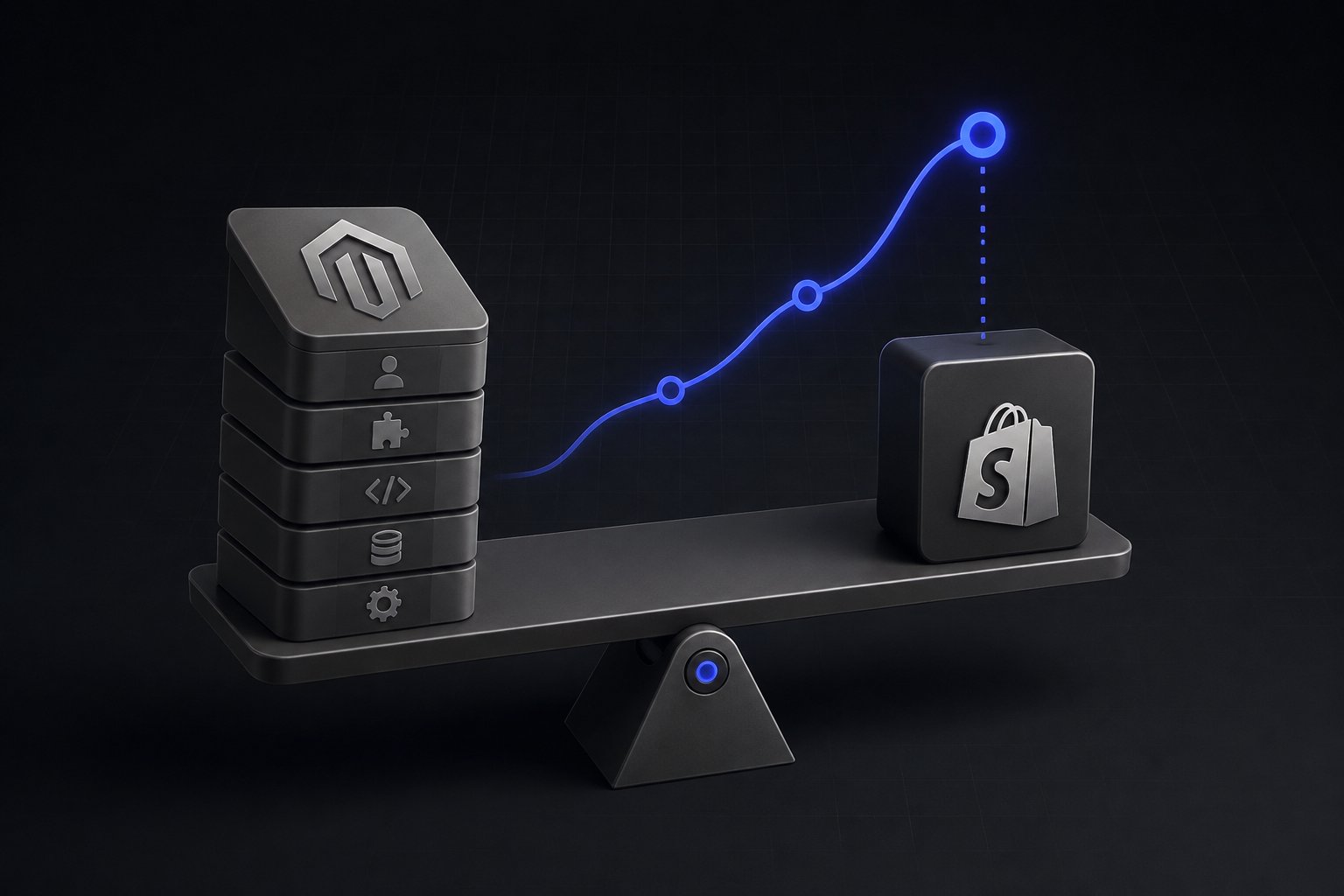
Somewhere in your finance system, spread across five different vendor relationships, is the real cost of running B2B commerce on Magento. It does not appear as one line, which is why it survives budget review after budget review: licensing renews in one quarter, the hosting invoice arrives monthly, the development retainer looks like normal operations, and the emergency patch weekend never gets booked against the platform at all. This article assembles those lines into one number, models it over three years against Shopify Plus, and shows the math plainly enough that you can rebuild it from your own invoices, which is the test any TCO claim should survive.
Quick answer: A mid-market B2B operation on Adobe Commerce typically carries $80,000 to $150,000 per year in platform overhead across five categories: licensing, hosting infrastructure, extension retainers, developer retainers, and security and compliance work. Over three years, that is $240,000 to $450,000. Shopify Plus starts at $2,300 per month, $82,800 over the same three years, with platform maintenance, security, and the core B2B feature set inside the fee. The gap between the two columns, before Shopify-side variables and the one-time migration cost, runs $157,000 to $367,000 over three years, and the migration question is whether those two items fit inside that corridor. For mid-market B2B, they typically do, inside the first year.
The Five Lines That Make Up Magento TCO
The $80,000-to-$150,000 figure is not an estimate invented for this article; it is the headline claim on Uncap's Magento to Shopify migration page, and this is the underlying math. Each line comes with the range we see across mid-market B2B operations, and each maps to invoices you can pull.
Licensing: $22,000 to $80,000 per year. Adobe Commerce licensing starts at $22,000 annually for on-premise and climbs with gross sales volume, reaching $125,000 or more at higher GMV tiers. Operations still on Magento Open Source escape this line and pay for it in the others, since fading Open Source support pushes more of the burden into development and security.
Hosting infrastructure: $30,000 to $60,000 per year. A Magento environment complex enough to run a real B2B build does not live on commodity hosting. Typical bills run $1,500 to $3,000 per month, and complex multi-environment setups reach $5,000 to $10,000 or more monthly once staging, database tuning, and infrastructure operations are counted.
Extension retainer: $5,000 to $40,000 per year. The extension stack that provides what Magento does not do natively, and the compatibility work every platform update forces on it. B2B operations sit at the high end because wholesale functionality on Magento has always been extension-heavy.
Developer retainer: $20,000 to $60,000 per year. The structural line, not the project line. On Magento, routine business changes are development tickets: new customer groups, pricing rule changes, checkout adjustments. This retainer is the cost of the platform's dependency model, separate from any new build work you choose to do.
Security and compliance: $8,000 to $20,000 per year. Every Adobe security patch release requires staging and production deployments and regression testing your team owns. PHP version upgrades periodically break custom modules, and getting back to stable after one commonly costs two weeks or more of developer time.
Sum the bottom of every range and you get roughly $85,000. The typical mid-market band is $80,000 to $150,000 because real operations sit low on some lines and high on others; summing the top of every line simultaneously describes a complex, high-GMV environment beyond the mid-market band, and those exist too.
The Three-Year View, and Why It Is the Honest One
Annual comparisons flatter Magento, because Magento's costs are not flat. The recurring lines above run every year, and on top of them sit episodic events the annual view hides: the PHP upgrade that breaks custom modules, the platform version migration that approaches a rebuild, the extension that stops being maintained and forces a replacement project. Three years is long enough to catch at least one of those events, which is why it is the honest modeling window.
The Magento column over three years: $240,000 to $450,000 at the typical band, before any episodic event lands. The Shopify Plus platform column over the same window: $2,300 per month, $27,600 per year, $82,800 across three, with hosting, security patching, platform upgrades, and the native B2B feature set (company accounts, price lists, catalogs, payment terms) inside the fee rather than adjacent to it. The upgrade events simply do not exist as customer-side costs; the platform versions itself.
That leaves a corridor of $157,000 to $367,000 over three years between the columns. A corridor is the right way to hold the number, because two things still have to fit inside it.
What Fills the Corridor on the Shopify Side
A TCO model you would show a CFO states its exclusions and its variables, so here they are.
Excluded from both columns because they are common to both: payment processing, marketing and analytics tooling, staff time spent on merchandising and operations, and the ERP itself, which you keep either way.
Variable on the Shopify side, and worth budgeting deliberately: app subscriptions for genuine gaps, occasional theme and development work (episodic rather than a standing retainer, which is the structural difference), and the ERP connector, since the integration that was a custom Magento module becomes a maintained sync service. These lines are real, they vary too much by operation for a generic model to fake precision on, and even loaded generously they do not close a six-figure corridor.
The one-time item: the migration itself. That cost has its own anatomy, four workstreams, with ERP re-integration typically the largest, covered in the B2B migration cost breakdown. The financial test is the one already implied: when the one-time project cost sits inside roughly a year of eliminated overhead, the migration functions as refinancing rather than spending, and clients typically eliminate a significant share of technology overhead within the first year, driven primarily by removed licensing and the end of the developer-dependency model.
What This Model Is Not
This is a financial comparison, not a feature comparison. Whether Shopify Plus covers your specific B2B workflows, quote flows, punch-out, catalog structures, checkout customizations, is a capability question, and the Magento versus Shopify Plus comparison handles it feature by feature. The two documents answer different objections, and budget approval usually needs both: the comparison proves the destination works, this model proves the move pays.
It is also not a claim that your numbers match these ranges. The stronger use of this article is as a worksheet: pull twelve months of invoices across the five categories, licensing, hosting, extensions, developer retainer, security work, build your own annual figure, multiply by three, and set it against $82,800 plus your scoped migration cost. If your number lands outside the band in either direction, the model still works; the corridor just resizes.
Uncap is a Shopify Platinum Partner, on Shopify since 2013, with 380+ storefronts launched on Shopify, including for manufacturers, distributors, and wholesalers. Talk to Our Experts if you want this model run against your actual invoices and a scoped migration number to place inside the corridor, that is a working session, not a pitch.
Related reading: How Magento and Shopify Plus compare on the B2B features wholesale operations run on.
Frequently asked questions
What does it really cost to run B2B commerce on Magento?
For mid-market B2B operations on Adobe Commerce, typically $80,000 to $150,000 per year across five categories: licensing ($22,000 and up, scaling with sales volume), hosting infrastructure ($30,000 to $60,000), extension retainers ($5,000 to $40,000), developer retainers ($20,000 to $60,000), and security and compliance work ($8,000 to $20,000). Episodic upgrade and rebuild events land on top of the recurring lines.
How does Shopify Plus pricing compare over three years?
Shopify Plus starts at $2,300 per month, $82,800 over three years, with hosting, security, platform upgrades, and native B2B features inside the fee. Against the typical Magento band of $240,000 to $450,000 over the same window, the gap runs $157,000 to $367,000 before Shopify-side app and development variables and the one-time migration cost.
Why model total cost of ownership over three years instead of one?
Because Magento's costs are episodic as well as recurring: PHP upgrades that break modules, version migrations that approach rebuilds, extensions that lose support. A single-year view misses whichever event has not happened yet, and three years is long enough to catch at least one.
Does the migration cost erase the savings?
It is the right question, and it has a clean test: place the scoped one-time migration cost inside the three-year corridor between the columns. When it sits inside roughly a year of eliminated overhead, which is typical for mid-market B2B, the migration behaves as refinancing, and the remaining corridor is retained margin.


