


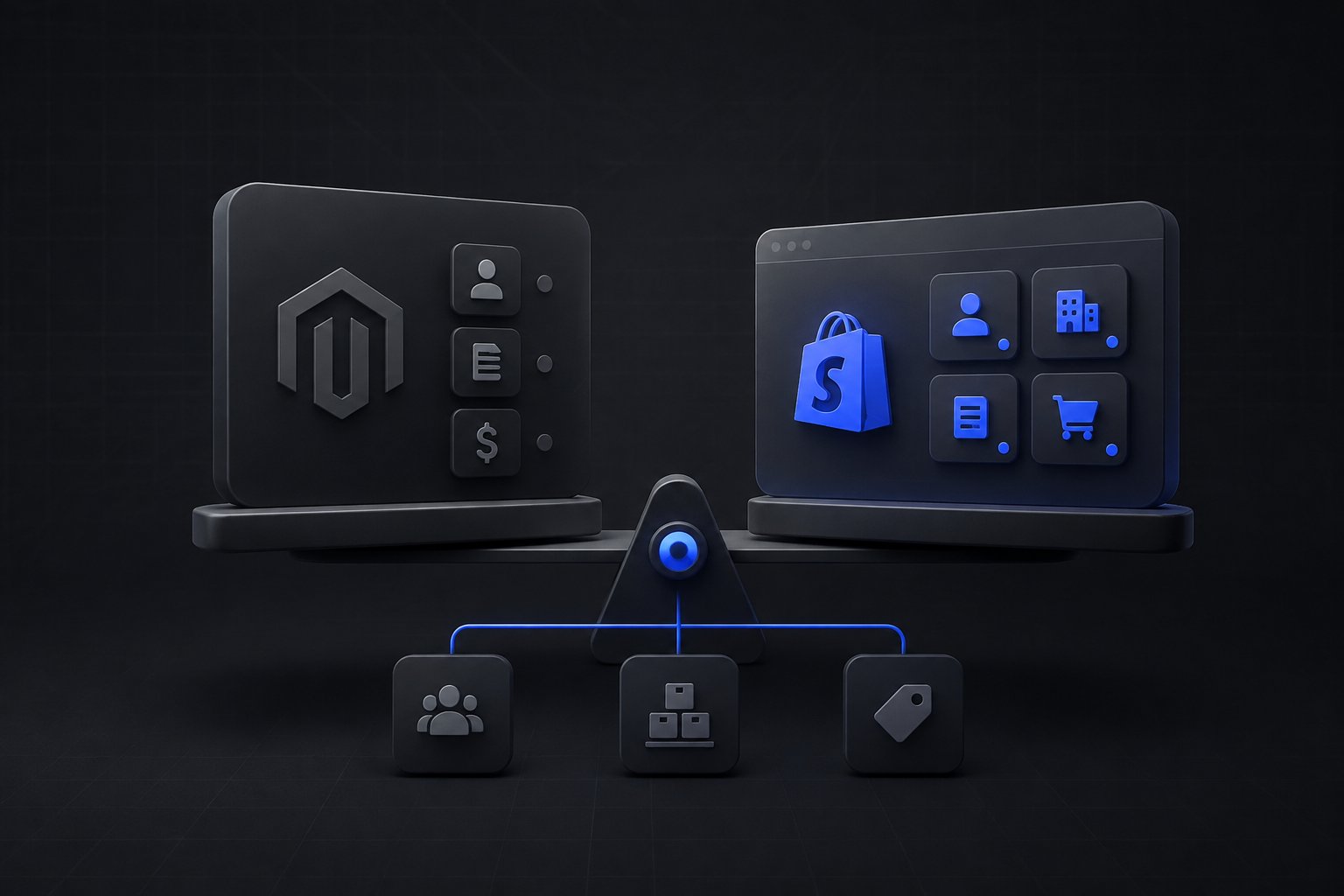
Most Magento-versus-Shopify comparisons are written for retail and mention B2B in a paragraph. That gets the evaluation exactly backwards for a manufacturer or distributor, because the B2B feature set is the evaluation: company accounts, contract pricing, quoting, purchase orders, and reorder workflows are where a wholesale operation lives all day. This comparison covers only that territory, feature by feature, with each platform's capabilities taken from its own documentation rather than paraphrased from memory. For the general platform comparison, hosting, extensibility, the broader decision, the Magento versus Shopify Plus comparison page is the right document; this one assumes you are B2B and goes deeper than a general page can.
Quick answer: On the B2B feature checklist, the two platforms are closer than either side's marketing admits. Adobe Commerce's B2B module is genuinely deep, and in three places, buyer-defined approval workflows, standing quotes, and assisted selling, it is ahead of what Shopify ships natively. Shopify Plus counters with native company accounts, catalogs and price lists, net terms, and vaulted-card payment automation that runs without custom code, plus an app and custom-build layer that fills its gaps without version-coupling them to the platform. The real difference is not the checklist. It is what each feature costs to change, and what happens to it at the next upgrade.
Company Accounts and Hierarchy
Adobe Commerce: the B2B module supports company accounts with multiple buyers organized into buying groups or hierarchies, and parent-child account structures for businesses with subsidiaries or regional operating companies, per Adobe's own B2B feature documentation. Buyers can even purchase on behalf of multiple companies and switch between accounts.
Shopify Plus: companies with company locations under them, each location carrying its own ship-tos, catalogs, and payment terms, with buyer roles and permissions per contact. The model maps cleanly to how a mid-market wholesale account actually looks: one business, several locations, a handful of people with different jobs.
The honest read: Adobe's hierarchy goes deeper for conglomerate-shaped customers, multiple subsidiaries rolling up through layers. Shopify's model covers the multi-location account structure that describes most manufacturer and distributor books, with less machinery to administer. If your account base genuinely needs three levels of corporate nesting, that is a real requirement to put on the table in discovery, not a reason to stop evaluating.
Custom Pricing and Private Catalogs
Adobe Commerce: customer-specific price books and product assortments, so each account's buying experience matches its contract terms.
Shopify Plus: catalogs and price lists assigned per company: which products an account sees, at what fixed prices or percentage adjustments, with quantity rules and volume pricing attached. Private, gated catalogs are the same mechanism doing visibility work.
The honest read: functional parity at the storefront layer, and a shared truth beneath both: for a B2B operation with an ERP, contract pricing does not really live in the commerce platform on either side. It lives in NetSuite, SAP, or Dynamics, and the storefront mirrors it. That makes the pricing comparison mostly a sync-architecture comparison, what the ERP integration looks like on each side of a migration, and on Magento that sync is custom, version-coupled code, while on Shopify it is an external service against stable APIs, which is the pattern Uncap Connect runs.
Quoting and Negotiation
Adobe Commerce: this is Magento's strongest B2B suit. Quote requests from the storefront, negotiation with trade messages and line-item discounts through to checkout, and standing quotes, templates with pre-approved contract terms applied across repeat purchases. Assisted selling lets a rep log in as the customer, with permission, and build orders or quotes on their behalf.
Shopify Plus: the native path is draft orders, a rep builds the quote, the buyer pays it, which covers simple sales-assisted flows and stops short of structured negotiation. The full configure-price-quote workflow on Shopify, request, revision, approval, conversion, with the negotiation record kept, is a product-layer build, which is exactly what Uncap Quotes exists to be.
The honest read: natively, Adobe wins this section, and a comparison that pretends otherwise should make you distrust the rest of it. The counterargument is structural rather than feature-based: Magento's quoting depth lives inside a platform your team maintains, while the Shopify equivalent is built once on a managed platform and does not enter a compatibility scramble at every upgrade. Which argument wins depends on how central negotiated quoting is to your revenue, which is a discovery question, not a blog conclusion.
Purchase Orders, Terms, and Payment
Adobe Commerce: buyer-defined purchase approval workflows, customers configure their own budget-based approval chains, plus payment on account against company credit, with credit visible in the self-service portal.
Shopify Plus: purchase order support and net payment terms at checkout, and a payment automation piece Magento does not match natively: B2B buyers can vault a card (with Shopify Payments, on the Basic, Grow, Advanced and Plus plans), and a Shopify Flow workflow can charge it automatically when the payment schedule is due. Buyer-side approval chains are not native; they are Flow-automation or custom-build territory.
The honest read: a split decision with a useful shape. Adobe is ahead on buyer-side purchasing governance; Shopify is ahead on getting paid without anyone touching the order. For sellers whose accounts pay on terms, invoice automation and vaulted collection are the operationally louder feature. For sellers whose customers demand internal approval routing, that lands in the build scope on Shopify and should be priced there, honestly.
Self-Serve Reorder and Requisition Workflows
Adobe Commerce: requisition lists of frequently purchased items, multi-SKU upload, one-click reorders, the hassle-free restocking set, in Adobe's phrasing.
Shopify Plus: reorder from order history natively, with the fuller B2B buyer experience, saved lists per location, standing orders, par-level programs, living in the app and custom layer. The architecture for recurring B2B ordering on Shopify, including why consumer subscription apps are the wrong tool and scheduled order generation is the right one, is its own explainer, and the buyer-facing shell is what Uncap Portal provides.
The honest read: near-parity in outcomes, different provenance. Magento ships more of it in the module; Shopify assembles it from platform primitives plus product layer. The assembled version is the one that survives platform upgrades untouched, which, for the feature buyers use most often, matters more than where it came from.
The Comparison Under the Comparison
Line the sections up and a pattern emerges: Adobe Commerce's B2B module is the deeper native checklist, and Shopify Plus is the deeper operating model. Every Magento B2B feature above rides on a platform your team patches with every Adobe security release, upgrades at real project cost, and extends through version-coupled custom code, the economics the three-year cost of ownership model prices line by line. Every Shopify B2B feature above, native or built, rides on a platform that maintains itself, where a new customer group or price change is configuration instead of a development ticket.
That is why B2B operations that would lose a feature-count contest still migrate: the checklist tells you what a platform can do on day one, and the operating model tells you what it costs to still be doing it in year three. What that migration involves, and what it protects, is the territory of Uncap's Magento to Shopify migration practice, and what the destination looks like assembled, accounts, pricing, quoting, and reorder working as one wholesale operation, is what Shopify B2B done properly means in practice.
Uncap is a Shopify Platinum Partner, on Shopify since 2013, with 380+ storefronts launched on Shopify, including for manufacturers, distributors, and wholesalers. Talk to Our Experts if you want this comparison run against your actual feature dependencies, the discovery question is which of these sections your revenue really lives in.
Frequently asked questions
Is Magento better than Shopify for B2B features?
Natively, Adobe Commerce's B2B module has the deeper checklist, and it genuinely leads in buyer-defined approval workflows, standing quotes, and assisted selling. Shopify Plus leads in payment automation (net terms with vaulted-card collection) and in the operating model: its B2B features, native and built, are maintained platform capabilities rather than version-coupled custom code. Which matters more depends on which features your revenue depends on daily.
Does Shopify Plus support company accounts and contract pricing like Magento?
Yes. Companies with locations, buyer roles, and permissions cover the account structure, and catalogs with price lists carry account-specific pricing, quantity rules, and gated catalog visibility. For ERP-run operations, contract pricing on either platform is really a sync question, since the ERP owns the rates and the storefront mirrors them.
What B2B features does Shopify handle through apps or custom builds instead of natively?
Structured quote negotiation beyond draft orders, buyer-side approval chains, and richer requisition-style reorder experiences. The architectural difference from Magento's approach is that these build on stable platform APIs rather than inside the platform, so they do not inherit the upgrade fragility that defines Magento customization.
Why do B2B brands migrate off Magento if its B2B module is so complete?
Because the module's depth is inseparable from the platform's economics: patch cycles, upgrade projects, and developer dependency for routine changes. The migration trade is a somewhat shorter native checklist, filled deliberately where it matters, in exchange for an operating model where the wholesale features still work, unattended, at the next upgrade.


