


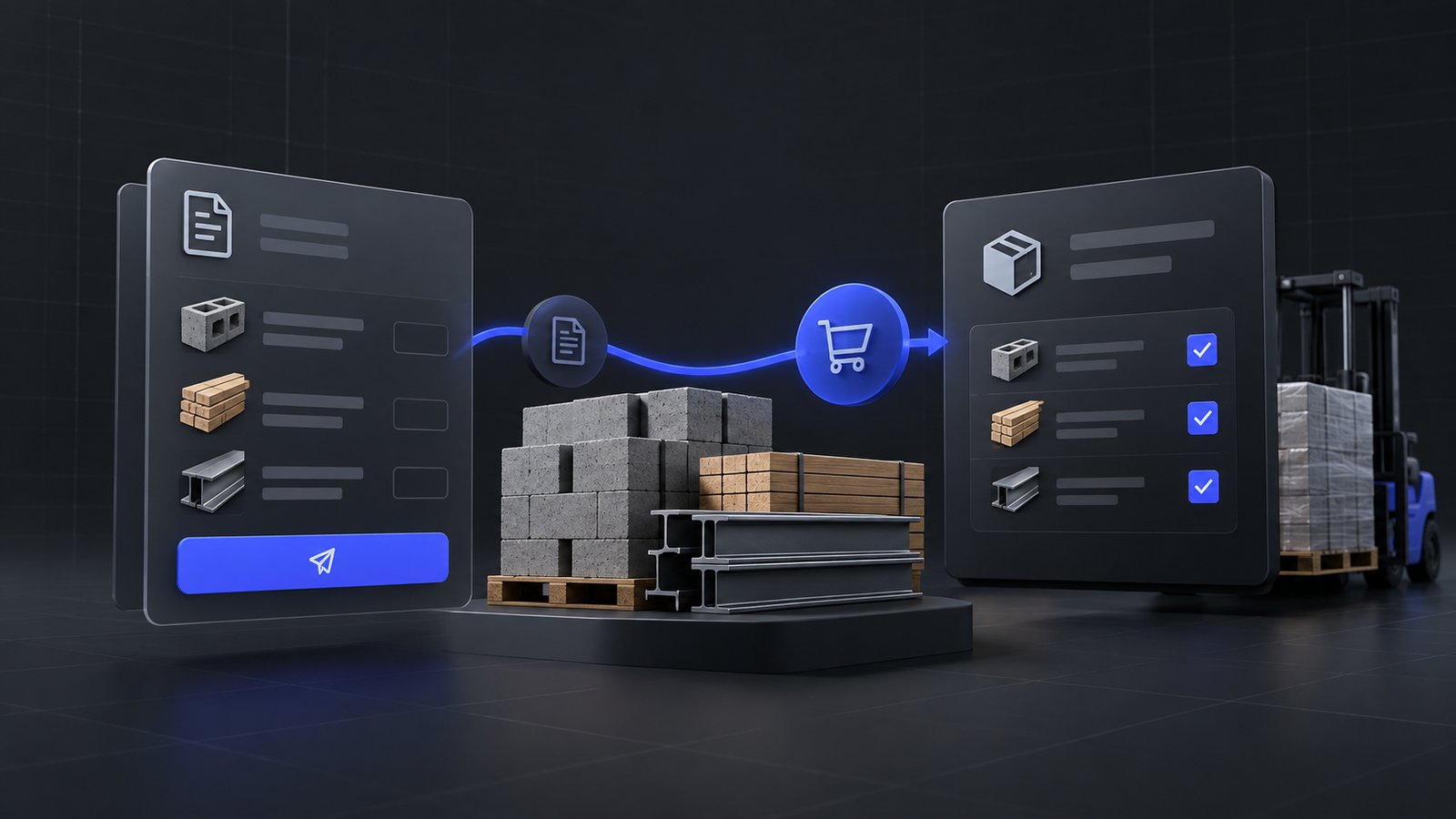
A contractor walks a takeoff list into a building products counter: forty line items, needed in three weeks, priced to win a bid the contractor has not won yet. The counter does not price it from shelf tags, because there is no shelf price for this transaction. The price depends on the quantities, the delivery, what the commodity lines cost this week, and how much this job matters to both sides. That is not pricing chaos; it is how construction supply works, and it is why the category's online ambitions keep stalling: a storefront built around a cart assumes the price is known before the conversation, and in this business the conversation is where the price comes from.
Quick answer: Quote-to-order is the workflow that puts job-priced selling online without pretending the job away. The contractor submits the takeoff list through the storefront, as an uploaded list or a cart flagged for quoting, and the system builds a quote priced from the account's contract baseline rather than a rep's memory. The rep adjusts what judgment owns, quantity breaks, freight, the competitive lines, and sends a versioned quote with a validity window. Revisions happen against the same record, approval converts the quote to an order carrying the account's terms, and nothing is rekeyed. The cart stays for fill-in replenishment; the quote is the native transaction for jobs.
Why every job legitimately prices differently
Four variables set a job's price, and none of them lives on a product page. Quantity: forty units of anything ships a different rate per unit than four hundred, and a bid list's volume is known only when the list arrives. Delivery: a jobsite drop with a boom truck three weeks out is a different cost than will-call tomorrow. The commodity float: framing lumber, sheet goods, rebar, and copper reprice with their markets, weekly and sometimes daily, so a number quoted in March is a donation by May. And the bid itself: the contractor is pricing to win a job, the supplier is pricing to win the contractor, and both are pricing against whoever else is bidding.
A storefront that ignores these four and posts one price per SKU is not simplifying the business; it is describing a different business. The design answer is not to hide pricing behind a phone number. It is to make the quote a first-class object online.
The RFQ is the native transaction of construction supply
An RFQ, a request for quote, is the buyer's half of job pricing: the list of what the job needs, submitted so the supplier can price it as a whole rather than as forty separate retail decisions. In construction supply the RFQ is not an enterprise procurement formality; it is the takeoff list the estimator produced, and it is how the category's largest transactions have always started. Putting it online means the storefront accepts the list in whatever shape the contractor has it: pasted line items, an uploaded file, or a cart the buyer builds and flags for quoting instead of checkout.
This is the two-speed store the category needs. Fill-in orders, the fasteners, flashing, and forgotten items that keep a job moving, run through the cart at account pricing with same-day expectations, the experience contractors say keeps them ordering from a supplier portal. Jobs run through the quote. A storefront that offers only the first speed handles the smallest transactions and sends the largest ones back to the phone.
From takeoff list to priced quote, without the rep guessing
The quiet failure in manual job quoting is not slowness; it is baseline drift. A rep pricing from memory starts from the last number they remember, not from the account's contract position, and over a few hundred quotes the account's actual pricing agreement stops describing reality. The fix is structural: the quote engine prices every line from the account's contract baseline, the same account tiers and contract pricing the storefront already enforces, and the rep's judgment is applied on top as explicit, visible adjustments. The rep still owns the competitive call. The system owns the starting point.
Line matching does the unglamorous work here: a takeoff list arrives in the estimator's language, mixed part numbers, descriptions, and sizes, and the quoting workflow has to resolve those lines to SKUs the same way search does, flagging what it cannot match instead of silently dropping it. A quote that prices thirty-eight of forty lines and says so plainly beats one that prices forty lines, two of them wrong.
A quote is a negotiation object, not a PDF
Job quotes get revised: the contractor won the bid but the general contractor cut the scope, the delivery moved, the alternates got exercised. A quote that lives as an emailed PDF forks into versions nobody can reconcile, which is why quotes stuck in email cost real margin. Run as a workflow object, the quote carries its own history: versions, who changed what, the approval that matters, and a validity window that expires honestly, because in a commodity-priced category an open-ended quote is an option the supplier wrote for free. When the buyer accepts, the quote becomes the order, on the account's terms, with every line and adjustment intact, and the ERP receives it without anyone retyping the takeoff list a third time.
That whole path, quote built against account pricing, versioned through the negotiation, converted in one click, is exactly what Uncap Quotes runs natively on Shopify B2B.
Where configured products are a different problem
One boundary keeps this design honest. If the price is unknown because the product itself is built to the buyer's specification, windows in custom sizes, doors with option trees, cabinetry, that is configure-to-quote, where the buyer's spec work drives the price, and it has its own playbook for made-to-order building products. This post's territory is the other half of the category: catalog products whose price varies by job, not by configuration. Most building products distributors need both, and the good news is they share machinery: the same account baselines, the same quote objects, the same convert-to-order path.
What this looks like at catalog scale
ULE Group runs cart-level convert-to-quote on its Shopify B2B storefront, an industrial supply operation with a specialized construction products catalog built to scale past one million SKUs, account-based payment terms beside the quote workflow, and pricing and inventory synced live from its Epicor ERP. That combination is the point: the quote workflow earns trust only when the baseline pricing and stock data behind it are current, which is why quoting, account pricing, and the ERP sync ship as one architecture, the pattern Uncap builds across building and construction distribution.
Uncap has been a Shopify Platinum Partner since 2013, with more than 380 B2B commerce projects delivered for manufacturers, distributors, and wholesalers. Book a Demo and bring a real takeoff list, watching it become a priced, versioned quote against a live account baseline is the fastest way to evaluate whether quote-to-order fits your counter.
Frequently asked questions
What is quote-to-order?
Quote-to-order is the workflow where a buyer's request, in construction supply, usually a takeoff list, becomes a priced quote built from the account's contract baseline, gets negotiated as a versioned record with a validity window, and converts directly into an order on the account's terms once approved. It replaces the emailed-PDF quote and the rekeyed order with one record from list to invoice.
How do contractors request quotes on a supplier's website?
Three ways, and a good storefront offers all of them: pasting or uploading the takeoff list as line items, building a cart and flagging it for quoting instead of checkout, or reordering from a previous job's quote as the starting point. The workflow resolves the lines to SKUs, flags what it cannot match, and routes the request to the rep with the account's pricing already applied.
How long should a building materials quote stay valid?
As long as the supplier can hold the underlying costs, which for commodity-linked lines is short: framing lumber, sheet goods, and copper reprice with their markets, so validity windows of one to two weeks are common, sometimes with commodity lines carved out for repricing at order. The structural answer is an explicit expiration on every quote, because an open-ended number in a floating market is free option value handed to the buyer.
Is quote-to-order the same as CPQ or configured quoting?
They share machinery but answer different problems. Configure-price-quote handles products whose price depends on the buyer's specification, custom windows, doors, cabinetry. Quote-to-order as described here handles catalog products whose price depends on the job: quantities, delivery, commodity timing, and the bid. Most building products sellers eventually run both on the same quoting backbone.