

Every building materials distributor already has contractor pricing. The rate sheets exist, the tiers exist, the negotiated accounts exist. What most distributors do not have is a way to enforce any of it online, which is why the portal shows list price, the contractor calls the counter to get their real number, and the digital channel quietly stops mattering. This is the implementation guide for closing that gap: how contractor pricing and account tiers actually map onto Shopify B2B, and how approval flows keep the exceptions from leaking back to the phone.
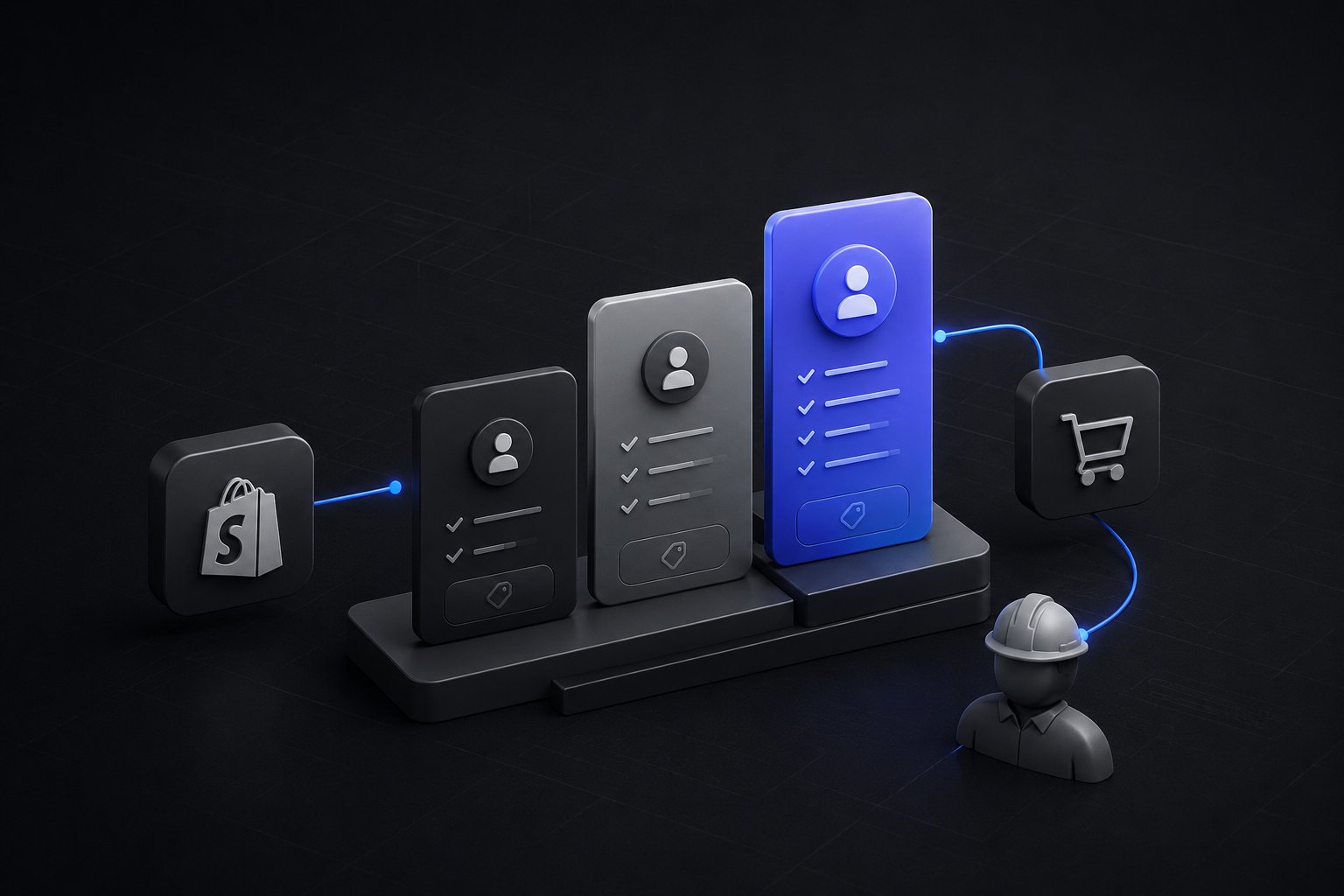
Quick answer: Contractor pricing on Shopify is enforced through three native B2B primitives working together: company accounts (the contractor business, with its locations and buyers), catalogs (which products each tier can see and buy), and price lists (the rates each account actually pays). Tiers become catalog-plus-price-list assignments, negotiated accounts get their own lists synced from the ERP, and orders that need judgment, project pricing, over-limit purchases, route through a quote and approval flow instead of failing silently.
What Contractor Pricing Means Before It Goes Online
At a supply house, "contractor pricing" is shorthand for a stack of decisions: a trade rate below list, tiers by contractor type and volume, and above that, account-specific rates negotiated with the GCs who move real volume. The tier taxonomy itself, how GCs, specialty trades, dealers, and occasional contractors differ as digital accounts, is covered in how building materials distributors are moving B2B ordering online. This article assumes that structure exists and deals with enforcing it.
Enforcement is the operative word. A rate sheet in a spreadsheet is a promise; a price list attached to an account is a guarantee. The difference shows up the first time a foreman orders at 6 AM without calling anyone to confirm the number.
Mapping Tiers to Shopify B2B Primitives
Shopify's B2B model gives you exactly the pieces this requires, and the mapping is cleaner than most distributors expect.
The company account is the contractor business. Not the individual buyer, the business, with its locations as sub-entities and its people as buyer contacts. Credit terms, tier assignment, and negotiated pricing all hang off the company, so every location and buyer inherits them automatically.
Catalogs control what each tier sees. A roofing sub does not need your full dimensional lumber catalog, and an occasional contractor should not see broke-lot contractor SKUs priced for volume accounts. Catalog assignment per tier keeps each account's buying view relevant, which is a usability feature and a pricing control at the same time.
Price lists carry the actual rates. Each tier gets a standard trade price list; negotiated accounts get their own. This is the enforcement layer: the buyer does not see a discount applied at checkout, they see their price on the product page, because the price list is resolved before the page renders. There is no wrong number for them to see.
The general mechanics of building these lists cleanly, fixed prices versus percentage adjustments, and keeping contract rates from drifting, are covered in how to run contract pricing cleanly on Shopify B2B. The building materials twist is mostly scale and volatility: commodity-priced SKUs change weekly, which means price lists have to update from the ERP on a cycle, not from a person on a good week.
Spec Accounts: The People Problem
A contractor account is a small organization, and the portal has to respect its internal structure. The foreman orders for the job. The project manager approves spend against the budget. The office pays invoices. Model that as one shared login and you get either chaos or, worse, the owner doing all the ordering because nobody else was set up.
The working pattern: multiple buyer contacts per company, each with their own login, with roles that match how the business runs. The foreman places orders against the job-site ship-to. The PM sees every order across the company's jobs. Accounting sees invoices and statements without needing to touch ordering at all. Job numbers and cost codes captured at the line level keep each purchase attributable to the project it belongs to, which is what makes the invoice postable when it lands.
Approval Flows: Enforcing Judgment, Not Just Rates
Price lists enforce the rates that are known. Approval flows handle the money decisions that are not.
Two flows cover most of what a supply distributor needs. The first is the order-approval case: a crew member can build an order, but it does not fire until the PM or owner signs off, useful for new hires, large orders, or accounts near their credit limit. The second is the project-pricing case: a GC pricing a forty-house framing package is not ordering off the standard tier, they are requesting a number. That request should arrive as a quote, get priced by the rep with the project discount and freight, and convert to an order on approval with the agreed pricing intact. Uncap Quotes runs that workflow natively on Shopify, request, revision, approval, conversion, so project pricing stops living in email threads with the storefront as a bystander.
The failure mode both flows prevent is the same: an exception that the system cannot express, so it exits to the phone and takes the account's digital habit with it.
Keeping the Tiers Honest
Contractor pricing decays without a sync. Rates get renegotiated at renewal, commodity costs move weekly, and accounts change tiers as their volume grows. If those changes reach the portal through manual updates, the portal is wrong most of the time, just wrong quietly.
The durable setup keeps the ERP as the source of truth and pushes pricing to Shopify on a schedule, with event-triggered updates for the volatile SKUs. Uncap Connect handles that sync both ways, pricing and terms down to the storefront, orders back up under the right account and job. And the ordering experience the pricing lives inside, the full contractor portal capability list, UOM, live branch inventory, net terms, is its own guide; this piece is the pricing layer of that larger build.
Uncap Portal is where these pieces surface for the account: each contractor logs into their own catalog, their own rates, their own jobs and history, with the tiers and approvals enforced underneath rather than promised on a rate sheet.
Uncap has been a Shopify Platinum Partner since 2013, with 380+ storefronts launched on Shopify, including for distributors, manufacturers, and wholesalers, including operators in building materials and construction supply. Book a Demo to see contractor tiers and approval flows running against a real catalog.
Frequently asked questions
How do contractor pricing tiers work on Shopify?
Each tier is a combination of a catalog (which products the tier sees) and a price list (what it pays), assigned at the company account level. Negotiated accounts get account-specific price lists on top of tier defaults, and every buyer and location under the company inherits the assignment automatically.
Can a contractor's employees have their own logins with different permissions?
Yes. Shopify B2B company accounts support multiple buyer contacts, so a foreman can order against job-site ship-tos while the project manager reviews orders across jobs and accounting sees invoices. Roles match how the contracting business actually runs instead of forcing one shared login.
What happens when an order needs approval or special pricing?
It routes instead of failing. Order-approval flows hold a purchase until the right person signs off, and project-scale purchases go through a quote workflow where a rep applies project pricing and the approved quote converts directly to an order. Both keep the exception inside the platform rather than pushing it back to the phone.
How does contractor pricing stay current when costs change weekly?
By syncing price lists from the ERP rather than maintaining them by hand: scheduled updates for the catalog at large, event-triggered pushes for volatile commodity SKUs. The ERP stays the source of truth, and the portal reflects it instead of drifting from it.