

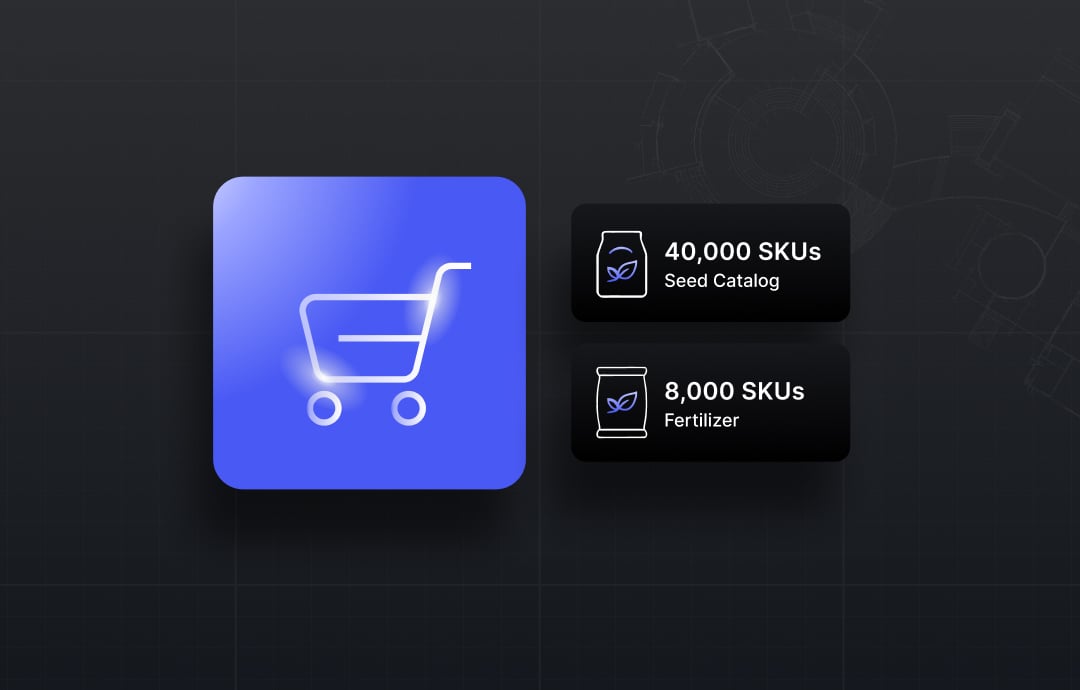
Your seed catalog has 40,000 SKUs. Your fertilizer section adds another 8,000. Crop protection chemicals are another 15,000, and half of them have EPA registration numbers that vary by state. Your equipment parts catalog is somewhere around 200,000 lines. A single customer order in spring planting season touches all four categories, carries customer-specific contract pricing, needs purchase order capture, and has to sync with your ERP before your warehouse team can pull it.
Agribusiness software built to help farmers plan field operations will not solve this. What agricultural distributors, farm supply companies, and ag input suppliers need is something different: a B2B commerce platform that can handle catalog scale, agricultural supply chain complexity, and the account-based purchasing behavior of co-ops, dealers, and direct farm accounts simultaneously.
This guide covers what those requirements look like in practice and what the right agribusiness software solutions look like for companies selling into agriculture at scale.
Why Agricultural Ecommerce Is Harder Than Any Other B2B Vertical
The product data problem in agricultural distribution is genuinely different from manufacturing or wholesale distribution in other sectors.
Consider what a single product record looks like for a crop protection chemical. You need the EPA registration number, which varies by state and can expire or change with reformulations. You need application rate tables that change by crop type, soil type, and target pest. You need safety data sheets linked at the SKU level. You need restricted use designations by state. You need compatibility data for tank mixing. And all of that sits on top of the standard attributes: manufacturer, active ingredient, formulation type, container size, pallet configuration, and seasonal availability.
Seed catalogs carry similar complexity. A single crop species might have 300 treatment variants, each with trait stacking combinations, disease resistance ratings, regional performance data, and replant restrictions. A co-op selling seed to farmers in three states might maintain a catalog that looks nothing like its distributor's master catalog, with local variety performance data layered on top.
This is before you get to pricing. Agribusiness pricing structures include co-op pool pricing, early order incentive programs, volume tier discounts, dealer rebate structures, and pre-pay programs that affect the effective unit cost of every product. A single-price-per-SKU system does not describe how ag distribution actually works.
Research published in PubMed Central confirmed what anyone in ag distribution already knows: the agricultural supply chain is characterized by fragmented information flows and pricing variability that make digital commerce significantly more complex than general B2B ecommerce. The same research identified ecommerce platforms as one of the highest-leverage interventions for addressing agricultural supply chain inefficiencies.
What Agribusiness Software Solutions Actually Need to Deliver
When an agricultural distributor or farm supply company evaluates agribusiness software solutions for their commerce operation, the requirements look different from what generic B2B ecommerce platforms advertise. Many distributors reach this evaluation while leaving a seasonal WooCommerce store that buckled under catalog swings and dealer pricing.
Product catalog management at scale. A catalog with 500,000 to 1,000,000 SKUs is not unusual in ag distribution. The platform needs to handle product data at that scale without degrading search performance for buyers or creating bottlenecks in catalog updates. Variant structures need to accommodate ag-specific attributes: formulation types, container sizes, treatment options, and regional availability flags.
Customer-specific pricing at account level. Agricultural buyers operate on negotiated pricing. A regional co-op pays a different price than a direct farm account. A dealer with a rebate agreement has an effective cost that changes with volume. The commerce platform needs to apply the right price to the right account at login, without requiring manual overrides or sales rep intervention for standard orders.
Net payment terms enforced at checkout. Agricultural purchasing runs on credit. Net 30, Net 60, and pre-pay structures with early order incentives are the norm, not the exception. A buyer portal that requires credit card payment at checkout does not work for most agricultural accounts.
Purchase order capture. Co-ops and larger farm operations require purchase order numbers on every transaction. The checkout flow needs to accept PO numbers and route them correctly to the ERP so that order records match the buyer's own procurement system.
ERP integration for supply chain data. Real-time inventory across multiple warehouse locations, pricing from the ERP rather than a static catalog, and automatic order export to the ERP for fulfillment are not optional features for ag distribution. A buyer who checks availability online and finds the wrong inventory count loses trust in the channel immediately.
Seasonal order management. Spring planting demand and fall harvest demand create volume patterns that look nothing like year-round B2B commerce. The platform needs to handle order volume spikes without performance degradation, and the catalog management workflow needs to accommodate seasonal additions and discontinuations without breaking existing product data.
The Agricultural Supply Chain and Where Ecommerce Fits
The agricultural supply chain runs from input manufacturer to distributor to retailer (which in many markets is a co-op or farm supply dealer) to the farmer. At each step in that chain, orders have historically been placed by phone, fax, or email, tracked in spreadsheets, and manually entered into ERP systems on both sides of the transaction.
The shift to digital ordering is well underway in agricultural supply chain management, but it is uneven. Enterprise ag input manufacturers have invested in EDI connections and distributor portals for their largest accounts. Mid-market agricultural distributors and farm supply companies are often still running on phone and email for their farmer and dealer accounts, even when those accounts are placing orders in the $50,000 to $250,000 range per season.
The reason is not that buyers do not want digital ordering. Research consistently shows that agricultural buyers, including farmers and ag dealers, prefer digital channels for routine reorders once those channels give them accurate inventory, correct account pricing, and payment term options that match their financing structures. The barrier has been platforms that cannot handle the product data complexity or the account pricing complexity of agricultural distribution.
Digital agricultural supply chain management in practice means: a buyer logs into a portal with their account credentials, sees the catalog filtered to products available in their state with their account pricing applied, places an order against their credit terms, and receives confirmation with a reference number that matches their own PO. That order lands in the distributor's ERP automatically, inventory is decremented in real time, and fulfillment begins without manual re-entry.
For a distributor whose spring planting season compresses six months of revenue into eight weeks, the difference between a digital channel that works this way and one that requires rep-assisted ordering for every account is the difference between managing 400 seasonal accounts or 4,000.
Managing a Million-SKU Catalog on Shopify B2B
Shopify B2B is the infrastructure layer that an increasing number of agricultural distributors are using to deliver the buyer experience described above. It handles the account-based purchasing model natively: company accounts with location hierarchies and role-based permissions, customer-specific price lists applied at login, draft orders for sales-assisted ordering, and net payment terms enforced at checkout without third-party apps.
The catalog scale question is where the architecture matters most. Shopify handles product catalogs at significant scale, but managing 500,000 to 1,000,000 SKUs effectively in an agricultural context requires deliberate product data architecture. Shopify Metafields are the mechanism for storing the ag-specific attributes that standard product fields do not accommodate: EPA registration numbers, active ingredient data, application rate references, regional availability flags, and trait stacking combinations for seed products.
A well-architected agricultural ecommerce catalog on Shopify separates product data into layers: core product identity and variants in Shopify's native product model, extended attributes in Metafields, and pricing managed through Shopify B2B price lists with ERP as the source of truth for account-specific contract prices.
The practical outcome for a buyer is a search experience that returns results filtered by their state, a product page with the full attribute set they need to make a purchasing decision, and a checkout that reflects their actual contract pricing and payment terms. For the distributor's team, it means product updates push from the ERP or product information system to Shopify automatically, without someone manually editing product records in a web interface.
Meeting those account expectations also means understanding what modern farmers now expect from ordering software.
Agricultural Supply Chain Management and ERP Integration
The ERP is where agricultural supply chain management lives for most distributors. NetSuite, SAP, Microsoft Dynamics 365, and Epicor are the most common ERP systems in mid-market ag distribution. The ERP holds pricing contracts, inventory across warehouse locations, customer account status, order history, and the financial data that determines whether a buyer's credit terms are active or on hold.
The Shopify-to-ERP connection is what determines whether the buyer portal works or just looks like it works. A buyer who sees inventory that was updated four hours ago, or pricing that does not reflect their current contract, will revert to calling the rep within a week of the portal going live.
The connection needs to be bidirectional and event-driven: inventory changes in the ERP sync to Shopify immediately when a warehouse transaction occurs, orders placed in Shopify create sales orders in the ERP without manual entry, customer-specific pricing from ERP contracts populates the correct Shopify B2B price list, and account status changes in the ERP are reflected in the buyer's portal access. For distributors running Acumatica, that connection is what keeps a grower or dealer from ordering against inventory already committed elsewhere.
For a mid-market ag distributor managing 800 active farm accounts and 15 dealer accounts across four states, getting this connection right is the difference between a portal that buyers trust and one that creates support tickets every week.
Across 380+ Shopify storefronts launched by Uncap as a Shopify Platinum Partner since 2013, the pattern in agricultural distribution implementations is consistent: distributors who planned the ERP integration architecture before selecting the ecommerce platform saw higher buyer adoption rates and fewer post-launch corrections than those who treated the two systems as separate decisions.
Uncap Connect handles the Shopify-to-ERP layer for agricultural distributors, with real-time bidirectional sync, B2B-aware data flows including customer-specific pricing and net payment terms, and multi-location inventory across warehouse sites. For ag distributors using NetSuite, SAP, or Microsoft Dynamics 365, the integration maps ERP customer account structures to Shopify B2B company accounts, so the pricing and permission model your team maintains in the ERP flows through to the buyer portal automatically.
Choosing the Right Agribusiness Software Solutions for Digital Commerce
Not every ag distribution operation needs the same configuration. The right agribusiness software solution depends on catalog size, account structure, ERP environment, and the volume of sales-assisted versus self-service orders.
Here is a practical decision framework for agricultural distributors evaluating ecommerce software:
Catalog under 50,000 SKUs, single ERP, straightforward pricing tiers. Shopify B2B with a standard connector handles this well. Product data can be managed directly in Shopify with Metafields for ag-specific attributes. Implementation timelines run 10 to 16 weeks.
Catalog 50,000 to 500,000 SKUs, multiple pricing programs, regional availability rules. This requires a product information management (PIM) layer between the ERP and Shopify to manage attribute enrichment, completeness validation, and regional catalog publishing. Plan for 16 to 24 weeks implementation and a deliberate data architecture phase before development begins.
Catalog over 500,000 SKUs, multi-warehouse inventory, complex account hierarchies. Enterprise implementation territory. ERP integration architecture, product data governance, and the buyer portal design need to be planned as a single project. Timelines run 24 to 36 weeks depending on ERP complexity and data quality.
High-volume sales-assisted ordering alongside self-service. Ag distributors who have rep networks alongside a self-service portal need the two workflows connected. Shopify draft orders allow reps to build orders on behalf of accounts, with the same pricing and terms as if the buyer placed the order themselves.
The full B2B tech stack for Shopify Plus operators covers the broader technology architecture for distributors building a multi-system commerce operation.
What Agricultural Distributors Get Wrong When Going Digital
The most common failure mode in agricultural ecommerce implementations is not a technology problem. It is a data problem that was never resolved before the platform launched.
Agricultural product data that lives in the ERP is operational data: part numbers, units of measure, bin locations, and costing data. It is not commerce data. Product names that make sense to a warehouse picker do not make sense to a farmer searching for a specific seed treatment. EPA registration numbers belong on a product page. Formulation-specific application rates belong on a product page. None of that lives in the ERP by default.
The distributors who get agricultural ecommerce right go through a deliberate product data enrichment phase before the platform launches: identifying which attributes belong on the storefront, where they currently live, how they will be maintained going forward, and what the publishing workflow looks like when a product changes. This is not glamorous work. It is the work that determines whether a buyer finds what they are looking for on the first search or calls the rep instead.
The second failure mode is launching without real-time inventory. An agricultural buyer who places a spring order for a specific seed variety, receives a confirmation, and then gets a call two days later saying the product is out of stock has had their trust in the digital channel broken. It is very hard to rebuild. Accurate, real-time inventory data from the ERP is not a phase-two feature. It is a launch requirement.
How Uncap Builds Agricultural Ecommerce Operations
Uncap works with manufacturers, distributors, and wholesalers in agriculture and adjacent sectors who are building B2B digital commerce operations on Shopify Plus. The agriculture and farming industry page covers the specific scenarios we address, from farm input distributors managing seasonal catalog complexity to equipment parts suppliers running dealer networks on private ordering portals.
The starting point for every agricultural ecommerce engagement is the same: understanding the ERP, the catalog structure, the account pricing model, and the buyer workflow before writing a line of code. That discovery work is what determines whether the final implementation delivers a portal buyers trust or one that becomes a support burden.
For agricultural distributors ready to move their accounts from phone and email ordering to a self-service portal, the distribution-specific solutions page covers how Uncap structures those projects. To see where agribusiness software for agricultural ecommerce fits among the other verticals we work in, browse the full list of industries we serve.
Talk to Our Experts to discuss what an agricultural ecommerce implementation looks like for your catalog size, ERP environment, and account structure.
Frequently asked questions
What is agribusiness software for ecommerce?
Agribusiness software for ecommerce is a B2B commerce platform configured to handle the specific product data, pricing, and account structures that agricultural distributors and farm supply companies operate with. Unlike farm management software, which helps farmers run their operations, agribusiness ecommerce software enables distributors and suppliers to sell agricultural products online to co-ops, dealers, and farm accounts at scale, with customer-specific pricing, net payment terms, purchase order capture, and ERP integration.
How does the agricultural supply chain connect to ecommerce?
The agricultural supply chain runs from input manufacturers through distributors and dealers to farmers. Digital ordering platforms connect buyers at each step of that chain to their suppliers, replacing phone, fax, and email ordering with self-service portals. When the platform is connected to the distributor's ERP in real time, buyers see accurate inventory, their correct contract pricing, and payment term options that match their agricultural financing structures. Orders flow directly to the ERP without manual re-entry.
What makes agricultural supply chain management different from other B2B supply chains?
Agricultural supply chain management involves seasonal demand concentration, regional regulatory variation, complex product attribute sets including EPA registrations and crop-specific performance data, and account pricing structures including co-op pool pricing, early order incentives, and dealer rebate programs. These characteristics require agribusiness software solutions with flexible product data models, account-based pricing at scale, and ERP integration that reflects pricing contracts rather than static price lists.
Can Shopify handle a million-SKU agricultural catalog?
Yes, with the right architecture. Managing 500,000 to 1,000,000 SKUs on Shopify B2B requires deliberate product data design, using Shopify Metafields for extended agricultural attributes, a product information management layer for attribute enrichment and regional catalog management, and an ERP integration that keeps pricing and inventory accurate in real time. The platform handles the scale. The architecture determines whether buyers find what they need and trust the data they see.
What ERP systems do agricultural distributors typically use?
Mid-market agricultural distributors commonly run on NetSuite, SAP, Microsoft Dynamics 365, and Epicor. Smaller farm supply operations may use QuickBooks for financial management alongside an inventory system. The ERP environment is one of the most important factors in agricultural ecommerce implementation planning, because the pricing, inventory, and account data that makes the buyer portal work live in the ERP, not in the commerce platform.
How long does it take to implement agricultural ecommerce software?
Implementation timelines in agricultural B2B ecommerce range from 10 weeks for simpler catalog configurations to 36 weeks for enterprise implementations with large SKU counts, complex ERP integrations, and multi-warehouse inventory management. The most common variable affecting timeline is the state of product data before implementation begins. Distributors who invest in product data enrichment and ERP data quality before the commerce platform build begins consistently complete implementations faster than those who discover data problems mid-project.