

Every B2B ecommerce launch has the same second week. The store is live, the demo went well, the team celebrated, and then the orders keep arriving exactly where they always did: the phone, the fax, the rep's inbox. Nobody did anything wrong. The store works. What launched was software; what did not launch was the channel, because in B2B the channel is your accounts changing a habit they have held for fifteen years, and habits do not read press releases.
The year after go-live is where B2B ecommerce succeeds or quietly becomes an expensive brochure, and almost nobody plans that year with a tenth of the care they planned the build.
Quick answer: The first live year has four jobs, in order. Adoption: moving accounts from the phone to the portal, one cohort at a time, with reps enrolled as the channel's sellers rather than its victims. Measurement: tracking the three numbers that matter, share of orders self-serve, share of active accounts ordering online, and reorder rate, instead of the traffic and session metrics that mean nothing in B2B. Iteration: shipping the fix list the first ninety days of real buyer behavior generates, because version one was a hypothesis and live accounts are the data. And ownership: someone whose actual job is the channel, because a store improved in spare afternoons is a store that stopped improving the week it launched.
The launch was the easy part
The build had a budget, a team, a deadline, and a party. The year after has none of those by default, which is why the pattern is so consistent: the backlog of improvements everyone agreed on piles up in a document nobody owns, growth becomes a side project that happens when someone finds a spare afternoon, and eighteen months later the store looks the way it did on day one while the operating assumption quietly becomes "our accounts just prefer the phone."
They might. But in most cases nobody actually asked them to move, and that is the first job of the live year.
Job one: adoption is a campaign, not an announcement
Accounts do not migrate because an email said the portal exists. They migrate when ordering online is visibly easier than the phone for their specific ordering pattern, and when someone walks them through it once. The working play is cohort by cohort: start with the accounts whose ordering is most routine, the weekly reorderers, because quick order and reorder workflows are where self-serve beats the phone most obviously, and a fifteen-minute walkthrough on their own order history converts them faster than any feature tour.
Reps decide whether this works. A rep who sees the portal as a replacement will quietly steer accounts back to the phone, and a rep who sees it as relief, order transcription off their plate, their book visible in one place, becomes its best salesperson. That means adoption design includes rep incentives and rep tooling, not just buyer onboarding, and it means the phone channel is never shamed, only outpaced.
Job two: measure the channel, not the website
B2B stores get judged by DTC metrics because those are the ones the analytics tools surface, and the result is a dashboard full of numbers that do not matter. Sessions, bounce rate, and conversion rate mean little when forty accounts generate the revenue and half of them order monthly whether they visit once or nine times.
The numbers that describe a B2B channel's health are three. Self-serve order share: what percentage of orders, and of revenue, entered without a human transcribing them, the number that carries the whole cost-to-serve case. Account adoption: what share of active accounts have ordered online at all in the last quarter, which is the habit-change metric. And reorder rate inside the channel: whether accounts that moved stayed moved. Everything else is diagnostic detail beneath those three, and the deeper funnel work, where buyers stall inside the store, belongs to the B2B conversion optimization playbook once the channel numbers say where to look.
Job three: the first ninety days write your real backlog
Version one of any B2B store is a well-informed guess about how accounts will behave. Live accounts replace the guess with data almost immediately: search logs full of part numbers the catalog spells differently, the pricing question that generates a support email per day, the checkout field nobody fills correctly, the account that built a forty-line cart and phoned it in anyway, which is the single most informative behavior in the log, because it marks the exact point where trust in the channel ran out.
The operations that win treat this as the real backlog, triaged monthly and actually shipped. The ones that plateau treat every finding as a phase-two item for a phase two that never gets a budget. The difference between those two stores after a year is not the build quality; it is whether anyone was shipping in months two through twelve.
Job four: somebody has to own the channel
All three jobs above fail without an owner, and the owner is the thing most post-launch plans forget to fund. The choices are honest: hire the capability, grow it internally, or retain it. Uncap's answer for the retained version is Managed Growth, a monthly engagement built on the premise the page itself states plainly: growth is not a launch event, it is a habit. Four levers moved every month, revenue, optimization, retention, and operations, with a defining rule that separates it from the vague retainers the market is full of: shipping monthly means code in production, automations live, and reports delivered, and if something did not ship, the next month's report says why.
The retention lever deserves the B2B underline: the second order is the channel's real conversion, and the machinery of coming back, reorder paths, email automation, the account experience that compounds, is exactly the territory covered in the B2B customer lifetime value playbook. A B2B store's growth curve is mostly a retention curve wearing a growth costume.
The honest shape of the first year
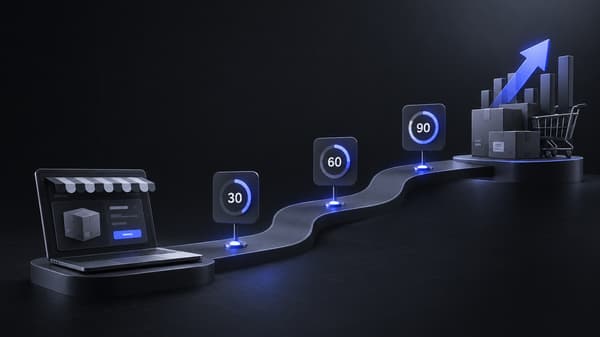
Quarter one is adoption and instrumentation: the first cohorts moved, the three numbers on a dashboard, the fix list started. Quarter two is iteration at cadence: the backlog shipping monthly, the second cohort of accounts, the reps converted from skeptics to sellers. Quarters three and four are compounding: retention machinery, deeper automation, and the moment worth waiting for, when the store stops being the project someone defends in meetings and becomes the way the business simply takes orders.
Uncap has been a Shopify Platinum Partner since 2013, with more than 380 B2B commerce projects delivered for manufacturers, distributors, and wholesalers, and Managed Growth picks up stores Uncap built and stores it did not, starting with an assessment and shaping the first ninety days around what will move most. Talk to Our Experts if your store launched and the orders are still arriving where they always did, the adoption-and-measurement review is the first conversation, and it usually finds the fix list already written in your own logs.
Frequently asked questions
Why is our B2B ecommerce store not getting orders after launch?
Usually because the channel launched but the habit migration never did: accounts keep ordering by phone because nobody walked them onto the portal cohort by cohort, reps were not enrolled as the channel's sellers, and the store stopped improving after go-live. The store is rarely the problem; the missing adoption campaign and the unowned backlog are.
What metrics matter for a B2B store after launch?
Three: self-serve order share (the percentage of orders and revenue entering without manual transcription), account adoption (the share of active accounts ordering online each quarter), and reorder rate within the channel. Traffic, bounce rate, and sessionized conversion rate are DTC metrics that say little about a channel where a few dozen accounts carry the revenue.
How do you get B2B customers to actually use the portal?
Cohort by cohort, easiest habits first: start with weekly reorderers, where quick order and reorder visibly beat the phone, give each account a short walkthrough on its own order history, and enroll reps by making the portal their relief rather than their replacement. Announcements do not move habits; guided first orders do.
What does Managed Growth include after a Shopify launch?
A monthly managed engagement across four levers, revenue, optimization, retention, and operations, on a month-to-month retainer with plans from $2,500, senior-led delivery, and a shipping rule: real changes live in production every month, reported honestly, with an assessment-first start for stores Uncap built and stores it did not.