

A buyer who reorders without a phone call is worth more than a buyer who orders once and calls every time after. That's the entire logic of customer lifetime value (CLV) in B2B ecommerce, and it's why the fastest way to grow it usually isn't a loyalty program. It's removing the friction that makes a buyer hesitate before they click reorder.
Most CLV advice online is written for a general ecommerce or SaaS audience: segment your customers, personalize your email, add a rewards tier. None of it accounts for how B2B buying actually works, longer relationships, larger and more predictable orders, and a purchase pattern built on trust in the price, the fit, and the fulfillment, not on discounts or points. This guide covers what actually moves CLV for a B2B store selling on Shopify.
What Is Customer Lifetime Value in B2B Ecommerce?
Customer lifetime value is the total revenue a buyer generates over the full length of their relationship with you, not just their first order. The basic formula is average order value multiplied by purchase frequency, multiplied by customer lifespan. In B2B, all three inputs behave differently than they do in consumer ecommerce.
Average order value is already high relative to B2C, so the biggest gains in the formula sit mostly in frequency and lifespan, in how often a buyer reorders and how long they keep buying before they churn or move to a competitor. A B2B buyer who's satisfied doesn't need to be won back with a discount code. They need the reorder to be easy enough, and the price and stock information reliable enough, that going anywhere else feels like more work.
That's the part most CLV content misses. It treats B2B retention like a marketing problem when, for a large share of B2B revenue, it's actually a storefront-friction problem.
Why B2B CLV Depends on the Storefront, Not Just the Relationship
For years, B2B customer relationships were carried by sales reps: the account manager who knew the buyer's preferences, chased the reorder, and smoothed over pricing questions. That relationship still matters. But as more B2B buying moves to self-serve, more of what used to be a rep's job now lives on the storefront itself, and a storefront that does that job poorly puts the whole relationship at risk, not just one order.
A buyer who has to call for a quote, hunt through old emails to reorder, or double-check a price at checkout because the storefront has been wrong before isn't building loyalty toward your brand. They're tolerating friction until a competitor makes it easier. Every one of those moments is a small, cumulative tax on lifetime value, and it compounds over years of a B2B relationship in a way it never has time to in a one-off consumer purchase.
Five Storefront Levers That Actually Move B2B CLV
1. Make the Reorder Effortless
Repeat orders are the biggest lever in the CLV formula for most B2B sellers, because so much of B2B revenue is the same buyer ordering the same or similar products again and again. If reordering means rebuilding a cart from memory or digging through past invoices, buyers put it off, or hand it back to a rep, which quietly caps how often they order.
Uncap Portal gives buyers order history, saved preferences, and one-click reorder in a single place. The less work a reorder takes, the more often it happens, and purchase frequency is one of the three direct inputs into lifetime value.
2. Keep Pricing and Account Terms Accurate
Nothing shortens a B2B relationship faster than a buyer catching a pricing error, especially one that favors you. A wrong price at checkout, even once, makes a buyer start double-checking everything, which slows every order after it and quietly damages the trust the relationship depends on.
Uncap Connect keeps customer-specific pricing, credit terms, and account data synced live between Shopify and your enterprise resource planning (ERP) system, so the number a buyer sees is always the number that's actually true for their account. Accuracy isn't a nice-to-have here, it's what keeps a buyer ordering instead of verifying.
3. Cut Down Fitment and Product Mistakes
A buyer who receives the wrong part twice starts assuming your catalog can't be trusted, and stops ordering the products they're less than certain about, which shrinks their basket even if they stay a customer. In categories like auto parts, industrial equipment, and manufacturing components, a fitment mistake is often the specific moment a long relationship starts to erode.
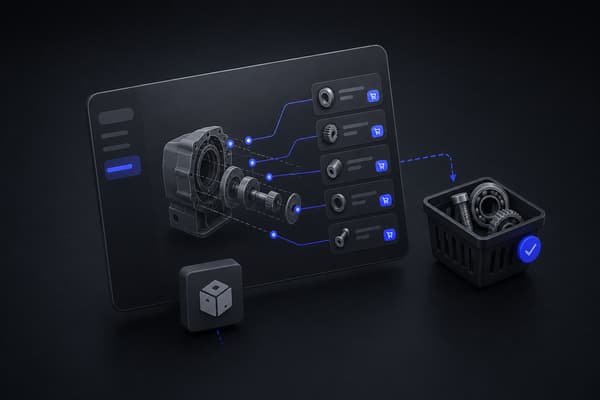
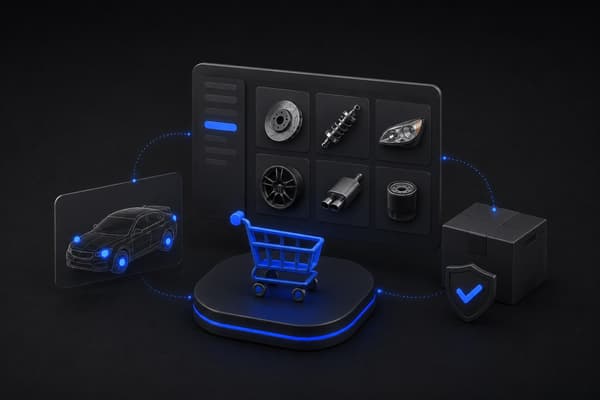
Uncap Garage lets buyers filter by Year-Make-Model so they only see parts that fit. Uncap Diagrams lets them click a part directly on a schematic instead of guessing at a SKU. Fewer wrong orders means fewer returns, and a buyer who trusts your catalog orders more of it.
4. Turn Quote Requests Into Orders Quickly
A buyer waiting on a quote is a buyer with an open window to check a competitor. The longer that quote sits unanswered, the more likely they are to place this order elsewhere, and once they've ordered from someone else once, some share of their future lifetime value has already leaked away, whether or not you ever hear about it.
Uncap Quotes captures a quote request directly inside Shopify, with the cart, quantities, and account attached, so it becomes a workflow instead of an email that waits in an inbox. Closing that gap faster keeps a buyer's whole order, and their next one, with you instead of a competitor who answered first.
5. Answer Buyer Questions Without Making Them Wait
A buyer who isn't sure a product fits, or can't tell two options apart, either calls a rep or leaves. Either way, the order stalls, and a buyer who's stalled once starts routing future purchases somewhere that answers faster.
An AI assistant trained on your own product, spec, and fitment data can answer those questions immediately, in plain language, without a buyer waiting on a rep's availability. This is Agentic Commerce applied to retention rather than first-time conversion, and it runs on the same structured product data that makes Uncap Garage and Uncap Diagrams work well in the first place.
The First 90 Days Set the Ceiling on Lifetime Value
Most CLV thinking treats the entire customer relationship as one long, even stretch. In B2B, the first few orders carry disproportionate weight. A new account that gets a smooth first order, an accurate price, the right product, a reorder that's easy to find, tends to keep buying at that same standard for years. A new account that hits friction early forms an opinion about how hard you are to work with, and that opinion is hard to undo later even after the underlying problem gets fixed.
That makes onboarding a B2B buyer onto self-serve ordering one of the most consequential moments in the entire relationship, not a formality before the "real" retention work starts. A company account that's set up correctly from day one, with the right pricing tier, the right catalog visibility, and the right approval roles already in place, removes the single biggest source of early friction before a new buyer ever has a reason to be frustrated. Getting that setup right the first time matters more for long-run CLV than almost any retention tactic applied later.
Segment Accounts Before You Try to Move the Average
Treating every account as equally likely to increase in value wastes effort. A useful segmentation splits accounts by where the friction and the upside actually are:
High-frequency, low-friction accounts. These buyers already reorder easily and rarely need help. The lever here isn't fixing anything, it's expanding basket size through better product findability and configuration tools, so an account that's already loyal also buys a wider slice of your catalog.
High-value, high-friction accounts. Large accounts that still call for quotes, still hit pricing errors, or still order manually are the most valuable segment to fix first, since the CLV upside per account is largest here and the friction is usually well understood internally already.
New accounts still forming a first impression. As covered above, these buyers are disproportionately sensitive to early friction. Segmenting them separately makes it easier to watch onboarding-specific metrics without those numbers getting diluted by long-tenured accounts.
At-risk accounts showing declining reorder frequency. A falling reorder rate on a previously healthy account is usually the earliest available warning sign of churn, well before the account stops ordering entirely, and it's worth a proactive check-in rather than waiting for the account to go quiet.
Segmenting this way turns "increase CLV" from a vague company-wide goal into a short list of specific accounts and specific friction points, which is a far more actionable starting point than a general retention initiative.
How to Measure CLV in a B2B Storefront
Tracking CLV in B2B doesn't require sophisticated modeling to be useful. A workable starting point:
Segment by account, not just by individual buyer. Many B2B relationships involve multiple buyers purchasing under one company account. Measuring lifetime value at the account level, not the individual login, reflects the actual relationship you're trying to grow.
Track reorder rate and time-to-reorder as leading indicators. A rising average order value with a falling reorder rate is often an early warning sign, even before total CLV drops, since frequency erodes before lifespan does.
Watch cohorts, not just averages. Compare buyers who onboarded through a clean, self-serve storefront experience against buyers who onboarded through a rockier one. The gap between those cohorts, tracked over time, is usually the clearest evidence of which storefront changes are actually paying off.
None of this requires a new analytics platform to start. It requires deciding which friction point to fix first, and watching whether reorder frequency moves after you fix it.
Where to Start
Customer lifetime value in B2B ecommerce is mostly a function of how much friction sits between a satisfied buyer and their next order. Fix that friction, and retention follows without a separate loyalty initiative.
Uncap has been a Shopify Platinum Partner since 2013, building B2B storefronts for manufacturers and distributors where the reorder, not the first order, is where most of the revenue actually lives. See how that work comes together in Uncap's case studies.
Talk to our experts at Uncap Growth about which storefront friction point is costing you the most reorders right now.
Frequently asked questions
Is customer lifetime value calculated differently for B2B versus B2C?
The formula is the same, average order value times purchase frequency times customer lifespan, but the inputs behave differently. B2B orders are typically larger and less frequent per buyer, and the relationship spans years rather than a handful of purchases, which makes reducing friction on existing buyers a more valuable lever than acquiring new ones.
What's the fastest way to improve B2B CLV on Shopify?
Start with whichever friction point is costing you the most reorders right now: slow reordering, unreliable pricing, fitment mistakes, or slow quote turnaround. Fixing the single biggest leak usually moves the number faster than adding a new retention program on top of an already-frustrating storefront experience.
Does a loyalty program help B2B customer lifetime value?
Not as much as it does in consumer ecommerce. B2B buyers are typically motivated by reliability, accuracy, and speed, not point systems or discounts, since the purchase is usually a recurring business need rather than a discretionary buy. Fixing storefront friction generally outperforms loyalty mechanics built for a B2C audience.
How often should I recalculate customer lifetime value?
A quarterly review is usually frequent enough to catch meaningful trends without reacting to short-term order timing noise. Reviewing more often than that mostly adds volatility without adding insight, since B2B order cycles are typically longer than consumer ones.
Should CLV be measured per buyer or per company account?
Per account, in most B2B relationships. Multiple individual buyers often purchase under a single company account, and measuring at the individual level can understate the account's true relationship value or miss the fact that purchasing responsibility shifted from one contact to another within the same company.
What's a common mistake companies make when trying to improve CLV?
Launching a retention campaign, email series, loyalty perks, before fixing the storefront friction that's actually driving buyers away. A well-designed campaign layered on top of a slow reorder flow or unreliable pricing treats a symptom instead of the cause, and the underlying friction keeps eroding CLV regardless of what the campaign does.