


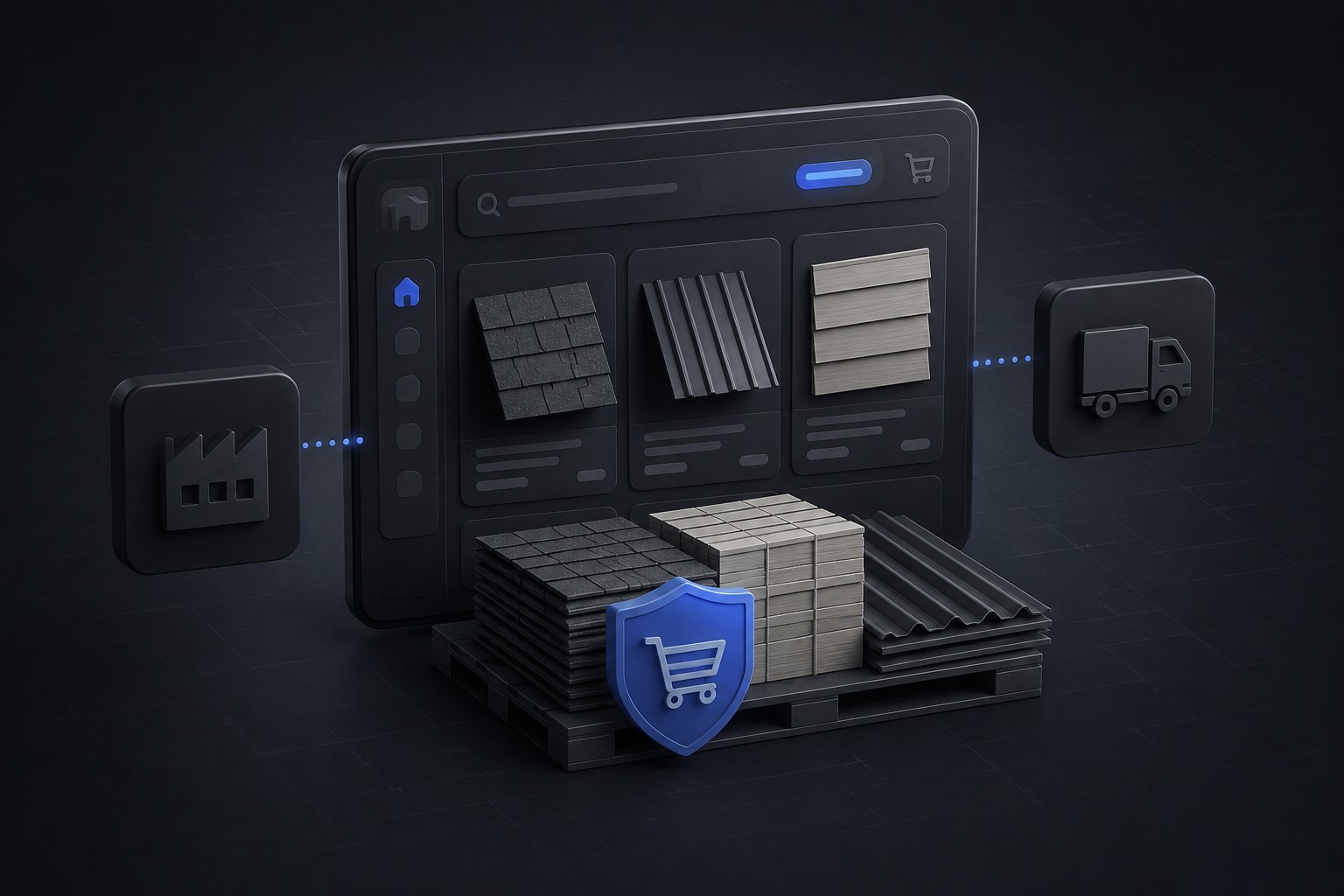
Nobody orders a roof one SKU at a time. A roofing job is a system: shingles, underlayment, ice and water barrier, starter strip, hip and ridge, fasteners, ventilation. A siding job is the same story in different materials. Yet most roofing supply and siding supply catalogs online are built like any other store, one product per page, quantity box next to it, leaving the contractor to translate "2,400 square feet, moderately cut-up roof" into line items on their own. That translation gap is where online orders stall and phone orders persist.
Quick answer: Selling roofing and siding supply online works when the store does the translation: coverage calculators that turn job measurements into correct quantities, bundled SKUs that sell the system instead of scattered components, and a quote path for the project-scale orders where pricing needs a rep. The distributors getting contractor orders online are not selling products harder. They are removing the arithmetic between the takeoff and the cart.
Why Roofing and Siding Break the Standard Catalog
The units are the first problem. Roofing is measured in squares, one square covering 100 square feet, and shingles typically ship three bundles to the square. Siding is measured in squares too, but ships in cartons whose coverage varies by profile. Underlayment covers by the roll, drip edge by the stick, fasteners by coverage per box.
A contractor thinks in job area; the catalog sells in manufacturer packaging. Every order requires converting between the two, and every conversion is a chance to be wrong.
Then comes waste. Real orders carry a waste factor, commonly in the range of 10 to 15 percent depending on how cut-up the roof is, and an experienced counter rep applies it instinctively. A bare quantity box does not. The contractor who orders exact coverage learns about waste factor on the job site, one delivery short, and remembers whose store let that happen.
The result is predictable: the products are commodities, but the ordering is expertise. Distributors keep that expertise at the counter, and the online channel stays a brochure. The fix is moving the expertise into the store itself.
Coverage Calculators: Turning Measurements Into Orders
A coverage calculator asks for what the contractor already knows, job area, pitch or complexity, product line, and returns what they actually need to buy: so many bundles, so many rolls, so many boxes, waste factor included. Done well, it is the single most valuable feature a roofing or siding storefront can add, because it replaces the exact conversation that currently forces the phone call.
The mechanics matter. The calculator has to know each product's real coverage math, bundles per square for that shingle line, carton coverage for that siding profile, not a generic square-footage divide. It should expose its assumptions, showing the waste factor and letting the contractor adjust it, because a pro who cannot see the math will not trust the output. And it should end in a cart, not a printable list: the calculated quantities become order lines in one action.
This is configuration logic, the same category of problem as any configurable product: inputs, rules, valid outputs. Uncap Builder handles that layer on Shopify, turning coverage rules and product relationships into a storefront experience instead of a PDF chart the buyer has to interpret.
Bundled SKUs: Selling the System
The second translation is completeness. A roof needs its accessories, and the manufacturer's warranty frequently depends on installing the full specified system rather than mixing components. A store that sells shingles on one page and leaves the contractor to remember starter strip, ridge cap, and the right underlayment is betting the order on the buyer's memory at the end of a long day.
Bundles fix this at the catalog level: a shingle line sold as a system, with the compatible accessories attached at correct ratios to the calculated quantity. The contractor confirms rather than assembles. Behind the storefront, that bundle is a real bill of materials, component SKUs, quantities, and pricing that fulfillment can pick against, the same BOM structure that drives configured products elsewhere in B2B. For the distributor, bundles also quietly raise order completeness, which shows up as fewer emergency will-call runs for the forgotten drip edge.
Quotes: The Project-Scale Path
Calculators and bundles handle the jobs a contractor can spec alone. They do not handle the reroof of a 40-unit townhome complex, where pricing depends on volume, delivery is phased across weeks, and the GC wants a number in writing before committing. Forcing that order through a cart is as wrong as forcing a single-roof order through a sales rep.
The quote path takes the same configured materials list, calculated quantities, chosen system, and routes it to a rep who applies project pricing, freight, and scheduling, then returns a quote the contractor approves into an order. Uncap Quotes keeps that loop native to Shopify, request through approval through conversion, so the project order carries its agreed pricing without being retyped from a PDF into the system.
The routing logic mirrors the rest of B2B supply: self-serve for what rules can price, quote for what needs judgment, both against the same catalog and the same account. And both paths should respect contractor pricing tiers and account structure, so the calculated cart and the quoted project each land at the account's real rate.
Where This Sits in the Bigger Build
Calculators, bundles, and quotes are the roofing-and-siding-specific layer on top of the standard contractor commerce foundation: account pricing at browse time, live branch inventory, net terms, and job-level ordering. The contractor portal guide for building materials covers that foundation, and the broader shift of building materials ordering online covers why the timing pressure is real, consolidation is raising the digital bar across the category.
Uncap has been a Shopify Platinum Partner since 2013, with 380+ storefronts launched on Shopify, including for distributors, manufacturers, and wholesalers, including operators in building materials and construction supply. Book a Demo to see coverage logic, bundles, and quoting running against a real catalog.
Frequently asked questions
What is a coverage calculator for roofing supply?
A storefront tool that converts job measurements into purchasable quantities: the contractor enters area and roof complexity, and the calculator returns bundles, rolls, and boxes per the actual coverage math of each product line, with an adjustable waste factor, ending in an add-to-cart action rather than a reference chart.
Why sell roofing products as bundles instead of individual SKUs?
Because a roof is installed as a system, and manufacturer warranties frequently depend on using the specified components together. Bundles attach compatible accessories at correct ratios automatically, which protects the contractor from incomplete orders and the distributor from the returns and emergency runs that follow them.
When should a roofing supply order go through a quote instead of the cart?
When pricing needs judgment: project-scale volume, phased delivery, negotiated rates. The configured materials list routes to a rep as a quote request, gets priced, and converts to an order on approval, keeping project orders in the same system as everyday cart orders.
Do coverage calculators work for siding as well as roofing?
Yes, the structure is identical: area in, packaged quantities out. The difference is the coverage data, siding cartons cover differently by profile and exposure, which is why the calculator has to run on per-product coverage rules rather than one generic conversion.