

The dealer account manager called at 8:30 on a Tuesday morning. The serpentine belt was showing $42.50 on the buyer portal. Their contract said $38.00. The pricing change had gone through in the ERP on Monday afternoon. The Shopify portal ran its sync before the contract update processed and was not due to run again until early Wednesday. The account had tried to order online, saw a price that did not match their agreement, and called the rep to find out which system was correct.
The ERP was correct. The buyer portal was wrong by $4.50 on a part they order every week.
This is the failure mode that defines inadequate ecommerce ERP integration for automotive distributors. The ERP holds the right price. The buyer portal reflects what the ERP knew fourteen hours ago. The gap between those two states generates a call that a well-built integration would have prevented entirely.
For automotive parts distributors running Shopify as their B2B buyer portal, connecting it to the back-office system that manages pricing contracts, inventory positions, and customer credit terms is foundational infrastructure. This guide covers what ecommerce ERP integration means specifically for automotive distribution, what the integration must deliver to work in a B2B context, how to evaluate the right approach, and what automotive-specific complexity the integration needs to handle.
DMS vs ERP: What Automotive Distributors Are Actually Connecting to Shopify
The term "DMS" in this guide's title reflects how many automotive distributors describe their back-office system. In the car dealership world, DMS (Dealer Management System) typically refers to platforms that manage vehicle inventory, finance and insurance, service scheduling, and parts management for a dealership operation.
For automotive parts distributors and wholesalers, the back-office system is almost always a distribution-focused ERP (enterprise resource planning system), not a dealership DMS. NetSuite, SAP, Microsoft Dynamics 365, Epicor, and Acumatica are the systems most commonly used in mid-market automotive parts distribution. These systems manage customer accounts and pricing contracts, inventory across warehouse locations, purchase orders and vendor management, order history and accounts receivable, and the financial record of every transaction the business processes.
Some distributors run hybrid environments: a dealership-adjacent DMS for service operations, alongside a separate ERP for distribution management. In either case, the Shopify integration challenge is the same. The back-office system holds the authoritative data for pricing, inventory, and account status. The Shopify buyer portal needs to display and act on that data in real time.
Throughout this guide, "ERP" refers to whatever back-office system an automotive distributor uses as their source of truth for operations data. The integration requirements described here apply whether that system is a traditional distribution ERP, an automotive-specific DMS, or a hybrid of both.
What Ecommerce ERP Integration Means for Automotive Parts Distributors
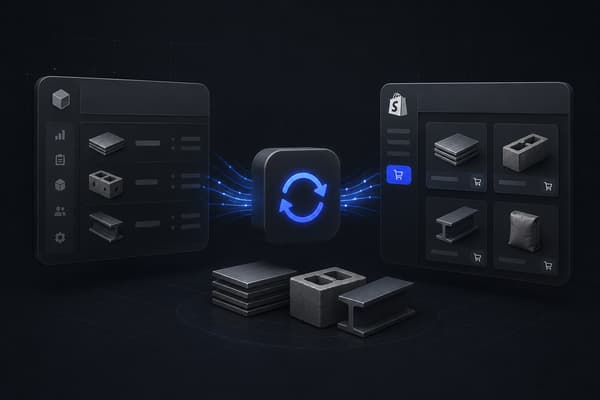
Ecommerce ERP integration for an automotive parts distributor is a bidirectional, event-driven data connection between Shopify (the buyer-facing portal) and the ERP or DMS (the back-office system of record). When a warehouse transaction updates inventory in the ERP, inventory counts in the Shopify portal update within seconds. When a pricing contract changes in the ERP, the buyer's account price in Shopify reflects it without delay. When a buyer places an order in Shopify, a sales order appears in the ERP automatically, with the correct PO number, account reference, and line items, and no manual re-entry required.
For general retail ecommerce, an integration that syncs at the end of each day is often sufficient. A consumer ordering online expects their item in two to five business days. A slight lag between warehouse transaction and inventory count does not typically affect a consumer order.
For an automotive parts distributor serving repair shops, dealer networks, and fleet accounts, that logic fails at the first test. A repair shop ordering for same-day service needs to know what is available right now, not what was available at midnight. A dealer account buyer who sees a price that does not match their contract will not assume the portal is wrong. They will call, and call, and eventually stop trying to order online at all. The gap between the ERP's actual state and the Shopify portal's displayed state is where buyer trust in the digital channel breaks.
B2B ecommerce ERP integration that works for automotive distributors is not a configuration task. It is an architecture decision about which system owns which data, how changes in one system propagate to the other, and how fast that propagation needs to happen for the buyer experience to be reliable. Most distributors reaching this decision are also retiring an older Magento storefront, where the ERP and DMS connections had been stitched together as custom modules that made every upgrade a risk.
Multi-location stock is the first of these flows, and how distributors get multi-warehouse inventory visibility and order routing right goes deeper on it.
The Four Data Flows That Must Be Real-Time in a Distributor ERP Integration
For automotive parts distributors, a Shopify ERP integration that keeps the following four data flows current in real time eliminates the most common buyer trust failures in B2B portal adoption.
Multi-location inventory, not aggregate stock. Automotive distributors run multiple warehouse locations: a primary distribution center, regional stocking points, branch locations. A Shopify portal that displays a single aggregate inventory number without location awareness will show parts as available that are physically located at a facility two states away with three-day shipping, or will allocate from a location that has already committed that stock to a priority order placed five minutes earlier. The integration needs to reflect inventory by warehouse location, with availability logic that accounts for the buyer's account region and shipping requirements. When a warehouse pick reduces stock in the ERP, the Shopify portal reflects that reduction immediately, not at the end of the shift.
Customer-specific pricing from ERP contracts. Dealer networks, repair shop accounts, fleet buyers, and co-op accounts operate on negotiated pricing that is specific to their account agreement. That pricing lives in the ERP as a contract, a customer price list, or a customer group discount structure. The Shopify buyer portal must show the account's correct price at the catalog level. A buyer who sees a different price in the portal than in their contract will not proceed to checkout to see if the right price appears. They will call. The pricing data needs to flow from the ERP contract record to the appropriate Shopify B2B price list in real time, so that any change to a contract in the ERP is reflected in the portal before the buyer next logs in.
Order-to-ERP with purchase order capture. When a buyer places an order in the Shopify portal, a sales order needs to be created in the ERP within seconds. The sales order must carry the buyer's PO number on the order record, because dealer accounts and fleet buyers use that PO number to reconcile their own procurement records against the distributor's invoice. If the Shopify order and the ERP sales order are created as separate records that must be manually matched, the process fails. If the PO number does not transfer automatically, the distributor's accounts receivable team has to enter it manually. For distributors processing hundreds of dealer orders during a peak period, that manual entry is where errors compound.
Account status and credit hold propagation. An automotive parts distributor with dealer accounts will periodically need to place an account on credit hold in the ERP because of a past-due balance, a credit limit breach, or a temporary account issue. When that hold is applied in the ERP, the buyer's ability to place orders through the Shopify portal should reflect it immediately. A buyer who can still check out in the Shopify portal while their account is on hold in the ERP creates a fulfillment problem, an accounts receivable conflict, and an awkward conversation that could have been prevented by an integration that propagated the hold status in real time.
These four flows are the minimum for a distributor ERP integration that supports a buyer portal buyers actually use. They are also the four flows that are most commonly missing, delayed, or incomplete in integrations built on general retail ecommerce tooling.
Integration Methods for Shopify ERP in Automotive Distribution
There are three methods for connecting Shopify to an automotive distributor's ERP. Each has a different risk, cost, and long-term maintenance profile.
Custom API integration. A development team writes a direct connection between Shopify's REST or GraphQL API and the ERP's API or web services layer. This gives the distributor complete control over which data flows, how field mapping works, and what business logic is applied at the integration layer. It also creates a technical dependency: when either platform updates its API, the custom integration may require changes. When a new ERP data field needs to flow to Shopify, a developer has to add it. For distributors with complex, non-standard requirements and in-house technical resources, a custom integration can be the right fit. For most mid-market automotive distributors, it introduces ongoing maintenance overhead that compounds over time.
Native or vendor-built connectors. Many ERP systems offer a native Shopify connector or integration app. Microsoft Dynamics 365 Business Central includes a Shopify connector that handles standard order and inventory sync. NetSuite has integration frameworks that connect to Shopify through their SuiteScript or REST web services. These native connectors work reliably for standard data flows. They typically cover general retail ecommerce requirements: product sync, order import, inventory update. B2B-specific requirements, including company account hierarchies, customer-specific price lists, net payment terms, and purchase order capture, often require configuration work that sits outside the connector's standard scope. Distributors who start with a native connector and then add B2B requirements frequently end up with a hybrid of native connector and custom code that becomes difficult to maintain when either platform updates.
Purpose-built B2B connector. A connector built specifically for Shopify B2B and distributor ERP environments includes the data flows that matter in a B2B distribution context from the start: account-based pricing, net terms enforcement at checkout, PO capture on order creation, credit hold propagation, multi-warehouse inventory by location. The connector's data model starts from a B2B distributor requirement rather than from a retail baseline that is then modified. For mid-market automotive distributors who need a reliable ERP integration without building and maintaining custom code, a purpose-built B2B connector is typically the right approach.
The relevant question for an automotive distributor evaluating integration methods is not which method is technically possible. It is which method handles the B2B and automotive-specific data flows without requiring a custom development effort for each requirement.
Why Automotive Distributor ERP Integration Is More Complex Than Standard Ecommerce
Automotive parts distribution introduces ERP integration complexity that standard ecommerce operations do not encounter.
Parts catalog volume and data separation. An automotive distributor may maintain 200,000 to 1,000,000 active SKUs. The ERP holds a subset of the product data: internal part numbers, pricing, inventory positions, cost, and supplier reference. The fitment and application data, including ACES (Aftermarket Catalog Exchange Standard) vehicle application records, lives in a separate catalog data source. The product attribute data, including PIES fields for dimensions, weight, and technical specifications, lives in yet another system or PIM layer. A Shopify ERP integration that only connects the distributor's ERP to Shopify will publish pricing and inventory without the fitment and specification data that automotive buyers need to place the right order. The integration architecture for an automotive distributor needs to account for multiple data sources, not just the ERP.
Dealer account hierarchies. A distributor selling through a dealer network may have dealers with multiple branch locations, each with their own pricing tier, approved product catalog, and credit terms. The ERP manages this as a company-location account structure with specific pricing contracts at each level. Shopify B2B supports company accounts with location hierarchies and location-specific price lists. But the integration needs to map the ERP's account structure to Shopify's account structure correctly, so that a buyer at one dealer branch sees only the catalog, pricing, and terms that apply to their specific location, not the terms of a sibling branch or the parent dealer company.
Seasonal volume spikes. Spring and fall create compressed demand cycles in automotive distribution. A large volume of orders arriving in a short window can expose integration weaknesses that are invisible at normal transaction volume. An integration that runs scheduled batch sync rather than event-driven real-time sync can fall behind during peak periods: inventory updates that normally process in minutes begin queuing, pricing that normally reflects in seconds starts lagging. The event-driven architecture that is necessary for daily accuracy becomes critical for peak-period reliability.
None of these challenges are unique to automotive distribution, but they concentrate there in a way that makes off-the-shelf integration tooling insufficient for distributors above a certain transaction volume.
What to Look for in a Shopify ERP Integration for Automotive Distribution
When evaluating a Shopify ERP integration for automotive parts distribution, four criteria determine whether the integration will handle B2B distributor requirements reliably or require ongoing intervention.
Event-driven sync, not scheduled batch. The integration should push changes from the ERP to Shopify in response to events: a warehouse transaction, a contract price change, an account status update, a new order confirmation. Not on a schedule. Scheduled batch sync is appropriate for overnight reconciliation checks. It is not appropriate as the primary mechanism for keeping a buyer portal accurate. An integration that runs every four hours means that at any point during the day, the portal could be up to four hours behind the ERP's actual state.
B2B-native data model. The integration should handle company accounts with location hierarchies, customer-specific price lists sourced from ERP contracts, net payment terms enforced at Shopify checkout, and purchase order capture at order creation without requiring custom development for each of these requirements. If those features are not in the integration's core data model, they will be built during your implementation project and will need to be maintained as both platforms update.
ERP as the source of truth for pricing. The integration should draw pricing from the ERP's contract and price list records and push it to the correct Shopify B2B price list, so that any change made in the ERP flows to the portal automatically. The pricing should not need to be maintained in two systems. The distributor's pricing team should be able to update a contract in the ERP and trust that the change reaches the buyer portal before the buyer's next order session.
Implementation experience with automotive distributors. An integration partner who has built Shopify ERP integrations for automotive parts distributors has already solved the dealer account hierarchy mapping, the multi-warehouse inventory logic, and the ACES data separation problem. A partner who has not will solve those problems during your project, on your timeline and budget. The reference check question is not "have you built Shopify ERP integrations" but "have you built Shopify ERP integrations for automotive distributors with dealer networks and multi-warehouse inventory."
The Shopify B2B platform's company account and price list architecture is built to support exactly these distributor requirements. The integration layer between Shopify and the ERP is what determines whether those features work reliably or require manual correction.
How Uncap Builds Shopify ERP Integrations for Automotive Distributors
Uncap is a Shopify Platinum Partner with 380+ storefronts launched on Shopify since 2013. For automotive distributors, the ERP integration is the first infrastructure decision in every project, not a phase-two addition. The buyer portal does not work correctly without it.
Uncap Connect is Uncap's ERP integration suite for Shopify, built around B2B distributor requirements from the beginning. The integration handles bidirectional, event-driven sync between Shopify and the distributor's ERP. The data model covers company accounts with location hierarchies, customer-specific price lists drawn from ERP contracts, net payment terms enforced at Shopify checkout, PO number capture at order creation, multi-warehouse inventory aggregated and attributed by location, account status and credit hold propagation, and order-to-ERP creation without manual re-entry.
For automotive distributors running NetSuite, the NetSuite Shopify integration maps NetSuite customer records, pricing contracts, and account locations to Shopify B2B company accounts and location-specific price lists. When a pricing contract changes in NetSuite, the change flows to the correct Shopify B2B price list within minutes. When a Shopify order is placed, a NetSuite sales order is created automatically with the PO number, account reference, and line items transferred. When a NetSuite warehouse transaction updates stock, Shopify inventory reflects the change in real time.
The same bidirectional, event-driven architecture applies to SAP, Microsoft Dynamics 365, Epicor, Acumatica, and other ERPs in the Uncap connector suite. For distributors running Epicor, which is common in automotive and industrial distribution, the integration handles Epicor's customer pricing and multi-warehouse inventory model specifically, not through a generic middleware translation.
Consider a mid-market automotive parts distributor with twelve dealer accounts across four states. Each dealer has between two and six branch locations. Each branch location has its own pricing agreement based on annual volume commitments, its own approved product catalog based on regional inventory, and its own credit terms. All of that account structure exists in the ERP. When Uncap Connect goes live, the entire account structure maps to Shopify B2B company accounts: each dealer becomes a company account, each branch becomes a company location, and each location's pricing and catalog is governed by its ERP contract, without the distributor's team building any of that structure manually in Shopify.
The auto parts and aftermarket industry page covers the full range of scenarios Uncap addresses for automotive parts distributors, from ERP integration to buyer portal design, fitment data management, and dealer network account architecture.
For the broader context of how ERP integration fits into a complete Shopify Plus technology architecture, the B2B ecommerce tech stack guide covers the adjacent systems, from PIM and product data management to payment terms and order approval workflows.
Talk to Our Experts to discuss what the right Shopify ERP integration looks like for your specific distributor ERP, catalog size, account structure, and seasonal volume profile.
Frequently asked questions
What is ecommerce ERP integration for automotive distributors?
Ecommerce ERP integration for an automotive distributor is a bidirectional, event-driven connection between the distributor's Shopify buyer portal and their back-office ERP or DMS system. It means inventory counts, customer-specific pricing, account status, and order records stay synchronized between the two systems in real time, without manual data entry or scheduled batch updates. When the ERP changes, the buyer portal reflects it. When a buyer orders in Shopify, the ERP creates the sales order immediately. The integration is what makes the buyer portal reliable enough for dealer accounts and repair shops to trust for routine ordering.
Why do automotive distributors need a different ERP integration than general retailers?
Automotive parts distributors have B2B account structures, pricing models, and data requirements that general retail ecommerce ERP integrations do not handle by default. Company accounts with multiple dealer locations, each with their own pricing contract, require an account hierarchy and price list mapping that retail integrations do not include. PO number capture at checkout, net payment terms enforcement, and credit hold propagation are standard B2B distributor requirements that need to be in the integration's core data model. Additionally, automotive distributors typically maintain catalog data across multiple source systems: the ERP for pricing and inventory, and separate systems for ACES fitment data and PIES product attributes. The integration architecture needs to account for all of those data sources.
What ERP systems does Shopify integrate with for automotive distribution?
Shopify connects to the ERP systems most common in automotive parts distribution: NetSuite, SAP, Microsoft Dynamics 365, Epicor, Acumatica, Infor, and others. The quality of the integration depends on the connector used and whether it is built for B2B distributor requirements or for general retail ecommerce. A connector built for retail will handle standard order and inventory sync but will require custom development to support account-based pricing, net terms, PO capture, and dealer account hierarchies. A purpose-built B2B connector has those capabilities in its core data model.
What is the difference between event-driven sync and batch sync for distributor ERP integration?
Event-driven sync pushes changes from the ERP to Shopify in real time, as transactions occur. When a warehouse pick reduces stock in the ERP, the Shopify inventory count updates within seconds. When a contract price changes in the ERP, the buyer's Shopify price list reflects the change before their next order session. Batch sync runs on a schedule, updating Shopify with ERP data at a set interval: hourly, every four hours, or nightly. For a buyer portal used by repair shops ordering for same-day repairs and dealer accounts checking pricing accuracy, batch sync introduces a lag between the ERP's actual state and what the buyer sees. Event-driven sync is the standard for distributor ERP integration where buyer portal accuracy is a requirement.
How long does a Shopify ERP integration take for an automotive distributor?
Implementation timelines for a Shopify ERP integration in automotive distribution typically range from eight to sixteen weeks, depending on ERP complexity, account hierarchy depth, and the state of product and catalog data before the build begins. Distributors with clean ERP data, a well-documented account structure, and a clear product data architecture complete integrations faster. Distributors who discover data quality problems mid-project, or whose ERP account structure does not map cleanly to Shopify's company account model, typically extend beyond the initial timeline. The most common way to reduce integration timeline is to complete an ERP data audit and account structure mapping exercise before the build begins.
Can a Shopify buyer portal show real-time inventory across multiple warehouse locations?
Yes. Shopify Plus supports multi-location inventory natively, and an ERP integration built for distributors will aggregate and attribute inventory from multiple warehouse locations in the ERP to the corresponding Shopify locations. A buyer can see whether a part is available at the stocking location closest to their delivery address, rather than seeing a combined inventory number that may include stock from a location too far away to fulfill same-day or next-day. For automotive distributors with regional stocking points serving dealer networks in specific territories, location-aware inventory accuracy is a material factor in buyer portal adoption.