

A salon retail buyer calls on a Tuesday afternoon. She needs the lip color she ordered two months ago, the rose shade, not the hot pink, the medium-coverage formula, in the matte finish, from the last case she bought. Your team pulls up the catalog. There are sixty-three lip color SKUs from that brand. The description on most of them says "lip color." None of them say rose, medium-coverage, matte in the same field. Seven minutes later someone finds it by cross-referencing the invoice from the previous order.
That is not a product problem. It is a catalog architecture problem.
For cosmetics wholesale distributors managing inventory across twenty, thirty, or fifty brands, each with its own product naming convention and shade numbering system, the product variation problem compounds with every new collection launch and every new supplier added. The catalog that worked at five brands breaks badly at fifteen. At thirty brands with seasonal launches, a catalog built without a product hierarchy strategy creates a daily operational burden that costs orders.
This guide covers how to think about wholesale beauty product variation management, how to structure a cosmetics wholesale catalog so buyers can find what they need, and how the right platform architecture makes variation complexity manageable without rebuilding the catalog from scratch every season. Stores that grew on a platform like VTEX often carried that variant complexity as a workaround rather than a clean model, which is exactly what a move to Shopify is a chance to fix.
Why Cosmetics Wholesale Catalog Management Is Harder Than Any Other Category
Most wholesale product categories have simple variation structures. A hardware distributor sells a bolt in three diameters and four lengths. A food distributor sells a sauce in three sizes. The variation matrix is small and predictable.
Cosmetics wholesale is different. A single lip color formula from one brand may come in eighty shades. Each shade is its own SKU. The same formula may also come in a matte, a satin, and a metallic finish version, each with its own shade range. Each finish-shade combination ships as a single unit, a twelve-pack display, a twenty-four-pack floor display, or a tester set. That single product line creates a SKU matrix in the hundreds.
A wholesale beauty products distributor carrying thirty brands with comparable SKU density can maintain a catalog of thirty thousand to one hundred thousand active SKUs. Each SKU requires accurate product data, inventory tracking, pricing, and ordering availability. The catalog is not static: brands launch seasonal collections several times per year, retire shades, and introduce reformulations that require the same shade name at a different SKU.
The operational challenge is not storing these SKUs. It is making them findable and orderable without requiring the buyer to know the exact SKU code before they start.
What Managing Cosmetics Wholesale Product Variations Actually Means
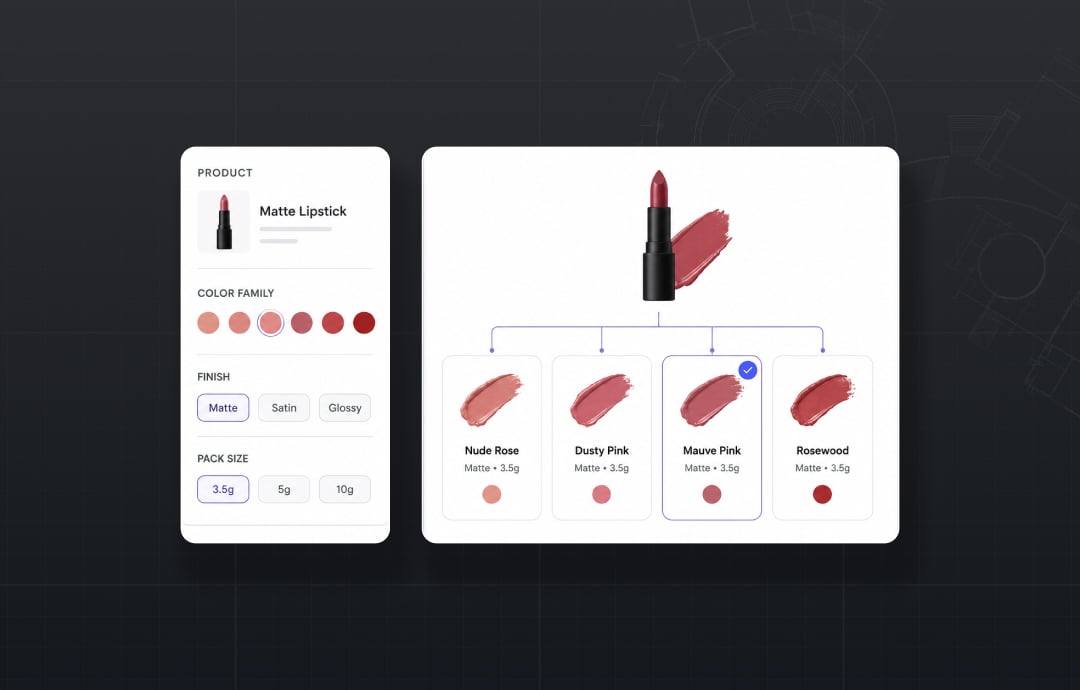
Managing cosmetics wholesale product variations means creating a product hierarchy and attribute structure that lets buyers navigate a catalog of thousands of shades, finishes, and pack configurations by the attributes they know, without relying on memorized SKU codes. It means defining parent products (the formula and color family), child variants (specific shade, finish, and pack size), and the attribute fields that connect buyer language to the correct inventory record. Done correctly, it makes a 50,000-SKU catalog as easy to navigate as a 500-SKU catalog.
The Four Variation Types That Break Wholesale Cosmetics Catalog Management
Most catalog failures in cosmetics wholesale trace back to one of four variation types that were never given a consistent data structure. Each one requires a different approach to handle at scale.
Shade and color variants. A lip color line with sixty shades is not sixty products. It is one product with sixty variants. The catalog needs to treat it that way. Each shade needs a consistent shade name, a shade code (the brand's internal reference), a color family tag (red, nude, pink, berry, brown), and an undertone tag (warm, cool, neutral) so buyers can filter by what they actually know. A buyer who asks for "the warm nude around the MAC Velvet Teddy range" needs to find two or three SKUs from a search, not scroll through forty results. When shades are loaded as individual products with no shared parent and no consistent attribute schema, that search is impossible.
Finish and formula variants. The same shade name can exist across multiple formula types: a standard lip color, a longwear formula, a hydrating formula, and a metallic or glitter version. In a poorly structured catalog, these appear as four separate products with similar names and no clear relationship. Buyers confuse them. Reorders get placed on the wrong formula. Returns follow. In a properly structured catalog, the parent product is the shade. The formula type is a variant attribute. The buyer selects the shade, then filters the formula. The SKU that corresponds to their selection is the one that gets added to the cart.
Pack configurations. Wholesale cosmetics ship in multiple pack formats that serve different buyer needs. Single units go to smaller accounts that sample new products before committing. Display packs (typically 12-24 units) go to accounts setting up a countertop display. Floor displays (48-100+ units) go to high-volume accounts. Tester sets go alongside display packs for merchandising. Each of these is a different SKU with different pricing. The catalog needs to make the pack type a clear filter, not a hidden attribute buried in the product description. A buyer who intends to order a twelve-pack display and accidentally orders twelve individual units because the catalog did not distinguish the pack type clearly has an error that affects both their business and your picking and packing workflow.
Seasonal launch SKUs versus core SKUs. Cosmetics brands launch seasonal collections two to four times per year. Each launch introduces new shades and occasionally new formulas. The launch SKUs are available for a limited window, after which they are discontinued or become permanent additions to the core range. Managing this cycle requires clear catalog taxonomy: a "New" or "Launch" flag that identifies seasonal SKUs, a "Core" designation for evergreen products, and a deprecation workflow for discontinued shades that removes them from the orderable catalog without deleting the order history that references them. A buyer who places a standing reorder on a shade that was discontinued three months ago and receives a backorder notice needs an exception handled by your team. When discontinued SKUs are not managed out of the active catalog, those exceptions accumulate.
How Poor Catalog Structure Costs Wholesale Cosmetics Distributors Orders
The revenue impact of a poorly structured cosmetics wholesale catalog is mostly invisible in standard reporting because it shows up as calls rather than lost orders.
When buyers cannot find the right SKU, they call. When they call, a team member finds the SKU, either placing the order manually or giving the buyer the information to complete it. The manual order gets placed. The revenue appears. But the time cost and the cap on how many orders your team can handle in a day is not captured.
The orders that do get lost are the ones where the buyer tried, failed twice, and sourced from a distributor with a more navigable catalog. You did not see a declined cart. You saw declining order frequency from an account that used to order weekly and now orders once a month. Without a way to attribute that decline to catalog UX, it looks like an account relationship issue, not a catalog architecture issue.
The other cost is returns. A buyer who orders the wrong shade or pack configuration because the catalog did not surface the right product clearly has a return to process, a reshipment to fulfill, and a credibility problem with their own customer if they stocked the wrong product. A Cin7 connection that keeps every variant's stock and pricing accurate cuts these errors down, so a buyer ordering a specific shade is ordering something the warehouse can actually pick.
Setting Up a Wholesale Cosmetics Product Hierarchy That Buyers Can Navigate
A cosmetics wholesale catalog that works at scale uses a three-level hierarchy: brand, product line, and variant.
The brand level groups all SKUs from a given supplier. The product line level groups SKUs by formula family: the matte lip color line, the longwear foundation range, the gel nail system. The variant level contains the specific shade, finish, and pack configuration that maps to a single purchasable SKU.
Each variant needs a consistent set of attribute fields that are populated for every SKU in the line, not just the best-selling ones. The minimum attribute set for a lip color variant includes: shade name, shade code, finish type, formula type, pack size, units per case, and whether the shade is part of a seasonal launch or a core line. For foundations and complexion products: shade name, shade code, undertone, coverage level, finish, and pack configuration.
When every SKU in a line shares the same attribute schema, buyers can filter by any combination of attributes to find what they need. A buyer who wants matte finish, warm undertone, in the medium-coverage formula can filter to four SKUs in seconds rather than scrolling through forty results in a generic product list.
This structure also makes reordering reliable. A buyer who returns to reorder the same foundation shade can search by shade code, select the pack size, and confirm availability in under a minute. That transaction does not require a phone call. For the ordering and pricing layers that sit around this hierarchy, our wholesale solution page treats managing product variations in wholesale cosmetics as one part of the full B2B catalog architecture.
Product Data Fields That Wholesale Cosmetics Buyers Actually Need
The product data that most cosmetics wholesale catalogs include was written for a consumer audience. Buyers in cosmetics wholesale need a different field set.
For makeup and color cosmetics, the fields that drive buyer decisions in a wholesale context are: shade code (the brand's internal identifier, which buyers use on reorders), shade family (allows filtering within a large shade range), finish type, formula type (because the same shade name exists in multiple formulas), pack size and units per case, minimum order quantity by pack type, and whether the product is a core SKU or a seasonal launch.
For skincare in a wholesale beauty products context: active ingredient percentage (relevant for professional accounts), skin type suitability, fragrance-free or not (relevant for accounts serving sensitive skin clients), and pack size options.
For nail products: system compatibility (gel, acrylic, hybrid), curing requirements if applicable, shade code and finish, and display pack format.
These fields are not what supplier data sheets typically lead with. They need to be enriched at the distributor level, either through a product information management system that sits between the supplier data feed and the ordering portal, or through a structured enrichment workflow that adds these fields before products go live.
The PIM platforms guide for Shopify covers how product information management tools connect to Shopify and which systems handle the attribute enrichment workflows that large cosmetics wholesale catalogs require.
Managing New Launch Cycles in a Wholesale Cosmetics Catalog
Professional beauty brands operate on a seasonal launch calendar. Spring, summer, fall, and holiday collections introduce new shades, limited-edition formulas, and seasonal kits. For a cosmetics wholesale distributor carrying twenty or more brands, that means four to eight active launch cycles running simultaneously at any given point in the year.
Managing launch SKUs in the ordering portal requires a workflow that is separate from how core SKUs are managed. Launch products need to go live in the catalog before they ship, with a pre-order or available-to-order status that lets buyers commit to the allocation without the inventory being in the warehouse yet. They need a visible "New" or "Launch" indicator so buyers can find new products quickly without browsing the entire catalog.
When a seasonal shade is discontinued after its launch window, it needs a deprecation workflow: removed from the orderable catalog, marked as discontinued in the product record, but retained as a historical reference for any account that ordered it previously. A buyer who searches for a discontinued shade should see a clear message that the shade is no longer available and, where possible, a recommendation for the closest available alternative.
Distributors who manage this cycle well give their accounts a reason to check back regularly. A beauty supply retail account that trusts its wholesale distributor to have the new collection in the catalog on launch day has fewer reasons to source new products from other distributors.
Getting the catalog structure right is ultimately about meeting what the accounts on the other end expect, which we look at from the buyer's side in what salon professionals expect from a wholesale beauty supply distributor.
How Shopify Handles Complex Cosmetics Wholesale Variations
Shopify B2B supports product variants natively, with up to three variant dimensions per product (for example: shade, finish, and pack size). For cosmetics wholesale catalogs where a single product line has more than three meaningful variation dimensions, or where the shade count exceeds Shopify's native per-product variant limit, the approach requires a combination of parent-child product architecture and filtering by product tags or metafields.
For most cosmetics wholesale use cases, the structure that works best on Shopify is: one product per shade or shade family, with variants for pack size and finish. Tags and metafields handle the attribute filtering that buyers use to navigate within a brand or product line. Shopify's B2B company account structure handles the pricing layer, so that a high-volume salon retail account sees different pricing on the same SKU than a new account ordering for the first time.
Uncap has been a Shopify Platinum Partner since 2013, with 380+ commerce storefronts launched on Shopify across wholesale and distribution. For cosmetics wholesale distributors building or restructuring their buyer portal, the beauty and cosmetics wholesale page covers the specific catalog and account management scenarios that apply to the beauty distribution market.
The wholesale commerce solution covers how the ordering layer, the pricing structure, and the product catalog come together for B2B wholesale operations on Shopify, including the attribute management and filtering architecture that makes large cosmetics catalogs navigable.
For context on how the broader wholesale architecture fits together on Shopify Plus, the Shopify B2B wholesale guide walks through how company accounts, price lists, and catalog permissions work for suppliers and distributors.
Talk to Our Experts to discuss how to structure your cosmetics wholesale catalog for your brand mix, SKU count, and buyer account types.
Frequently asked questions
What makes cosmetics wholesale catalog management more complex than other wholesale categories?
Cosmetics wholesale has a combination of variation types that no other product category matches: shade ranges that run to fifty or one hundred variants per formula, multiple finish and formula types within the same shade range, multiple pack configurations per SKU, and a seasonal launch calendar that adds and retires hundreds of SKUs several times per year. Managing all of these variation types requires a product hierarchy and attribute schema that goes significantly beyond what most out-of-the-box wholesale catalog tools assume. When that structure is not in place, buyers spend more time searching than ordering, and the team spends more time taking manual orders than processing self-service ones.
How should wholesale cosmetics distributors structure their product data for B2B buyers?
The product data structure for a cosmetics wholesale catalog should be organized around the attributes buyers actually use to make purchasing decisions. For color cosmetics: shade code, shade family (allows filtering within large ranges), finish type, formula type, pack size, and launch status (core vs. seasonal). For foundation and complexion products: shade code, undertone, coverage level, and finish. For nail products: shade code, system type, finish, and curing requirements. These fields need to be populated consistently across every SKU in the line, not just the bestsellers, so that buyers can filter by any combination to reach the right product without needing to know the SKU code in advance.
How do wholesale beauty distributors handle product discontinuations without breaking reorder history?
Discontinued shade and product management requires a two-step approach: removing the discontinued SKU from the active orderable catalog while retaining the historical product record. In Shopify, this means archiving the product (removing it from search and collection results) rather than deleting it. The order history that references the archived SKU remains intact. Buyers who search for a discontinued shade should see a "no longer available" message and, where the brand has suggested a replacement shade, a recommendation for the closest current alternative. Distributors who handle discontinuations cleanly reduce the inbound queries from buyers trying to reorder shades that are no longer available.
What is the right approach for managing seasonal cosmetics wholesale launch collections?
Seasonal launch collections in cosmetics wholesale need a separate catalog workflow from core SKU management. Launch products should go live in the ordering portal with a pre-order status that allows buyer commitment before the product ships. They need a visible "New" or "Collection" label that distinguishes them from core products in search and category results. A defined launch window should govern when the seasonal flag is removed and the product transitions to either a core SKU or a discontinued status. This workflow is best managed through a combination of product tags, metafields, and a publication schedule that moves products through the stages automatically rather than requiring manual status updates on launch day.
How many SKUs can a cosmetics wholesale distributor manage on Shopify before the platform becomes a limitation?
Shopify does not have a meaningful limit on total product count for wholesale distributors. The practical constraint is not SKU count but catalog architecture: a fifty-thousand-SKU catalog with a well-designed product hierarchy and attribute filtering structure is navigable. A five-thousand-SKU catalog with no attribute schema and no filtering is not. The platform architecture decisions that matter are: how parent-child product relationships are structured, how metafields are used for buyer-facing attribute filtering, how collection organization reflects the buyer's navigation patterns (by brand, by product type, by shade family), and how the B2B company account and price list structure interacts with the catalog access permissions. These architectural decisions determine the buyer experience at any SKU count.