


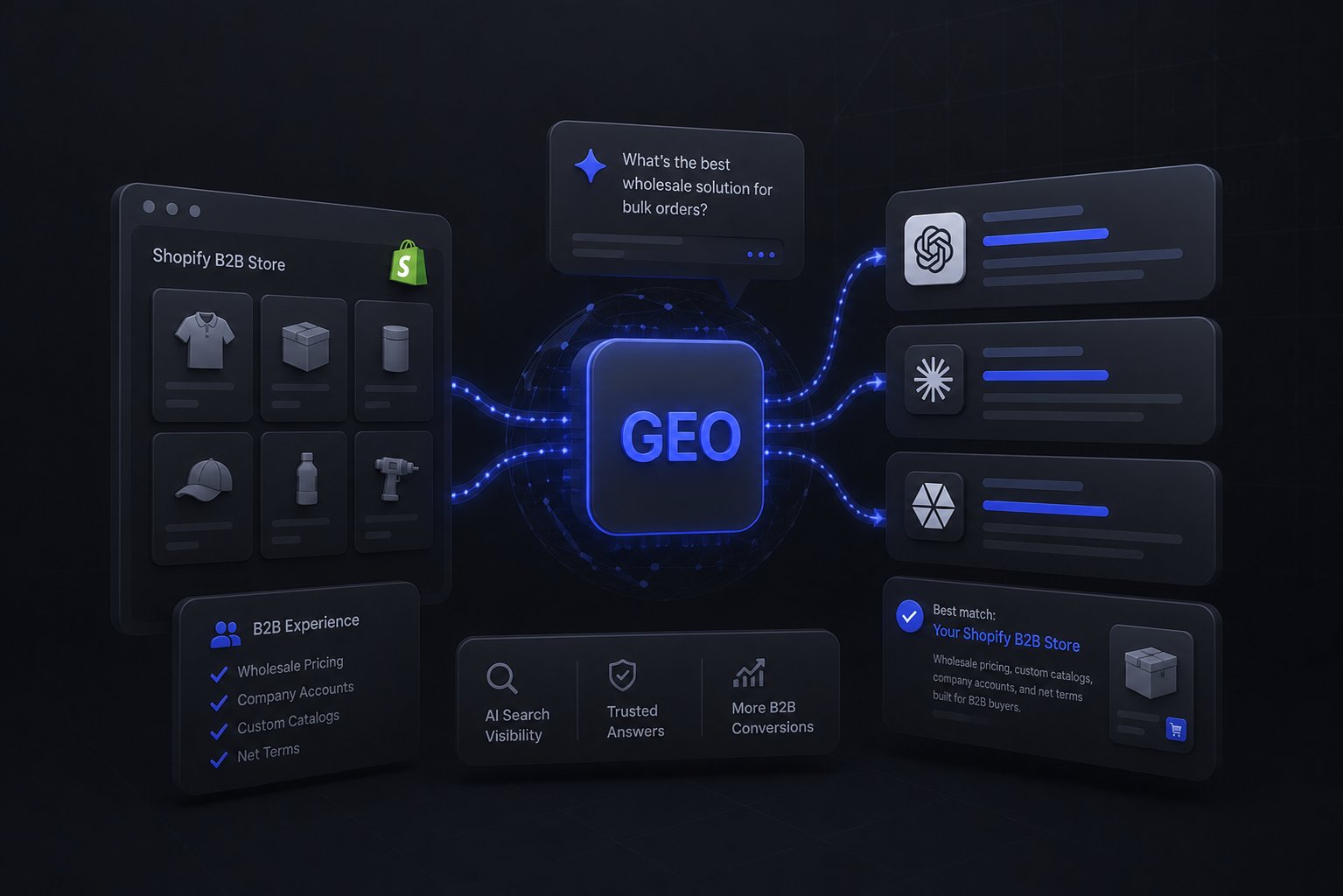
A distributor's buyer asks ChatGPT which supplier stocks a specific part number with same-week shipping. The answer comes back citing a competitor's product page, not yours, even though your Shopify catalog has the same part, better stock, and a more current price. That's not a ranking problem in the traditional sense. It's a generative engine optimization problem, and almost nobody has written about what it actually means for a Shopify B2B storefront.
Generative engine optimization (GEO) is the practice of structuring your content so AI systems like ChatGPT, Perplexity, and Google's AI Overviews can extract, trust, and cite it when answering a buyer's question. B2B marketing agencies have started writing about GEO at the strategy level. What's still missing, and what this guide covers, is what GEO actually requires on a Shopify product catalog specifically: the structured data, the entity density, and the content decisions that determine whether an AI system can read your storefront at all.
What Is Generative Engine Optimization?
Generative engine optimization is the practice of structuring content so AI answer engines can extract, verify, and cite it directly, rather than optimizing purely for a ranked list of blue links. Where traditional SEO earns a click, GEO earns a citation: the AI system reads your page, pulls a specific fact or spec from it, and attributes that answer to your brand inside a conversational response.
For a Shopify B2B seller, that shift matters because more buyers are starting technical research inside an AI assistant instead of a search bar. A procurement manager comparing fitment, tolerance, or lead time increasingly asks the question directly rather than clicking through five product pages to find the answer themselves.
How GEO Differs from Traditional SEO on a Product Catalog
Traditional SEO optimizes a page to rank for a keyword a human types into a search box. GEO optimizes content so a language model can lift a specific, verifiable fact out of it and use that fact in a generated answer. The two overlap, but they reward different things.
A page can rank well and still perform poorly for GEO if the actual answer to a buyer's question is buried in a paragraph, split across a PDF spec sheet, or missing structured markup that tells an AI system what it's looking at. Conversely, a page with modest traffic can get cited constantly in AI answers if it states facts clearly, names entities precisely, and carries the structured data that makes those facts machine-readable.
For a Shopify catalog specifically, this means the unit of optimization shifts from the page as a whole to the individual, extractable fact: a spec, a compatibility statement, a lead time, a certification. Each one needs to be stated plainly enough, and marked up cleanly enough, that a model can lift it without ambiguity.
What AI Systems Actually Need From a Shopify Product Page
Structured data that names what the product actually is. Shopify's product schema and Metafields let a merchant attach structured, machine-readable attributes, material, certification, compatibility, dimensions, directly to a product, rather than burying that information in prose an AI system has to parse and guess at.
Named entities stated precisely, not implied. An AI system trusts a page more when it names the specific standard, part number, or compatible system explicitly ("ISO 9001 certified," "compatible with JD Edwards EnterpriseOne") rather than describing it in vague marketing language. Precision is what makes a fact citable.
A direct answer to the question a buyer is actually asking. Featured-snippet-style writing, a clear, complete answer in the first sentence or two of a section, works for GEO the same way it works for a Google featured snippet, because both systems are trying to extract one clean fact rather than read an entire page.
Freshness that reflects reality, not just a recent edit timestamp. AI systems weight content that appears current, and for a B2B catalog that means pricing, stock status, and spec sheets need to actually be current, not just look recently touched.
Off-site corroboration. AI systems cross-reference what a brand says about itself against what other sources say. A claim that only appears on your own product page carries less weight than one that's also reflected in a case study, a review, or an independent mention.
GEO vs. AEO: Is There a Real Difference?
The terms get used almost interchangeably, including by some of the largest publishers writing about this topic, and for a Shopify catalog, the practical difference is small enough that it rarely changes what you actually do.
Generative engine optimization (GEO) usually refers to getting cited inside a generated, conversational answer, the kind ChatGPT or Perplexity produces when a buyer asks an open-ended question. Answer engine optimization (AEO) usually refers to the broader practice of structuring content to be pulled into any kind of direct answer surface, a featured snippet, a voice assistant response, or a generative AI answer alike.
For a Shopify B2B seller, both rest on the same foundation: structured data, precise entity naming, and direct answers stated plainly. Optimizing a product catalog for one gets you most of the way to the other. The distinction matters more to marketing theorists than to the person deciding what goes in a Metafield.
Why Generic B2B GEO Advice Doesn't Cover This
Most of what's published on GEO for B2B is written at the strategy level: brand mentions, share of voice, content pillars, and prompt monitoring. Some of it is genuinely deep, including guidance aimed specifically at manufacturers and industrial buyers. What it isn't written for is the mechanics of an actual ecommerce catalog, the part where the "content" being optimized is a product page with a price, a spec sheet, and a stock count, not a blog post or a landing page.
That distinction matters because a Shopify B2B catalog has structural advantages a typical B2B content page doesn't: native product schema, Metafields built for structured attributes, and a data model that already separates a product's facts from its marketing copy. Most B2B marketing teams writing about GEO are telling clients to add more citable content. A Shopify seller already has the citable content, it's the product catalog. The work is making sure that catalog is structured well enough for an AI system to actually read it, which is a data and merchandising problem as much as a content problem.
That also means GEO for a Shopify B2B store isn't owned by the marketing team alone. Whoever manages product data, fills in Metafields, and keeps specs current is doing GEO work whether or not anyone calls it that.
How to Measure Whether GEO Is Working
There's no native Shopify report for AI citation yet, so measurement here is closer to manual monitoring than to a dashboard. A few practical signals to track:
Direct prompt testing. Periodically ask ChatGPT, Perplexity, and Google's AI Overviews the specific product and fitment questions a buyer in your category would ask, and note whether your brand gets named, and how accurately. Repeat the same set of prompts on a schedule so results are comparable over time.
Referral traffic from AI sources. Traffic showing up in analytics from chatgpt.com, perplexity.ai, or similar sources is a direct signal that a citation turned into a visit. It's usually a small number relative to organic search today, but it's worth tracking as its own channel rather than folding it into generic referral traffic.
Which pages get cited, and which don't. If AI systems consistently cite your comparison guides but never your product pages, that's a signal the product pages themselves aren't structured clearly enough to be extractable, even if the surrounding content is.
None of these are perfect measurements. The tooling for GEO-specific analytics is still catching up to the practice itself, which is normal for a discipline this new.
A Practical GEO Checklist for Shopify B2B Catalogs
Fill Metafields for every spec a buyer would ask about, not just the fields Shopify shows by default. Material, tolerance, certification, and compatibility all belong here, structured, not just written into the description.
Write the direct answer first, then expand. Every product page and spec page should answer its most likely question in one clear sentence before adding supporting detail.
Name the standards and compatible systems explicitly. "Meets ANSI B18.2.1" and "fits Case IH 7000 series" are citable facts. "Industry-standard quality" is not.
Keep pricing and stock status genuinely current, since an AI system citing a wrong price or a phantom in-stock item damages trust in the brand's answers going forward, not just in that one response.
Publish supporting content that corroborates product claims, buying guides, fitment guides, spec comparisons, so an AI system has more than one page from you to cross-reference.
GEO and SEO Aren't Competing Priorities
None of this replaces traditional SEO. A page that ranks well and one that gets cited well share the same foundation: clear writing, real structured data, and facts a reader (human or machine) can verify. The Shopify B2B storefronts positioned best for GEO are the ones that were already doing accurate, specific product content, this just makes the payoff explicit and gives it a name.
Uncap writes every piece of content, from product pages to blog guides, with both the human reader and AI retrieval systems in mind: explicit entity naming, direct answers before expansion, and operational specifics an AI system can actually extract. That's the same discipline this guide is describing, applied to Uncap's own work.
Where to Start
Generative engine optimization for a Shopify B2B catalog isn't a separate marketing initiative, it's an extension of the same accuracy and structure a good B2B storefront already needs: real specs, real stock data, and facts stated precisely enough that both a buyer and an AI system can trust them.
Uncap is a Shopify Platinum Partner, on Shopify since 2013, building B2B storefronts and content for manufacturers and distributors where product accuracy is the whole business. See how that discipline shows up in Uncap's case studies.
Talk to our experts about whether your product data is structured well enough for AI systems to actually find it, as part of Uncap Growth's ongoing optimization work.
Frequently asked questions
Does GEO replace SEO for a Shopify B2B store?
No. GEO and SEO share the same foundation, clear, accurate, well-structured content, and most of the work that improves one improves the other. GEO adds an additional layer specific to how AI systems extract and cite facts, structured data, precise entity naming, and direct-answer formatting, on top of the SEO fundamentals a Shopify catalog should already have.
How do I know if AI systems are already citing my Shopify store?
Ask the AI assistant a specific product or fitment question a buyer in your category would ask, and see whether your brand or a competitor's gets named in the answer. There's no native Shopify analytics for this yet, so manual spot-checking against real buyer questions is currently the most reliable method.
Do Shopify Metafields actually affect AI citation?
Structured, accurate Metafields make product facts machine-readable rather than requiring an AI system to parse them out of prose, which is exactly the kind of clean, structured data these systems favor when selecting what to cite. It's the same underlying discipline that improves rich results in traditional search, applied to a newer set of consumers.
Is GEO the same thing as AEO?
The two terms overlap heavily and are often used interchangeably, even by large publishers. GEO usually refers specifically to citation inside generative AI answers; AEO is the broader practice of structuring content for any direct-answer surface. For a Shopify catalog, optimizing for one covers most of what the other requires.
Do I need a specific GEO app or tool to get started?
No. The foundational work, filling in Metafields accurately, writing direct answers, naming entities precisely, uses Shopify's native product data structure. Third-party GEO monitoring tools can help track citation over time, but they're not a prerequisite for doing the underlying work correctly.
How long does it take to see GEO results?
There's no fixed timeline, and it depends heavily on how AI systems' training and retrieval cycles pick up updated content, which isn't fully transparent. Unlike traditional SEO, where a crawl and reindex cycle is fairly predictable, GEO citation can lag behind a content update in ways that are still being understood industry-wide.