

Every B2B ecommerce agency website says roughly the same thing: full-service, results-driven, platform experts. None of that tells you whether they have actually built what you need. Here is what to check before you sign anything.
Quick answer: The agencies worth shortlisting can show real B2B work, not B2C sites with a login screen bolted on: company accounts with tiered pricing, ERP or PIM integration they can name specifically, and references from businesses your size. Ask for all three before you ask about price.
Someone gets handed the mandate: get us a real B2B storefront, buyers are still emailing purchase orders and calling for pricing that should already be on the account. The research starts the same way for almost everyone. A dozen agency sites open in a dozen tabs, and by the third one they all start to sound identical. Everyone does B2B. Everyone is a growth partner.
Nobody's homepage tells you who has actually built a company-account structure with tiered pricing synced to an ERP, and who is a general Shopify shop that added "B2B" to their services list last year.
What a B2B Ecommerce Agency Actually Does
A B2B ecommerce agency builds and runs the digital side of business-to-business selling: company accounts with negotiated pricing, catalogs deep enough for thousands or millions of SKUs, checkout built around net terms and purchase orders instead of a credit card, and the back-office connections, ERP, PIM, CRM, sometimes EDI and punchout, that keep the storefront honest.
That is a different scope of work than a general ecommerce agency that builds consumer storefronts and occasionally takes on a wholesale login page as a side feature. The tell is usually in how they talk about the work. An agency that has actually done B2B talks about account hierarchies, price lists, and ERP sync specifics. An agency that has not talks about B2B in the same generic language it uses for everything else.
The Real Test: B2B Experience vs. B2C With a Login Screen
The single most useful thing to check is whether an agency's B2B work is actually B2B, or a consumer storefront with a gated wholesale section stapled on.
Ask to see three things in a portfolio review: a company account structure with more than one price tier, a catalog large enough to need real search and filtering rather than a dozen featured products, and a specific answer about how pricing and inventory sync with the client's ERP. An agency that built real B2B commerce can walk through this in detail, down to which ERP, what the sync frequency is, and what happens when a contract price changes. An agency that has not will talk in generalities about "custom pricing" and "integrations available."
This matters because the fixes are expensive later. A storefront built on B2C assumptions, one login type, one price list, batch inventory sync, gets rebuilt once the account structure and pricing complexity a real B2B operation needs shows up in month three.
Questions to Ask Before You Sign
A short list of direct questions separates agencies that have done this work from agencies that are about to learn on your project.
Which ERP, PIM, or CRM systems have you actually integrated with, by name? A vague answer here, "we can integrate with most systems," usually means the integration work has not been done before, not that it is easy.
Can I talk to a reference running an operation close to my size and complexity? A distributor with 200,000 SKUs and a manufacturer with twelve products need different things from an agency. A reference from a business at a similar scale tells you more than a logo wall.
Is this a fixed-scope project or open-ended hourly work? Fixed scope means the budget you approve is close to the budget you spend. Open-ended hourly work on a B2B build, where requirements tend to surface mid-project, is where budgets run away.
What happens to pricing accuracy if my ERP data changes tomorrow? The answer should describe a sync mechanism, not a manual update process someone on your team will inherit.
What does a normal timeline actually look like, and what has pushed it past that on past projects? An honest agency will name the things that commonly cause delays: dirty product data, an account hierarchy that does not map cleanly, a stakeholder sign-off that takes longer than planned.
Red Flags Worth Walking Away From
A few patterns show up consistently in agency pitches that turn into difficult projects.
No B2B-specific references, only B2C portfolio work. If every case study on the site is a consumer storefront and B2B is mentioned as a capability rather than shown as delivered work, the first B2B project they build may effectively be a learning project, on your timeline.
Vague answers about ERP integration. "We can connect to your ERP" without naming systems, describing sync frequency, or explaining what data flows which direction is a sign the integration work is unproven, not just unspecified.
Pricing that sounds too good for the scope described. A B2B build with real account hierarchies, ERP sync, and catalog complexity is not the same project as a standard Shopify storefront, and the estimate should reflect that. A quote well below what the scope implies usually means something gets cut, most often the integration work that does not show up until after launch.
No clear answer on what happens after launch. B2B commerce needs ongoing attention: pricing rules change, new account types get added, catalog structure evolves as the product line grows. An agency with no answer for what support looks like after go-live is planning to hand you a finished build and disappear.
Platform Choice Still Matters, Just Not the Way It Used To
For years, the honest answer to "should I run B2B on Shopify" was often no, dedicated B2B platforms handled company accounts and complex pricing natively, and Shopify did not. That gap has closed. Shopify's B2B tools now handle company profiles, customer-specific price lists, quantity rules, and net terms checkout as part of the core platform, not a bolted-on module.
What that means for choosing an agency: the platform conversation should be about fit for your catalog size, integration needs, and total cost of ownership, not about which platform the agency happens to specialize in. An agency locked into one legacy enterprise platform will make a case for it regardless of whether it is the right fit for your specific operation. A platform-agnostic conversation, one that weighs your actual requirements against build cost and long-term maintenance, is a better sign than a pitch that leads with a single platform before hearing what you need.
What a Real B2B Build Looks Like Once It Is Running
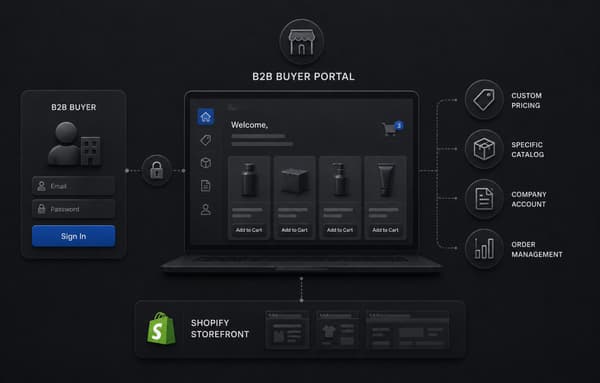
The clearest way to evaluate an agency is to ask what the finished operation actually does, not what technology it uses. A buyer logs in and sees their negotiated price on every item, not a retail price they have to call about. A quote can be built, sent, and converted to an order without leaving the platform. A change to a contract price in the ERP shows up in the storefront without anyone touching Shopify by hand. Reordering takes one click instead of a phone call.
Uncap Connect is built around that last piece specifically, real-time, two-way sync between Shopify and the ERP, so pricing and inventory stay accurate without a manual update process. Uncap has been a Shopify Platinum Partner since 2013, with 380+ storefronts launched on Shopify, including for manufacturers, distributors, and wholesalers, and the work speaks to the pattern more than any pitch can.
The Agency Question Is Really a Scope Question
Most of what separates a good B2B ecommerce agency from a risky one is not personality or pitch quality. It is whether they have actually built the specific things your operation needs: account hierarchies, tiered pricing synced from a real system of record, a catalog that holds up at your SKU count. Ask for that proof before the contract, not after the first missed deadline. What that looks like on Shopify specifically is worth a closer read once you know what questions to ask.
Talk to Our Experts to walk through what a fixed-scope, ERP-connected B2B build looks like for your specific catalog and account structure.
Frequently asked questions
How much does a B2B ecommerce agency typically cost?
It depends heavily on catalog size, account complexity, and integration scope, far more than on the agency's day rate. A straightforward B2B storefront with a handful of account tiers costs far less than a build with a large SKU catalog, multiple ERP integrations, and EDI or punchout requirements. A fixed-scope quote tied to your specific requirements is a more useful number than any general price range.
How long does a B2B ecommerce build usually take?
Most mid-market B2B builds run several months from kickoff to launch, depending on catalog size, data cleanliness, and how many back-office systems need to connect. Timelines commonly extend when product data needs cleanup before migration or when an ERP integration surfaces requirements that were not scoped up front.
Do I need a B2B-specific agency, or can any Shopify agency handle this?
Shopify's B2B tools are available to any agency building on the platform, but knowing the tools exist is different from having built company account hierarchies, synced ERP pricing, and structured large catalogs before. An agency without that specific experience will likely solve those problems for the first time on your project.
What should I ask a reference customer, beyond whether they were happy?
Ask what surprised them during the build, what the agency's response was when something did not go to plan, and whether the post-launch relationship matched what was promised during the sales process. Satisfaction alone does not tell you how the agency handles complexity or setbacks.
Is a lower quote ever the right choice for a B2B build?
Sometimes, if the scope genuinely matches a simpler operation. But a quote significantly below others for the same stated scope is worth questioning directly: ask what is included and what is not, particularly around ERP integration, data migration, and post-launch support, before assuming it is simply a better deal.