

If you search this question, you get two kinds of answers: the agency blog post that says yes, full stop, buy Shopify Plus today, and the competing software vendor that says no, Shopify was built for DTC, use their tool instead. Neither gives you what you actually need.
The honest answer to whether Shopify is good for B2B is a conditional yes. It depends on what your wholesale operation actually looks like, where your order complexity lives, and which gaps you are prepared to close with additional tooling. Here is what that conditional looks like in practice.
Does Shopify Work for B2B?
Yes. As of April 2026, Shopify supports native B2B on all paid plans, including company accounts, customer-specific pricing catalogs, net payment terms, purchase order numbers, self-serve ordering, and Shopify Flow automations. Every one of these features is now available without a Shopify Plus subscription. Shopify confirmed the expansion on April 2, 2026. For a manufacturer or distributor launching a formal wholesale channel, the platform gives you real infrastructure to work with across every plan tier. Operators asking this are often mid-move off Magento, bringing years of custom pricing rules onto a platform built to handle them natively.
The meaningful caveat is that foundational functionality and complete wholesale commerce are not the same thing. Whether Shopify covers your operation depends on where your complexity lives.
What Shopify B2B Does Well
Shopify has been building its native B2B toolkit since 2022, and the April 2026 expansion to all paid plans made its core capabilities accessible to a much broader range of wholesale operators. Here is where the platform genuinely delivers.
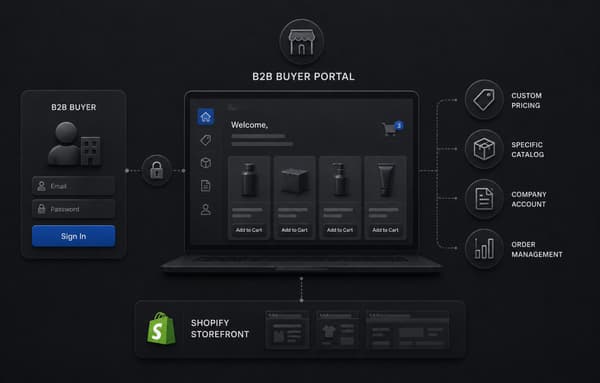
Company accounts and buyer management. Shopify lets you create company profiles, assign contact roles, and manage multiple locations under a single company record. A distributor with regional buying offices can assign each location its own price list and permissions within one account. Buyers get a company-specific login rather than a generic storefront.
Customer-specific pricing catalogs. You can build and assign price lists to individual companies or locations. On Basic, Grow, and Advanced plans, you get up to three active pricing catalogs, enough for a manufacturer with distributor, dealer, and direct pricing tiers. For operations that need more, Shopify Plus removes the cap.
Net payment terms built into checkout. Net 30, Net 60, and Net 90 are supported natively. Buyers place orders and pay on terms, with enforcement at checkout. This used to require a third-party app or manual invoicing outside the platform. It does not anymore.
Purchase order numbers at checkout. Buyers can submit a PO number with every order, and it comes through with the order record in your Shopify admin. Standard requirement for virtually every wholesale relationship.
Self-serve ordering for repeat buyers. Buyers log in, see their assigned prices, and place orders without a rep in the loop. For commodity SKUs and routine reorders, this removes friction on both sides of the transaction.
Unified B2B and DTC from one storefront. One Shopify admin, one inventory pool, one product catalog, shared across wholesale and retail channels. Product updates, inventory changes, and fulfillment workflows run from the same place. For a brand managing both channels, this simplifies operations in ways a separate wholesale system cannot.
Shopify Flow for wholesale automations. You can automate workflows triggered by B2B order events: flag large orders for review, auto-tag company accounts by segment, notify your operations team when net-terms orders exceed a threshold. All of it through Flow's no-code builder without developer involvement.
According to Shopify's official B2B documentation, all of these features are included on every paid plan. For a detailed breakdown of which capabilities each plan tier unlocks, and where Plus still has the edge, the Shopify B2B on all plans article covers the full comparison.
Where Shopify B2B Falls Short
The platform covers the foundational layer. For operations with genuine order complexity, several consistent gaps remain that native features do not resolve.
The three-catalog ceiling on non-Plus plans. Basic, Grow, and Advanced plans support up to three active pricing catalogs. A distributor managing pricing for national accounts, regional dealers, direct buyers, and key accounts across eight or more tiers hits that ceiling immediately. Shopify Plus removes the limit, but the price point that comes with Plus is not the right fit for every stage of growth.
No native quoting or request-for-quote workflow. Shopify B2B has no built-in quote management. If your buyers submit pricing requests before placing orders, if your reps build and send proposals, or if pricing is negotiated before a sale confirms, that workflow does not live inside Shopify's native toolset. You need a quoting layer on top, which typically means a third-party app or a custom build.
ERP integration is not native. Shopify does not sync with NetSuite, SAP, Microsoft Dynamics, or most enterprise resource planning systems. For wholesale operations where customer account data, pricing tiers, credit limits, and inventory levels live in a back-office ERP, that information needs to flow into Shopify through a connector. When the sync is absent or unreliable, prices go stale, orders fail to create records downstream, and your operations team manually corrects what automation should have handled.
Multi-step order approvals are not built in. If your B2B buyers operate under internal purchasing policies where a manager approves an order before it confirms, Shopify does not have a native approval layer for this. App-based solutions attempt to cover it, but none do so completely within the standard Shopify checkout flow.
Custom checkout logic requires Plus and developer resources. Shopify Functions, the mechanism for writing custom checkout rules, is a Shopify Plus capability. For operations that need to enforce buyer-specific order minimums, validate credit limits at checkout, or add custom fields for downstream fulfillment, both Plus and the developer capacity to implement it are required.
A dedicated B2B storefront requires Plus. On non-Plus plans, B2B and DTC buyers share the same storefront and URL. Shopify Plus allows a separate B2B storefront with its own domain, navigation, and checkout experience. For wholesale operations where keeping the two audiences entirely separate matters, that distinction is real.
Is Shopify B2B Worth It?
The short answer is yes for most wholesale operations in the $2M to $20M revenue range. The native feature set covers enough to run a real buyer program without building a custom portal or managing a parallel wholesale system.
The longer answer requires segment-specific honesty.
For manufacturers launching a wholesale channel, Shopify B2B is a practical starting point. Company accounts, a pricing catalog, and net payment terms bring a manual-order operation onto a digital channel without a Plus contract or custom development. For an operation with two or three pricing tiers, the non-Plus feature set handles the core workflow.
For DTC brands adding a dealer or distributor program, the infrastructure is already there if you are already on Shopify. Adding company accounts and a price catalog extends what you have rather than building a separate system. The unified admin makes the addition lighter operationally than a standalone wholesale tool.
For distributors with manageable buyer complexity, Shopify B2B handles it cleanly. If you work with fewer than twenty buyer accounts across two or three pricing tiers and your orders do not require custom checkout logic, the platform is well-suited to the workflow.
For operations that qualify for Shopify Plus economics, the additional capabilities close many of the gaps the lower plans cannot. Unlimited catalogs, a dedicated storefront, and Shopify Functions for custom checkout logic make Shopify a substantially more complete wholesale commerce platform at that level.
Uncap has delivered more than 380 B2B implementations for manufacturers, distributors, and wholesalers on Shopify since 2013. The operations that run best are the ones that match their plan selection to their actual complexity, not the ones that over-build on a plan they do not need, and not the ones that under-plan and hit gaps after launch.
Who Should Use Shopify for B2B?
The right candidate for Shopify B2B is not one size. Here is how it maps to different operator profiles.
Manufacturers launching their first wholesale channel. If you currently take wholesale orders by email, phone, or spreadsheet, Shopify gives you a buyer login, a price catalog, and net payment terms without custom development. The barrier to getting a buyer program online is now lower than it has ever been.
Brands running DTC and wholesale from the same product line. The unified admin is a real operational advantage here. Managing two channels from one system (same inventory, same product data, same order queue) reduces the overhead that comes with running separate platforms.
Wholesalers with a straightforward pricing structure. If your buyer program involves two or three tiers and your checkout needs are standard, the native B2B layer covers the full workflow cleanly. Net terms, PO numbers, company logins, and self-serve reordering are all there without apps.
Growing businesses where Plus economics make sense. If your revenue and order volume put Plus within reach, the additional capabilities (unlimited catalogs, dedicated storefront, custom checkout logic through Shopify Functions) close the gaps that matter for larger or more complex wholesale operations.
When Shopify B2B Is Not Enough on Its Own
Shopify provides the commerce layer. For operations with specific requirements above that layer, the platform needs to be paired with the right tooling to be operationally complete.
Quoting and RFQ workflows. If your sales cycle starts with a pricing request and ends with an approved quote before any order is placed, you need a quoting workflow that Shopify does not provide natively. For how these workflows operate in practice across Shopify wholesale operations, the Shopify B2B guide for wholesale suppliers covers the common patterns and where operators build above the platform.
ERP integration. If your pricing, inventory, and customer data live in NetSuite, SAP, or Microsoft Dynamics, your Shopify storefront depends on reliable sync to stay accurate. For wholesale businesses, this is not an optional add-on, it is the piece that makes the storefront operationally reliable. Uncap Connect is built specifically for this: a native Shopify integration with the major ERP systems, handling order creation, pricing sync, and customer account data without a separate middleware layer.
Multi-step procurement approvals. If your buyers operate under internal purchasing policies that require manager sign-off before an order confirms, Shopify does not have a native multi-step approval workflow. This is a real gap for wholesale operations with institutional buyers where purchasing compliance matters.
Operations with more than three pricing tiers on non-Plus. The catalog ceiling has no workaround on Basic, Grow, or Advanced plans. If your buyer program requires more than three distinct price lists and Plus is not in the budget, this is the deciding constraint.
The Shopify B2B Limitations Most Articles Skip
Virtually every "is Shopify good for B2B" article in the SERP is written by either an agency that sells Shopify implementations or a software vendor that sells an alternative. The first category oversells. The second category undersells. Neither has a reason to give you an honest operational read.
The actual picture: Shopify's native B2B layer is the best it has ever been, and the April 2026 all-plans expansion made it accessible to far more operators. The storefront, the buyer management, the pricing catalogs, the net payment terms, all of it is genuinely capable for a wholesale operation that fits within the platform's design.
The gaps that remain, ERP integration, quoting workflows, multi-step approvals, custom checkout logic, are not small. They are the parts of wholesale commerce where operational complexity actually lives. A manufacturer with a few dozen accounts and two pricing tiers may never encounter them. A distributor with 200 active accounts, real-time ERP pricing dependencies, and a rep-driven sales motion will run into all of them. In hospitality and food service supply, that shows up as standing orders and par-level reordering the native layer cannot fully carry on its own.
The question worth asking is not whether Shopify is good for B2B. It is whether Shopify is good for your B2B operation specifically, and what the complete setup looks like for your buyers and your back office. For the build-side answer to Is Shopify good for B2B?, our wholesale solution page lays out what a production-grade wholesale channel on Shopify actually includes.
If you want an honest read on that, what plan you actually need, what integrations matter, and what to build first, talk to our experts about your wholesale operation.
Frequently asked questions
Is Shopify good for B2B?
Conditionally yes. Shopify handles company accounts, negotiated pricing, net terms, and self-serve wholesale ordering natively. Whether it fits depends on where your order complexity lives and which gaps you close with integrations.
What does Shopify B2B do well?
The buyer-facing storefront: company accounts with locations and roles, customer-specific catalogs, payment terms at checkout, and a self-serve reordering experience that replaces email-and-phone ordering.
Where does Shopify B2B fall short?
Deep back-office needs: complex contract pricing beyond catalog limits, quoting, EDI, and real-time ERP data. These are solvable, but through an integration layer, not native settings.
Who should not run B2B on Shopify alone?
Operations whose pricing, availability, and credit logic must come live from an ERP at order time. They can still run Shopify, but only with a real-time integration doing the heavy lifting behind the storefront.