

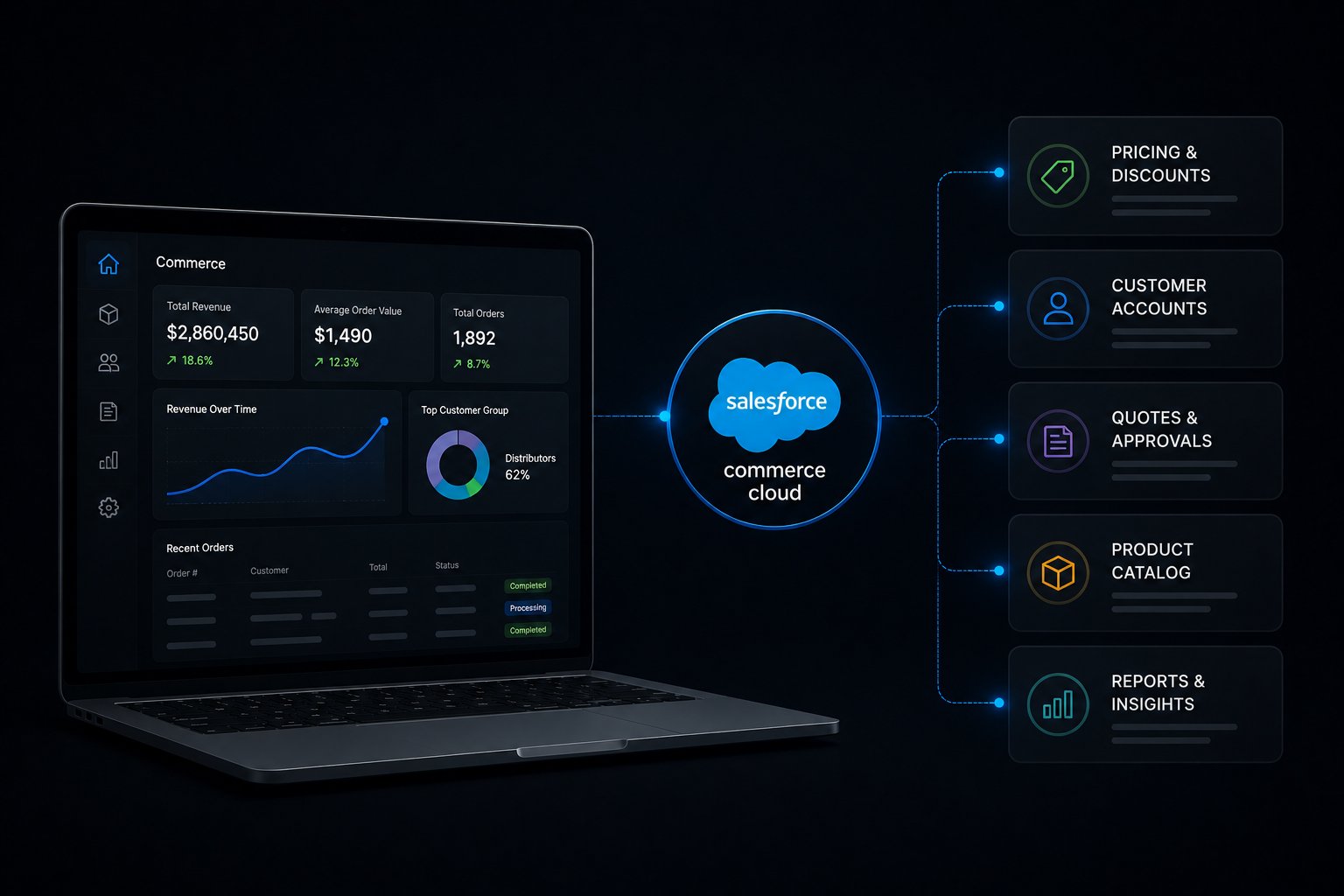
Salesforce Commerce Cloud pricing for B2B brands is GMV-based, not subscription-based. The B2B Growth edition charges 1% of gross merchandise value annually. The B2B Advanced edition charges 2% of GMV annually. Neither rate is negotiable as a published standard: both require direct sales engagement, and your actual rate depends on contract term, total Salesforce product commitment, and volume. That is the starting point, not the ending point.
For a B2B manufacturer or distributor processing $10 million in annual digital orders, 1% means $100,000 in Commerce Cloud license fees before Premier Support, before implementation, before SI partner retainers, and before any add-ons. At $25 million GMV, you are at $250,000 in license fees per year for the Growth edition. If you upgrade to Advanced for full order management, that doubles to $500,000. The brands most exposed to this math tend to sit in electrical and electronics distribution, where deep component catalogs push digital GMV higher as they grow.
This guide breaks down every cost layer of Salesforce Commerce Cloud B2B pricing, explains what each edition actually includes, and shows the math B2B brands need to make a realistic total cost of ownership comparison before signing or renewing a multi-year contract.
Salesforce B2B Commerce Cloud Pricing at a Glance
B2B Commerce Growth
Pricing: 1% of GMV (confirmed)
Storefronts: 6 storefronts
Order Management: Order Management Lite
Analytics: Analytics, Automation, Segmentation
Data Cloud Credits: 250K credits
Agentforce: Merchant Agent
B2B Commerce Advanced
Pricing: 2% of GMV (confirmed)
Storefronts: 10 storefronts
Order Management: Full Order Management
Analytics: Advanced Analytics, Automation, Segmentation, Personalization
Data Cloud Credits: 500K credits
Agentforce: Merchant Agent
Source: Salesforce's official B2B Commerce pricing page confirms the GMV percentages and feature entitlements listed above. Exact dollar amounts require a direct sales quote.
How the GMV Pricing Model Works for B2B
Gross Merchandise Value is defined by Salesforce as total revenue processed through your Commerce Cloud storefront, minus tax and shipping. The platform charge applies to the revenue that runs through the Commerce Cloud storefront only. Orders taken through other channels, such as a call center, an EDI integration, or a third-party marketplace, are not included in the GMV calculation for Commerce Cloud purposes, but they are also not managed by Commerce Cloud unless you purchase Salesforce Order Management as a standalone product.
This distinction matters for manufacturers and distributors who split order volume between digital and traditional channels. If 40% of your orders come through EDI or sales rep entry and 60% through the Commerce Cloud portal, only that 60% applies to the GMV charge. But managing the other 40% through Salesforce's ecosystem requires additional licensing.
The model has two characteristics that B2B brands should model explicitly before signing:
Cost scales with revenue. A strong quarter increases your Salesforce bill proportionally. At 1% GMV, every $1 million in additional digital revenue adds $10,000 to your annual platform cost. This is predictable but not capped.
All B2B Commerce licenses require annual contracts. There is no monthly billing option. If your digital channel underperforms relative to projections, you cannot scale down mid-term without renegotiating.
What Each B2B Edition Includes
Commerce Cloud B2B Growth (1% of GMV)
Growth is the entry-level B2B edition. It includes six storefronts, which covers most mid-market manufacturers running separate portals for dealer, wholesale, and direct B2B accounts.
The Order Management included is "Order Management Lite," which Salesforce describes as limited unmanaged orders per license. This covers order lifecycle management for orders placed through the Commerce Cloud storefront. Orders from outside the storefront, such as orders entered by sales reps, phone orders, or EDI orders, are not covered in Growth and require standalone Salesforce Order Management.
Additional inclusions: 20 inventory locations, 250,000 Data Cloud credits (for analytics segmentation), Merchant Agent (Agentforce for merchants), CRM Analytics for 3 users, and Knowledge Management for 3 users.
For a manufacturer operating two or three dealer portals with the majority of orders placed self-service through the storefront, Growth typically covers the core workflow. The 6-storefront limit becomes a constraint only for multi-brand or multi-region operations with distinct buyer portals per business unit.
Commerce Cloud B2B Advanced (2% of GMV)
Advanced doubles the GMV rate and adds the capabilities Growth limits. The primary additions for B2B brands:
Full Order Management for all orders placed through the Commerce Cloud storefront (non-storefront orders still require standalone OM). Ten storefronts versus six. Advanced Analytics, Automation, Segmentation, and Personalization. 500,000 Data Cloud credits versus 250,000. CRM Analytics for 5 users versus 3.
Advanced is the correct edition for manufacturers with high transaction volumes, complex order approval requirements, or personalization needs by buyer tier. It is also required for merchants who have Salesforce Order Management already in their stack and want full integration with their Commerce Cloud channel.
The critical cost reality: if your B2B GMV is $15 million, the jump from Growth ($150,000/year) to Advanced ($300,000/year) is $150,000 in additional annual license fees. The Advanced features must deliver that incremental value to justify the upgrade.
The Full Cost of Salesforce B2B Commerce: Every Layer
The GMV percentage is one layer. A complete budget for Salesforce Commerce Cloud B2B includes five additional cost lines that most procurement teams underestimate in initial planning.
1. Premier Success Plan: 30% of Net License Fees
Salesforce offers three Success Plan tiers. Standard is included with all licenses and provides self-guided resources (documentation, Trailhead, community). It does not include direct technical support.
Premier is priced at 30% of net license fees and includes expert guidance, health checks, product education, and 24/7 support access for business-critical issues. For a manufacturer using Commerce Cloud B2B Growth at $100,000 per year, Premier adds $30,000 annually.
Signature is the top tier, includes a designated Technical Account Manager and the fastest support response times, and is priced by custom quote.
Most enterprise B2B implementations operate on at least Premier during the first two years when the team is still building platform competency. That 30% add-on is frequently absent from initial budget estimates. At $200,000 in annual license fees, it is a $60,000 budget line.
2. Implementation: $200,000 to $560,000+
Salesforce Commerce Cloud requires certified SI (System Integrator) partners for implementation. Implementation agencies estimate the typical range at $200,000 to $560,000 for initial deployment, with complex multi-brand or multi-region implementations exceeding $1 million. This is a one-time cost, typically paid to your SI partner rather than Salesforce directly.
The breakdown for a standard mid-market B2B implementation:
Discovery and Design
Estimated Cost: $15,000-$40,000
Timeline: 4-6 weeks
Core Development
Estimated Cost: $100,000-$300,000
Timeline: 8-16 weeks
Data Migration
Estimated Cost: $20,000-$50,000
Timeline: 2-4 weeks
ERP and CRM Integration
Estimated Cost: $30,000-$100,000
Timeline: 4-8 weeks
QA and Testing
Estimated Cost: $15,000-$40,000
Timeline: 2-4 weeks
Training
Estimated Cost: $15,000-$30,000
Timeline: 2-3 weeks
Total
Estimated Cost: $195,000-$560,000
Timeline: 4-6 months
Implementation timelines of four to six months also represent parallel operating cost: you are running your existing system and the new Commerce Cloud build simultaneously during this window.
3. Ongoing SI/Agency Retainer: $24,000 to $600,000 Per Year
Salesforce Commerce Cloud B2B is not a platform that a general web developer can operate. Certified SFCC developers are a specialized talent pool, and most B2B brands maintain either an SI partner retainer or an internal SFCC-certified engineer on staff.
Third-party implementation agency estimates place monthly retainers at $2,000 to $50,000 depending on the complexity of ongoing work. For a mid-market manufacturer making regular updates to pricing rules, account tier configurations, and catalog logic, a $4,000 to $10,000 monthly retainer is typical. That is $48,000 to $120,000 per year in ongoing development cost beyond the platform license.
4. Agentforce Add-Ons: $125 to $550+ Per User Per Month
Salesforce's Merchant Agent capability (part of Agentforce) is included in both B2B editions. However, in June 2025, Salesforce announced Agentforce add-on pricing starting at $125 per user per month for additional AI capabilities, and Agentforce 1 Editions starting at $550 per user per month.
For B2B brands that want AI-assisted quote generation, intelligent reorder recommendations, or automated account management workflows beyond the bundled Merchant Agent, these add-ons represent an additional layer that was not part of the original Commerce Cloud pricing model.
5. Standalone Order Management for Non-Storefront Orders
For orders taken outside the Commerce Cloud storefront, Salesforce's official FAQ is explicit: "For orders processed through channels outside of your Commerce Cloud storefront but are leveraging Salesforce Order Management capabilities, there is a separate charge beyond the complementary limits provided with each Edition."
Salesforce Order Management is priced separately, with industry estimates placing it at 0.25% to 1% of GMV for orders processed through it. For B2B manufacturers where a significant order volume still flows through EDI, phone, or sales rep entry, this is a direct line item that can add meaningfully to the total platform cost.
Salesforce B2B Commerce Total Cost of Ownership by GMV Level
The table below models total annual cost at four GMV levels, using confirmed rates (GMV percentage, Premier Support at 30%) and third-party estimates for implementation (annualized over 3 years) and agency retainer. These are not official Salesforce figures; they represent the cost range enterprise buyers should budget for planning purposes.
$5M Annual B2B GMV
License (Growth, 1% GMV): $50,000
Premier Support (30% of License): $15,000
Implementation (Annualized over 3 Years): $22,000-$62,000
Agency Retainer (Mid Estimate): $48,000
Estimated Annual TCO: $135,000-$175,000
$10M Annual B2B GMV
License (Growth, 1% GMV): $100,000
Premier Support (30% of License): $30,000
Implementation (Annualized over 3 Years): $22,000-$62,000
Agency Retainer (Mid Estimate): $72,000
Estimated Annual TCO: $224,000-$264,000
$25M Annual B2B GMV
License (Growth, 1% GMV): $250,000
Premier Support (30% of License): $75,000
Implementation (Annualized over 3 Years): $22,000-$62,000
Agency Retainer (Mid Estimate): $120,000
Estimated Annual TCO: $467,000-$507,000
$50M Annual B2B GMV
License (Growth, 1% GMV): $500,000
Premier Support (30% of License): $150,000
Implementation (Annualized over 3 Years): $22,000-$62,000
Agency Retainer (Mid Estimate): $180,000
Estimated Annual TCO: $852,000-$892,000
Year 1 costs are higher than the above because the full implementation cost falls in year one. At $10M GMV, year 1 total cost ranges from approximately $420,000 to $660,000 when implementation is included upfront.
What the GMV Model Means Specifically for B2B Brands
B2B order economics differ from B2C in a way that makes GMV-based pricing particularly significant for manufacturers and distributors.
A B2C brand might process 50,000 orders at an average order value of $200, generating $10M GMV from a high volume of small transactions. A B2B manufacturer might process 2,000 orders at an average order value of $5,000, generating the same $10M GMV from a fraction of the transaction count. Both pay the same 1% platform fee, but the B2B brand's operational complexity is often higher (account hierarchies, price lists, approval workflows, ERP sync) while the order volume generating the fee is far lower. That back-office complexity does not disappear in a replatform either; a connection to a system like Oracle has to be rebuilt on the new platform regardless of which one you choose.
This asymmetry means the cost-per-order math is worse for B2B than for B2C at the same GMV level. A B2B brand processing $10M in 2,000 orders pays $100,000 in Commerce Cloud fees, or $50 per order in platform cost. That is before support, implementation, and retainer.
B2B brands with large average order values but modest order counts are paying a premium that the platform's pricing model does not adjust for.
Salesforce Commerce Cloud B2B vs Shopify Plus B2B: Cost Comparison
Shopify Plus B2B introduced native company accounts, customer-specific price lists, net payment terms, and buyer role management in 2023. Shopify Plus{:target="_blank"} is priced at a fixed $2,300 to $2,500 per month ($27,600 to $30,000 per year), regardless of GMV. There are no GMV penalties, no transaction fees on top of payment processing, and no Premier Support surcharge at 30% of license.
License at $10M GMV
Salesforce B2B Commerce Growth: $100,000/year
Shopify Plus B2B: $30,000/year (fixed)
License at $25M GMV
Salesforce B2B Commerce Growth: $250,000/year
Shopify Plus B2B: $30,000/year (fixed)
License at $50M GMV
Salesforce B2B Commerce Growth: $500,000/year
Shopify Plus B2B: $30,000/year (fixed)
Support Cost
Salesforce B2B Commerce Growth: Premier: +30% of license
Shopify Plus B2B: Included
Implementation Range
Salesforce B2B Commerce Growth: $200K-$560K
Shopify Plus B2B: $50K-$200K (simpler stack)
Developer Talent Pool
Salesforce B2B Commerce Growth: Smaller, SFCC-certified required
Shopify Plus B2B: Large, widely available
Monthly Dev Retainer
Salesforce B2B Commerce Growth: $2K-$50K
Shopify Plus B2B: $1K-$15K
GMV Cost Growth as Revenue Scales
Salesforce B2B Commerce Growth: Yes, proportional
Shopify Plus B2B: No, fixed regardless of GMV
Native B2B Features (Company Accounts, Price Lists, Net Terms)
Salesforce B2B Commerce Growth: Yes, via B2B Edition
Shopify Plus B2B: Yes, native as of 2023
Checkout Customization
Salesforce B2B Commerce Growth: Custom development required
Shopify Plus B2B: Shopify Functions (native)
The license cost gap at $25M GMV is $220,000 per year. At $50M GMV, the gap is $470,000 per year. Over a three-year contract, $25M GMV brands save approximately $660,000 in license fees alone on Shopify Plus versus Salesforce B2B Commerce Growth.
For B2B brands already deeply embedded in the Salesforce ecosystem (Sales Cloud, Service Cloud, Marketing Cloud) and deriving genuine value from unified CRM-commerce data, this gap may be justified by reduced middleware cost, better pipeline-to-order visibility, and unified platform governance. For B2B manufacturers or distributors without that ecosystem dependency, it requires a harder justification.
The Shopify B2B platform feature documentation covers what native B2B capabilities are included at each Shopify Plus tier, including the company account hierarchy, price list configuration, and net payment term setup that would otherwise require Salesforce's B2B Edition add-on.
When Salesforce Commerce Cloud B2B Pricing Makes Sense
Salesforce Commerce Cloud B2B tends to justify its cost in specific operating conditions:
Deep Salesforce ecosystem dependency. If your organization runs Sales Cloud, Service Cloud, and Marketing Cloud, Commerce Cloud connects buyer behavior, account history, and service data in one unified CRM model. The middleware cost you avoid by keeping everything within Salesforce can offset the platform premium, particularly for sales-led organizations where rep visibility into digital ordering is operationally valuable.
Very high average order values with strong gross margins. At 1% GMV with high margins per order, the platform cost is a small fraction of gross profit. A $50M B2B brand with 40% margins pays $500,000 in Commerce Cloud license fees against $20M in gross profit: approximately 2.5% of gross margin. For a low-margin distributor, the math is different.
Multi-brand or multi-region enterprise operations. With 6 to 10 storefront entitlements and native Data Cloud segmentation, Salesforce B2B Commerce handles complex multi-brand architectures where centralizing buyer data and account management at the enterprise level has strategic value.
Regulated industries requiring native Salesforce compliance infrastructure. Organizations with medical, financial, or government sector requirements that are already served by Salesforce's compliance certifications may find the ecosystem lock-in rational for governance and audit reasons.
When to Evaluate the Alternative
Salesforce B2B Commerce Cloud is expensive at scale and complex to operate. Evaluating alternatives is rational when:
Your GMV is growing faster than the platform delivers new value. At $20M-$25M B2B GMV, annual license costs of $200,000-$500,000 represent a material cost that warrants platform benchmarking against fixed-fee alternatives, especially if your team is not using the full Salesforce ecosystem.
Storefront updates require a developer ticket. If routine changes to pricing rules, catalog visibility, or account tier assignments require agency involvement and a two-week turnaround, the platform is creating operational friction rather than enabling it.
Your implementation partner pool is too small or too expensive. SFCC-certified developers represent a narrow talent pool with accordingly higher hourly rates. If your SI partner dependency is becoming a bottleneck or a disproportionate share of your total commerce budget, that is a structural cost issue, not a temporary project cost.
You are buying Salesforce licenses you do not need. Some B2B brands are on Commerce Cloud primarily because they started their Salesforce journey with Sales Cloud and grew into it, not because Commerce Cloud was the right fit for their use case independently.
For B2B manufacturers and distributors ready to evaluate replatforming, the enterprise ecommerce replatforming checklist outlines what to assess before committing to any platform decision, and the Salesforce Commerce migration framework covers what a move from Salesforce Commerce Cloud to Shopify Plus actually involves at the architecture, data, and integration level.
How to Negotiate Your Salesforce Commerce Cloud Contract
Salesforce Commerce Cloud pricing is not fixed. Buyers who approach the contract process strategically consistently reach better terms than those who accept the first proposal.
Negotiate rate, not just features. The GMV percentage is negotiable. Multi-year commitments (three years rather than one) and larger total Salesforce product commitments both create discount levers. Firms advising on Salesforce procurement report that 20% to 40% reductions from list pricing are achievable for significant volume and term commitments.
Time to fiscal quarter-end. Salesforce's fiscal year ends January 31. Sales reps have the most flexibility to discount in the final weeks of each fiscal quarter. Initiating negotiations in October or November for a January close is the highest-leverage window.
Request ramp-up pricing. Do not commit to your projected future GMV volume from day one. Negotiate a ramp structure that aligns with actual expected growth during the first contract year.
Lock in annual escalation caps. Salesforce's standard contract terms may include annual price increases. The 2023 announcement included a 9% average increase on certain editions; the 2025 announcement included a 6% average increase on Sales Cloud, Service Cloud, and select Industries Clouds. Negotiate a cap of 3% or less on annual price escalation for Commerce Cloud before signing.
Negotiate Premier Support rate separately. The 30% of net license fees figure is a published rate, not a fixed requirement. Some buyers negotiate this to 20% to 25% by bundling it into a larger total contract negotiation. If your support needs are predictable and limited, document your actual usage pattern as leverage.
Get non-storefront order scope in writing. Document exactly which channels are covered by your Commerce Cloud license and which require standalone Order Management. Surprises here add cost mid-contract.
This analysis of Salesforce Commerce Cloud pricing: what B2B brands pay is one piece of a larger replatforming decision, and our migration guides walk through what moving off each major enterprise platform involves.
Book a Strategy Session
Uncap has delivered 380+ B2B commerce implementations as a Shopify Platinum Partner since 2013. If your B2B brand is evaluating Salesforce Commerce Cloud pricing against alternatives, or preparing to migrate from Salesforce Commerce Cloud to Shopify Plus, we can assess your current architecture, contract exposure, and ERP integration requirements and provide an honest cost comparison in a single working session.
Frequently asked questions
What is the confirmed pricing for Salesforce B2B Commerce Cloud?
Salesforce's official B2B pricing page confirms the model: B2B Commerce Growth charges 1% of GMV annually, and B2B Commerce Advanced charges 2% of GMV annually. Both editions require annual contracts and custom sales quotes for exact dollar amounts, as rates are subject to negotiation. No fixed dollar pricing is published.
What is included in B2B Commerce Cloud Growth?
B2B Commerce Growth includes 6 storefronts, 20 inventory locations, Order Management Lite (for storefront orders only), Analytics and Segmentation, 250K Data Cloud credits, Merchant Agent (Agentforce), CRM Analytics for 3 users, and Knowledge Management for 3 users. Orders processed outside the Commerce Cloud storefront require standalone Salesforce Order Management.
What does Order Management Lite cover?
Order Management Lite is included in the B2B Growth edition and covers orders placed through your Commerce Cloud storefront. Orders placed through other channels, such as EDI, phone, sales rep entry, or third-party marketplaces, are not covered and require a separate Salesforce Order Management purchase. B2B Advanced includes Full Order Management for all storefront orders, with the same non-storefront exclusion.
How much does the Premier Success Plan cost?
Premier is priced at 30% of net license fees. At $100,000 per year in Commerce Cloud license fees, Premier adds $30,000 annually. Standard (free) includes self-guided resources only. Signature is custom-priced and includes a designated Technical Account Manager and the fastest support response times.
What are typical implementation costs for Salesforce B2B Commerce?
Third-party implementation estimates place the standard range at $200,000 to $560,000, with complex multi-brand or multi-region deployments exceeding $1 million. Implementation covers discovery, core development, data migration, ERP and CRM integration, QA, and training. Timeline is four to six months. This is a one-time cost separate from ongoing platform fees.
Does Salesforce Commerce Cloud include ERP integration?
ERP integration is not included natively. Connecting Commerce Cloud to NetSuite, SAP, Microsoft Dynamics, or other ERP systems requires either MuleSoft (Salesforce's integration platform, priced separately), a third-party middleware layer, or custom API development by your SI partner. Integration builds are included in implementation cost estimates and may add $30,000 to $100,000 to the initial implementation scope.
How does the August 2025 price increase affect Commerce Cloud?
In June 2025, Salesforce announced a 6% average price increase on Enterprise and Unlimited editions of Sales Cloud, Service Cloud, Field Service, and select Industries Clouds, effective August 1, 2025. This increase applies to those specific products, not directly to Commerce Cloud GMV-based pricing. However, B2B brands using Commerce Cloud alongside Sales Cloud or Service Cloud will see those bundled product costs increase. The announcement also introduced Agentforce add-on pricing at $125 per user per month.
Can you negotiate Salesforce Commerce Cloud pricing?
Yes. Salesforce pricing is almost always negotiable. Third-party advisors report discounts of 20% to 40% below list pricing for multi-year commitments and significant volume. The strongest negotiating windows are at the end of Salesforce fiscal quarters, with the fiscal year ending January 31.
How does Salesforce B2B Commerce pricing compare to Shopify Plus B2B?
Shopify Plus charges a fixed $2,300 to $2,500 per month regardless of GMV. At $10M B2B GMV, Shopify Plus is approximately $70,000 less expensive per year in license fees than Salesforce B2B Growth. At $25M GMV, the gap is $220,000 per year. Shopify Plus B2B includes native company accounts, price lists, and net payment terms. Implementation is typically simpler and less expensive, and the Shopify developer talent pool is substantially larger and less specialized than the SFCC-certified developer pool.
What should a B2B brand ask Salesforce during vendor evaluation?
During procurement, ask: (1) the exact negotiated GMV rate and whether it is locked for the contract term; (2) which storefront channels are covered and what triggers standalone Order Management charges; (3) the annual escalation cap in writing; (4) the exact data included in GMV calculation; (5) the ramp schedule if your digital GMV will grow significantly during year one; and (6) how the Premier Support rate is calculated and whether it is negotiable. Do not accept any of these as standard terms without written confirmation.