

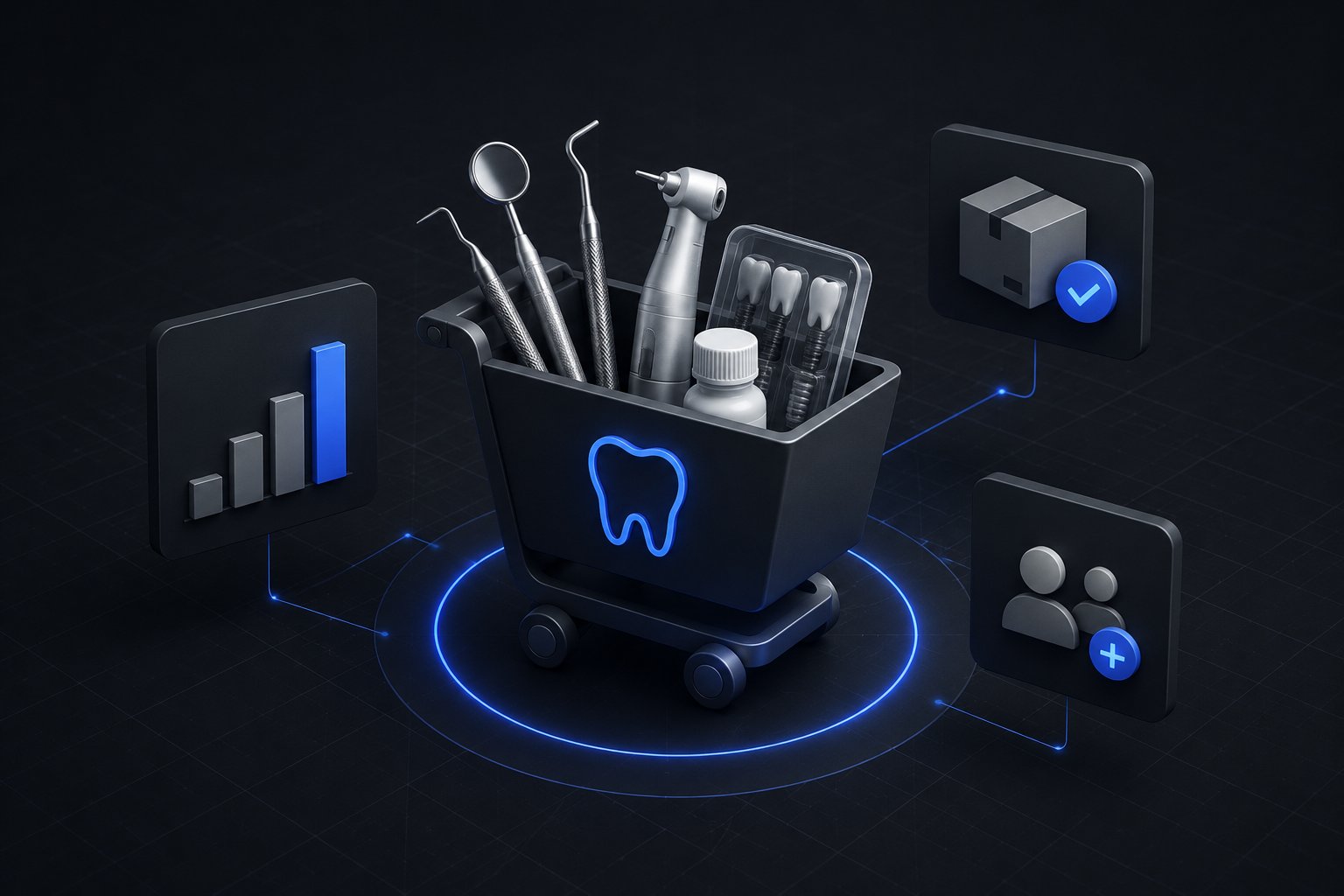
A dental supply distributor's catalog runs from a box of nitrile gloves to a treatment chair that costs as much as a car, and the same practice buys both. That range is the central design problem of dental supply ecommerce: three fundamentally different kinds of products, bought three fundamentally different ways, that still have to live in one storefront, under one account, at one set of negotiated prices.
Quick answer: Structure the catalog around how each segment is actually bought, not around product taxonomy alone. Consumables are replenishment: built for speed, saved lists, and one-tap reorder. Instruments and handpieces are considered purchases: built for spec depth, compatibility clarity, and confident selection. Equipment and chairs are capital purchases: built for configuration and a quote path, not a buy button. One account structure and one ERP sync hold the three together.
Three Catalogs Wearing One Storefront
The mistake is treating the catalog as one long product list with categories. The segments differ on every axis that matters for commerce design.
Consumables, gloves, composites, impression material, burs, sterilization pouches, anesthetic supplies, are bought weekly or monthly, in patterns that barely change, usually by the office manager or an assistant between patients. Price sensitivity is high, decision effort is near zero. The buying question is "the usual, again."
Instruments and handpieces sit in the middle: scalers, forceps, high-speed and low-speed handpieces, and their maintenance. Purchases are less frequent, more deliberate, and loyal to what the clinicians trained on. The buying question is "exactly which one, and does it work with what we have."
Equipment and chairs, treatment chairs, delivery units, imaging, sterilizers, are capital purchases with configuration choices, installation, financing, and a decision cycle measured in weeks. The buying question is "talk me through this."
A storefront tuned for any one of these frustrates the other two. The design job is letting each segment behave like itself.
Consumables: The Replenishment Engine
Consumables are where the account is won, because they are where the ordering happens. The workflow requirements are the same ones that decide wholesale medical supplies ordering: the account's negotiated price visible while browsing, net terms at checkout, and reordering built around the practice's actual buying pattern, saved lists, order history, quantities that match how products ship.
The dental-specific layer is the practice structure. A multi-location group or DSO needs location-level ordering, one practice's operatories do not stock like another's, with shared pricing and terms at the organization level. Uncap Portal is built for exactly that shape: each account, and each location under it, gets its own ordering view, its own lists, its own history, while the organization keeps one commercial relationship with the distributor.
Instruments & Handpieces: Selling Certainty
The middle catalog is a product-data problem more than a workflow problem. A handpiece purchase involves coupling compatibility, speed range, head size, and sterilization requirements, and the buyer needs to get every one of them right against what the practice already owns. The product page has to carry that certainty: full specifications, compatibility stated explicitly rather than implied, and the maintenance context, lubrication, turbine replacement, service options, that a rep would mention across the counter.
This is also where catalog structure earns its keep. Instruments should be findable both by clinical category and by the brand-and-line logic clinicians actually think in, and the relationship between an instrument and its consumable dependencies, the burs a handpiece takes, the pouches an instrument cassette needs, should be navigable in both directions. A distributor that models those relationships once, in the catalog, stops re-explaining them one phone call at a time.
Equipment & Chairs: The Quote Path
Nobody impulse-buys a treatment chair. Equipment carries configuration, upholstery, delivery unit options, left or right orientation, installation and delivery scheduling, and often financing, none of which belongs in a standard checkout. The right storefront treatment is honest about that: present the equipment fully, let the buyer configure and express intent, and route the result into a quote workflow where a rep completes pricing, logistics, and terms, with the approved quote converting to an order without re-entry. Uncap Quotes runs that loop natively, which keeps capital purchases inside the same account and history as everything else the practice buys.
What matters is that the equipment path and the consumables path share an account. The practice that bought its chairs through the quote path and its gloves through the reorder path is one customer with one price file, and should experience the distributor that way.
One Back Office Holding It Together
All three segments read from the same commercial spine: account pricing, stock, terms, and order history, owned by the ERP. Uncap Connect keeps that spine synced both ways in real time, negotiated prices flowing to every segment's price display, orders from every path landing in the ERP under the right account, inventory honest across the catalog, whether the SKU turns over daily or quarterly.
That shared spine is also what makes the segments' differences workable. Consumables can update stock every few minutes while equipment syncs its longer lead times; instruments can carry deep spec data without slowing the reorder path; and the account's tier applies everywhere without being maintained three times.
The rest of the medical-dental distribution picture, license-gated catalogs, tier pricing at the network level, ERP architecture, and where to start, is covered in the medical supply distributor's guide to B2B ecommerce and on the medical and dental industry page.
Uncap has been a Shopify Platinum Partner since 2013, with 380+ storefronts launched on Shopify, including for distributors, manufacturers, and wholesalers, including operators in medical and dental supply. Book a Demo to walk through your catalog's three segments and what each path looks like against your ERP.
Frequently asked questions
How should a dental supply distributor structure an online catalog?
Around buying behavior, not just taxonomy: consumables built for fast replenishment with saved lists and reorder, instruments built for specification depth and compatibility clarity, and equipment built for configuration with a quote path. All three share one account structure, one price file, and one ERP sync.
Do dental practices actually reorder supplies online?
Yes, when the reorder path is faster than calling: their negotiated price visible while browsing, saved lists per location, net terms at checkout, and history that makes "the usual, again" a one-minute task. Practices revert to the phone when any of those is missing.
How do multi-location dental groups and DSOs order differently?
Each location orders against its own lists, ship-to, and history, while pricing, terms, and the commercial relationship live at the organization level. The account structure has to support both layers at once, location independence inside organizational consistency.
Should dental equipment be purchasable directly online?
Usually not through a standard checkout. Chairs and capital equipment carry configuration, installation, and financing decisions, so the storefront's job is configuration and intent capture, with a quote workflow completing pricing and logistics and converting to an order on approval.