

Selling aftermarket auto parts online is not like selling anything else online. The product only exists in relation to a vehicle: a brake pad is not a product, it is a product for a 2019 Ford F-150 with a specific package. Get that relationship right and buyers trust the store enough to stop calling. Get it wrong once, ship one part that does not fit, and they go back to the phone, the counter, or a competitor whose site already knows their truck.
Quick answer: Aftermarket auto parts ecommerce runs on three things working together: fitment data (ACES/PIES) that tells the store which parts fit which vehicles, a Year-Make-Model search experience built on that data, and operational plumbing, inventory, pricing, and B2B accounts, that keeps what the storefront promises aligned with what the warehouse can ship. This guide covers each layer and links to the deeper build guides for every piece.
The Market Has Already Moved
The numbers are not subtle. Grand View Research values the global ecommerce automotive aftermarket at $62.1 billion in 2023, an estimated $90.6 billion in 2026, and a projected $208.2 billion by 2030, an 18.9% annual growth rate. North America is the largest region at a 28.9% revenue share, helped along by a U.S. vehicle fleet whose average age now exceeds 12 years. Older vehicles need more parts, and the people fixing them, DIY owners and professional shops alike, increasingly buy those parts online.
One detail in that research matters most for anyone reading this as a seller: business-to-consumer is the larger segment today, but business-to-business, repair shops, jobbers, and fleet buyers purchasing through digital channels, is projected to grow significantly. The sellers building for both audiences now are positioning for where the volume is going, not where it has been.
Fitment Is the Whole Game
Every hard decision in aftermarket ecommerce traces back to one question: how does the store know what fits?
The answer is structured fitment data. The industry standards are ACES (vehicle applications: which part fits which year, make, model, submodel, and engine) and PIES (product attributes: specs, descriptions, images, pricing fields). If your catalog does not carry this data, or carries it inconsistently across brands and suppliers, no storefront feature can compensate. ACES and PIES explained in full is the right starting point if these standards are new to you.
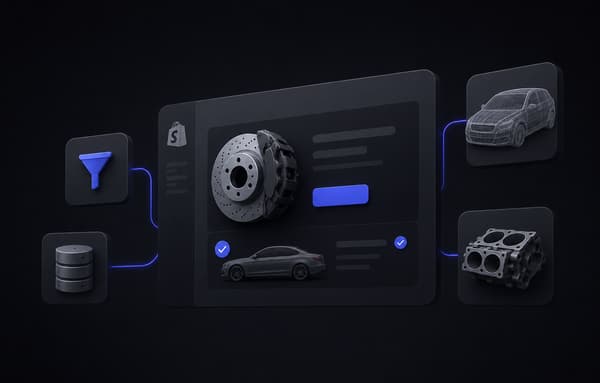
On top of that data sits the buyer-facing experience: Year-Make-Model search. The buyer picks their vehicle, and the catalog filters to only what fits. Done well, YMM search is the difference between a store that answers "does this fit my truck" and one that makes the buyer guess. The five YMM fitment apps worth comparing on Shopify covers the tooling options, including what changes when B2B account pricing has to carry through the filter.
And fitment is not just a sales feature. It is a returns policy. Wrong-part orders are among the largest avoidable costs in this category, and most of them trace back to missing or stale fitment data rather than buyer error. The fitment data return problem breaks down where those returns actually come from and what fixing the data layer does to the rate.
B2C, B2B, or Both
Most aftermarket brands and distributors do not get to choose one audience. A performance parts manufacturer sells direct to enthusiasts and wholesale to dealer networks. A distributor serves walk-in retail and delivers to repair shops on account terms. The ecommerce build has to hold both without running two separate businesses.
The B2C side is the familiar storefront: YMM search, clear fitment confirmation, fast shipping expectations set by the big marketplaces. The B2B side layers on what professional buyers require: account-specific pricing that survives the fitment filter, net terms instead of a card, and ordering fast enough to fit between repair jobs. What a wholesale auto parts portal for repair shops actually requires covers that buyer's workflow in detail, and it is a different workflow than the enthusiast's, even when both are buying the same brake pad.
The practical pattern on Shopify: one catalog and one fitment data layer serving both audiences, with company accounts, price lists, and catalog visibility handling the B2B side rather than a separate wholesale site running on its own data.
The Stack: Platform, Fitment Tooling, and Data Plumbing
The platform layer for most aftermarket sellers today is Shopify, which brings checkout, payments, and native B2B account structure without custom infrastructure. What Shopify does not have natively is any concept of vehicle fitment, which is why the app and integration layer decides how good the store actually is. The seven apps every automotive store on Shopify should evaluate maps that layer end to end, from fitment to shipping to reviews.
For the fitment piece specifically, Uncap Garage is built for the B2B end of the category: YMM filtering powered by ACES/PIES data, with account pricing and ERP-synced stock carrying through the vehicle filter, so a shop's buyer sees fitment-confirmed parts at their negotiated rate against real inventory.
The data plumbing underneath is the least glamorous and most decisive layer. Fitment data needs an owner and an update cycle, because parts get superseded and applications change. Inventory shown online has to match the warehouse, which for distributors means syncing from the ERP rather than maintaining stock in two places. Pricing, especially B2B contract pricing, has to flow from the system that owns it. Sellers who treat these as one-time setup tasks end up with a storefront that slowly stops telling the truth.
The Failure Modes to Design Against
A few patterns account for most aftermarket ecommerce disappointments. Fitment data imported once and never maintained, so supersessions and new applications drift out of date. Aggregated inventory that shows "in stock" when the stock is in the wrong warehouse for the buyer's timeline. B2B treated as an afterthought, forcing shop buyers through a retail checkout that ignores their pricing and terms. And YMM search bolted on as a widget without connecting it to account pricing or real stock, which looks like fitment but breaks the moment a professional buyer relies on it.
None of these are platform problems. All of them are data-ownership and architecture problems, which is why the build partner matters more in this category than in most of ecommerce.
What Uncap Builds for Aftermarket Sellers
Uncap has been a Shopify Platinum Partner since 2013, with 380+ storefronts launched on Shopify, and fitment logic for auto parts is one of the deepest patterns in that portfolio. Kooks Headers, a performance exhaust manufacturer, runs its Shopify Plus storefront on Uncap's aftermarket build, including ACES database integration, Year-Make-Model fitment synced to the store rather than maintained by hand.
The auto parts and aftermarket industry page covers the full build pattern: fitment data architecture, YMM search, B2B accounts for shop and dealer buyers, and the ERP integration that keeps stock and pricing honest.
Where to Start
Start with your fitment data, not your platform. Audit what you actually have: which brands supply clean ACES/PIES files, which supply spreadsheets, and which supply nothing. That audit determines the scope of everything downstream, because the storefront can only be as accurate as the data behind it.
Then decide the B2B question early. If shops, dealers, or fleets are part of your revenue, account structure and pricing belong in the initial architecture, not a later phase. Retrofitting B2B onto a retail build costs more than designing for both from the start.
Talk to Our Experts if you want to walk through your catalog, your fitment data, and what a build would look like against them.
Frequently asked questions
What makes aftermarket auto parts ecommerce different from regular ecommerce?
Fitment. Every product's relevance depends on the buyer's vehicle, so the store needs structured vehicle-application data (ACES), product attribute data (PIES), and a Year-Make-Model search experience built on both. Without that layer, buyers cannot trust that a part fits, and wrong-part returns erase margin.
Do I need ACES and PIES data to sell auto parts online?
For any catalog beyond a handful of universal-fit products, yes. ACES describes which vehicles each part fits; PIES describes the part itself. Most established brands supply both, and the seller's job is aggregating, cleaning, and keeping that data current as parts are superseded.
Can Shopify handle auto parts ecommerce?
Yes, as the platform layer: checkout, payments, catalog, and native B2B company accounts. Vehicle fitment is not native, so a fitment app or custom integration provides YMM search on top, and for B2B sellers the fitment layer needs to respect account pricing and ERP-synced stock.
Should an aftermarket brand sell B2C, B2B, or both online?
Most end up serving both: direct-to-consumer plus wholesale to shops and dealer networks. The efficient architecture is one catalog and one fitment data layer with B2B accounts, price lists, and net terms layered on, rather than separate retail and wholesale sites maintaining duplicate data.
How big is the online aftermarket parts market?
Grand View Research valued the global ecommerce automotive aftermarket at $62.1 billion in 2023, estimates $90.6 billion for 2026, and projects $208.2 billion by 2030, growing at 18.9% annually, with North America the largest region at a 28.9% share.