


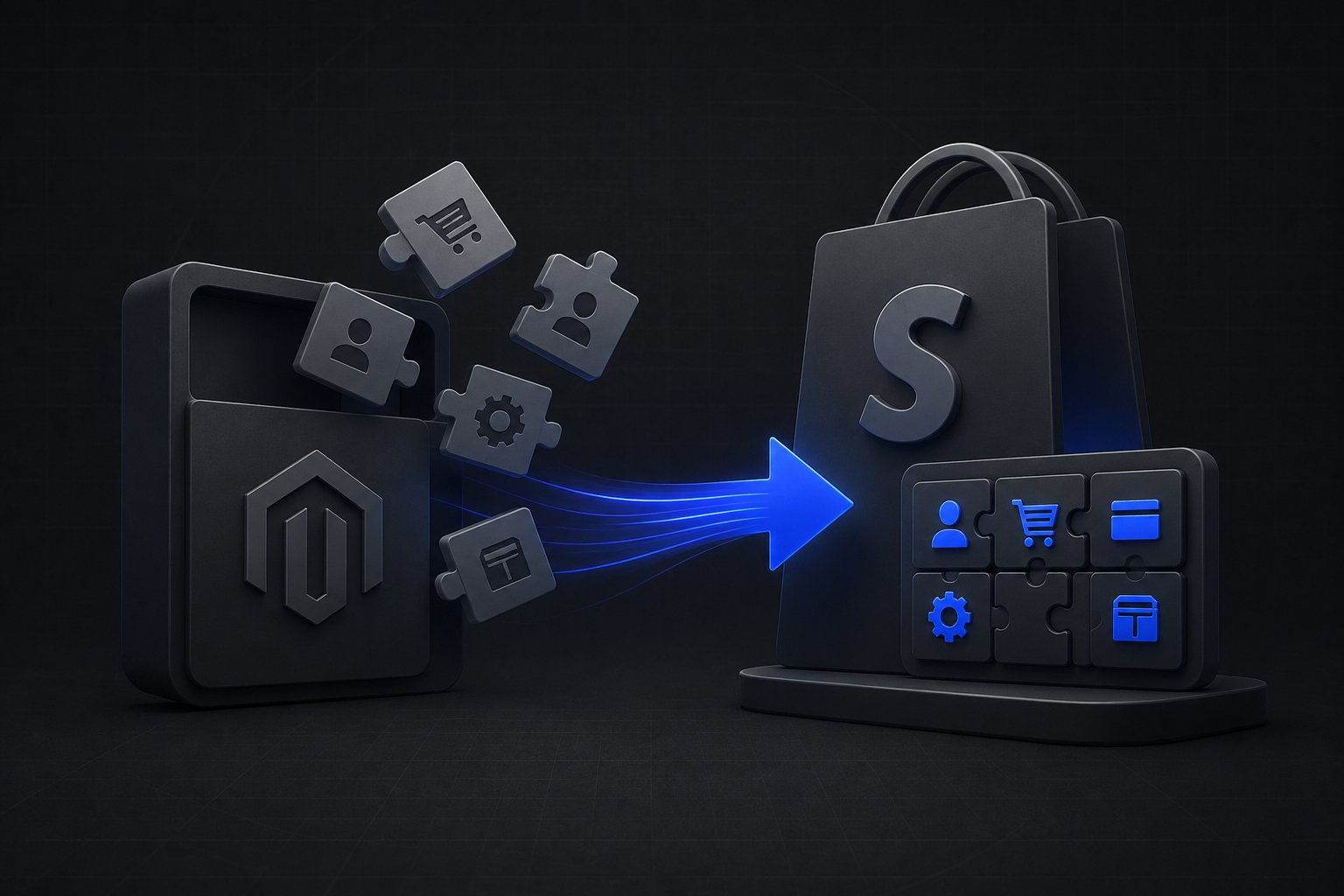
The question that stalls more Magento migrations than any other is not about data or cost. It is a quieter one, usually asked by whoever has run the store longest: "we have forty extensions on this thing, half of them customized, and I am not sure anyone remembers what a few of them do. What happens to all of that on Shopify?" It is the right question, because functionality loss is the real migration risk for a heavily customized store, and the generic answer, "there's an app for that", is not an answer. This is the module-by-module version: how each major category of Magento extension maps to its Shopify equivalent, and how to tell which of your modules should not make the trip at all.
Quick answer: Every Magento extension lands in one of five buckets on the other side. Native: Shopify or Shopify Plus does the job out of the box. App: a maintained App Store equivalent replaces it. Product layer or custom build: the gap is deep enough that a purpose-built product covers it, or a Shopify app gets built for logic genuinely unique to your business. Retire: the module existed to fix Magento, and its job no longer exists. A surprising share of a typical extension list lands in the first and last buckets, which is why the audit usually shrinks the problem instead of growing it.
Start With the Five-Bucket Triage
Before mapping categories, run the inventory: every extension and custom module, what it actually does today, and who depends on it, the same audit that opens the B2B migration checklist. Then sort each module into native, app, product layer, custom build, or retire.
Two rules make the triage honest. Sort by the job, not the module: the question is never "what replaces this vendor's extension" but "what does the business need this job done by on Shopify," because a single Magento extension often bundles three jobs that land in three different buckets. And challenge every module's existence before replacing it: paying to rebuild a workaround is the most expensive mistake in extension migration.
B2B and Wholesale Extensions
The largest category on most lists, and the one with the best news. The Magento B2B extension stack, company account modules, customer-group pricing extensions, quick-order and requisition tools, exists largely because merchants needed B2B before platforms carried it natively. On Shopify, the core of that job is platform: company accounts with locations and buyer roles, catalogs and price lists for account-specific pricing and gated visibility, net payment terms, and purchase order support. Whole sub-stacks of extensions land in the native bucket.
What remains splits predictably. Structured quote negotiation and buyer approval workflows go to the product layer or custom build, Uncap Quotes covers the quote-to-order workflow, and a dedicated buyer experience for key accounts is Uncap Portal's territory. The storefront-facing wholesale experience, quick-order layouts, catalog-heavy navigation, is theme work rather than extension work on Shopify, and the B2B themes distributors actually use show how much of the old extension stack becomes design.
PIM and Attribute Extensions
Magento's EAV model made it a magnet for attribute-management extensions: layered navigation add-ons, attribute import tools, spec-sheet generators. On Shopify the structural answer is metafields and metaobjects, structured, typed data attached to products and variants, which absorbs the attribute-storage job cleanly for most catalogs.
The judgment call is when attribute complexity has outgrown any commerce platform. If your team maintains rich technical specs across tens of thousands of SKUs, feeds multiple channels, and fights data quality weekly, the honest replacement for the extension pile is not metafields alone but a PIM feeding Shopify, and the PIM platforms that fit Shopify are a decision worth making deliberately during migration rather than after it. The migration is the cheapest moment you will ever have to move attribute truth into a system built to own it.
Fitment Extensions and Product Configurators
Vehicle-fitment extensions, Year-Make-Model search modules, parts finders, garage widgets, are load-bearing for automotive and powersports sellers, and this category is product-layer territory on Shopify because fitment is a data architecture, not a widget. Uncap Garage runs YMM filtering from ACES/PIES or your own fitment data on the same Shopify catalog that carries your B2B pricing and stock, and the fitment data inside your old extension's tables deserves its own migration workstream, preserving YMM and application data through the move is a discipline, not an export button.
Product configurators, options builders, bundle-and-kit modules, follow the same logic: simple option extensions often land in native variants plus apps, while configurators enforcing real constraint logic between choices are worth building into the storefront. The test is whether the module merely displays choices or actually validates them; validation logic is worth a real build, display logic usually is not.
Subscription and Recurring-Order Extensions
Here the mapping comes with a platform fact worth knowing before anyone installs anything: consumer subscription apps are built on selling plans, and selling plans are not supported on Shopify's B2B checkout. For a wholesale operation, the Magento recurring-order module's replacement is not a subscription app but scheduled order generation against company accounts, with terms billing or vaulted-card collection, the standing-order architecture that actually fits B2B replenishment. For D2C subscription lines, the app bucket works exactly as advertised. Same extension category, two very different destinations depending on which checkout the revenue runs through.
Checkout, Search, Shipping, and the Long Tail
The remaining list on a typical store sorts fast once the five buckets exist.
One-page and custom checkout extensions land in the retire bucket with honors: Shopify's checkout is the platform's crown jewel, and the extensions that fought Magento's checkout friction have no job left. Checkout customization that encoded real B2B behavior, PO fields, terms display, moves into Shopify's checkout configuration and B2B features rather than a rebuilt extension.
Search and merchandising modules land in the app bucket, where the Shopify search ecosystem is mature; the deciding factor is whether your search needs are generic or entangled with fitment and attributes, in which case they route through those categories instead. Shipping and tax extensions split between native capability and the established carrier and tax apps. Performance modules, cache warmers, image optimizers, speed patches, retire outright, because they were Magento maintenance wearing a feature costume.
And the ERP connector, often the most customized module of all, is deliberately not covered here: the integration gets rebuilt, not replaced, and the ERP re-integration explainer covers that workstream on its own terms.
The Modules That Should Not Survive
Run the triage on a real forty-extension store and a pattern shows up that surprises stakeholders: the retire bucket fills faster than the custom-build bucket. Modules that patched performance, hardened security, fixed admin usability, or worked around platform limits were never functionality, they were rent paid to the old platform, and their disappearance is the migration working as intended. The functionality that actually differentiates the business, the fitment data, the configurator logic, the quoting workflow, concentrates into a handful of deliberate builds on stable APIs instead of forty version-coupled dependencies.
That concentration is the real answer to the stakeholder who asked the opening question. The store does not lose its functionality in a migration done properly. It loses its inventory of workarounds, and keeps what was worth keeping in a form that survives the next upgrade, which is precisely the promise Uncap's Magento to Shopify migration practice is built around: audit every module in discovery, map each to its bucket, and scope the builds before work begins.
Uncap is a Shopify Platinum Partner, on Shopify since 2013, with 380+ storefronts launched on Shopify. Talk to Our Experts if you want your extension list triaged against the five buckets, that exercise is part of discovery, and it usually shrinks the project on the spot.
Frequently asked questions
Do Magento extensions work on Shopify?
No, nothing transfers directly: Magento extensions are PHP code inside the platform, and Shopify runs no merchant code inside the platform. Every extension's job gets re-provided through one of five routes: native Shopify features, App Store equivalents, purpose-built products, custom Shopify apps, or retirement when the job no longer exists.
What replaces Magento B2B extensions on Shopify?
The core, company accounts, account-specific pricing and catalogs, net terms, purchase order support, is native to Shopify B2B, retiring whole sub-stacks of extensions. Structured quoting, buyer approval workflows, and dedicated buyer portals sit in the product and custom-build layer on top of that native foundation.
What happens to a custom module no app can replace?
It becomes a scoped custom Shopify app, built against stable platform APIs instead of inside the platform. That path is reserved for modules encoding genuinely unique business logic, configurator rules, specialized workflows, and the discovery audit exists to separate those from the workarounds that only looked essential.
How many Magento extensions typically get retired rather than replaced?
More than most teams expect, though the share varies by store. Performance patches, checkout fixes, admin tools, and platform workarounds all existed to compensate for Magento itself, and their jobs disappear with the platform. The differentiating functionality concentrates into a much shorter list of deliberate replacements.


