


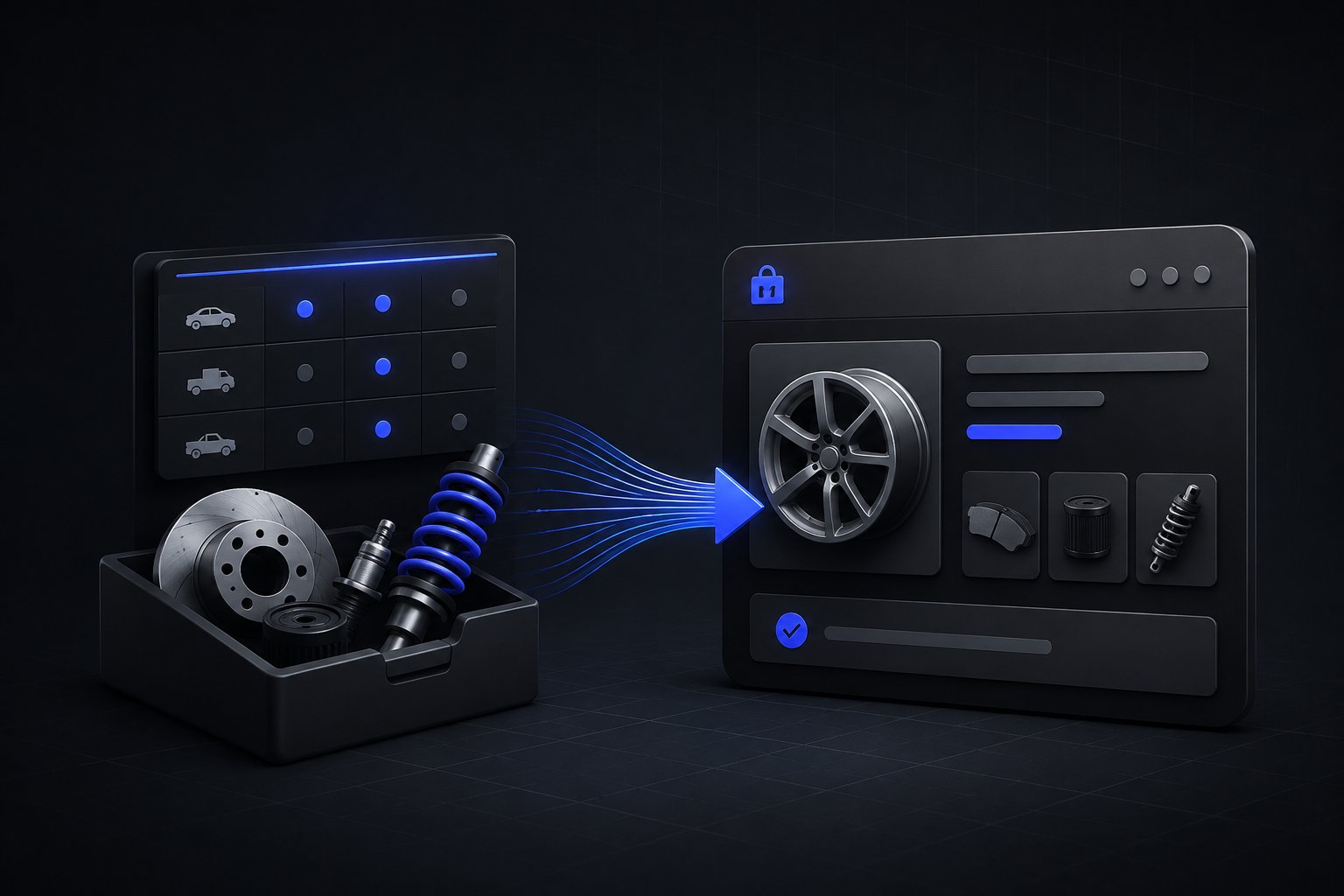
Ask an auto parts seller why they are still on a platform they have outgrown and the answer is rarely loyalty. It is fear, and the fear has a specific shape: years of Year-Make-Model mappings, cross-references, and application data living in the old system, and no confidence any of it survives a move. The fear is rational. Standard migration tooling moves products, customers, and orders competently, and treats the fitment layer, the single hardest-won asset in a parts business, as if it does not exist.
Quick answer: Fitment data survives a Shopify migration when it is treated as its own workstream with its own inventory, extraction, and verification steps, separate from the product migration. The sequence: find every place application data actually lives in the old stack, extract it to a neutral, ACES-shaped format keyed to part numbers rather than platform IDs, rebuild the fitment layer on Shopify against the new catalog, then verify application counts and vehicle-page redirects before cutover. Products can be re-imported if a migration goes sideways. Fitment mappings, once lost, are rebuilt by hand at catalog scale.
Why Fitment Is the Real Migration Risk
A replatforming project moves several kinds of data, and they are not equally fragile. Products, customers, and orders exist in standard shapes every migration tool understands. Fitment does not.
On Magento it typically lives in extension tables with their own schema. On WooCommerce, in plugin structures or product meta. On older custom builds, sometimes in database tables one developer understood, sometimes in the search appliance's configuration, occasionally in a spreadsheet that feeds an upload script nobody has touched since 2019.
None of that maps to a default export. Which means the honest framing for a parts migration is two projects wearing one name: a store migration that follows the standard replatforming checklist, and a fitment data migration that needs its own plan. Sellers who discover the second project midway through the first are the source of most auto parts migration horror stories.
Step One: Find Where Fitment Actually Lives
Before anything moves, inventory the fitment layer as it exists, and expect surprises. The questions that matter:
What is the source of truth? Some stores maintain fitment in a PIM or an ACES data subscription and push it to the platform, in which case the platform copy is disposable and the migration is a re-push. Others maintain it in the platform itself, hand-edited over years, in which case the platform copy is the only copy, including corrections that exist nowhere else. Most established stores are a mix, and knowing which SKUs fall on which side is the whole audit.
Where do cross-references and supersessions live? Interchange data frequently lives in a different structure than YMM applications, and it is the layer most often forgotten until buyers start searching OEM numbers on the new site and finding nothing.
What did the old platform generate from the data? Vehicle landing pages, filtered category URLs, fitment tables on product pages. These matter for the SEO step later, so catalog them now while the old site is still crawlable.
Step Two: Extract to Neutral Ground
The extraction target is a platform-independent format keyed to things that survive the move: part numbers and vehicle definitions, never internal product IDs. ACES-shaped structure is the natural choice, application rows tying a part number to year, make, model, submodel, and engine, because it matches the industry standard the data should have been in anyway, and because it makes the extracted set auditable on its own: you can count applications per SKU and compare against the old platform before the new one enters the picture.
This is also the moment to clean rather than faithfully preserve. Migrations copy garbage as reliably as they copy gold, and a fitment set carrying dead vehicles, duplicate applications, and superseded numbers is cheaper to fix in a spreadsheet-shaped format now than inside a live storefront later.
Step Three: Rebuild, Don't Port
On the Shopify side, the fitment layer is rebuilt against the new catalog rather than ported structure-for-structure, because the old platform's fitment schema was an artifact of that platform's limitations, not a design worth preserving. The extracted application data loads into the new fitment system keyed by part number, matched to the new product records, with the vehicle database normalized once instead of inheriting a decade of inconsistent make and model spellings.
This is where the destination matters. Uncap Garage runs YMM fitment on Shopify from ACES/PIES-shaped data, which means the neutral extract from step two is close to load-ready, and for sellers with shop or dealer accounts, the rebuilt layer filters the same Shopify catalog that carries each company's B2B pricing and stock, rather than reproducing a retail-only widget. Kooks Headers, a performance exhaust manufacturer, runs its Shopify Plus storefront with its vehicle fitment system connected to a PDM Automotive PIM, which is the standard this step should aim at: fitment as synced data infrastructure, not a hand-fed app.
Step Four: The SEO Layer Nobody Budgets For
A fitment store's organic footprint is not just product pages. Vehicle-filtered URLs, brake pads for a given truck, all parts for a given model, often carry years of accumulated rankings, and they are generated URLs, which means the old and new platforms will generate them differently. Losing them silently is how a migration that "went fine" loses a third of its organic traffic by month two.
The work is unglamorous and mechanical: crawl the old site's indexed URLs before cutover, map vehicle and category patterns to their new equivalents, and redirect at the pattern level with explicit handling for the highest-traffic pages. The broader revenue-preservation context, and why redirects are half of any replatforming's SEO survival, is covered in the B2B ecommerce replatforming guide.
Step Five: Verify Like a Skeptic
Cutover readiness for a parts store is testable, and the tests are specific. Application counts per SKU on the new site should reconcile against the extraction, with discrepancies explained rather than shrugged at. The top hundred vehicles by historic sales should return sensible filtered results, and the top OEM and competitor numbers should resolve through search.
A handful of known-tricky parts, mid-year splits, superseded numbers, multi-application universals, should behave correctly on the pages buyers will actually see. And zero-results search monitoring should be live from day one, because on a parts store a spike in zero-results is the sound of fitment data failing in production.
Run the same discipline as the launch checklist for a new parts store, with one addition: keep the old platform's data accessible in read-only form for a quarter. The question you cannot answer from the new stack will come up in week three.
Where Uncap Fits
Uncap is a Shopify Platinum Partner, on Shopify since 2013, with 380+ storefronts launched on Shopify, and Shopify migrations with fitment-heavy catalogs are among the deepest patterns in that portfolio, including Magento, where most of the aftermarket's aging stores still live. The full aftermarket build pattern is on the auto parts and aftermarket industry page.
Talk to Our Experts if you want a read on where your fitment data actually lives and what its migration would involve.
Frequently asked questions
Can fitment data be migrated from Magento or WooCommerce to Shopify?
Yes, but not by standard migration tools, which move products, customers, and orders and ignore extension-level fitment structures. The working approach extracts application data to a neutral, part-number-keyed format, rebuilds it on Shopify against the new catalog, and verifies application counts before cutover.
What happens to vehicle landing page SEO in a migration?
It survives only if someone maps it. Vehicle-filtered URLs are platform-generated, so old and new sites produce different patterns, and unredirected patterns quietly drop years of rankings. Crawl the indexed URLs before cutover and redirect at the pattern level, with the highest-traffic pages handled explicitly.
Should fitment data be cleaned during migration or copied as-is?
Cleaned. The extraction step is the cheapest moment the business will ever have to remove dead vehicles, duplicate applications, and superseded numbers, because the data sits in an auditable, spreadsheet-shaped format between platforms rather than inside a live storefront.
How do you know the fitment migration worked before going live?
Reconcile application counts per SKU against the extraction, test the top vehicles by historic sales, confirm OEM and competitor numbers resolve in search, and check known-tricky parts by hand. After launch, watch zero-results searches, since a spike there is fitment failure showing up in buyer behavior.


