


Every manufacturer that sells through dealers eventually gets the go-direct memo: the margin on a retail sale is too good to keep declining, buyers expect to find the brand's own store, and the dealer channel alone no longer tells the whole demand story. Then the project stalls on a structural question that sounds technical and is not. Do the wholesale accounts and the retail buyers get separate stores, or one? The two-store answer feels safer and quietly costs more every month it runs. This playbook is the case for one store, and the design work that makes one store safe.
Quick answer: You do not need two stores to run two channels. On Shopify, the channels separate inside one storefront: retail buyers browse the public catalog at retail prices and check out as consumers, while dealers and account buyers log into company accounts that swap in their price lists, their catalog scope, their payment terms, and their ordering workflows. One product record, one inventory pool, one ERP sync, two experiences. What follows is the operating manual: the separation architecture, the dealer-protection design that makes going direct survivable, and three live blended builds. For what unified commerce means as a category, the unified commerce explainer owns the definitions.
Why the Two-Store Instinct Costs More Than It Solves
The second store gets proposed because it feels like insulation: wholesale pricing can never leak to retail if wholesale lives behind its own URL. What it actually creates is a duplicate of everything else.
Count the copies. Two catalogs to keep in sync when a product changes. Two theme codebases to maintain and two app stacks to license. Inventory either split between stores or synced between them by yet another integration. Analytics that can no longer answer the simplest unified question, which is what a given product actually sells across both channels.
And the leak the second store was built to prevent happens anyway, just in reverse. Dealers shop the retail store to check the brand's public pricing, retail buyers find the wholesale login and wonder what they are missing, and the operations team reconciles two order streams into one ERP. The insulation was never the URL. It was always the account model, and the account model works inside a single store.
The Separation Model: One Store, Two Experiences
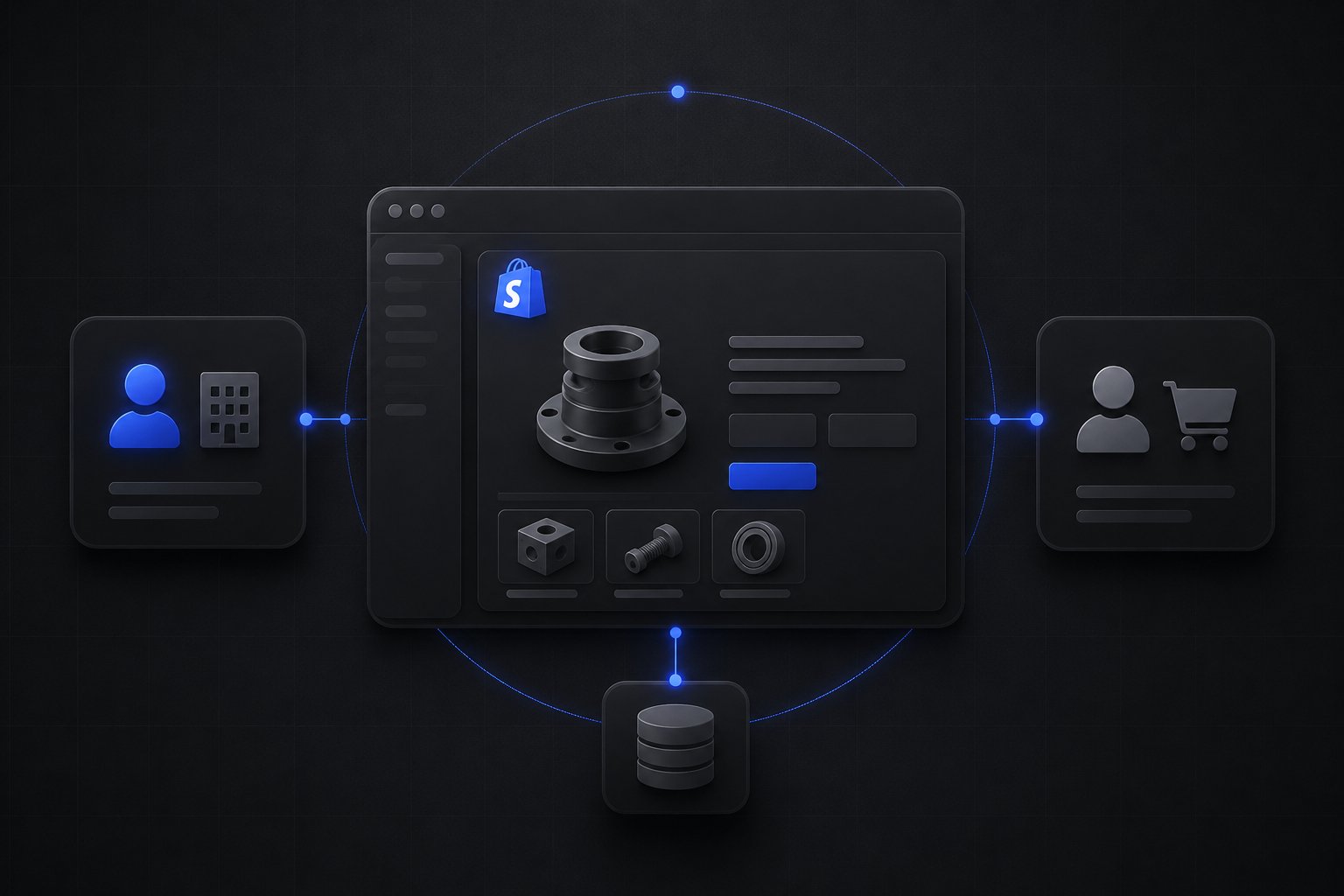
Shopify's B2B primitives do the separating natively. A retail buyer arrives anonymous, sees the public catalog at retail prices, and checks out with a card like any consumer. A dealer logs into a company account, and the same storefront changes shape around the login: price lists replace retail pricing with that account's program rates, catalogs scope which products the account can see and buy, payment terms and purchase orders replace the consumer checkout, and quantity rules enforce case packs and minimums where the program requires them.
What the two experiences share is the point. One product record feeds both channels, so content is maintained once. One inventory pool serves both, so the warehouse never allocates stock between storefronts. One connection to the ERP carries both order streams under the right account and terms, which is the job Uncap Connect does in both directions. The separation is real where it matters, pricing, catalog, checkout, and gone where duplication would only cost money.
The discipline that keeps this trustworthy is the same one that governs any B2B build: the storefront displays channel truth, it does not own it. Dealer program pricing mirrors the ERP's records per account. Retail pricing is the public list. Neither channel's numbers are typed into the other's tables, which is precisely the drift risk the two-store architecture multiplies by two.
The Dealer-Protection Design
Going direct is a channel decision before it is a build decision, and the build should encode the channel answer. Dealers watch a manufacturer's DTC launch for one signal: are you competing with us? The one-store architecture, done properly, is how a brand answers no in a way dealers can verify.
Retail price integrity comes first: the direct channel sells at full retail, every day, which protects the margin that makes carrying the line worth a dealer's while. The direct store becomes the price floor dealers can point to rather than the discounter they fear. Second, the direct channel takes the demand dealers cannot economically serve, the long-tail SKUs, the replacement parts, the one-unit consumer orders, while volume and relationship business stays where it lives. Third, the same storefront can serve the network itself: the dealer's login is a working portal with program pricing and reorder workflows, so the site that sells direct is also the site that makes selling through easier. The fuller version of that trust argument, including how to frame the rollout to the network, is in the dealer portal playbook.
What It Looks Like Live
E3 Spark Plugs runs exactly this shape. The Uncap-built E3 store is a blended B2C and B2B storefront on Shopify: retail buyers get a Year Make Model fitment tool and a cross-reference application that converts competitor part numbers to E3 SKUs, dealers get group pricing through Shopify's native B2B features, and Shopify Markets carries the brand's international selling, all from one build replacing the outdated platform it ran before.
Kodo Kids proves the model outside automotive. Kodo designs play-based learning tools for early childhood education and sells to families on one side and schools and institutions on the other. Its blended Shopify Plus storefront gives consumers custom upsell and cross-sell features plus a product add-on feature built to raise average order value, gives institutional buyers catalogs and net payment terms, and keeps HubSpot CRM and Unleashed ERP fully integrated behind both experiences with all company data migrated intact.
Sanitaire shows the migration path into it. The company has built commercial cleaning equipment for nearly fifty years and sells through a B2B distributor model, and its legacy platform had stopped keeping pace. Uncap migrated Sanitaire to Shopify Plus with customer data retained and the ERP integrated, and the case study's stated result is this playbook's thesis in one line: a more stable and scalable solution for reaching multiple sales channels.
When Two Stores Is Actually Right
The one-store default has honest exceptions. Distinct brand identities that would confuse each other's buyers argue for separate storefronts. So do separate legal entities with separate tax and currency regimes that expansion stores exist to serve, and assortments with almost no overlap, where the shared catalog that powers the model would be shared in name only. The test is the same one that runs through this whole playbook: count what the second store duplicates against what it separates. When the duplication list is longer, and for most manufacturers going direct it is, the answer is one store with the channels separated by account, not by URL.
For the brands and manufacturers Uncap builds unified commerce for, that counting exercise is the first working session: which accounts, which catalogs, which price programs, and what the dealer network needs to see to trust the launch.
Uncap has been a Shopify Platinum Partner since 2013, with 380+ storefronts launched on Shopify, including for manufacturers, distributors, and wholesalers. Talk to Our Experts if you are weighing one store against two, the account-model mapping usually settles it in a single conversation.
Frequently asked questions
Can one Shopify store really serve both B2B and DTC buyers?
Yes, and natively. Retail buyers see the public catalog at retail prices with consumer checkout, while company-account buyers get their own price lists, scoped catalogs, payment terms, and quantity rules on the same storefront. The channels share one product record, one inventory pool, and one ERP connection, which is where the economics of the single store come from.
How is wholesale pricing kept away from retail buyers?
By account, not by URL. Program pricing lives in price lists attached to company accounts and renders only after a buyer logs in, and catalogs control which products each account can see at all. An anonymous visitor sees retail truth only, which is a stronger guarantee than a separate wholesale store whose login link is one forward away.
Will selling direct damage the dealer network?
It damages the network when the direct channel undercuts it, and supports the network when the design protects it: full retail pricing on the direct store, the long-tail and one-unit demand dealers cannot serve economically, and a dealer login on the same site that makes ordering from the brand easier than it was. Channel trust is a design input, not a launch-day hope.
When are separate stores the better answer?
When the things a second store duplicates are genuinely not shared: distinct brands with separate identities, separate legal entities and currency regimes, or assortments with almost no catalog overlap. Outside those cases, the second store mostly duplicates catalog, apps, themes, and integrations that a single store with B2B account separation maintains once.


