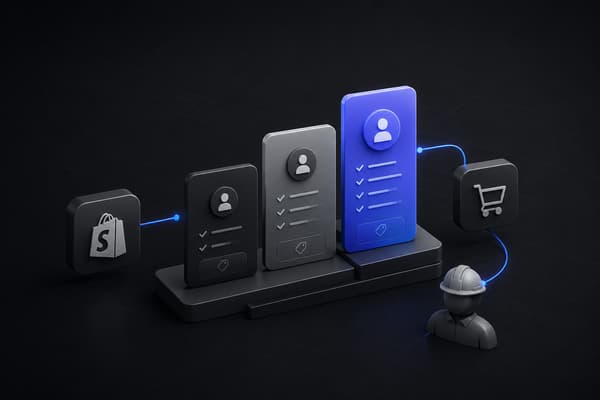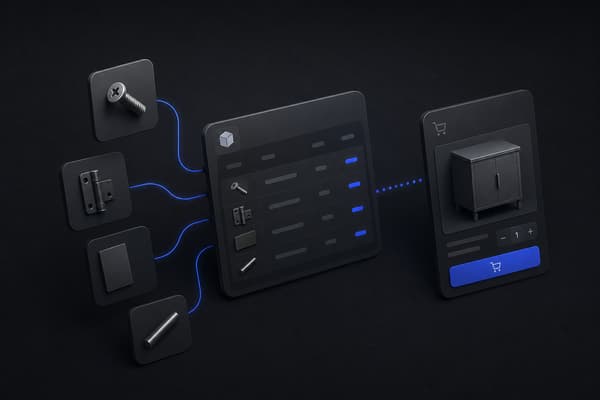



A wholesale buyer asks for a revised quote on a $40,000 order, and the rep rebuilds the whole thing from scratch because the last version only exists in an email thread. A distributor's ERP says one number is in stock and the Shopify store says another. A manufacturer's dealer network expects net 30 terms and a private catalog, not a public storefront. Shopify B2B commerce is not one problem. It looks different depending on whether you sell wholesale, distribute through a dealer network, manufacture the product yourself, or run B2B and DTC on the same store as one unified operation. Most Shopify agencies still build for DTC first and treat B2B as an add-on. Here are six Shopify B2B agencies and partners worth knowing, starting with Uncap. Many of the operators comparing this list are also weighing a BigCommerce migration after their pricing logic stopped scaling.
What to Look for in a Shopify B2B Agency
Not every Shopify agency has real B2B depth. Plenty can ship a polished storefront and still miss the operational core: company accounts, customer-specific price lists, net payment terms, and a quoting process that does not fall apart the moment a buyer asks for a change. Shopify B2B covers the native feature set, but configuring it correctly for a distributor running five pricing tiers and a dealer network takes real B2B experience, not just a Shopify Plus badge.
Four things separate a real B2B partner from a generalist:
Shopify partner tier. Shopify Partner is the entry-level badge. Shopify Plus Partner means a vetted track record on the enterprise tier. Shopify Platinum Partner, the top global designation, means verified outcomes at volume. You can confirm any agency's current tier in Shopify's Partner Directory.
B2B feature depth. Ask how many company-account, price-list, and quoting builds they have actually shipped, not how many Shopify sites they have launched in general.
ERP integration approach. Your commerce and your ERP need to agree on the same numbers in real time: inventory, pricing, credit terms. Ask whether they build native, embedded integrations or hand that work off to a third-party middleware platform.
Vertical fit. A wholesale account tree, a distributor's multi-location inventory, and a manufacturer's dealer network are three different problems wearing the same "B2B" label. Ask an agency to describe a project in your specific vertical, not B2B commerce in general.
Part of that operational core starts with the storefront foundation itself, and we compare which Shopify B2B themes hold up for large distributor catalogs.
What Does a Shopify B2B Agency Actually Do?
A Shopify B2B agency configures Shopify's native B2B features (company profiles, custom price lists, net payment terms, purchase order checkout) and connects them to the systems a wholesale operation already runs on: ERPs, CRMs, and inventory platforms. The strongest ones also solve the quoting workflow itself, so a sales rep can revise a quote without rebuilding it, and a buyer can negotiate and approve without the process leaving Shopify.
That second part is where a lot of generalist agencies stop short. A DTC-first shop can turn on company accounts and call the B2B build done. A real B2B partner also solves for the customer who wants a different volume tier mid-negotiation, the dealer network expecting net 30 terms without a fight, and the ERP that needs to see every order the moment it is placed, not overnight.
Shopify B2B Looks Different in Wholesale, Distribution, Manufacturing, and Unified Commerce
"Shopify B2B agency" is a broad label for four fairly different buyer realities, and the right partner depends on which one describes your operation.
B2B and wholesale operations sell in bulk to trade accounts: buyers expect tiered pricing by volume, minimum order quantities, seasonal buying windows, and account credit that does not require a phone call to check. The agencies on this list with the deepest wholesale-specific work are the ones who can point to a live company-account and price-list build, not just a Shopify Plus certification.
Distribution operations add a layer most wholesale-only builds never touch: multi-location inventory, order routing, back-order management, and freight terms that change by region. Shero Commerce's ERP integration work and BlueSwitch's published client roster both lean hard into distribution accounts, which shows up in how each firm talks about inventory and fulfillment sync.
Manufacturing operations run on dealer networks, purchase orders, bills of materials, and custom pricing tiers tied to a rep relationship, not a public catalog. Teifi Digital's B2B Commerce Suite (buyer hierarchies, role-based approvals) and BlueSwitch's named manufacturing clients both point to real repetition in this vertical specifically, which matters more than a generic B2B portfolio.
Unified Commerce is what happens when a brand runs B2B and DTC on the same Shopify store instead of maintaining two separate systems: one inventory count, one order management system, one customer view, with wholesale buyers and retail shoppers checking out through the same platform. This is the model Uncap's own "Uncap Commerce. Unified." positioning is built around, and it is worth asking any agency directly whether they configure B2B and DTC to share inventory and fulfillment, or whether their B2B build effectively becomes a second, disconnected store.
Shopify B2B Agencies and Partners Compared
Agency | Best For | Shopify Partner Tier | Standout B2B Strength |
|---|---|---|---|
Uncap | Wholesale, distribution, and manufacturing brands running B2B and DTC as one unified Shopify operation | Platinum Partner (since 2013) | Native ERP integration and quote-to-cash built for B2B, with B2B and DTC unified on one store |
Zaelab | Enterprise B2B brands wanting Shopify-native configurators and modern buyer experiences | Shopify Premier Partner | Co-developed a B2B commerce app and framework directly with Shopify |
Teifi Digital | Manufacturing and distribution brands needing buyer hierarchies and approvals without custom middleware | Platinum Partner | A purpose-built B2B Commerce Suite native to Shopify, no legacy portals |
Praella | Brands wanting UX and conversion optimization layered onto B2B functionality | Platinum Partner (since 2014) | CRO and retention expertise on top of standard B2B configuration |
Shero Commerce | Manufacturers and distributors with a named legacy ERP already in place | Shopify Premier Partner | A dedicated ERP integration practice naming NetSuite, SAP, Dynamics, Epicor, and Sage |
BlueSwitch | Distribution and manufacturing brands needing a modular, multi-part B2B solution suite | Platinum Partner | A long track record of named clients across distribution and manufacturing |
1. Uncap
Uncap is a Shopify Platinum Partner and Shopify Expert since 2013, with 380+ storefronts launched on Shopify, including for manufacturers, distributors, and wholesalers. What sets Uncap apart from a generalist Shopify shop is that the work does not stop at the storefront, and it does not treat B2B as a separate system bolted onto DTC. Commerce Build handles the launch, migration, or upgrade itself: company accounts, price lists, net terms, and purchase order checkout, built to fixed scope, with wholesale and retail buyers running through the same unified Shopify store instead of two disconnected ones.
From there, two Uncap products pick up the parts of the operation that a storefront alone cannot solve. Uncap Connect is a native, embedded Shopify-to-ERP integration built for B2B data (customer-specific pricing, credit terms, multi-location inventory) that syncs with systems like NetSuite, SAP, and Microsoft Dynamics in real time, not on an overnight batch, which matters most for distributors juggling inventory across multiple warehouses. Uncap Quotes runs the full quote-to-cash workflow natively inside Shopify: a rep builds and sends a quote from the same admin they already use, revises it without starting over, and converts an approved quote into an order in one step, the kind of workflow a manufacturer's dealer network runs on daily.
For a mid-market distributor running dealer pricing tiers and a rep network, that combination (fixed-scope implementation, real-time ERP sync, and a quoting workflow that never leaves Shopify) is the difference between a store that looks like B2B and one that actually runs like it.
2. Zaelab
Zaelab is a Shopify Premier Partner and self-described end-to-end digital consultancy focused on B2B revenue growth. What separates Zaelab from most agencies on this list is how directly it works with Shopify itself: the two co-developed Portul, an app aimed at bringing enterprise-grade B2B commerce to smaller merchants, and the B2B Commerce Spectrum, a framework for understanding where a B2B operation sits on the maturity curve. Zaelab's published case work includes a visual product configurator built for an equipment brand, alongside broader B2B implementations focused on custom pricing models and buyer account structures. Brands that want a partner with a direct product relationship with Shopify's own B2B team, not just a certification, tend to be the best fit here.
3. Teifi Digital
Teifi Digital is a Shopify Platinum Partner and unified commerce consulting agency, and one of the more specialized names on this list when it comes to manufacturing and distribution specifically. Teifi built a dedicated B2B Commerce Suite that runs natively on Shopify: company switcher for multi-entity buyers, order approval flows, role-based access control, live and regional pricing, and ship-from-location logic, all without a custom middleware layer or a bolted-on legacy portal. Their published work includes bringing unified commerce to automotive brands with triple-digit annual growth and seven-figure cost savings for at least one named account, and their team describes its Shopify Plus experience as covering manufacturing, parts, and distribution accounts specifically. Manufacturing and parts distribution brands with genuinely complex buyer hierarchies are where Teifi's product work is strongest.
4. Praella
Praella is a Shopify Platinum Partner (since 2014) known for pairing UX and conversion rate optimization with Shopify Plus development. Where Teifi and Shero lean hardest into backend and vertical-specific complexity, Praella's differentiator is retention and lifecycle work layered on top of standard B2B configuration: the team publishes regularly on Shopify Plus B2B topics like pricing strategy and catalog structure, and positions itself as an extension of a brand's own team rather than a one-time build shop. Praella does not skew toward one vertical the way some others on this list do, which makes it a reasonable fit across wholesale, distribution, or manufacturing as long as the basic B2B architecture is already in place and the priority is sharpening conversion and repeat purchase behavior.
5. Shero Commerce
Shero Commerce is a Shopify Premier Partner based in New York, recently expanded as part of Ambientia Group, and the most ERP-focused name on this list outside of Uncap itself. Their dedicated Shopify ERP integration practice names direct experience with NetSuite, SAP, Microsoft Dynamics, Epicor, and Sage, and their process starts with mapping data flows before any integration work begins: what needs to sync, in which direction, and what happens when a record fails. Shero is candid that not every integration needs a custom build, using iPaaS platforms where they genuinely reduce cost and maintenance rather than defaulting to bespoke work every time. Named clients in their published case work span outdoor gear and safety equipment manufacturing, alongside beverage and music retail distribution. Manufacturers and distributors who already know which ERP they are standardizing on will find that specificity useful.
6. BlueSwitch
BlueSwitch is a Shopify Platinum Partner based in New York, and the agency on this list with arguably the longest visible track record of named B2B clients concentrated in distribution and manufacturing. Their positioning is built around a modular Unified Commerce Suite: a set of B2B solutions meant to extend Shopify rather than replace what it already does well. The client roster BlueSwitch has published publicly spans industrial supply and equipment manufacturing, including names like True Manufacturing, Sunnen Products Company, and CNC Supply Solutions, alongside distribution accounts like L&R Distributors and TRC Electronics, which signals real repetition in these two verticals specifically rather than one-off projects. Manufacturing and distribution brands looking for an agency with deep, visible experience across heavier industrial accounts tend to gravitate here.
7. Ask Phill
Ask Phill is a Shopify Platinum Partner and unified commerce specialist for Europe's leading fashion, lifestyle, and beauty brands, with 200+ stores launched. Rather than treating channels in isolation, Ask Phill makes Shopify the commerce core, connecting B2C, B2B, social, and emerging agentic sales channels into a single, unified operation. Their work spans zero-downtime replatforming and migrations, along with custom Liquid and Hydrogen/Next.js builds. Brands wanting one connected Shopify Plus foundation across every channel their customers buy through, rather than a B2B build bolted onto a separate DTC store, are the strongest fit here.
8. ECORN
ECORN is a Shopify agency specializing in design, development, and CRO for Shopify Plus and DTC brands, helping ambitious ecommerce teams build and scale high-converting storefronts.
9. WebContrive
WebContrive is a Certified Shopify Plus Partner with 13+ years of experience, having built 1,500+ stores across fashion, food and beverage, health and beauty, jewelry, and electronics. Their work spans DTC and B2B ecommerce consulting, Shopify Plus development, WooCommerce and Magento migrations, and ongoing managed support. Brands looking for an established partner with a broad multi-industry portfolio, rather than a narrow B2B specialist, are a strong fit here.
10. Codup
Codup is a Shopify Plus Partner focused on manufacturers, distributors, and wholesalers running complex B2B operations on Shopify. Where Codup differentiates is on the product side of B2B complexity: multi-tier pricing, contract pricing, and product configurators that handle millions of SKU/option combinations while staying simple for the buyer - the kind of build a standard company-account setup doesn't touch. Brands with a genuinely complex catalog, not just a wholesale price list, are the strongest fit.
How to Choose the Right Partner for Your B2B Build
Match the agency to your actual bottleneck, not just your budget, and be specific about which of the four realities above describes your operation. If your storefront looks fine but your ERP and your Shopify store disagree on inventory the moment volume picks up, that is a distribution problem and you need integration depth over visual polish. If your team is still rebuilding the same quote three times for a dealer network, that is a manufacturing problem and you need a partner who treats quoting as its own workflow. If you are trying to stop running B2B and DTC as two separate systems, ask directly how a candidate handles unified inventory and fulfillment, not just a separate B2B storefront. Ask every agency on this list the same three questions: how many B2B builds have you shipped in your vertical in the last year, what does your ERP integration actually look like under the hood, and who supports this store after launch when the pricing logic inevitably changes. The answers will tell you more than any case study page. If you are still deciding between an agency, a freelancer, or building in-house, this breakdown walks through when each makes sense.
Where to Start
The right Shopify B2B agency depends on where your operation is actually stuck: storefront design, ERP integration, or a quoting process that still runs on rebuilt spreadsheets and email threads. It also depends on whether you sell wholesale, distribute through a dealer network, manufacture the product yourself, or need B2B and DTC unified on one platform. Uncap has spent over a decade solving all of it for manufacturers, distributors, and wholesalers running B2B on Shopify.
Talk to our experts about building your B2B revenue engine on Shopify.
Frequently asked questions
Do I need a Shopify Plus Partner for a B2B build, or will any Shopify agency work?
You need at least a Shopify Plus Partner, and ideally a Platinum Partner, for a serious B2B build. Shopify's B2B features (company accounts, price lists, net terms) are available broadly, but configuring them correctly for real wholesale, distribution, or manufacturing complexity, like dealer pricing tiers, multi-location inventory, or a quoting workflow with real version history, requires an agency that has done it repeatedly, not one learning on your project.
Does my industry (wholesale, distribution, or manufacturing) actually change which agency I should hire?
Yes. Wholesale builds center on tiered pricing and account credit, distribution builds center on multi-location inventory and order routing, and manufacturing builds center on dealer networks and bill-of-materials pricing. An agency with five wholesale launches and zero distribution launches is not automatically the right fit for a distributor, even if both projects get labeled "B2B."
How much does a Shopify B2B agency cost?
Cost depends on scope: a straightforward B2B configuration on an existing store runs far less than a full migration with ERP integration and a custom quoting workflow. Ask for fixed-scope pricing rather than open-ended hourly billing, since B2B builds have a way of expanding once integration work starts.
Can one agency handle both my ERP integration and my storefront build?
Yes, but not every agency does both well. Some specialize in front-end B2B experience and outsource integration work; others are built around systems architecture first. Ask directly whether ERP integration is built in-house or handed off to a third party, since that answer affects both cost and long-term support.