


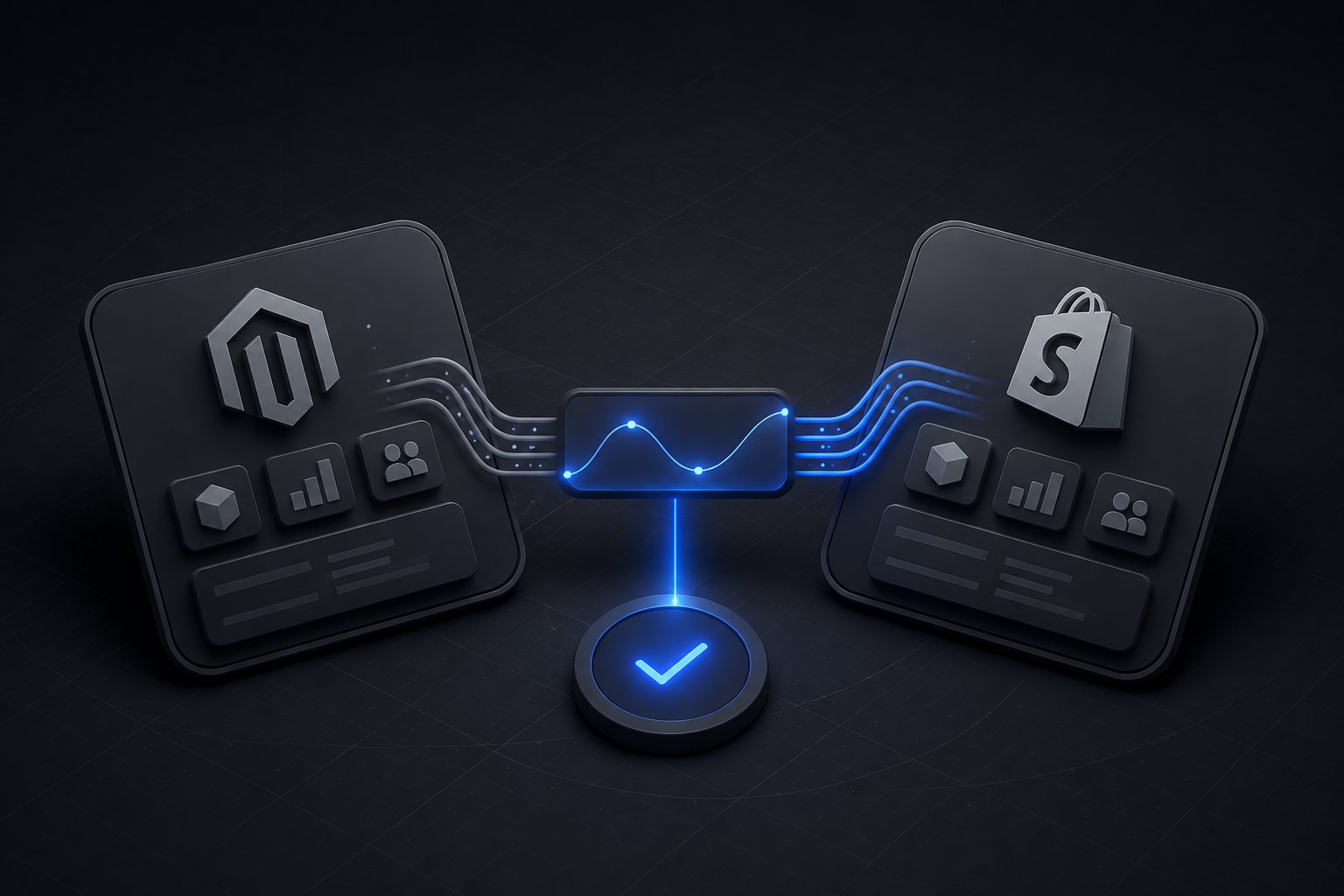
Every migration agency promises some version of "no downtime, no data loss." Almost none of them explain the machinery behind the sentence, which is a strange omission, because revenue disruption is the number one fear holding replatforming decisions hostage, and the fear does not respond to reassurance. It responds to mechanism. So here is the mechanism: what running both environments simultaneously actually means in practice, what happens on cutover day hour by hour, and why the zero-downtime claim is an architecture rather than a promise.
Quick answer: Parallel go-live means Magento remains the production store, taking every order, while a complete second store is built on Shopify Plus beside it: full catalog, company accounts, price lists, and the rebuilt ERP integration, all running against real data but serving no customers yet. Validation happens on the parallel store, with pilot accounts and line-level order reconciliation, while revenue flows through the old one untouched. Cutover is then a DNS event measured in minutes, not a rebuild measured in downtime, and rollback exists for the same reason: the old store is still there, still warm, until the new one has carried real volume.
What "Parallel" Actually Means
The phrase gets misread as two half-live stores splitting traffic, which would be genuinely risky. Parallel go-live is the opposite: one store carries all production traffic and all revenue for the entire project, and the other rehearses.
Magento stays exactly as it is. Buyers log in, orders flow, the existing ERP integration keeps doing what it does, nothing about the production environment changes because a migration is underway. Meanwhile the Shopify Plus environment is stood up as a complete store rather than a staging sketch: the real catalog, the real company accounts and price lists, the real payment and shipping configuration, and, critically, the rebuilt ERP integration running against live business data. The parallel store is not customer-facing, but it is not fake either, and that distinction is what makes the eventual cutover boring, which is the goal.
What Runs in Parallel, Concretely
Four workstreams run against the parallel environment while Magento serves customers, and together they are the validation the cutover depends on.
The ERP sync runs for real. The new integration, built for Shopify's APIs rather than ported from the Magento module, syncs the actual item master, actual price lists, and actual inventory into the parallel store on its production cadence. This is the workstream with the longest tail of surprises, which is exactly why it runs early and continuously rather than in a final week, the ERP re-integration explainer covers its internals.
Orders rehearse the full round trip. Test orders placed on the parallel store land in the ERP under the right customer, terms, and references, and fulfillment and invoice data flows back. Reconciliation here is line-level: quantities, prices, tax, references, compared field by field until discrepancies are explained rather than shrugged at.
Pilot accounts do the honest testing. A handful of friendly trade accounts log into the parallel store and see their world: their pricing, their catalog, their terms. Internal QA confirms the system works; a pilot buyer confirms the business survived the move, and their complaints arrive by first name while Magento still carries their real orders.
The exit ramp gets built before it is needed. The redirect map, from a crawl of the live site's indexed URLs to their new equivalents, is prepared and staged before cutover, alongside the customer communication for the one genuinely unavoidable friction: password hashes cannot move between platforms, so accounts get a reset flow with timing planned rather than improvised.
The Divergence Problem, Handled
Two stores running for weeks creates an obvious question: Magento keeps accumulating new orders, new customers, and edits while the parallel store is validated. What stops the new store from launching stale?
The answer has two halves. The larger half is architectural: for a B2B operation, the data that matters most, pricing, inventory, account terms, credit, is owned by the ERP, not by either storefront, and both environments read from that same source of truth through their integrations. ERP-owned data cannot diverge between the stores because neither store owns it. The smaller half is procedural: web-native data, newly registered customers, recent order history, content edits, is handled with delta migrations, an initial bulk load followed by top-up syncs, with a final delta at cutover. The freshness gap at go-live is measured in hours of storefront-native records, not in weeks of business truth.
Cutover Day, in Order
By the time cutover is scheduled, nothing about it should be discovery. The sequence is deliberately unexciting.
DNS time-to-live gets lowered days in advance, so the eventual switch propagates in minutes instead of hours. The final delta sync tops up customer and order records. The redirect map activates with the domain switch, so the old site's indexed URLs resolve to their new homes from the first crawl. The account communication goes out on its planned schedule, with password-reset instructions landing when the new store is the one buyers reach. And the teams on both sides, commerce, ERP, and finance, watch the first orders arrive with the reconciliation checklist already open.
The honest sentence about interruption: there is no downtime, because a fully working store is serving traffic at every moment, but there can be a brief coordination window, minutes, where an order lands on one side of the switch or the other. That window is safe for the same architectural reason as everything else: whichever storefront took the order, it lands in the same ERP, under the same customer, into the same fulfillment flow. In-flight orders spanning the cutover are fulfilled normally because fulfillment never lived in the storefront to begin with.
And rollback is not a contingency document, it is a property of the architecture: the old store is still standing, still warm, still connected. If something material surfaced in the first hours, the DNS points back and Magento is production again. The best evidence of how rarely that path gets used is how cheap it is to keep available.
The First Two Weeks After
Cutover ends the switch, not the vigilance. The first days of live orders get reconciled against the ERP line by line, the same discipline as the rehearsal, now with real volume. Redirect coverage and 404 reports get watched through the reindexing window. Search behavior on the new store, especially zero-result queries, gets monitored as a leading indicator of catalog or data gaps. And Magento is retired in stages: first out of production, then held read-only for around a quarter, because the question only the old system can answer reliably shows up in week three.
Why the Claim Is an Architecture, Not a Promise
Strip the sequence down and the "no downtime, no data loss" claim stops being marketing and becomes three design decisions. Downtime cannot occur because the migration never modifies the store that is serving customers; it builds a second one and moves the sign. Data loss cannot occur in the layer that matters because business truth lives in the ERP, which neither moves nor stops, while storefront-native records move on a delta schedule with a final top-up. And risk cannot accumulate silently because validation happens against real data, real orders, and real buyers before a single customer touches the new store.
That is the machinery behind the sentence on the Magento to Shopify migration page, where parallel go-live is standard scope rather than a premium add-on, and the same cutover discipline applies across Shopify migrations generally, whatever the departure platform. The full project sequence around it, what happens in the phases before the parallel run begins, is the B2B migration checklist.
Uncap is a Shopify Platinum Partner, on Shopify since 2013, with 380+ storefronts launched on Shopify, including for manufacturers, distributors, and wholesalers. Talk to Our Experts if you want the parallel go-live sequence mapped against your store, your ERP, and your season, because the other thing a coordinated cutover lets you control is the calendar.
Related reading: Headless and PWA on Shopify Plus vs Magento PWA Studio.
Frequently asked questions
Does a Magento-to-Shopify migration require taking the store offline?
No. In a parallel go-live, Magento serves all customers and takes all orders while the complete Shopify Plus store is built and validated beside it. Cutover is a DNS switch measured in minutes, with a working store serving traffic on one side or the other at every moment.
What happens to orders placed right around the cutover?
They are safe by architecture: whichever storefront takes an order, it lands in the same ERP under the same customer and flows into the same fulfillment process. Orders in flight at cutover are fulfilled normally, because fulfillment lives in the ERP, not in either storefront.
Can you roll back if something goes wrong after cutover?
Yes, and cheaply: the old store remains standing, warm, and connected until the new one has carried real volume. Rollback is pointing DNS back, which is why parallel go-live is the low-risk pattern, the exit exists until the moment it is no longer needed.
How do the two stores stay in sync while both exist?
The data that matters most, pricing, inventory, terms, credit, is ERP-owned and read by both environments from the same source, so it cannot diverge. Storefront-native records like new registrations and recent orders move through delta syncs, with a final top-up at cutover.


