

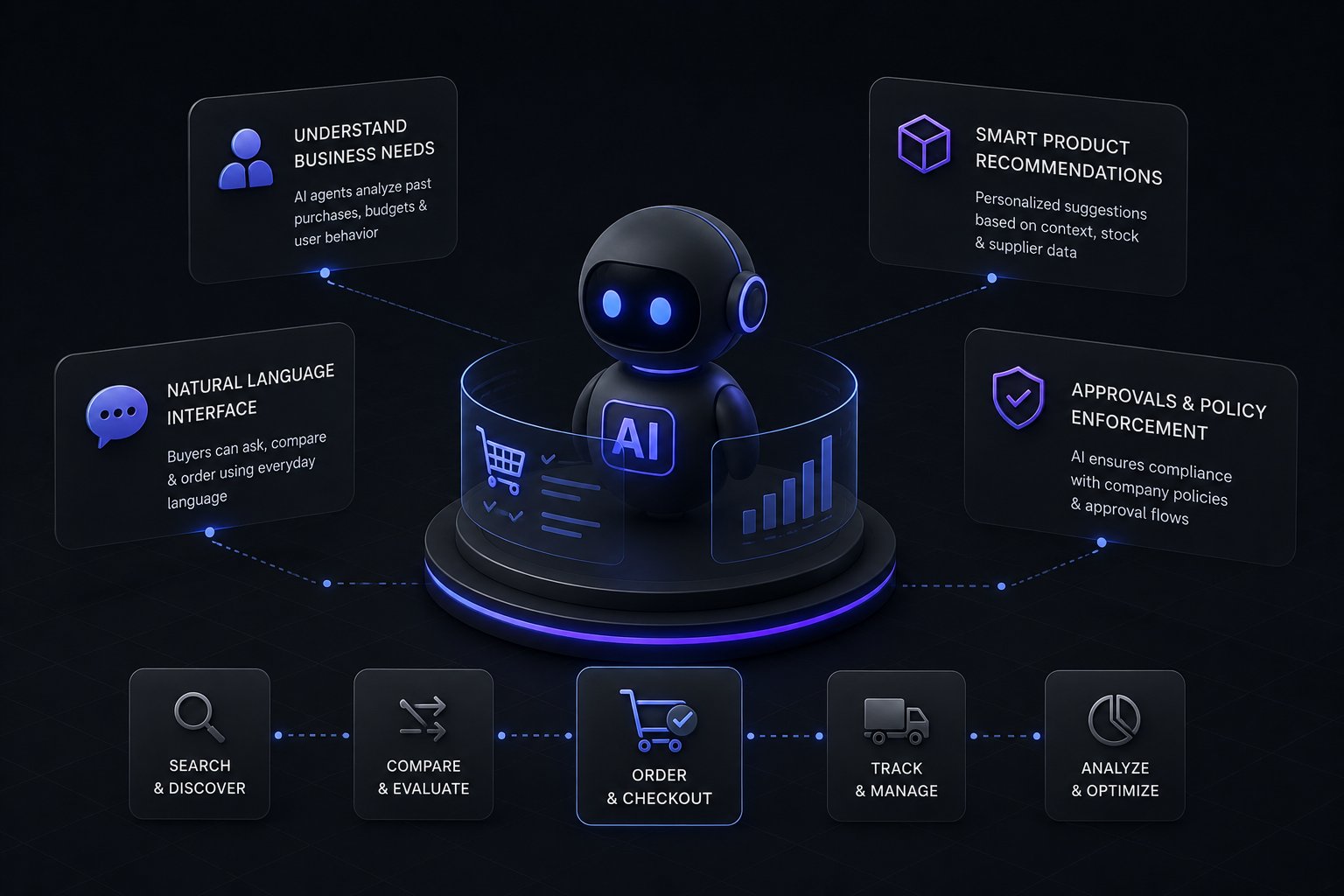
Your buyers have already made up their minds before they ever speak to your sales rep. That is what AI tools changed.
A purchasing manager at a mid-market distributor now opens ChatGPT, describes what they need, and gets back a vendor shortlist, a feature comparison, and a recommendation in ten minutes. The same process used to take two days of site visits, sales calls, and spreadsheets. By the time they pick up the phone, the decision is halfway made.
For manufacturers, distributors, and wholesalers running Shopify B2B, this is not a marketing problem. It is a commerce infrastructure problem. If your catalog is unclear, your pricing is opaque, or your store has no self-service path, AI agents filter you out before you ever get a chance to make your case.
This post covers what AI agents are doing in B2B buying right now, the specific Shopify use cases where this shows up in practice, and what operators need to build to stay visible in a buying process that no longer starts with a phone call.
What AI Agents Are Actually Doing in B2B Buying Right Now
AI agents in B2B buying are software programs that handle vendor research, sourcing comparisons, or procurement tasks on behalf of a buyer, with minimal oversight after the initial instruction.
The most common version today is research. A buyer describes their requirements in natural language, and an AI tool surfaces vendor options, feature comparisons, pricing ranges, and recommendations automatically. The research phase that used to involve five sales calls now happens in a single AI session before a supplier is ever contacted.
There are three modes operating at scale right now, each with different implications for your Shopify B2B store.
Research agents use general-purpose AI tools to answer questions like "which B2B platforms support net 30 terms with NetSuite integration" or "best wholesale order management for distributors under $10M." Your product pages, integration documentation, and published content either appear in those answers or they do not.
Sourcing agents are more structured. Procurement teams configure AI tools to evaluate suppliers against defined criteria: pricing, MOQ, lead times, certifications, ERP compatibility. These agents pull from whatever they can find about your business online. If your catalog does not publish that information clearly and consistently, you are not evaluated at all. In regulated categories like medical and dental supply, those criteria include compliance attributes an agent checks before anything else.
Order-execution agents are the emerging edge. Some enterprise procurement systems can now initiate reorders through a supplier's API once a vendor is pre-approved. If your catalog is not API-accessible and your pricing is not machine-readable, you are invisible to these systems. This is what is starting to be called agentic commerce: not just AI helping buyers decide, but AI helping buyers transact directly.
The B2B Buyer Arrives Pre-Decided
For a mid-market manufacturer selling through a dealer network, the old buying journey looked like this: a sales rep calls, a pricing sheet gets emailed, a quote gets built manually, a purchase order follows three weeks later. The manufacturer was involved at every step.
Now, by the time a buyer reaches out, they have already used an AI tool to identify three or four vendors, compare them on price and capability, and often draft an initial specification. Your sales team's first conversation is a validation checkpoint, not a discovery call.
This is what the B2B industry calls the invisible funnel. The research, evaluation, and shortlisting that used to happen through direct vendor interaction now happens before it. Operators without clear, AI-parseable information about what they sell, who they serve, and how their pricing works get filtered out before they ever get a chance to present.
The implication is not that sales reps become irrelevant. It is that the discovery work they used to do in early calls has moved upstream. Buyers arrive more specific, more informed, and sometimes with a draft purchase order ready. The operators visible to AI tools at the research stage have a structural advantage before the first conversation happens. For a deeper look at how AI agents are changing B2B buying and what it takes to stay visible, see our agentic commerce overview.
Traditional B2B Buying vs AI-Mediated B2B Buying
Vendor Discovery
Traditional: Word of mouth, trade shows, cold outreach
AI-Mediated: AI tools generating shortlists from online data
Evaluation
Traditional: Multiple sales calls and catalog reviews
AI-Mediated: AI comparison using structured public information
Spec Building
Traditional: Sales-assisted, back-and-forth
AI-Mediated: Buyer drafts spec independently with AI
RFQ Submission
Traditional: Email or phone
AI-Mediated: Structured form, API, or AI-generated document
Reordering
Traditional: Sales rep relationship, manual PO
AI-Mediated: Agent-triggered reorder from pre-approved suppliers
First Contact with Vendor
Traditional: Discovery phase
AI-Mediated: Post-decision validation
Shopify B2B Use Cases for AI Agents in Buying
Here is where it gets specific for operators. These are the real places AI-mediated B2B buying intersects with Shopify operations, and what each use case requires from your commerce infrastructure.
Automated reorder triggers. A buyer's procurement system flags that a fast-moving product is below reorder threshold. An AI agent checks the pre-approved supplier list, verifies current pricing, and places a draft order or initiates an RFQ without anyone making a call. For this to work, your Shopify B2B store needs structured product data, current pricing visible to authenticated company accounts, and a clear self-service order path. Shopify's native B2B features cover the foundation: company accounts, customer-specific price lists, and draft orders. Where that pricing lives in an ERP, an Oracle integration keeps the stock and contract terms the agent verifies accurate in real time.
AI-assisted quote requests. A buyer uses an AI tool to draft a purchase specification and submits it through your quote workflow. Uncap's Advanced Quote Management captures that request directly into the Portal, where your team responds, revises, and closes without re-entering anything. The full conversation, the specification, and the approved version live in one place. [CUSTOMER PROOF, request from brand team]
Conversational order intake. Some buyers now use AI tools to draft and send orders through email. A buyer sends an AI-formatted order summary to your sales inbox. If your team is running Conversational Commerce, that email becomes a Shopify draft order automatically. No manual re-entry, no delay, no orders lost when someone is out of the office. For the seller side of the same shift, see our complete B2B guide to agentic commerce on Shopify.
Research-stage discoverability. When a buyer asks an AI tool "which Shopify B2B agencies support manufacturers with NetSuite integration," the answer pulls from whatever that AI can access. Documentation, integration pages, detailed use-case content, and consistent product terminology all feed into how AI systems represent your capabilities. Uncap's Agentic Commerce solution is built specifically around this: making your catalog and capabilities visible and transactable for both human buyers and AI systems.
Smart reorder suggestions. As a Shopify Platinum Partner since 2013, with 380+ storefronts launched on Shopify, the pattern we see across manufacturer and distributor accounts is consistent: operators who automate the reorder prompt capture more reorder volume from accounts that would otherwise go quiet between active selling cycles.
How to Make Your Shopify Store Ready for AI-Mediated Buyers
If your store is not set up for how buyers research today, the fixes are structural rather than dramatic. Most are improvements you would want to make regardless.
Clean up your product data. AI research tools parse whatever they can find. Clear product names, accurate descriptions, precise specifications, and current pricing make your catalog readable by both buyers and sourcing agents. Vague product titles, missing attributes, and pricing that requires a phone call to access are invisible to any automated evaluation system. Operators replatforming from VTEX usually have to restructure that catalog data before agents can read it cleanly.
Build pricing into Shopify B2B. Customer-specific pricing, account tiers, volume discounts, and net terms should live in Shopify B2B company accounts rather than spreadsheets or sales rep memory. When a procurement agent checks whether you support $50K net 30 orders for wholesale distributors, that answer needs to be findable inside the platform.
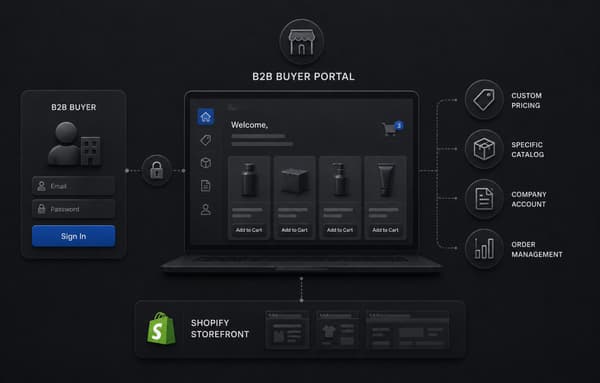
Create a self-service transaction path. Even buyers who arrive pre-decided want to place that order on their own schedule. A Shopify B2B portal with company accounts, saved carts, and quote request submission means buyers do not have to wait for business hours.
Publish structured, specific content. Detailed integration pages, use-case documentation, and vertical-specific articles with clear headings and direct answers are what AI tools reference when building vendor comparisons. The operators investing in that content now are the ones appearing on AI-generated shortlists in 2026 and beyond. Uncap's guide to AI best practices in B2B commerce goes deeper on the content side.
What AI Agents in B2B Buying Mean for Your Operation
The shift to AI-mediated buying does not replace your sales team. It moves the research and evaluation work upstream, before your team is involved. Buyers arrive more informed, more specific, and sometimes with a draft purchase order ready.
For manufacturers, distributors, and wholesalers on Shopify, the question is whether your commerce infrastructure is ready for buyers who arrive that way. Clean catalog data, structured pricing, a self-service path, and content AI tools can read are not optional extras. They are the baseline for staying visible in a buying process that increasingly happens before the first conversation.
For operators building this out, Unified Commerce is where the full picture comes together: B2B and DTC channels, ERP integration, and the workflows your team needs to handle buyers however they arrive.
Request a Quote to see what your current buyer experience looks like from the outside.
Frequently asked questions
What is an AI buying agent in B2B?
An AI buying agent is a software program that handles vendor research, sourcing comparisons, or procurement tasks on behalf of a human buyer. In B2B, these range from general-purpose tools used for vendor shortlisting to purpose-built procurement agents that initiate reorders from pre-approved suppliers through an API. A human sets the criteria once, and the agent executes the research or transaction without needing step-by-step oversight.
How are AI agents changing the B2B buying process?
AI agents are compressing the research and evaluation phases of the B2B buying journey. Buyers now use AI tools to generate vendor shortlists, compare features and pricing, and draft purchase specifications before contacting suppliers directly. The result is that vendors get less involvement in early-stage decisions and more scrutiny once they make the shortlist. Suppliers without clear, AI-accessible catalog data and content are at a disadvantage before the first call takes place.
How does Shopify support AI-mediated B2B buying?
Shopify B2B supports company accounts, customer-specific pricing, purchase order workflows, net terms, and draft orders. That is the infrastructure AI-mediated buyers expect when they arrive ready to transact. Shopify's API also makes the catalog accessible to sourcing tools and procurement systems. For operators who need more on top of that, including Advanced Quote Management or ERP sync, Uncap builds those workflows on Shopify's native B2B foundation.
What is agentic commerce in B2B?
Agentic commerce in B2B is the use of AI agents not just to research vendors but to execute commercial transactions: placing reorders, submitting RFQs, comparing catalog pricing in real time, and in some cases completing purchases through a supplier's API. For Shopify operators, it means the commerce infrastructure that handles human buyers, including clear product data, structured pricing, and a self-service order path, also needs to work for AI-initiated transactions.