
Choosing a B2B ecommerce platform is one of the highest-stakes decisions a manufacturer, distributor, or wholesale operation makes. The wrong platform means years of workarounds, expensive customization, and a buying experience that frustrates the buyers you worked hard to acquire. The right one handles your workflows natively and gets out of the way.
Shopify Plus and BigCommerce are two platforms that come up often in this conversation. Both serve B2B operations, and they make meaningfully different bets on how B2B ecommerce should work.
This comparison is written from Uncap's perspective as a Shopify Platinum Partner with 380-plus Shopify storefronts, including for manufacturers, distributors, and wholesale operators. We have a clear preference, Shopify Plus is the platform we build on and the one we recommend, but we also work with operators who are evaluating both platforms seriously, and a useful comparison requires honesty about where each one leads and where it falls short.
Shopify Plus vs BigCommerce for B2B: Quick Overview
Shopify Plus is the enterprise tier of Shopify, which powers over 4 million merchants worldwide. It adds B2B-specific functionality, company accounts, custom catalogs, tiered pricing, net terms, and draft orders, on top of Shopify's standard infrastructure. BigCommerce B2B Edition is BigCommerce's enterprise offering with native B2B features including customer groups, purchase orders, quote management, and shared shopping lists. Shopify Plus starts at $2,300 USD a month on a 3-year term, or $2,500 USD a month on a 1-year term, and BigCommerce's pricing page lists no separate price for B2B Edition. The right choice depends on your operation's complexity, your ERP, and your team's technical capacity.
BigCommerce B2B Edition in Brief
BigCommerce B2B Edition is the enterprise-tier offering specifically designed for B2B and wholesale operations. It adds a B2B-specific buyer portal, company account hierarchy, quote management, shared shopping lists, and purchase order workflows on top of BigCommerce's standard enterprise platform. BigCommerce B2B Edition is frequently evaluated against Shopify Plus by manufacturers and distributors because both address similar operational requirements at the enterprise tier. For what B2B Edition is and a plan-by-plan comparison, see BigCommerce B2B Edition vs Shopify B2B.
One key distinction: several of BigCommerce's B2B capabilities, customer groups and group-level pricing, are available on lower-tier BigCommerce plans, not only the enterprise offering. This gives BigCommerce a meaningful cost-of-entry advantage for smaller operations. The full BigCommerce B2B Edition, including the buyer portal and advanced account hierarchy features, requires the enterprise plan.
B2B Ecommerce Features: Shopify Plus vs BigCommerce
This is where the comparison matters most for manufacturers and distributors, and it is where the platforms diverge most clearly.
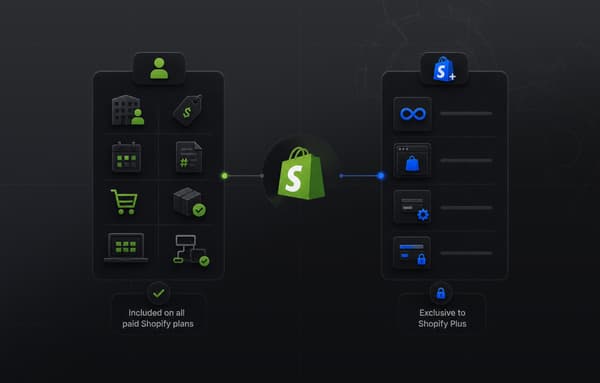
Shopify Plus B2B native features (via Shopify B2B):
- Company accounts: Organize buyers into companies with multiple locations, each with its own catalog, pricing, and contact assignments. Buyers log in and see only what their account is authorized to purchase.
- Custom catalogs and price lists: Assign different product catalogs and price lists to different company accounts. A buyer on a contract rate sees their rate. A prospect sees a standard public price.
- Net payment terms: Configure Net 30, Net 60, Net 90, or custom terms per company account. Buyers on terms check out without friction.
- Draft orders: Sales reps can build orders on behalf of buyers and send them for review and approval before processing.
- Quantity rules and order minimums: Set minimum order quantities, increments, and maximum quantities per product per company account.
- Storefront password protection: Gate the entire B2B storefront behind a login or restrict access by company account.
These features were significantly expanded between 2022 and 2024 and are now native to Shopify Plus without requiring third-party apps. That was not always the case, and some older comparisons reflect an earlier version of Shopify's B2B capability.
BigCommerce B2B Edition native features:
- Customer groups: Apply tiered pricing and catalog visibility rules at the customer group level. This feature is available on BigCommerce's standard plans, not only Enterprise.
- Quote management: Native quote-to-order workflow where buyers request quotes and reps respond and convert to orders within the platform.
- Purchase orders: Native PO number input at checkout, tied to the buyer's account.
- Shared shopping lists: Buyers can save and share carts within their organization, useful for procurement workflows.
- Company account hierarchy: Multi-user company accounts with role-based access.
Where each platform leads:
Shopify Plus leads on catalog management, custom pricing architecture, and the overall quality of the self-service B2B checkout experience. BigCommerce leads on native quote management and the availability of customer group pricing without requiring the Plus plan tier.
For manufacturers and distributors whose buyers work through a rep-assisted ordering model, where most orders go through a quote request or approval workflow, BigCommerce's native quote functionality was genuinely ahead of Shopify's for several years. Shopify has closed that gap significantly through apps like Uncap Quotes and Shopify's own draft order workflow, but the native comparison still tilts toward BigCommerce on that specific feature.
For operators whose buyers are self-service, logging in, browsing, and placing orders independently, Shopify Plus's catalog, pricing, and checkout experience is more polished and easier to configure without custom development. In categories like hospitality and foodservice supply, where accounts reorder on standing schedules, that self-service polish carries real weight.
Ease of Use and Admin Experience
Shopify's admin is one of the clearest advantages it holds over every other enterprise ecommerce platform. Order management, customer accounts, analytics, and app configuration are organized in an interface that non-technical operators can learn in hours, not weeks.
BigCommerce's admin is functional but carries more complexity. It has improved significantly in recent years, but operations without dedicated ecommerce or IT staff will find the day-to-day admin work more demanding on BigCommerce than on Shopify. Managing customer groups, pricing rules, and storefront configurations requires more familiarity with the platform's architecture.
For distributors where the ecommerce operation is owned by a small team, sometimes one or two people, this difference matters operationally. The team managing the platform needs to be able to move quickly without opening a support ticket or engaging a developer for routine tasks.
Pricing and Total Cost of Ownership
Shopify Plus starts at $2,300 USD a month on a 3-year term, or $2,500 USD a month on a 1-year term. BigCommerce lists its Performance plan at custom pricing starting at $1,499 per month billed annually, and its pricing page lists no separate price for B2B Edition, which is provisioned through BigCommerce support.
That starting point gap narrows quickly when total cost of ownership is calculated:
- Transaction fees: Shopify Plus charges no third-party transaction fees when using Shopify Payments. Using a third-party payment processor adds 0.20% per transaction. BigCommerce charges no fee on orders through its Embedded Payment Providers. For other providers it charges an Open Payment Provider Fee of 2.0%, 1.0%, or 0.6% on its Core, Growth, and Scale plans, and 0.0% with contract on Performance.
- App costs: Shopify Plus operators frequently add $500 to $2,000 per month in apps for B2B-specific functionality that BigCommerce includes natively, quote management, customer portal features, documentation tools. As Shopify's native B2B features have expanded, this cost has decreased, but it has not disappeared.
- Development costs: BigCommerce's open SDK architecture gives developers more low-level control. That flexibility can reduce dependency on the app ecosystem for custom workflows, which can reduce ongoing app subscription costs. It can also increase upfront development costs if the team building the integration is not experienced with BigCommerce's architecture.
- Support and partner network: Shopify has a significantly larger certified partner network than BigCommerce. For operators working with an agency or implementation partner, the pool of experienced Shopify Plus partners is deeper, which affects both the quality and cost of available expertise.
Neither platform is categorically cheaper for all operators. The cost calculation depends on which apps you need, which payment processor you use, and how much custom development your operation requires.
Ecosystem and Integrations
Shopify says you can integrate with thousands of apps. BigCommerce lists over 1,200 apps. The gap in ecosystem maturity is real and consequential.
For B2B operations connecting Shopify Plus to ERPs, NetSuite, Dynamics 365, Acumatica, Epicor, Infor, the Shopify integration ecosystem is broader and better supported. Uncap's ERP integration work covers this specific area. Integration platform options, native ERP connectors, and Shopify-specific middleware are all more mature for Shopify than for BigCommerce. For operators running accounting-led back offices, a QuickBooks integration is one of the most common Shopify B2B connections we build.
For CRM connections, PIM systems, 3PL integrations, and marketing automation, the same holds. Shopify's API is well-documented, actively maintained, and widely implemented by third-party tools.
BigCommerce's API has one genuine advantage: more generous rate limits at non-enterprise tiers. Operations running high-volume API calls for inventory sync, ERP data exchange, or real-time pricing updates sometimes find Shopify's API rate limits a constraint when using the standard plan. On Shopify Plus, API rate limits are significantly higher and are rarely a practical issue at typical B2B order volumes.
If you have already decided BigCommerce is not the fit, we go deeper into why manufacturers are moving from BigCommerce to Shopify Plus.
Performance and Scalability
Shopify's global CDN and infrastructure are proven at very large scale. The platform processes millions of transactions daily, handles traffic spikes during peak sales events, and delivers consistent performance across geographies. Shopify Plus merchants get dedicated resources and priority infrastructure during high-traffic periods.
BigCommerce's infrastructure is solid but its track record at the highest traffic volumes is less established than Shopify's. For most B2B operations, which tend to have lower traffic peaks than high-volume DTC stores, this difference rarely shows up in practice.
For manufacturers and distributors whose B2B operations grow significantly over time, Shopify's platform headroom is an advantage. The infrastructure can absorb growth without requiring re-platforming.
Customization and Storefront Flexibility
Both platforms support headless commerce architectures, allowing front-end experiences built on modern frameworks to connect to the platform's commerce APIs. Shopify's Hydrogen framework and Oxygen hosting give developers a purpose-built stack for building headless Shopify storefronts. BigCommerce's open architecture is similarly flexible.
For operators who need a heavily customized front-end, an equipment configurator, a parts diagram interface, a complex guided buying flow, both platforms can support it. The choice between them in a headless context comes down to the APIs, the developer ecosystem, and which platform's commerce logic fits the operation's data model.
For operators who want a more standard theme-based storefront, Shopify's theme ecosystem is significantly larger and more mature. High-quality Shopify themes built for B2B are available, and Shopify's Liquid templating language is widely understood by the developer community.
Migrating from BigCommerce to Shopify Plus
For operators currently on BigCommerce and evaluating a migration to Shopify Plus, this is one of the most commercially important decisions in the ecommerce category, reflected in the fact that "migrate from BigCommerce to Shopify" carries some of the highest search intent signals in the entire comparison keyword cluster.
The migration scope covers four main areas: product catalog and data, customer accounts and order history, integrations and third-party apps, and storefront theme.
Product data migration from BigCommerce to Shopify is well-supported. Shopify's import tools and third-party migration services handle standard product structures cleanly. Complex product configurations, custom fields, and variant structures may require mapping work. Customer account and order history migration follows a similar pattern, standard data transfers well, and edge cases require attention.
Integration replacement is often the most work. Apps and integrations built for BigCommerce do not transfer to Shopify. Each integration needs to be assessed and rebuilt or replaced with a Shopify-native equivalent. For operations with a BigCommerce ERP integration, the ERP connection needs to be rebuilt on Shopify's API. This is the area where most BigCommerce-to-Shopify migration projects take longer than expected.
Uncap's BigCommerce migration to Shopify practice covers the full migration scope: data migration, integration replacement, storefront build, and launch support. The timeline for a typical B2B migration runs from 10 to 16 weeks depending on complexity. If weighing Shopify Plus vs BigCommerce for B2B ends in a decision to switch, that migration guide walks through each step in detail.
Which Platform Is Right for Your B2B Operation?
No comparison produces a universal answer. The platform that works best depends on your operation's specific requirements.
Shopify Plus is the stronger fit if:
- Your buyers are self-service, placing orders directly from your storefront without rep assistance on every transaction.
- You need deep ERP integration and want access to the broadest pool of Shopify-experienced integration partners and tools.
- Your team manages the platform day-to-day and values an admin that non-technical operators can use without friction.
- You are running or planning a hybrid B2B and DTC operation on a single platform, Shopify handles both natively.
- You are in a growth phase and want platform headroom without re-platforming.
BigCommerce may be the stronger fit if:
- Your buying process is heavily rep-assisted, with most orders going through a formal quote request workflow, and you want native quote management without additional apps.
- Your development team has specific technical requirements that BigCommerce's open architecture satisfies better than Shopify's.
- Your operation works with a payment processor where Shopify's transaction fee structure would significantly increase your cost of sale.
For most manufacturers, distributors, and wholesale operators in the $2M to $50M GMV range, Uncap's core client profile, Shopify Plus is the better platform. The combination of native B2B features, a mature integration ecosystem, an accessible admin, and a larger partner network consistently produces better outcomes for operators in that segment.
If you are currently on BigCommerce and considering a move, or evaluating both platforms before a first build, Uncap's Shopify B2B implementation work is focused on exactly this segment.
Make the Platform Decision Once, and Make It Right
The platform you build your B2B operation on shapes everything downstream: your buyer experience, your integration architecture, your team's operational workflow, and your capacity to grow. Switching platforms after a full build is expensive and disruptive.
Uncap has built Shopify Plus B2B operations for manufacturers, distributors, and wholesale operators across a wide range of industries. If you are evaluating Shopify Plus, considering a move from BigCommerce, or working through what the right platform decision looks like for your specific operation, talk to our experts.
Frequently asked questions
Is Shopify Plus or BigCommerce better for B2B ecommerce?
For most B2B operators, manufacturers, distributors, and wholesalers, Shopify Plus is the stronger platform overall. Its native B2B feature set has expanded significantly since 2022 and now covers company accounts, custom catalogs, net terms, and tiered pricing without third-party apps. BigCommerce has a genuine advantage in native quote management and charges no fee on orders through its Embedded Payment Providers.
How much does Shopify Plus cost compared to BigCommerce B2B Edition?
Shopify Plus starts at $2,300 USD a month on a 3-year term, or $2,500 USD a month on a 1-year term. BigCommerce lists its Performance plan from $1,499 per month billed annually, and its pricing page lists no separate price for B2B Edition. Total cost of ownership varies based on apps, transaction fees, payment processor choice, and development requirements. Neither platform is categorically cheaper for all operators.
Does BigCommerce have better native B2B features than Shopify Plus?
BigCommerce has historically led on certain native B2B features, particularly quote management and customer group pricing available on all plans, not only Enterprise. Shopify Plus has closed the gap significantly since 2022 with the expansion of Shopify B2B. For operators who need a formal quote-to-order workflow natively, BigCommerce still holds an advantage in that specific area.
How long does it take to migrate from BigCommerce to Shopify Plus?
A typical B2B migration from BigCommerce to Shopify Plus takes 10 to 16 weeks. The fastest migrations involve standard product catalogs, minimal ERP integration requirements, and clean data structures. The longest involve large catalogs with complex variant structures, existing ERP integrations that need to be rebuilt on Shopify's API, and multi-store configurations. Integration replacement, rebuilding existing ERP connections and third-party app workflows on Shopify's infrastructure, is consistently the most complex part of the migration and the most common source of schedule extension.
Can you migrate from BigCommerce to Shopify Plus for B2B?
Yes. BigCommerce-to-Shopify Plus migrations for B2B operations are well-established. The migration covers product data, customer accounts, order history, integrations, and storefront. Integration replacement is typically the most complex part. Migrations for B2B operations run from 10 to 16 weeks depending on catalog complexity and integration scope.
Which platform has a bigger app ecosystem: Shopify Plus or BigCommerce?
Shopify says you can integrate with thousands of apps, while BigCommerce lists over 1,200. The gap is particularly evident for B2B-specific tools, ERP integrations, and third-party platform connections. For operators who need to connect their ecommerce platform to ERPs, CRMs, and other operational tools, Shopify's ecosystem provides more options at every price point.