

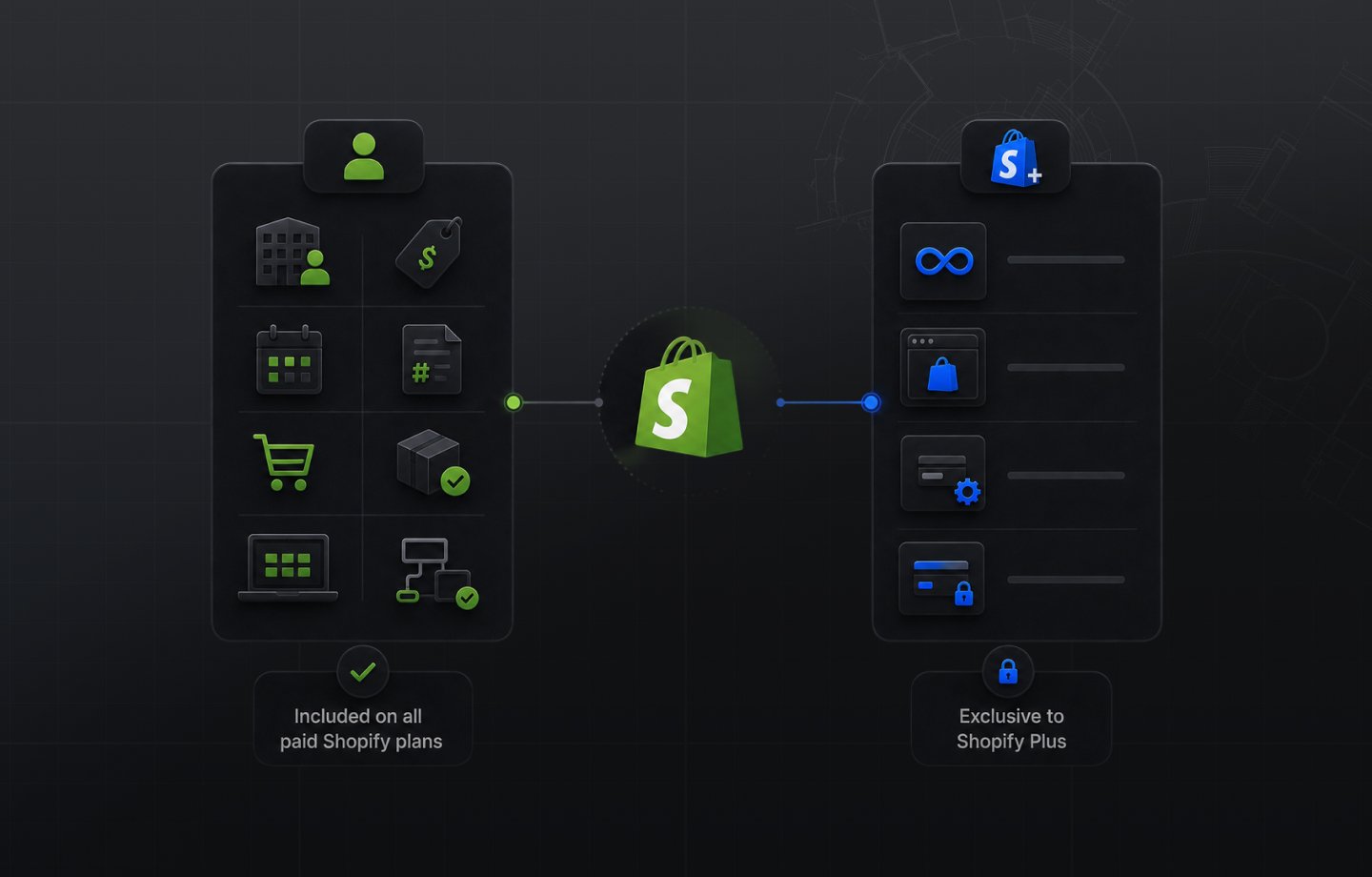
Shopify's native B2B toolkit has changed significantly since its initial release in 2022, and the April 2026 expansion to all paid plans was the most consequential update yet. Features that were previously exclusive to Shopify Plus, company accounts, pricing catalogs, net payment terms, self-serve ordering, and Shopify Flow automations, are now available across every paid Shopify plan at no additional cost.
This guide covers what Shopify B2B features actually include in 2026, how each one works in a real wholesale operation, which capabilities still require Shopify Plus, and what sits outside the native feature set entirely. Teams asking these questions are often mid-move off WooCommerce, where wholesale pricing and account structure had to be bolted on with plugins.
What Are Shopify B2B Features?
Shopify B2B features are a suite of native capabilities built directly into the Shopify admin that let you sell business-to-business from your existing Shopify store. They include company account management, customer-specific pricing catalogs, net payment terms, purchase order numbers, self-serve buyer ordering, bulk order tools, draft orders, and automated wholesale workflows through Shopify Flow. As of April 2026, all foundational B2B features are included on every paid Shopify plan. Advanced capabilities, including unlimited catalogs, a dedicated B2B storefront, custom checkout logic, and vaulted credit cards, remain exclusive to Shopify Plus.
Company Accounts and Buyer Management
The company account is the structural foundation of Shopify B2B. Every wholesale buyer relationship starts here, and the company record controls what that buyer sees and can do when they log in.
Company profiles. You create a company record in the Shopify admin for each wholesale buyer organization. A company can hold multiple contacts, each with their own login credentials, assigned role, and order permissions. One company profile supports up to 50 locations, making it workable for national distributors and key accounts with regional ship-to addresses under a single parent record.
Location management. Each location within a company can carry its own assigned pricing catalog, shipping address, payment terms, and buyer contacts. A distributor with offices in five regions can have each office see its own contracted pricing when buyers log in, without your team manually adjusting anything on each order.
Contact roles and permissions. Contacts within a company account can be assigned roles that govern what they can view and do: whether they can see prices, place orders, or only view order history. This creates a basic buyer hierarchy within the company structure without requiring custom development.
Company-specific storefront experience. When a B2B buyer logs into a Shopify store with B2B enabled, they see their company's assigned catalog and pricing automatically. Retail prices and other buyers' pricing are not visible to them. The B2B experience is gated to their company login.
Pricing Catalogs and Price Lists
Pricing is where most wholesale operations are won or lost. Shopify B2B handles pricing through catalogs, collections of products with prices assigned specifically for a buyer or group of buyers. In industrial machinery distribution, those catalogs only earn their keep once they reflect the real contract terms behind each account.
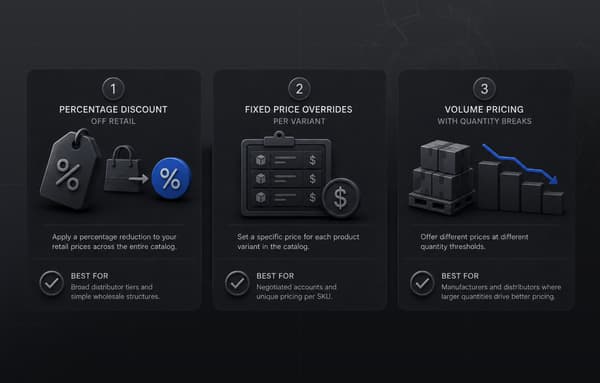
Custom price lists. Each catalog can carry a distinct pricing structure per product: a fixed wholesale price, a percentage discount from retail, or a cost-plus calculation. You assign a catalog to one or more company accounts or locations, and every buyer in those accounts sees those prices at login. No price confusion, no manual overrides at checkout.
Plan-based catalog limits. On Basic, Grow, and Advanced plans, you can have up to three active pricing catalogs. For a manufacturer running separate pricing for distributors, dealers, and direct accounts, three catalogs covers the standard setup. Shopify Plus removes the limit, allowing as many catalogs as your pricing structure requires.
Volume pricing and quantity rules. Within a catalog, you can set minimum order quantities, maximum quantities, and order increment rules per product. A buyer who must order in multiples of 12 gets that rule enforced at the cart level. A product with a 50-unit minimum does not let a buyer check out with 30. These rules apply automatically without sales rep intervention.
Percentage discounts vs. fixed prices. Catalogs support both approaches. Percentage discounts make it easier to maintain pricing when your retail list prices change frequently, wholesale pricing adjusts automatically. Fixed prices require manual updates when costs change but give you exact control over each SKU's wholesale rate.
According to Shopify's official B2B feature overview}, pricing catalogs are one of the core B2B features now available on every paid plan. For the definitive comparison of which specific capabilities are included on each plan tier, from Basic through Plus: Shopify's B2B features by plan documentation is the authoritative reference.
For the wider checklist these native features are meant to satisfy, we lay out the 15 must-haves for a B2B ecommerce website.
Shopify B2B Payment Features
B2B payment workflows are fundamentally different from retail. The expectation of immediate payment at checkout does not hold in wholesale. Shopify's native B2B features cover most standard requirements.
Net payment terms. Net 30, Net 60, and Net 90 are built directly into the platform. When a buyer with terms assigned to their company account checks out, Shopify collects the order without requiring immediate payment. A payment due date is applied to the order automatically, and Shopify sends reminders as that date approaches. This used to require a third-party app or manual invoicing outside the platform. It does not anymore.
Purchase order numbers. Every B2B checkout includes a field where buyers can enter their PO number. It flows through as part of the order record in your Shopify admin and can be included on order confirmations, invoices, and packing materials. This is a standard requirement for virtually every institutional wholesale account.
Draft orders and invoicing. Your sales team can create draft orders in the Shopify admin on behalf of buyers, apply pricing or discount adjustments, and send a payment link or invoice directly from the order. This covers rep-assisted ordering and handles edge cases that sit outside the self-serve flow.
Vaulted credit cards (Shopify Plus only). On Plus, B2B buyers can save a payment method on file for their company account. Repeat orders can be charged without the buyer re-entering card details at each checkout. For buyers who place frequent, high-volume orders, this materially reduces friction on each transaction.
Deposit and partial payments (Shopify Plus only). Plus merchants can collect a deposit on a B2B order and settle the remainder on fulfillment, or accept partial payments against a single invoice. This is relevant for made-to-order manufacturers and large-volume contracts where full upfront payment is not standard practice.
Self-Serve Buying and the Buyer Portal Experience
A core goal of Shopify B2B is moving wholesale buyers away from phone calls, email threads, and PDF order forms and toward self-service. Several features support that shift.
Buyer login and company-specific experience. When a B2B buyer logs in, they see their company's catalog and pricing automatically. On non-Plus plans, the same storefront serves both retail and wholesale visitors, with pricing and product visibility differentiated by whether the visitor is logged in to a company account. On Plus, a dedicated B2B storefront with its own URL and navigation is available.
Quick order lists. Shopify B2B includes a spreadsheet-style bulk ordering interface where buyers can enter SKUs and quantities directly without clicking through individual product pages. For buyers who know their SKUs and reorder the same products on a regular cycle, this is significantly faster than browsing.
Easy reorder. Buyers can access their order history and reorder from a previous order in a single step. For operations with predictable, repeating patterns, a retailer restocking the same 30 SKUs monthly, this removes most friction from the reorder cycle and keeps volume moving without rep involvement.
Self-serve account management. Buyers can manage their own company contacts, update shipping addresses within their assigned locations, and view full order history without contacting your team. This reduces inbound account management requests and scales cleanly as your buyer count grows.
Shopify B2B Checkout Features
The B2B checkout experience is designed around the specific requirements of wholesale transactions.
B2B checkout with company account context. When a buyer in a company account checks out, Shopify enforces their company's pricing, payment terms, and order rules at the checkout layer, not just in the cart. Net terms buyers complete checkout without making a payment. PO numbers are captured at checkout. The company context flows through the entire order.
Shopify Forms for account registration. You can create a custom wholesale account request form on your storefront using Shopify Forms. Prospective wholesale buyers fill out the form; your team reviews and approves them in the admin; approved buyers get access to the B2B catalog and pricing. No separate lead capture tool or external form is required for managing wholesale application flow.
Checkout extensibility via Shopify Functions (Shopify Plus only). For operations that need custom logic at checkout, enforcing order minimums per buyer, validating credit limits before an order confirms, adding required custom fields for downstream fulfillment, or building validation workflows into the checkout process, Shopify Functions allows developers to write custom rules at the checkout layer. This is a Plus-only capability and requires developer resources to implement.
Dedicated B2B storefront (Shopify Plus only). Plus merchants can operate a separate storefront exclusively for B2B buyers, with a distinct domain, its own navigation structure, and a checkout experience tailored to wholesale buyers. On non-Plus plans, the same storefront and URL structure handles both retail and wholesale audiences.
Shopify B2B Automation with Shopify Flow
Shopify Flow is the platform's native automation builder, and its B2B integrations cover several of the most time-consuming manual tasks in wholesale operations.
Company account onboarding automation. When a new wholesale account is approved, Flow can trigger a sequence automatically: assign a default pricing catalog, apply default payment terms, send a welcome email to the buyer contacts, and notify your sales team. The entire onboarding workflow runs without manual steps from your team.
Order event automation. When a B2B order is placed, Flow can route it automatically, flag orders above a specified value for manager review, notify the appropriate sales rep for orders from their accounts, auto-tag orders by company tier for downstream reporting, or escalate orders where the buyer is approaching their credit limit.
Account maintenance workflows. Flow can automate changes to company records over time: update payment terms based on order history thresholds, flag accounts with overdue invoices to your credit team, or send reorder reminders to buyers who have not ordered in a set number of days.
Shopify Flow is included on all paid Shopify plans. B2B automation is not gated behind Plus.
What Shopify B2B Features Do Not Cover
Understanding the gaps in the native feature set is as operationally important as understanding what is included. Several functions that matter to wholesale operators sit entirely outside what Shopify provides natively.
No quoting or RFQ workflow. Shopify B2B has no native quote management. If your buyers submit pricing requests before placing orders, if your reps build and send proposals, or if pricing is negotiated before a sale confirms, that workflow does not exist inside Shopify's native toolset. You need a quoting layer on top, either through a third-party app or a custom build. For how quoting fits into real wholesale operations built on Shopify, the Shopify B2B guide for wholesale suppliers covers where the platform ends and where additional tooling picks up.
No ERP integration. Shopify does not natively sync with NetSuite, SAP, Microsoft Dynamics, or most enterprise resource planning systems. For wholesale businesses where customer account data, contracted pricing, credit limits, and inventory quantities live in a back-office ERP, that data needs to flow into Shopify through a purpose-built integration. When the sync is unreliable, prices go stale, orders fail to generate downstream records, and your operations team manually corrects what automation should have handled. Uncap Connect is built specifically for this: a native Shopify integration with the major ERP systems, handling order creation, pricing sync, and customer account data without a separate middleware platform to manage.
No multi-step order approval workflows. If your B2B buyers operate under internal purchasing policies that require manager approval before an order confirms, Shopify does not have a native approval layer built into the checkout flow. App-based solutions address parts of this, but none solve it completely within the standard Shopify checkout experience.
No sales rep ordering interface. For wholesale operations where reps take orders on behalf of buyers via phone, email, or direct conversation, the Shopify admin handles draft order creation but does not provide a purpose-built rep-facing ordering interface with deal tracking or conversation history.
Shopify B2B Features Available by Plan in 2026
The April 2026 expansion significantly changed the plan-based feature distribution. Here is how the feature set currently maps across plan tiers.
Available on all paid plans (Basic, Grow, Advanced, and Plus): Company accounts with up to 50 locations per company, up to three active pricing catalogs, net payment terms (Net 30, Net 60, Net 90), purchase order numbers at checkout, self-serve buyer ordering, quick order lists, reorder from order history, draft orders with invoice-from-draft, Shopify Flow automations for B2B workflows, and Shopify Forms for account registration.
Shopify Plus only: Unlimited active pricing catalogs, dedicated B2B storefront with its own domain and navigation, vaulted credit card storage for buyer accounts, deposit and partial payment capabilities, and checkout extensibility via Shopify Functions for custom checkout logic.
For the operational breakdown of what these plan differences mean for a manufacturer, distributor, or wholesaler making a plan decision, the Shopify B2B on all plans guide covers the complete comparison with context for different operation types.
Making the Shopify B2B Feature Set Work for Your Wholesale Operation
The native B2B feature set covers enough to run a real wholesale buyer program across every paid Shopify plan. Company accounts, pricing catalogs, net payment terms, self-serve ordering, and automation through Shopify Flow are all present and operational, without third-party apps or a Plus subscription.
The operations that perform best on Shopify B2B are the ones that pair the native layer with the right tooling for what Shopify does not cover natively. ERP integration keeps pricing and inventory accurate across systems. A quoting workflow handles the sales cycle before orders are placed. The implementation connects the storefront to the back office so that a buyer-facing transaction creates the right records downstream without manual intervention.
As a Shopify Platinum Partner since 2013, Uncap has built more than 380 B2B commerce implementations for manufacturers, distributors, and wholesalers. If you want to understand which features matter for your specific wholesale operation and what a complete Shopify B2B setup looks like for your buyers and your back office, talk to our experts about your wholesale channel.
Frequently asked questions
What are Shopify's core B2B features?
Company accounts with locations and buyer permissions, pricing catalogs and price lists, net payment terms, B2B checkout behavior, self-serve buying through the buyer portal, and Shopify Flow automation.
Do Shopify B2B features work on every plan?
Since April 2026, the core set is available on all paid plans. Shopify Plus raises the limits and adds checkout customization, deposits, and higher catalog and company ceilings.
What do Shopify B2B features not cover?
ERP integration, quoting, EDI, and advanced contract pricing sit outside the native set. They are delivered through apps and integrations layered on the native primitives.
How do pricing catalogs work in Shopify B2B?
A catalog pairs a product selection with a price list and is assigned to company locations. Buyers signed in to that location see their negotiated prices storewide, including at checkout.