

A large industrial buyer wants to order from you, but not from your storefront directly. Their procurement team works inside SAP Ariba, Coupa, or Jaggaer, and company policy requires every purchase to originate there, not on a supplier's website. If your Shopify store can't meet that buyer inside their own procurement system, the order doesn't happen, no matter how good your pricing or your catalog is. That's the problem a PunchOut catalog solves.
This guide covers what PunchOut actually is, when a B2B seller genuinely needs it versus when a company account and a login are enough, and what has to be true about your Shopify B2B storefront before PunchOut is worth adding.
What Is a PunchOut Catalog?
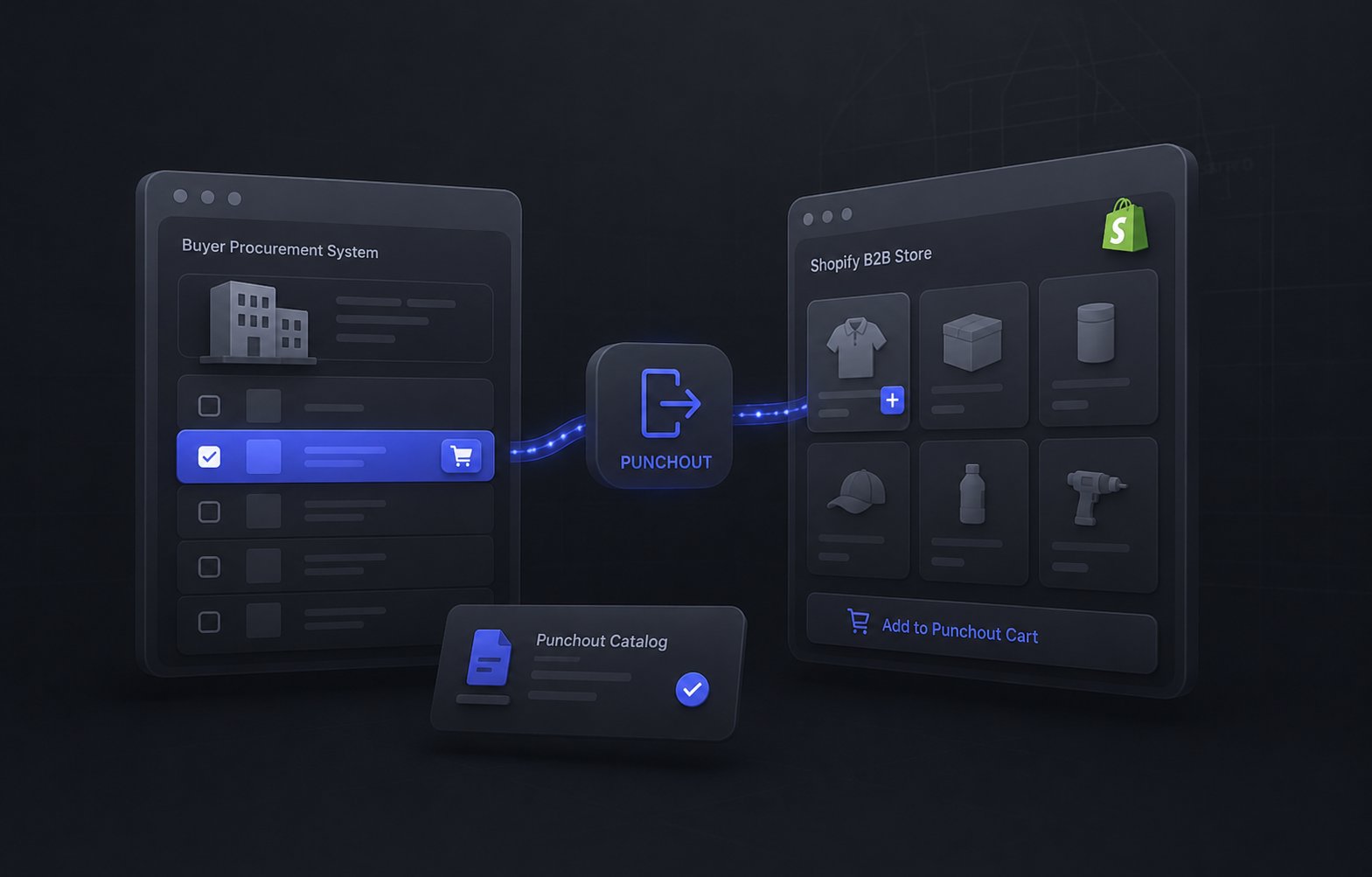
A PunchOut catalog is a live connection that lets a corporate buyer leave their procurement system, shop your actual Shopify catalog with their negotiated pricing and account context already applied, and send their finished cart back to their own system as a requisition, without ever creating a separate login on your site. The buyer's procurement platform stays the system of record for approval and purchase order issuance the entire time.
That's different from a hosted catalog, where the seller uploads a static product file into the buyer's procurement system once and updates it periodically. PunchOut is live: the buyer is browsing your real Shopify store in real time, with real inventory and real pricing, inside a session controlled by their own procurement platform.
Why Large B2B Buyers Require PunchOut
Enterprise procurement teams standardize on PunchOut for a reason that has nothing to do with your storefront: control. A company running SAP Ariba, Coupa, Jaggaer, or Workday wants every purchase, from every supplier, to flow through one system so spend gets tracked, approvals get enforced, and nobody on staff is buying outside policy with a personal login on a supplier's site.
For a manufacturer or distributor selling into large accounts, this shows up as a hard requirement rather than a preference. A procurement team won't create an exception for one supplier's login page. If PunchOut isn't available, that buyer either finds a supplier who has it, or routes the order through a slower manual process that neither side wants.
This is the same dynamic that drives EDI adoption among distributors selling to large retailers, a buyer-side mandate a seller has to meet to keep the account, not a feature a seller chooses because it sounds useful.
Picture an industrial equipment manufacturer with a $400,000-a-year account at a large facilities operator. The buyer's procurement team runs SAP Ariba company-wide, and every purchase over a few hundred dollars has to originate as an Ariba requisition or it doesn't get paid against. The manufacturer's Shopify store has the right products, the right negotiated pricing, and a solid company account setup, none of which matters to that buyer's AP department if the purchase can't start inside Ariba. Losing that account isn't about product fit or price. It's about a protocol the storefront doesn't speak yet.
How a PunchOut Session Actually Works
A PunchOut transaction follows the same basic sequence regardless of which procurement platform the buyer runs:
The buyer clicks into your catalog from inside their procurement system. A single sign-on handoff, typically using the cXML or OCI protocol, authenticates them and passes along their company and cost-center context.
They shop your live Shopify catalog. Pricing reflects their negotiated contract rate, and inventory reflects what's actually available, not a static snapshot.
They build a cart and send it back. Instead of checking out on your site, the cart returns to their procurement system as a requisition.
Their own approval workflow runs. Whoever needs to sign off on the purchase does so inside the buyer's system, not yours.
A purchase order gets issued back to you. That PO, not a Shopify checkout confirmation, is what authorizes you to fulfill the order.
Every step happens inside systems the buyer already trusts. Your Shopify store is the catalog they're shopping, not the system recording the transaction. That distinction is what trips up sellers new to PunchOut: the instinct is to treat the returned cart like a normal Shopify order, when the purchase order that comes back after approval is the actual authorization to fulfill, not the cart itself.
PunchOut vs. Just Giving Buyers a Login
A company account with a login and negotiated pricing already solves real friction for most B2B buyers, and it's genuinely enough for accounts that aren't required to route purchases through a corporate procurement platform. PunchOut isn't a better version of that experience. It's a different requirement entirely, driven by the buyer's own procurement policy, not by how good your account experience is.
The practical test is simple: does the buyer's team need to route every purchase through Ariba, Coupa, Jaggaer, or a similar system before it's authorized? If yes, a login alone won't satisfy that policy no matter how well-built it is. If no, the company account and pricing work most Shopify B2B stores already have is the right scope, and PunchOut would be effort spent on a requirement nobody's actually asking for.
What a Shopify B2B Store Needs Before Adding PunchOut
PunchOut sits on top of a Shopify B2B storefront, it doesn't replace the work of building one. Before a PunchOut connection is worth adding, three things need to already be true:
Company accounts with real negotiated pricing. The buyer's PunchOut session only has value if the price they see matches their actual contract rate. Shopify B2B supports company accounts and customer-specific pricing natively, which is the foundation any PunchOut connector builds on top of.
Inventory that's actually current. A buyer who punches out, builds a cart, and gets a backorder notice after their requisition is approved has a worse experience than if PunchOut didn't exist at all. Once a buyer punches into your Shopify store, they need to see the same real price and inventory Uncap Connect already keeps synced from your ERP, not a snapshot that's hours or days stale.
A B2B storefront built to handle the account complexity in the first place. Multi-location accounts, role-based purchasing, and account-specific catalogs all need to be solid before a procurement-driven buyer ever punches out to see them. A PunchOut connection built on top of a thin, single-price-list storefront just exposes that thinness to a buyer who's used to a fully negotiated catalog everywhere else they shop.
Getting this sequence backward, adding PunchOut before the underlying storefront can support real account complexity, is the single most common reason a first PunchOut implementation has to be redone within a year.
Common PunchOut Implementation Mistakes
Treating every procurement platform the same. Ariba, Coupa, and Jaggaer each implement cXML and OCI with their own quirks. A connector configured for one doesn't automatically work cleanly for another, and testing against only one platform is how a second enterprise account's integration breaks in production.
Static pricing behind a live-looking session. PunchOut is supposed to feel real-time. If the pricing engine behind it isn't actually synced to the same source of truth as the rest of your store, buyers eventually notice the numbers don't match what they were quoted, and trust in the whole channel erodes.
No fallback for buyers who don't need PunchOut. Not every account requires it. A storefront built as if every B2B buyer arrives through a procurement platform makes the experience worse for the accounts that just want a company login and their negotiated price.
Where to Start
PunchOut is a buyer-side requirement, not a storefront feature to add for its own sake. The sellers who implement it well already have solid company accounts, synced pricing, and real inventory data before they add the procurement-platform handshake on top. Get that foundation right first.
Uncap has been a Shopify Platinum Partner since 2013, building B2B storefronts and ERP-synced pricing and inventory for manufacturers and distributors who sell into accounts with exactly this kind of procurement complexity. See how that work comes together in Uncap's case studies.
Talk to our experts about whether PunchOut is actually the right next step for your wholesale accounts, or whether the foundation needs work first.
Frequently asked questions
Does Shopify support PunchOut natively?
Not out of the box. PunchOut requires a dedicated connector app or integration built for cXML or OCI, layered on top of Shopify's native B2B company account and pricing features. Shopify B2B provides the account and pricing foundation; the PunchOut protocol handshake itself is a separate, specialized integration.
Do all B2B buyers need PunchOut?
No. Most B2B buyers are well served by a company account, negotiated pricing, and a normal login, and PunchOut adds real implementation complexity without benefit for accounts that don't require it. It matters specifically for buyers whose procurement policy mandates routing purchases through a platform like Ariba, Coupa, or Jaggaer.
What's the difference between a hosted catalog and a PunchOut catalog?
A hosted catalog is a static product file uploaded into the buyer's procurement system and updated periodically. A PunchOut catalog is a live session where the buyer shops the seller's actual storefront in real time, with current pricing and inventory, before sending a cart back as a requisition.