
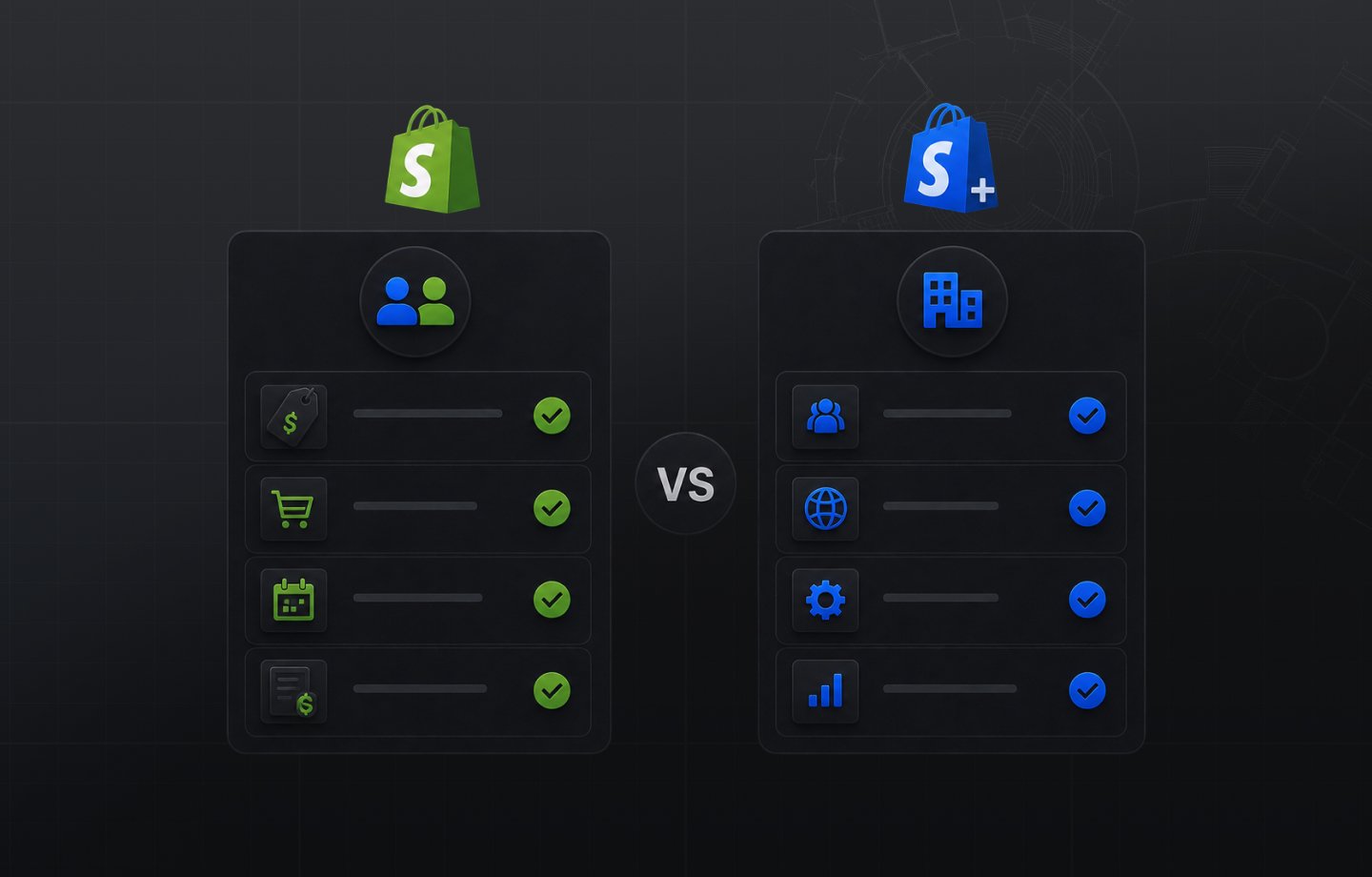
The answer changed in April 2026. Before that, if you wanted to sell wholesale on Shopify with company accounts, custom pricing catalogs, and net payment terms, you needed Shopify Plus. After April 2026, most of those features moved to the Basic, Grow, and Advanced plans.
That shift makes the B2B vs Plus question more nuanced than the articles currently ranking for it, many of which were written in 2022 and 2023, when B2B was Plus-only. Here is an honest, current answer to whether you still need Plus for wholesale in 2026 and what the actual determining factors are.
Do You Need Shopify Plus for B2B?
No. As of April 2026, most B2B features are available on the Basic, Grow, Advanced, and Plus plans. Company accounts, customer-specific pricing catalogs (up to three), net payment terms (Net 30/60/90), purchase order numbers, self-serve buyer ordering, quick order lists, draft orders, and Shopify Flow automations all work without a Plus subscription.
What still requires Shopify Plus is a specific list of advanced capabilities: unlimited pricing catalogs, catalogs assigned directly to companies and company locations, deposits, partial payments, payment requests per fulfillment, and custom checkout logic built with Shopify Functions in custom apps. A dedicated B2B storefront with its own domain runs as a separate Shopify store, and vaulted credit cards work on the Basic, Grow, Advanced, and Plus plans. If your wholesale operation does not need any of those, Plus is not required. That calculus shifts in categories like auto parts and aftermarket distribution, where catalog depth and account pricing tend to force the Plus question well before revenue does.
For a complete breakdown of what each plan tier includes after the April 2026 expansion, Shopify's official B2B features by plan documentation is the authoritative reference. The April 2026 announcement post at shopify.com/news/b2b-for-all covers the context behind the expansion.
What Changed in April 2026
Before April 2026, native B2B on Shopify was a Plus-only feature. Company accounts, custom pricing, and net payment terms required a Plus contract to access. Merchants on lower plan tiers had to use third-party wholesale apps to run a buyer program, since the Wholesale Channel (now deprecated) was also a Plus-only sales channel.
The April 2026 expansion moved the foundational B2B feature set to the Basic, Grow, Advanced, and Plus plans. This was a material change, not a minor update. The majority of what made Shopify B2B commercially useful is now accessible to every Shopify merchant.
What did not move: the advanced capabilities that distinguish Plus at scale. Unlimited catalogs, direct catalog assignment to companies and locations, custom checkout logic built in custom apps, and advanced payment workflows stayed Plus-only. The gap between plans narrowed significantly, but it did not disappear.
Shopify B2B on Basic, Grow, and Advanced: What You Get
A Shopify merchant on Basic, Grow, or Advanced now has access to a substantial B2B toolkit. Here is what that means in practice.
Company accounts with up to 10,000 locations. Create a company record for each wholesale buyer. Assign multiple contacts, control their permissions, and manage up to 10,000 ship-to locations under a single company profile. A regional distributor with multiple warehouse addresses can manage them all under one account.
Up to three pricing catalogs. Build custom price lists and assign them through B2B markets that include specific company locations. Each catalog can use fixed prices, percentage discounts from retail, or quantity-tiered pricing. Three catalogs covers a standard manufacturer pricing structure: distributor, dealer, and direct tiers.
Net payment terms at checkout. Net 30, Net 60, and Net 90 are enforced at the checkout layer, not as an honor system you manually track. Buyers check out on terms; Shopify creates the order with a payment due date and sends payment reminders automatically.
Purchase order numbers and draft orders. Every B2B checkout includes a PO number field. Your sales team can create orders on behalf of buyers through the draft order flow and send invoices directly from the admin.
Shopify Flow automations. Automate company onboarding, order routing, account tagging, and payment term assignments without code. Flow is included on the Basic, Grow, Advanced, and Plus plans.
For a complete feature-by-feature breakdown, the Shopify B2B on Basic, Grow, and Advanced guide covers exactly what changed and what each plan tier unlocks.
What Shopify Plus Adds for B2B That Lower Plans Do Not
The gap between Plus and non-Plus on B2B is real. Here is what Plus unlocks specifically for wholesale operations.
Unlimited pricing catalogs. The three-catalog cap on lower plans does not exist on Plus. For wholesale operations managing pricing across dozens of accounts with individually negotiated rates, or for distributors running regional pricing books across multiple markets, unlimited catalogs are not a nice-to-have. They are a practical requirement.
Dedicated B2B storefront. You can run a separate storefront exclusively for wholesale buyers, with its own domain, navigation, and branding. It is a separate Shopify store with its own admin, and Plus includes expansion stores that can fill that role. In a blended store, B2B and DTC buyers share the same storefront, with the experience differentiated by login. For wholesale operations where keeping the two audiences entirely separate matters operationally or for brand reasons, a dedicated store is the option within the native feature set.
Vaulted credit cards (now on Basic, Grow, and Advanced too). Since April 2026, B2B buyers on the Basic, Grow, Advanced, and Plus plans can save payment methods on file. Repeat orders are charged without the buyer re-entering card details at each checkout. For buyers who place frequent, high-volume orders on a net-terms or credit card basis, this removes a real friction point.
Deposit and partial payment workflows. Plus merchants can collect a deposit on a B2B order and settle the remainder on fulfillment, or accept partial payments against a single invoice. For made-to-order manufacturers and large-volume contracts, this reflects how the transaction actually works in practice.
Shopify Functions for custom checkout logic. Functions is the mechanism that allows developers to write custom rules at the checkout layer: enforcing buyer-specific order minimums, validating credit limits before an order confirms, building approval workflows, or adding custom fields for downstream fulfillment. Building these rules in a custom app is Plus-only and requires developer resources to implement; public App Store apps that contain functions work on any plan.
For the history of how the Plus B2B feature set has evolved, including changes to checkout extensibility and Functions access, the Shopify Plus B2B updates overview covers the progression.
How Much Does Shopify Plus Cost for B2B?
Shopify Plus pricing starts at $2,300 per month on a 3-year term or $2,500 on a 1-year term, and Shopify says more complex, higher-volume businesses might pay a variable platform fee based on their revenue and business model. B2B features are included in Plus, they are not an add-on and do not carry separate licensing costs. The same Plus plan that powers your DTC storefront gives you access to the full B2B feature set.
For wholesale operations where the revenue volume and order complexity justify it, the per-month cost is often offset by the operational capacity it unlocks, particularly if unlimited catalogs, direct catalog assignment to companies, or custom apps with Shopify Functions are requirements for the operation to function correctly.
For merchants who are not yet at Plus scale, the economics typically do not work. The non-Plus B2B feature set is capable enough that most operations below $5M in wholesale revenue do not need what Plus adds to make the wholesale channel function.
Net terms are among the foundational features the Basic, Grow, Advanced, and Plus plans now include, and our guide to offering Net 30, 60, and 90 to wholesale buyers covers how to set them up.
When Shopify Plus Pays Off for a Wholesale Operation
There are specific conditions where Plus is the right call for B2B. The clearest indicators are:
You need more than three pricing catalogs. This is the hardest cap to work around on lower plans. If your wholesale buyer program involves more than three distinct pricing tiers (national accounts, regional distributors, independent dealers, key accounts with individually negotiated rates), the catalog ceiling forces a difficult choice. You either collapse pricing tiers to fit within three catalogs, which means not all buyers see their actual contracted prices, or you move to Plus.
A dedicated B2B storefront matters for your buyers or your brand. Some wholesale operations need the buyer portal to be visibly distinct from the retail storefront, separate URL, separate navigation, separate branding. In a blended store, that separation does not exist; it takes a dedicated B2B store, which is a separate Shopify store with its own admin, and Plus includes expansion stores that can fill that role. If your wholesale buyers are large institutional accounts where the experience of a consumer-facing retail site creates friction or concern, a dedicated store resolves it.
Custom checkout logic is a hard requirement. If your operation needs to enforce credit limits at checkout, route orders based on buyer tier, or add compliance fields that flow through to downstream fulfillment systems, that logic is built with Shopify Functions, which Shopify says "allow developers to customize the backend logic of Shopify." Shopify adds "Only stores on a Shopify Plus plan can use custom apps that contain Shopify Function APIs," while public App Store apps that contain functions work on any plan.
Your orders are paid in stages. Saved payment methods now work on the Basic, Grow, Advanced, and Plus plans, but deposits, partial payments, and payment requests per fulfillment are Plus-only. For operations that collect a deposit up front or bill per shipment, that capability carries across hundreds of orders and dozens of accounts.
You are running at a scale where Plus support tier is operationally relevant. Beyond the features, Plus includes dedicated launch support, priority account management, and SLA-backed uptime commitments. For wholesale operations at high volume where downtime has direct revenue impact, the support tier is part of the value.
When Shopify B2B Without Plus Is the Right Call
For a substantial range of wholesale operations, Plus is not the right call. Here is where non-Plus Shopify B2B performs well.
Manufacturers launching their first formal wholesale channel. If your current wholesale operation runs on email, phone, and spreadsheets, getting to Shopify B2B on any of the Basic, Grow, Advanced, and Plus plans is a significant step forward. Company accounts, pricing catalogs, and net payment terms bring a manual process onto a digital channel. You do not need Plus to make that transition. The same is true for merchants moving off a NetSuite storefront, where the plan tier matters far less than getting the replatform right.
DTC brands adding a dealer or trade program. If you are already on Shopify, extending into B2B with company accounts and a price catalog is lightweight operationally. You are not building a second system. You are extending the one you have. The unified admin is a real advantage here, and non-Plus handles it cleanly for most dealer and trade programs.
Wholesale operations with a straightforward pricing structure. Three pricing catalogs covers a wide range of setups. Manufacturer pricing with distributor, dealer, and direct tiers is the standard configuration. If your buyer program fits that structure, the non-Plus catalog limit is not a constraint.
Operations that have not yet reached the revenue threshold where Plus economics make sense. At $2,300/month, Plus requires volume to justify. An operation running $2M in wholesale revenue is not going to find the Plus ROI favorable for what it adds specifically to B2B. The non-Plus feature set is the right operational starting point.
The Part Neither Plan Fixes
Both Plus and non-Plus Shopify B2B share the same gaps in two areas that matter significantly for most wholesale operations.
ERP integration is not native on any plan. If your pricing, customer data, inventory, and order records live in NetSuite, SAP, or Microsoft Dynamics, that data does not flow to Shopify automatically regardless of which plan you are on. Without reliable sync, your storefront shows prices that may be out of date, your orders do not generate the downstream ERP records they need to, and your operations team manually corrects what an integration should handle. Solving this is not a plan decision; it is an implementation decision. For wholesale operations on Shopify, Uncap's wholesale commerce solutions are built specifically around this: connecting Shopify to the back-office systems that B2B operations depend on.
Native quoting and RFQ run through draft orders, on Plus and on Basic. Shopify's B2B draft orders let your team quote a negotiated price by setting a custom price on a line item, and checkout to draft and draft order to invoice are B2B features on the Basic, Grow, Advanced, and Plus plans. If your sales motion includes self-serve configuration, approval routing, or quote versioning before a purchase order is confirmed, that goes beyond what draft orders handle. You need a quoting layer on top, either through an app or a custom implementation.
These gaps are relevant to the Plus vs. non-Plus decision because they are costs and capabilities that exist at both plan levels. A merchant considering Plus to fix an ERP integration problem will find that Plus does not fix it. The plan decision and the integration decision are separate.
The Bottom Line: Shopify B2B vs Shopify Plus
For most wholesale operations, the right question is not whether to use Plus for B2B, it is whether your specific operation requires what Plus uniquely provides. Most wholesale operations launching on Shopify in 2026 do not need Plus on day one. The foundational B2B feature set that is now available on the Basic, Grow, Advanced, and Plus plans covers company accounts, pricing, net terms, and self-serve ordering.
The operations that need Plus are the ones that have crossed a specific threshold: more than three pricing tiers, a buyer base that needs customer-level pricing or deposits, custom checkout logic requirements, or a revenue scale where Plus economics make sense and the support tier carries operational value.
If you are not sure which side of that line you fall on, or if you want an assessment of what your wholesale channel actually needs before you make a plan decision, Talk to Our Experts about your operation. As a Shopify Platinum Partner, on Shopify since 2013, with 380+ storefronts launched on Shopify, we can tell you directly where the plan matters and where the implementation is what actually determines the outcome.
Frequently asked questions
Do you need Shopify Plus for B2B?
Not anymore. Since April 2026 the core B2B feature set ships on the Basic, Grow, Advanced, and Plus plans. Plus is now a question of scale and customization, not access.
What does Shopify Plus add for B2B?
Unlimited catalogs and direct catalog assignment to companies, checkout extensibility, deposits on terms orders, custom B2B checkout logic in custom apps, and the operational headroom (staff accounts, expansion stores) larger wholesale programs need.
How much does Shopify Plus cost for B2B?
Plus starts around $2,300 per month on a three-year term (about $2,500 on one-year). Whether it pays off depends on volume and how much your program leans on Plus-only capabilities.
What does neither plan fix?
Back-office integration. Plan ERP sync, quoting beyond draft orders, and EDI as an integration layer you add to either plan.